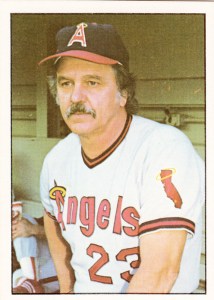
Baseball Ethics: Revealed At Last! Extraordinary Cheating By The 1975 California Angels

Dick Williams, cheat...but a successful and creative cheat, you have to admit.

Dick Williams, cheat…but a successful and creative cheat, you have to admit.

Yesterday on the New England Sports Network broadcast of the Red Sox-Yankees game, Sox color man Jerry Remy was discussing how some teams doctor their home fields for tactical advantages. The Yankee Stadium infield grass, for example, is kept long, slowing down ground balls so the infielders have a better chance of getting to them before they scoot into the outfield for hits. The current Yankees team hitting, such as it is, tends to be fly ball oriented. Jerry expounded on how teams that bunted a lot would sometimes have groundskeepers slant the dirt around the foul lines toward fair territory. “In 1975, when I played for the Angels,” he said, “our home baselines were like gutters. A bunted ball almost couldn’t roll foul.” Such customization is considered fair gamesmanship, because the rules don’t specify ground conditions in sufficient detail.

Then Remy revealed an example of  baseball cheating in the extreme. Also n 1975, Remy said, during his rookie year with the California Angels, manager Dick Williams realized that speed on the bases was one of his few assets on a weak roster. (The ’75 Angels would finish  last in the AL West with a 72-89 record) Remy, Tommy Harper, Mickey Rivers and Dave Collins were all accomplished base-stealers, so Williams had groundskeepers move second base six inches closer to first base, thus shortening the distance a base-runner attempting to steal second would have to cover.

“It was that way all year,” Remy said. “Nobody ever noticed.” Continue reading
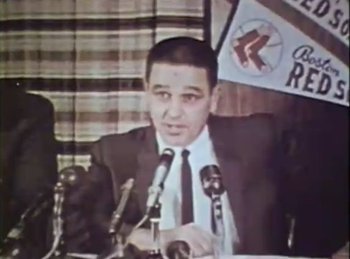
Thanking Dick Williams…Finally

The late Dick Williams, doing what great leaders do

If you are not a baseball fan, or under the age of thirty, you probably never heard of Hall of Fame manager Dick Williams, who died yesterday at the age of 84. I never met Williams myself, but I have been indebted to him for four decades. I never told him the immense difference he made in my life, just by doing his job.

In the winter of 1967, I was a devoted fan of my home town team, the Boston Red Sox, and had been since 1962.  Over that period I had listened to every single baseball game on my transistor radio when a game wasn’t on TV, which was most of the time, or when I wasn’t at the game, which was almost always the case. I was the only person I knew who followed the team, and for good reason: it was torture. The Red Sox were hopelessly mediocre on the way to awful, and hadn’t had a winning season in more than ten years.

It is a great character builder to follow the fortunes of a terrible baseball team. Almost every day, for six months, you are let down, and yet return to the scene of your despair the next, attempting to muster hope while steeling yourself against likely disappointment. You find yourself finding things to appreciate other than winning: the gallant veteran player who “plays the right way” (Eddie Bressoud, shortstop, 1962-1965); the exciting rookie who gives promise of a better future (Tony Conigliaro, right fielder—rest in peace, Tony); the unique talent who is worth watching for his own sake (Dick Radatz, relief pitcher, 1962-1966). These things help, but following a perennial losing team and caring about them is like being punched in the gut four or five days a week without knowing which day you’re getting it.

Since 1965, I had always reserved seats for the first day of the season and one of the last two home games, just in case those last games would be crucial to a (hahahaha!) Red Sox pennant drive. This was especially pathetic, since the team was getting worse. They had finished in a tie for 9th place in 1966, and as the 1967 season loomed, Vegas had them installed as 100-1 underdogs to win the American League pennant. In truth, the odds should have been longer. Nonetheless, I wrote the Red Sox and got my tickets, this time for the next to last day of the season.

The team was full of rookies and near rookies, and appropriately had hired a minor league manager, Dick Williams, to be the new skipper. Williams was something else, however: he was a gifted leader. One day, in the middle of Spring Training, a Boston scribe asked the new manager what the prospects were for the upcoming season. Would the team escape the cellar? Would there be forward progress? Williams’ answer was instant front page news:

“We’ll win more than we lose.” Continue reading

Tony C., Chaos, and the Ethics of Blame

“And then one night

The kid in right

Lies sprawling in the dirt.

The fastball struck him square—he’s down!

Is Tony badly hurt?”

Just about everyone who lived in Boston, Massachusetts in 1967 knows that bit of doggerel, an epic poem written to commemorate the Boston Red Sox miracle “Impossible Dream” pennant that year. Tony, “the kid in right,” was Tony Conigliaro, or Tony C. for short, the 22-year-old Italian stud from nearby Swampscott who was ticketed for the Hall of Fame. Tony had everything: looks, talent, an adoring hometown public and a flair for the dramatic—everything but luck. On August 19, 43 years ago today, an errant pitch from Angels starter Jack Hamilton struck him in the face, nearly killing him. The beaning began a series of events that turned “The Tony Conigliaro Story” from a feel-good romp to an epic tragedy. He was never quite the same after the beaning, though he bravely played three more seasons with a hole in his vision he never told anyone about. He quit, tried pitching, actually made a second comeback that was derailed by injuries, and quit again. He was about to become the Red Sox cable TV color man when he suffered an inexplicable heart attack that left him brain-damaged and an invalid until his death, at only 45, in 1990.

Since 1967, there has been a storyline connected with Tony C.’s beaning, and it resurfaces every year. Let’s have an enthusiastic Red Sox blogger tell the tale: Continue reading