The Ethical Significance of the Post-Dolly Response

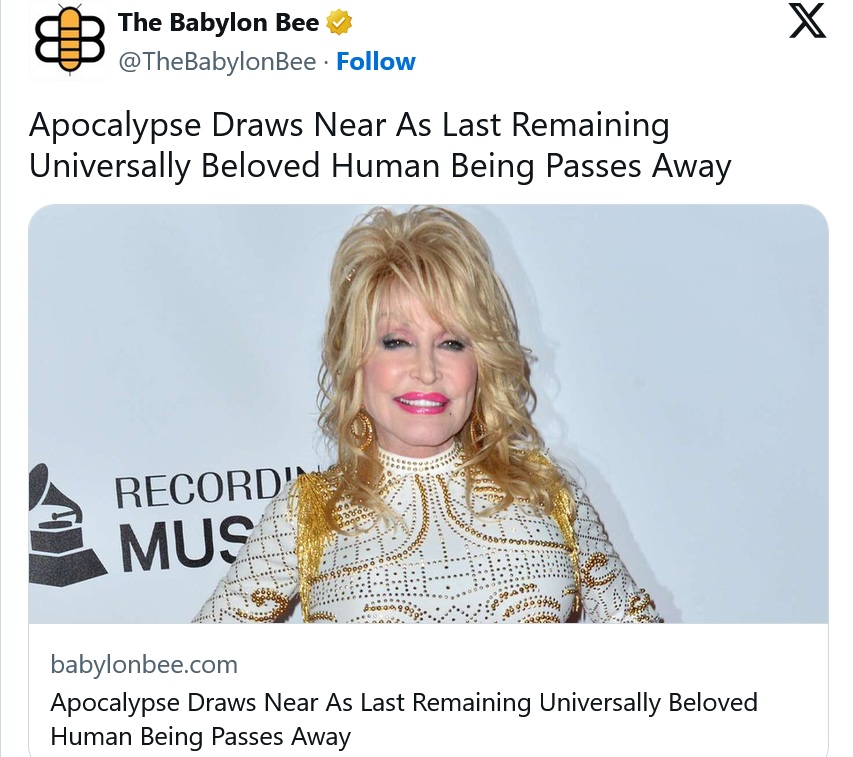
As you must know by now unless you have been in a submerged submarine with a broken communications system like the one in “Crimson Tide,” Dolly Parton died yesterday at 80. Why her death is being described as a shock is a mystery: as my father said when he hit 80, “It’s the Red Zone, son. I can kick off any second from here on!” Nonetheless, the public and official outpouring of grief, love and admiration is unlike anything we’ve seen at least since Princess Diana’s demise in 1997.

The tectonic reaction is certainly not based on Dolly’s singing, acting or song-writing. Personally, I was never a fan; Dolly’s singing voice always sounded to me like someone who has inhaled helium. Her songs were pleasant but unremarkable to my ear. As an actress, I place Dolly Parton in the large category of experienced public performers who can project their own personalities effectively into roles and stories where their personalities seem appropriate, a diverse group that ranges from the late Fred Thompson to the late Bob Newhart to the not-quite-late Ringo Starr.

Clearly, the reason Dolly is being mourned so vigorously is that her public persona was entirely benign, virtuous and lovable, even aggressively so. She literally gave nobody any reason not to like her. In 2020, as the Great Stupid was grabbing American society by the throat, Hollywood producer Rob Long wrote an appreciation of Dolly in “Commentary” exploring her universal popularity. He wrote in part,

Finally “The Ethicist” Has Found A Legitimate Topic Again: The Dementia Victim’s Spouse

In fact, I’ll make this one an Ethics Quiz.

I don’t need to extensively quote the letter inspiring the column. A woman whose much older husband is now consumed with dementia and unable to function or recognize her asks if it would be ethical for her to seek an intimate relationship while remaining married to her husband and serving as his caretaker. “I have a lot of working years and child-rearing years ahead of me…and I find myself desiring physical and emotional intimacy with a partner,” “Name Withheld” writes.

No, it wasn’t Jill Biden. At least, I don’t think so…

If you have been reading my periodic posts involving Kwame Anthony Appiah’s ethics advice in the Times “The Ethicist” column, I’m sure you can guess his response. Hey girl, go for it! No harm no foul! Your man is a veg, and you’re stuck with him: why not live a little in the meantime?

Ok, that framing may be a bit unfair, but it’s still where Kwame comes out. Without saying he’s necessarily wrong, I have several problems with that knee-jerk response.

If that’s the verdict with one serious debilitating illness, why not others, like cancer or ALS…or, to reference something I’m very familiar with, alcoholism? Is the distinction that the demented spouse doesn’t know his or her spouse is having affairs? Hey Ethicist Man, what happened to “Ethics is what you do when no one’s looking”?

I do know that my wife frequently said that if I cheated on her if she became seriously ill, she would come back from the grave and haunt me like Tevye’s grandmother in “Fiddler on the Roof.” And she wasn’t kidding.

Then we have the reverse situation famously experienced by former Supreme Court Justice Sandra Day O’Connor. She stepped down from SCOTUS in 2005 to care for her husband, John Jay O’Connor, after his Alzheimer’s diagnosis. His condition progressed to the point that he required full-time care and he was moved into an assisted living facility in Phoenix. There his mind deteriorated to the point where he no longer remembered or recognized his wife, and he fell in love with a fellow Alzheimer’s patient. Justice O’Connor was supportive of the relationship, saying, at least in public, that she was thrilled and relieved that her husband was relaxed, happy, and comfortable in his new reality. Later, he became engaged to an ottoman.

(Okay, I was kidding about that last part. )

Your Ethics Alarms Ethics Quiz of the Day is…

Do you agree with “The Ethicist” that stepping out on your demented spouse is ethical?

Ethics Dunce: Bride-To-Be Rochelle Mindrum

When social media over-sharing meets publicity obsession, the result is misbehavior like Rochelle Mindrum’s.

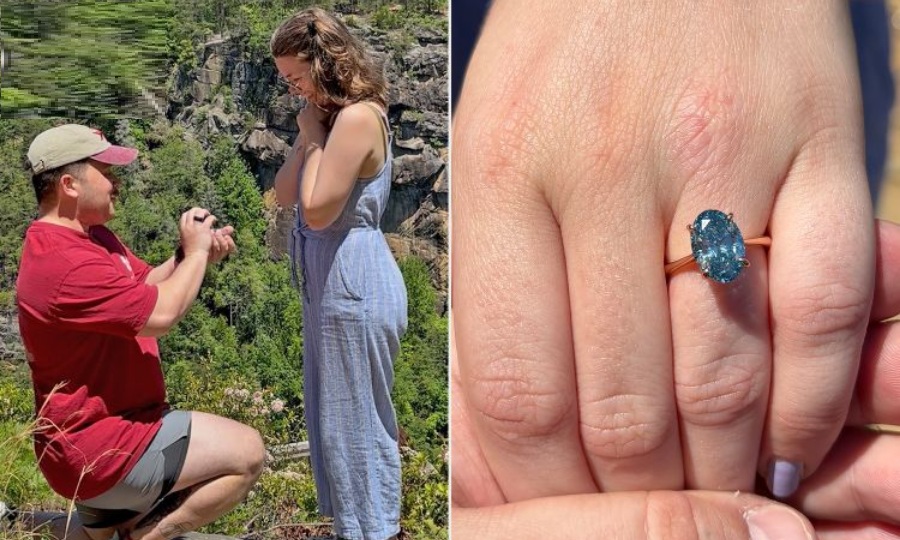
The 29-year-old was expecting her boyfriend Jak Keller to pop the question, and had even gone ring shopping with him. She specified that she wanted the proposal to be done “in nature.” When they took a trip to Georgia together, she figured it must be coming soon. Sure enough, after a hike, on the side of a cliff, Keller set up his phone to take a video. He took Mindrum’s hands in his, got down on one knee, and proposed. But when Mindrum looked down at the ring, she saw that her fiancé had chosen a blue diamond rather than the colorless diamond she’d picked out. And she blurted out her disappointment on camera: “It’s so blue!”

Rochelle accepted, then posted the video on Tik-Tok along with a note that she was disappointed with the color. “I was extremely surprised by the blue diamond,” she says now. “The box it was in was dark blue, so at first I thought it was a reflection of the box. Once it was on my finger though, I was able to see that the diamond was in fact blue.”

The Amityville House has some advice for Jak, her already hen-pecked fiancé:

Unbelievable! This guy tries his best to give his girlfriend the proposal she dreams of, and the thanks he gets is to have her complain about the color of the diamond on TikTok, where it went viral. Why? Because she’s an ungrateful ethics dunce, and viewers were horrified.

It gets worse! Since the video was getting so much attention, “People” magazine, which apparently has nothing better to write about, gave Rachel another platform to bitch from, and sure enough, she did. From the article “Woman Surprised When Boyfriend Got Down on One Knee and Proposed. The Type of Ring He Chose Left Her ‘Shocked’ (Exclusive)”:

“I thought the ring was gorgeous, however, I had always dreamed of my engagement ring being a colorless diamond, so it just didn’t fit my vision,” she explains. “It does not help that my birthstone is aquamarine, so I am used to receiving blue-hued stones.” “It turns out he was trying to get me a higher quality diamond and the website was a little confusing, so he thought the higher quality diamonds all threw off a little blue hue, as the pictures online were a very faint blue,” continues Mindrum. “He was scared to drop the ring, so he never took it out of the box. He only looked at in the box. So he was just as shocked as I was with how blue it was!”

Ethics Quiz: The Dogs of The Titanic

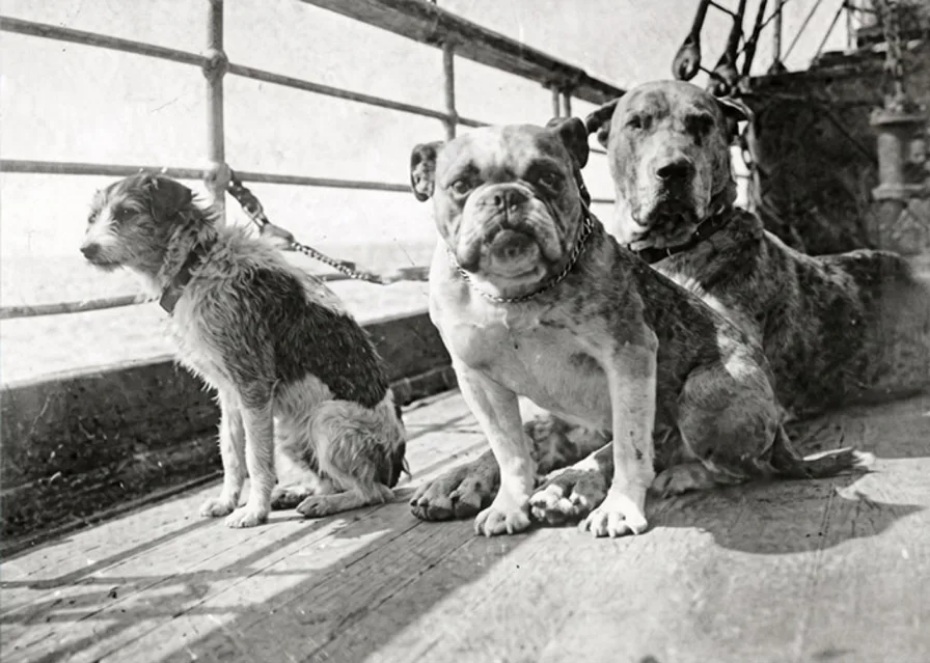
According to J. Joseph Edgette from Widener University, there were twelve dogs that have been confirmed as passengers on the iconic doomed ship, which sank in April of 1912. Three of the dogs survived; they were all small breeds that their owners could wrap up in blankets and hide in their coats. The crew told passengers (only the First Class passengers brought their dogs) that the limited number of life boats meant that dogs would have to be left behind. 

When the ship struck the iceberg and it became clear that it was going down, the dog-loving steward in charge of the ship’s kennel released all of its canine occupants, which then ran all over the ship, surely confused, while the chaos intensified. (How did James Cameron not use that in his movie?) The three survivors were all kept in their owners’ staterooms. Lady, a Pomeranian belonging to passenger Margaret Hays, was one; Sun Yat Sen, a Pekingese belonging to Myra Harper and Henry Harper, was another, and a second Pomeranian owned by Martin and Elizabeth Rothschild was the third lucky dog.

The larger dogs that died included a King Charles Spaniel, a Poodle, a Borzoi, an Airedale, another large terrier, a Chow-Chow, a Fox Terrier, a French Bulldog and a Great Dane.

According to Titanic lore, Ann Elizabeth Isham owned the Great Dane pictured above. Rather than leave him to die alone, she chose to stay behind and comfort her beloved dog as the sea rushed in. Isham was one of the four first-class female passengers who lost their lives on the Titanic, but the only one who allegedly decided to die rather than leave her pet.

In fact, there is no evidence that she really died that way, or that she ever owned a dog, much less died with one. Nonetheless, Isham has acquired a saintly reputation among dog lovers, so let’s assume she did die rather than abandon her dog.

Your Ethics Alarms Change-of-Pace Ethics Quiz of the Day is…

Was that decision rational and ethical or emotional and irresponsible?

Would you do that under similar circumstances?

I’m pretty sure my late wife Grace would have.

Incidentally, there is another famous dog story about Titanic that has also been debunked. Supposedly a Newfoundland named Rigel belonging to Titanic’s First Officer William Murdoch was able to withstand the freezing waters after the ship sank. As the rescue ship Carpathia approached, nobel Rigel barked so loudly that the ship could locate the lifeboats. 

The tale is fiction. Murdoch had no dog on board. No survivor mentioned “Rigel.” The story apparently first popped up in 1912, in “The New York Herald.” See? The news media was making stuff up even back then. The news reporter also claimed that Donald Trump was to blame for the sinking. 

Kidding!

The “Other Woman” Scorned Asks The Ethicist: “Is It Ethical To Wreck the Bastard’s Marriage?”

I’m surprised she didn’t ask if she could cook his little girl’s bunny too, like Glenn Close did in “Fatal Attraction.”

It amazed me that someone like this reads a NYT column called “The Ethicist.” She’s sounds like she’s never heard of the concept. She writes,

Last summer, I was dating a man in our weekender community outside New York City who seemed like a wonderful guy. A month after we became intimate, he told me that he was married but that he had been separated from his wife for a year. He explained that the reason he has not gotten a divorce is that she has cancer and is on his health insurance. He said she had just had surgery and was recovering. Naturally I felt compassion and said I wouldn’t push him. Eventually, I ended the relationship, because I started feeling I wasn’t getting the full story. When I mentioned our relationship to a friend who also knows him, I learned that my instincts were correct. Apparently, he is very much still with his wife, and she is healthy. I am so shocked by this. Should I contact his wife and let her know this is what he is doing and saying? Given that they are both journalists, I would think veracity would be a priority.

Translation: “I hate this lying bastard and want to hurt him, and his wife too. That’s OK, right?”

Uh. no. I haven’t even read The Ethicist’s answer, but Prof. Appiah, for all his faults and weaknesses, surely can get this one right. Let’s see…

Yup. In a mealy-mouthed way, but he agrees.

The Ethics Alarms 2025 “It’s A Wonderful Life” Ethics Companion

2025 INTRODUCTION

Once again, the annual Ethics Alarms posting of my guide to watching the 1946 classic is in Thanksgiving week, first, because I concluded a few years ago that it is a Thanksgiving movie, and second, because I personally need the movie right now. It’s a Thanksgiving movie because a man learns through divinely orchestrated perspective that he has a lot to be thankful for, even if it often hasn’t seemed like it in his life of disappointments and dashed dreams. He’s married to Donna Reed, for heaven’s sake! He has nothimg to complain about.

I just finished re-reading last year’s version and making some additions and subtractions. You know what? It’s worth reading again. I wrote the thing, and I still get a lot out of it.

Last year was a particularly gloomy one for me, and I’m afraid my annual introduction reflected that. It was hard for me to even watch “It’s a Wonderful Life,” which was my late wife’s favorite movie (well, tied with “Gone With the Wind” and “To Kill a Mockingbird”) last year, and, though I have had 364 days more to get used to existence with out her, I’m more resigned than better.

This year, in September, I had an “IAWL” moment when a lawyer whom I had only known for a few days pulled me aside at a gala celebration of the 52nd year of continuous operation of a student theater group I had founded my first year in law school. He said that his two young children, who I could see playing in the courtyard, wouldn’t exist if I hadn’t started the organization  where he met his wife, and he wanted to thank me.

The reunion of lawyers who  participated in the over 150 plays, musicals and operettas produced by the group revealed that dozens of lasting marriages and their children had been an unanticipated result of the unique organization, the only graduate school theatrical group in the U.S. “Strange, isn’t it?,” Clarence says to George as the metaphorical light finally dawns. “Each man’s life touches so many other lives. When he isn’t around he leaves an awful hole, doesn’t he?”

I’m not celebrating Thanksgiving this year for too many reasons to go into, but I guess I’m thankful that I’m here instead of a hole. It’s a lowly measure of success, but I’ll take it.

Grace so loved the final scene when Harry Bailey toasts, “To my big brother George, the luckiest man on earth!” and everyone starts singing  “Auld Lang Syne.” She always started crying, and, to be honest, I think I’ll skip that part this year. When I watched it last year, it almost killed me. 

Besides, Billy Crystal (actually Nora Ephron, who wrote his lines) pretty much ruined “Auld Lang Syne” for me with his observations in “When Harry Met Sally.” The song really doesn’t make any sense, it just feels right. One might say the same thing about “It’s A Wonderful Life.”

I won’t, however.

PREFACE

Frank Capra must have felt that the movie was bitterly ironic. It was a flop, and destroyed his infant project with some other prominent directors to launch a production company called “Liberty” that would give directors the liberty to put their artistic visions on the screen without interference from the money-obsessed studios. “It’s A Wonderful Life” was the first and last film produced by Liberty Studios: it not only killed the partnership, it just about ended Capra’s career.

James Stewart was, by all accounts, miserable during the shooting. He suffered from PTSD after his extensive combat experience, and the stress he was under shows in many of the scenes, perhaps to the benefit of the film.

It is interesting that the movie is scored by Dmitri Tiompkin, a Russian expatriate who is best known for scoring Westerns like “Red River” and “High Noon.” He wasn’t exactly an expert on small town America, but his trademark, using familiar tunes and folk melodies, is on full display. Clarence, George’s Guardian Angel (Second Class), is frequently underscored with the nursery rhyme “Twinkle Twinkle Little Star” because he is represented by a star in the opening scene in Heaven. The old bawdy tune “Buffalo Girls” is another recurring theme, an odd one for a wholesome film, since the buffalo girls were prostitutes.

Donna Reed is a revelation in the film. She is best remembered as the wise and loving Fifties mom in “The Donna Reed Show” (in the brilliant satiric musical “Little Shop of Horrors,” doomed heroine Audrey singing about her dream of domestic bliss “somewhere that’s green” sings “I cook like Betty Crocker and I look like Donna Reed.”) But she was an excellent dramatic actress, and Hollywood did not do her talents justice. She was also, I am told by my freind and hero Paul Peterson who played her young son Jeff, as nice and admirable in person as she seemed on the show.

Lionel Barrymore, once described by a critic as an actor who could overact just by sitting still, is nonetheless a memorable villain. It was no coincidence that he was known at holiday time for playing Scrooge in an annual radio prouduction of “A Christmas Carol.” Barrymore was an alcoholic like his two siblings, John and Ethel, both regarded more highly as actors but less able to work reliably through their addiction. Lionel was in a wheelchair for his latter career; he wouldn’t have been if he had been born a few decades later. He needed hip replacements and those weren’t possible for his generation. As a result, he is the only memorable wheelchair-bound film actor of note.

Thomas Mitchell, George’s pathetic Uncle Billy, was one of the greatest Hollywood character actors of his or any other era. He is memorable in many classics, including “High Noon,” “Gone With the Wind,” “Mr. Smith Goes to Washington,” “Stagecoach” and more, while also starring in several successful Broadway plays.  On stage he created the role of the rumpled detective “Columbo,” his final role.

The cop and the cab driver, Bert and Ernie (names borrowed by “Sesame Street” in a strange inside joke) were played by Ward Bond, another prolific character actor who shows up in key roles in too many great movies to list, and  Frank Faylen, who made over 200 movies with IAWL being the only certified classic. Both Bond and Faylen found their greatest success on TV, Bond as the cantankerous wagonmaster and star of “Wagon Train” and Faylen as the apoplectic father of highschooler Dobie Gillis in “The Many Loves of Dobie Gillis.” I don’t think any character on TV made my father laugh as hard as Faylen’s “Herbert T. Gillis.”

Now that the introductions are over with, let’s go to Bedford Falls…but first, a stop in Heaven…

1. A Religious Movie Where There Is No Religion

Continue reading

Ethics Alarms Encore: An Ethics Tale, A Romance, And A Ghost Story…

Happy Halloween, from Ethics Alarms!

***

The Highwayman

By Alfred Noyes

The wind was a torrent of darkness among the gusty trees.   

The moon was a ghostly galleon tossed upon cloudy seas.   

The road was a ribbon of moonlight over the purple moor,   

And the highwayman came riding—

         Riding—riding—

The highwayman came riding, up to the old inn-door.

Continue reading

The Villain In The Phillies-Marlins Ball Heist Was NOT the Obnoxious Phillies Fan…

No, indeed.

The incident that has “gone viral” from the stands at a Phillies-Marlins game in Miami is covered in the videos above. Phillies outfielder Harrison Bader hit a home run into the left field seats. The ball hit the bleachers and rolled around as four fans tried to nab the souvenir. A man appeared to win the battle, returned to his seat and gave the ball to his young his son, who rewarded him with a hug.

Enter Cruella DeVille. A woman who had been scrambling for the ball, wearing Phillies gear, confronted the man and demanded the ball, claiming she had a hold of it before he got it. The father complied, taking the ball out of his son’s glove and handing it to the woman. Of course the incident was filmed and posted on social media, with the unidentified woman being quickly dubbed “Phillies Karen.”

Sensing a public relations opportunity, the staff at the Marlins’ LoanDepot Park (another horribly named baseball park: money isn’t everything, guys!) wanted to make things right, so they sent a stadium employee to give the son and his sister a goody bag full of baseball stuff.

Awwwww…

The villain in this incident was not the horrible woman. (She doesn’t know her baseball ball-chasing rules, incidentally. In those scrambles for bouncing balls, whoever gets a firm grip on the ball first wins fair and square. I have been in many of these tussles, one of which featured a little old lady snatching the ball from me —a Mickey Mantle foul!—just as I thought I had it in my grasp….) No, the villain was the weenie father.

What a disgrace. This guy gave up in the face of an unjust and unreasonable confrontation because he didn’t have the guts to tell the woman to buzz off, de-gifting his son of a prize—it was his birthday!—in the process. In that moment, he taught to boy many things, none of them good. Don’t fight for what’s yours. Let bullies win. Avoid unpleasant confrontations at all costs, even when it means letting unethical tactics prevail.

He also taught his son that his father is a weenie. Good to know, I guess.

The Ethicist Rejects Unconditional Love

I don’t.

“My Brother’s an Unpleasant Drunk. Can I Cut Him Off?” the headline to The New York Time’s weekly ethics advice column reads. Well, obviously you can cit him off, but this is ethics: should you cut him off? I must confess, I developed a healthy dislike of the inquirer, who may not be a drunk but is also unpleasant. He writes in part…

Continue reading

Examining Two Unethical Pathologies

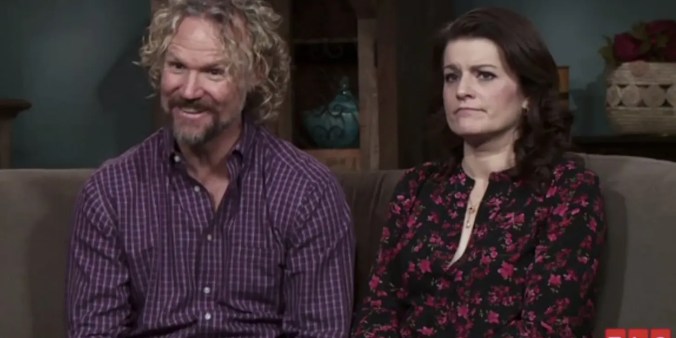
The substacker “Holly Mathnerd,” not for the first time, has a well-written and interesting post about her reaction to a book by the “star” of a reality show I had never heard of and definitely never watched. Christine Brown Woolley’s memoir “Sister Wife: A Memoir of Faith, Family, and Finding Freedom,” released today, is about one of the “stars” of “Sister Wives,” a reality show that has been running for 15 years, including 20 seasons. The show centers on Kody Brown, a fundamentalist Mormon man with twelve children from three wives. His “family” dwells in what Holly calls a “polygamist house”with three apartments branching off a shared common space. That’s Kody above with one of his other wives.

Yikes.

I really don’t care about the details. Polygamy and polyamory (the same thing but without bothering with the marriages) are unethical; never mind the morality issues. Like adultery and prostitution, these are practices that undermine families, real marriages, subjugate women and harm children. Libertarians see nothing wrong with polygamy, or at least think it should be legal, which adequately tells you what’s wrong with libertarians.

I can’t imagine buying a book by a woman who voluntarily submitted to a polyamorous relationship and now wants to make money by writing about what a mistake it was. Gee, ya think? I put Woolley’s memoir in the same category as I would a book by someone who used to shoot nails into his head but who now realizes it was probably a mistake.

From Holly Mathnerd’s account, it seems like the better part of the book is its account of just how phony “reality” shows are, not that this should be a shock to anyone who is familiar with the genre. Holly writes in part,

“…The memoir also peels back the curtain on how fake “reality” really is. Watching the show, you’d think you were seeing the Browns’ daily life: family dinners, arguments, weddings, tears. But Christine makes clear that what you’re really seeing is a carefully curated product — sometimes scripted, sometimes manipulated, always edited with an eye toward what would get people talking on Twitter.

Kody, in particular, seemed to understand this instinctively. He weaponized the cameras. He would drop painful revelations on air — things Christine was hearing for the first time along with millions of strangers — and then claim that the wives couldn’t “control the narrative” because they weren’t “being honest enough.” Meanwhile, what they were really up against was the power of editing: hours of footage boiled down into forty-two minutes that could make anyone look like a saint, a villain, or an afterthought depending on what the producers wanted.

It reminded me of the gaslighting built into the whole setup. The audience was constantly asked to question its own eyes: “No, you didn’t see favoritism; you saw family unity. No, you didn’t see cruelty; you saw tough love. No, you didn’t see neglect; you saw the noble sacrifice of plural marriage.” Christine’s memoir blows a hole in that façade by admitting what fans always suspected: our eyes weren’t lying, the edit was….

Another benefit of the post was that the blogger introduced the term “parasocial relationship,” which I had never encountered before. She didn’t define it, but I looked it up: Google’s bot says that “a parasocial relationship is a one-sided, one-way connection in which an individual develops a strong sense of intimacy, familiarity, and emotional investment with a public figure or fictional character they don’t know personally. These relationships are common and often occur through media, such as television, social media, or podcasts, where an individual feels like they have a personal connection with the person or character on screen or in their feed. While these relationships can be a natural part of human behavior and even provide positive influences, they become unhealthy if they interfere with real-life interactions or daily functioning.” 

Good to know! You can read Holly’s post here….