There has been so much weird, impulsive, counter-intuitive and counter-factual support for frauds, knaves and evil-doers on the ideological left that I have had a hard time keeping up with it—or maybe my brain is just rejecting what it regards as bad juju. An astounding number of young Democratic-Socialists lionize Luigi Mangione, who shot an insurance exec in the back in an alley. Hasan Piker, who campaigned with Abdul El-Sayed, now the Michigan Democratic Party candidate for the U.S. Senate, has repeatedly expressed his approval of the assassination of Charlie Kirk. I have several Trump-Deranged friends who would have sent metaphorical flowers of thanks to any of the recent failed assassins whose target was President Trump. The support for Jason Arday and his sanctification as a victim is also part of the trend.
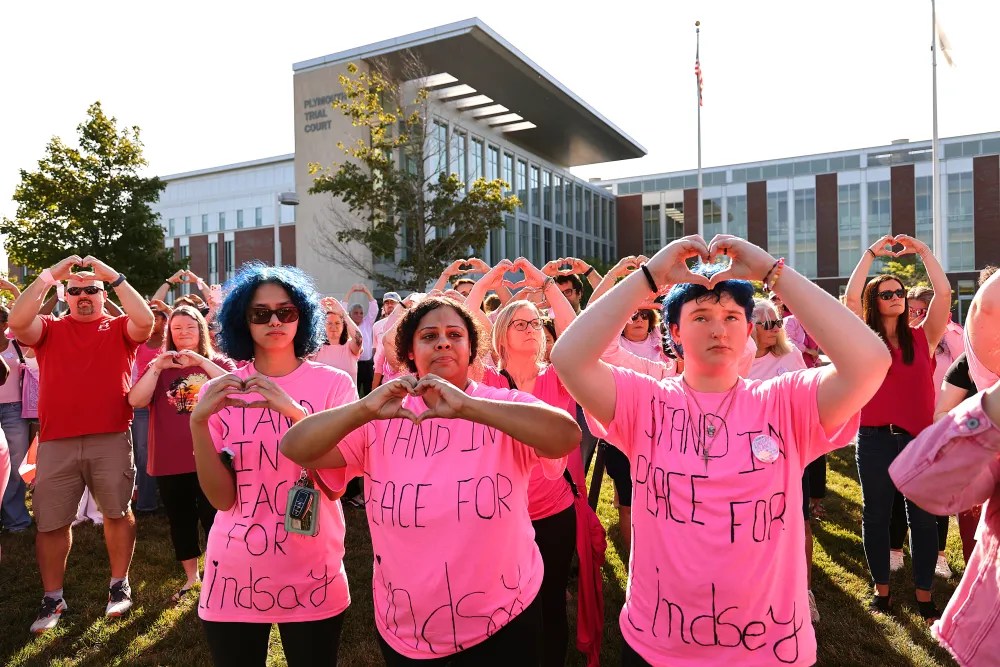
But this latest example is special. Hundreds of women, dressed in pink, protested last week outside Plymouth Superior Court in Massachusetts to show their support for Lindsay Clancy, the former nurse being tried for the murder of her three young children.
The mob wore shirts reading “Believe,” “She Needed Help” and “Peace for Lindsay.” Clancy, 36, pleaded not guilty to three counts of first-degree murder in the deaths of her children—Cora, 5, Dawson, 3, and Callan, 8 months, in January 2023. Her defense now is that she was suffering from postpartum psychosis and severe mental illness and therefore should not be held criminally responsible. Okay. That’s the defense’s job in a case like this, and surely any mother who would murder her own kids, or any children for that matter, has a strong argument that she was legally insane. However, in 1994 when Susan Smith was convicted of murdering her two sons, three-year-old Michael and one-year-old Alexander, by strapping them in their car seats, and rolling her car into a lake, there was no such public sympathy for her. The defense’s insanity defense was rejected by the jury.
Social media, of course, is part of the difference, and the Clancy episode may stand as a perfect example of how the internet warps values, perception and ethics. The murderous mother’s sympathizers have followed the livestreamed trial daily, often analyzing witness testimony in real time. TikTok has viral videos with legends like “I Am Lindsay Clancy,” often showing the poster holding her own infant. (I would think such videos justify visist from child protective services.) “I Stand With Lindsay” merchandise—shirts, hats, stickers, mugs, socks and bags —-are being sold on line. A GoFundMe established for Clancy’s parents had 31,000 contributions by the end of last week, raising over a million dollars.
This woman murdered her children, remember, and there is evidence that she planned it; she didn’t just “snap.”
So Ethics Alarms has to ask the threshold question to begin an inquiry into so many ethics problems: “What’s going on here?”
Ironically, while I was feting an old friend over the Independence Day weekend, another old friend, this time a college classmate who roomed with one of my very close friends so I spent quite a bit of time with him, used Linked-In to promote a “Medium” essay he seemed to think was worth reading. Foolishly, I read it earlier this week.
Let’s call this old friend “Bobo.” Bobo has had some tough breaks, but he’s smart and resilient and landed on his feet. He did end up on my blacklist for what I consider to be a major breach of ethics and friendship. About 30 years ago Bobo reached out to me when he was visiting D.C. and said he wanted to get together to catch up. When we did meet, he pitched me on a ski resort he worked for as the head of marketing, complete with a promotional package. The meeting had nothing to do with “catching up”: Bobo was using our past relationship to get a contract from the organization I was working for at the time.
The next time he was in town and called me, I ignored him.
The Medium essay was as good an example of Trump Derangement and progressive indoctrination as one is likely to find. Bobo is based in Colorado, and is apparently a Boulder ventriloquist dummy with the Axis of Unethical Conduct drinking glasses of water while he mouths their message. This thing carried the obnoxious headline, “Is 850,000 Fireworks enough?“, so I knew what I was probably in for. Still, the essay was even worse than I expected. As I said, Bobo is smart, or used to be. But here is what he wrote, absent gratuitous quotes from John Adams, FDR, Dr. Mortimer Adler (?), and Thomas Paine, a pompous introduction, and shoehorned in at the end, another promotion of a project he’s involved in, and probably paid to push
“Nearly every day, our social fabric is being torn apart by executive orders, endless lawsuits, and odious Supreme Court rulings cheered on by the current administration. Let’s also put a bookmark in place to visit the fragmented, siloed media landscape that has amplified unimaginable lies, perpetrated false claims, and exaggerated ludicrous conspiracy theories while doing the bidding of dark money moguls and narrow corporate interests. These bad actors are ripe for prosecution. Criminal disinformation is rampant as they continue to mislead far too many Americans. Do I need to remind my readers that FOX News was guilty of knowingly lying to their listeners and paying nearly a $Billion$ fine? The more we learn about the fragmentation of our sources of information and loss of integrity in journalism, the uglier it gets. There is so much more to say about news deserts, food deserts, lack of trust, wealth disparity, homelessness etc. The meta crises are vast and complex… All this chaos is by design and funded by what many call the Big Ugly Bill — supporting the 800-plus pages of Project 2025. The primary architect and author of that project, Russell Vought, is currently the Director of the Office of Management and Budget (OMB).
“In 2017, at the Conservative Political Action Conference (CPAC) Steve Bannon declared that Donald Trump’s cabinet appointees were selected for the purpose of the “deconstruction of the administrative state”. And, that was his first administration. My last article in Medium addressed the issue of accountability — it fell on the deaf ears of Republican Senators….In Trump 2.0, think of the Department of Government Efficiency (DOGE) and Elon Musk. This all boils down to fewer public servants looking out for what people care about, like clean water, clean air, food safety, and better schools for our children. And that’s just the tip of the iceberg.
“…Wondering whether there was anything to be said that hadn’t already been said, concerned that more words would simply be adding trauma to an already deeply traumatized citizenry, I hesitated…. In 1993, we were celebrating our nation’s 217th anniversary of the courageous Declaration of Independence. I had recently returned from the United Nations’ Earth Summit in Rio, where I had been embarrassed by the proclamation of then President George H.W. Bush, whose first words to the assembly and the world were: “The American Lifestyle is non-negotiable”…
“…Celebrating our independence from tyranny and oppression is baked into our cultural heritage. Yet, in the midst of an historic heat wave, ironically fueled by more than a century of polluting our atmosphere, we have a President determined to “set a world record, like you’ve never seen before” by adding 850,000 bombs bursting in air this evening. Let’s find another way to celebrate that doesn’t add one more molecule of pollution to our precious atmosphere… before this administration literally burns down everything they detest.
“Most observers agree we have precious little time left to change; others are certain collapse is unavoidable. The optimists see this as a golden opportunity to redesign everything that is dysfunctional and destructive. A friend recently reminded me that HOPE is a VERB with its sleeves rolled up! With empathy and compassion, courage and heartbreaking bravery we can move beyond this moment of cruel havoc and selfishness…”
As you know, I have been regularly wrestling my fingers to the floor to avoid responding to such junk on Facebook and elsewhere, but this was too much, especially coming from a fellow Harvard grad. I wrote as a reply to his Linked In post that included the Medium link:
Since you asked for feedback, [Bobo], it’s bad form to complain about false media reporting and then to post “that FOX News was guilty of knowingly lying to their listeners and paying nearly a $Billion$ fine.” That’s not true in several ways. 1. Fox wasn’t found guilty of anything: there was no trial. 2. The issue was alleged defamation, not “lying to their listeners.” The First Amendment protects networks from being punished for lying; otherwise, MSNBC and CNN would be indicted every day. 3. There was no “fine.” A settlement is not a fine or even damages.
Spinning like that removes an essay from the realm of enlightening commentary to just partisan talking points. A collection of characterizations isn’t an argument. Which SCOTUS opinions to you consider “odious”? I read them all, and they were all legally sound, including the one that rejected the President’s EO ending birthright citizenship.
Meanwhile, how about that Graham Platner?
Linked In made me delete a several hundred words. What I originally had before the Platner sign-off was this:
The summary of the Pope Leo’s open letter to “all people of good will” is at Part I, along with a link to the whole 42,000 word opus. News reports on the document can be read here, hereand here.
1. The document appears to begin, as we would expect, from the basic socialist/Communist/progressive bias the Catholic Church has always displayed, which includes suspicion and contempt for capitalism. In the text, Pope Leo says that while “technology should not be considered, in itself, as a force antagonistic to humanity,” he added that “the pursuit of greater profits cannot justify choices that systematically sacrifice jobs.” The encyclical doesn’t resolve the obvious conflict that has always existed in that perspective: technology ideally improves the quality of life for humanity, saves resources and redistributes them elsewhere, and often reduces the costs of goods and services making them more affordable to all. One of my favorite inventors, Walter Hunt (inventor of the safety pin), invented the first practical sewing machine but didn’t patent or market it because he was certain that it would put seamstresses out of work. So Elias Howe patented the sewing machine instead. Were more jobs lost or created by the invention? I have no idea. This has been the inevitable sequence with new technology throughout human history: its ultimate impact is usually impossible to predict.
Ethics Lesson: Trying to develop rules and laws limiting the uses of emerging technology is stifling as well as futile, and foolish to boot.
2. A Pope using the Biblical fable of the Tower of Babel as his primary analogy to justify limiting the use of artificial intelligence is signature significance that makes me, for one, tend to roll my eyes at the entire document. That’s a story about the Old Testament God finding sinful the aspirations of mankind and sabotaging an effort by humans to cooperate in creating something ambitious and unprecedented. The encyclical demands acceptance of human limits, while science, capitalism and American individualism set no limits on human advancement. The Pope seems to be saying the equivalent of “If God had meant for us to fly, he would have given us wings.”
[From your host:I know the headline and graphic is my style and not Ryan’s. The valuable commentary below came out of a thread on the last Open Forum. I decided that it was worthy of a stand-alone guest post, especially since I should have written pretty much the same post when this news was first reported.Also, with this post I am officially Christening “The Climate Change Hysteria Ethics Train Wreck.” I should have done it years ago. JM]
I’m seeing some news that the IPCC (the International Panel on Climate Change) has rejected the RCP8.5 model as pretty much an impossible scenario. What is significant about this is how much research and how many policies were based on this scenario. With the IPCC actually stating that RCP8.5 is simply not plausible, the foundation for so much of the climate change hysteria has been ripped away.
To provide a little more detail, RCP8.5 is one of thousands of different models (computer simulations) trying to predict the impact of human activity on climate change up to the year 2100. These models try to take into account factors like human population growth, adoption or rolling back of climate policies, differing degrees of climate forcing due to carbon dioxide (because the science is definitely NOT settled on how much forcing CO2 actually contributes), and a host of other factors. RCP8.5 has always been one of the most extreme models, predicting an increase of 8.5 W/m^2 by 2100. There are scores of other models that are far more modest in their projections, and certainly observed data has favored models that project something closer to 3.4 W/m^2, though even those are diverging from observed data as time goes on.
The upshot, though, is the sheer scope of how much of the world’s climate policies are based on RCP8.5. From this article, we have
“Why this matters: these scenarios live in policy. The now-implausible upper-end scenarios — RCP8.5, SSP5-8.5, and SSP3-7.0 — are not just academic constructs used in esoteric research. They are embedded in the policies and regulations of most of the world’s largest economies, found across the world’s most important multilateral institutions, and used in the climate stress tests that govern hundreds of billions of dollars in bank capital. National climate impact assessments in the United States, United Kingdom, Germany, Canada, Australia, Japan, and the Netherlands all use RCP8.5 or SSP5-8.5 as a reference scenario. The Network for Greening the Financial System framework, used by more than 140 central banks, has utilized a “Hot House World” scenario calibrated to RCP8.5 physical risk into the bank stress tests run by the European Central Bank, the Bank of England, the Reserve Bank of New Zealand, the Banque de France, and the US Federal Reserve. The World Bank’s Climate Change Knowledge Portal, which provides the climate diagnostics that feed into the Country Climate and Development Reports for more than 100 client countries, defaults to SSP5-8.5 and SSP3-7.0.”
We have trillions of dollars worldwide tied into climate policies. Europe is practically destroying itself trying to achieve Net Zero targets. Industries are dying, people are facing energy insecurity, prices are skyrocketing, and the entire continent is growing in unrest over the devastation to livelihoods. All this comes from countries making policies based on a model that people have warned for years is unrealistic. But the good news is at least with the IPCC ruling the scenario implausible, there is no defense for anyone to keep using those high-end scenarios to craft policy.
Sadly, I’ll bet few policies are actually updated to reflect this ruling.
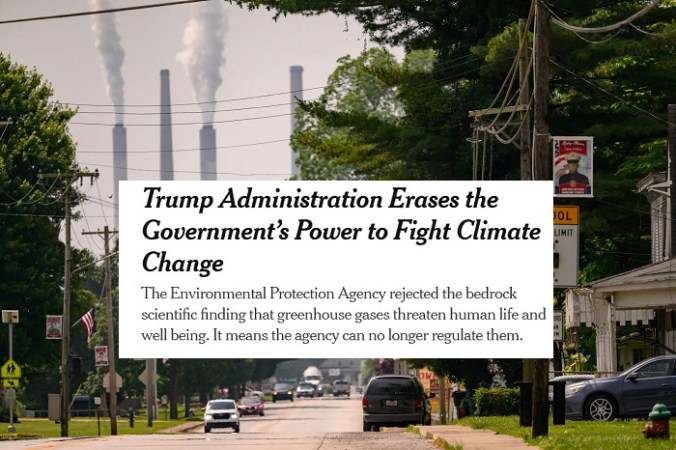
I don’t want to dwell on the headline above from the Times, but this is just another example of how, as in democracy’s death of a thousand cuts, our journalists deceive, confuse and manipulate public opinion. They also think they are clever about it, just as they think they are smarter than they are.
“President Trump on Thursday announced he was erasing the scientific finding that climate change endangers human health and the environment, ending the federal government’s legal authority to control the pollution that is dangerously heating the planet,” the Times piece begins. “The action is a key step in removing limits on carbon dioxide, methane and four other greenhouse gases that scientists say are supercharging heat waves, droughts, wildfires and other extreme weather.”
[From your Host:This excellent essay arrived on an Open Forum, and as I sometimes do, has been elevated from Comment of the Day status to a Guest Column. I’ll even forgive Sarah for making me look bad in comparison to such thoughtful, eloquent and perceptive work.]
***
“The embarrassment is that chemistry was treated as a mere technicality rather than the foundation of the entire conclusion. The embarrassment is that skepticism—real skepticism, the disciplined refusal to accept claims without robust evidence—was framed as denial rather than diligence.”
This particular article discusses the extraordinary claim that our brains contain a huge amount of microplastics. The problem with this claim is that the study has a fatal methodological flaw. The study relies on spectroscopy and detecting signatures of chemicals to determine a sample’s composition. However, the fats in the brain break down into similar compounds as polyethylene, which means without further differentiation methods, there is no way to tell if the “microplastics” the study detected were actually just normal lipids found in the brain. The whole article is worth reading, as it does an excellent job of explaining the issue.
I recently saw a post on Facebook that decried the idea that experts could be challenged by some novice watching a few YouTube Videos and reading a few scientific papers. This led to a long discussion in the comments, which was unfortunately extremely one-sided. Most everyone agreed that trying to correct an expert in their field was utter hubris.
“Take something you are good at, like maybe changing transmissions. Imagine someone who has watched a few YouTube videos comes up and tells you that you are doing it all wrong. How would you respond?”
The main problem with this is that, in terms of changing a transmission, we can obviously see who is right and who is wrong. The car will run, or the car will not. Indeed, if you truly are an expert in changing transmissions, you can step up and, in simple terms, explain why your process is the correct one, what is wrong with the YouTube watcher’s process, and even perhaps teach your skeptic how to do it correctly.
With any field of expertise, we have to remember that experts are people too, and all humans have flaws. Experts can be tempted by money, power, prestige, and politics. There are also limitations that even experts struggle to overcome. For example, in many branches of research, there are serious problems (often ethical in nature) in creating a good control group.
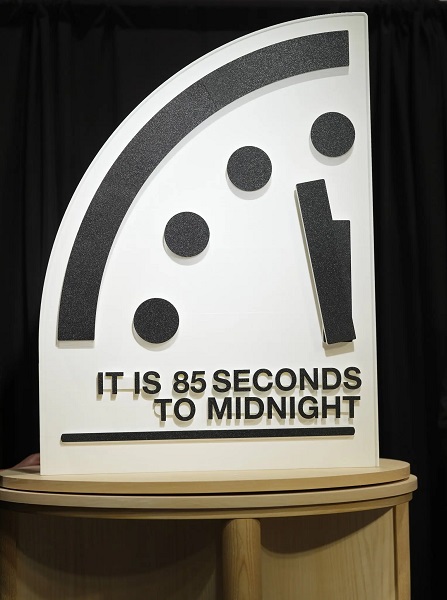
If anyone or anything ever deserved an Ethics Alarms “Bite Me!,” it’s the ridiculous Doomsday Clock and the pompous, biased, fear-mongering scientists who set it.
The Bulletin of the Atomic Scientists has set the clock each year since 1947, and to say it does not have a sterling record, whatever standards one uses, would be an understatement. Well, I’ll take that back: they have a sterling record for being wrong. Still, once again the thing is in the news. “The ‘”‘Doomsday Clock'”‘ — a symbolic clock that supposedly represents how close humanity is to global catastrophe according to “experts” — “has moved closer to midnight,” ABC News tells us. “The Bulletin of the Atomic Scientists announced Tuesday that the clock is now 85 seconds to midnight, with midnight representing the apocalypse.”
That’s the closest its ever been!AAAAIIIIIIIIII!!!
[Watch out now, you have to click on “2” below to keep reading…]
…showing her that her hysteria is based on lies, bad stats, politicized “science” and hooey?
I admit it, that headline sucked me in to reading “Social Q’s,” a Times advice column that puts wokeness over wisdom, causing me to put it on the EA blacklist.
“My wife has become an eco-warrior,” a married weenie writes. “She has strong feelings about the environment and other people’s carbon footprints. She challenges our friends repeatedly about their lifestyle choices. I agree with her in principle, but I can’t support her moral outrage. …Help!“
Predictably, the column’s proprietor, Phillip Galanes, begins by saying, “I would begin by praising her, rightfully, for her commitment to an important issue.” I’ll fix it for him: “an important issue that nobody really knows much about, especially indoctrinated progressives who are passionate about what their bubble-mates are passionate about regardless of facts.”
First, on the ethical side…we have The Foundation for Individual Rights and Expression, which picked up the metaphorical baton on non-partisan defense of freedom of speech after the ACLU threw their mission away and became just another lackey for the Democratic Party.
A federal district court today dismissed with prejudice the lawsuit against Iowa pollster J. Ann Selzer stemming from her late and spectacularly wrong poll before the 2024 election showing Donald Trump losing reliably Republican Iowa to Kamala Harris. The lawsuit, brought by a subscriber to The Des Moines Register and structured as a class action asserted claims under Iowa’s Consumer Fraud Act was fraud and attempted election interference. It was a stupid lawsuit, so Selzer, represented pro bonoby FIRE, which explained that commentary about a political election, including polls, are protected speech. The court agreed that “polls are a mere snapshot of a dynamic and changing electorate” and “the results of an opinion poll are not an actionable false representation merely because the anticipated results differ from what eventually occurred.” The court also held the plaintiff had “no factual allegations” to support his fraud claim, instead “invok[ing] mere buzzwords and speculation” to support his claims.