Sweeney, the shapely and bold young actress who already angered the Left with her jeans/genes ad that supposedly dog whistled white supremacy, is now getting attacked by the Mad Left for the video above. She’s objectifying female athletes, you see. Or something. Because women athletes have never used sexual attractiveness to promote themselves and their sports…
Hey, how did pro-golfer Paige Spiranac get in there? Away with you, Devil Woman!
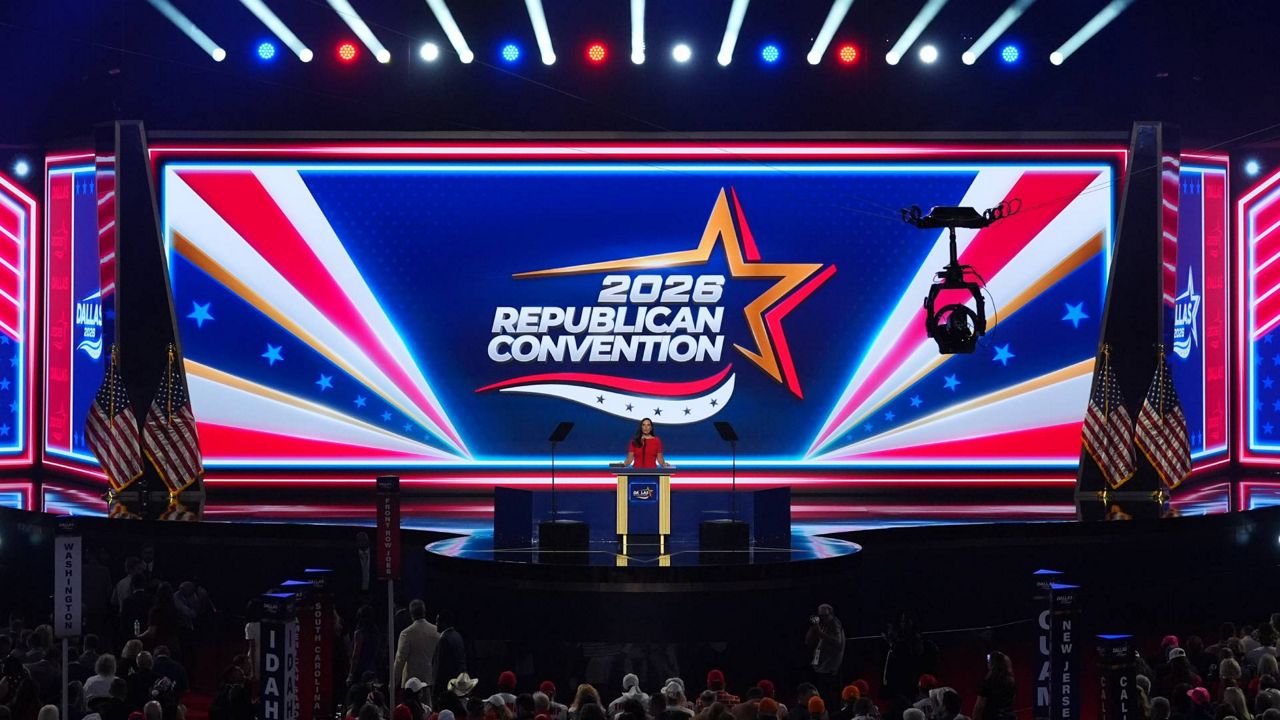
I could write full posts about many of these, and if I had time, I would. The networks and the Axis want to ignore it and are trying to bury it in negatives, but the event is obviously news, and attention should be paid….
Observations:
1. Competence! If this was the President’s idea, it was a great one. The GOP has to get voters to the polls (or to mailboxes, if he can’t stem mail-in balloting). If the event picks up just one or two percentage points in Republican voter participation, it will have been a success. If Republicans hold Congress, I guarantee both parties will make this tactic a tradition.
Incidentally, adding a mid-term convention is another so-called “democratic norm” that Trump is violating. The Horror.
2. Fetterman! One of the two biggest stories to come out of last night’s opening of the convention was Senator John Fetterman’s surprise video appearance, shot in front of a steel mill. Fetterman praised and endorsed his fellow Pennsylvania Senator David McCormick, a Republican, and said that they would work together “and work with President Trump and defend the steel way of life.” This makes Fetterman the Ethics Hero of the convention thus far. It also tells Democrats that if they are going to try convict Trump after a House impeachment and try to pack the Supreme Court, they will need to flip an extra Senate seat to their side.
One side benefit of having to watch all the Red Sox games as Boston closes in on a serious run for the 2026 World Series is getting a chance to see the various campaign ads for Congressional candidates in Massachusetts, New Hampshire, and the other New England states served by the New England Sports Network (NESN) that broadcasts the games to “Red Sox Nation.” Let me rephrase that: getting the chance to see how idiotic the ads are.
The one you see above, by Democrat Chris Pappas, is easily the best of the dozens of ads I have seen, and it’s idiotic—infuriatingly vague, misleading, and using broad innuendos that don’t make any sense.
What restaurant has “VIP sections”? The analogy between a restaurant and Congress is so strained it makes my brain hurt. What does “play by their own rules” mean?
I view any Democrat as ethically estopped from complaining about members of Congress engaging in stock trading. The most powerful Democrat in Congress for decades, Nancy Pelosi, was also the most flagrant beneficiary of Congressional inside trading. The Trump Administration has done a great deal to lower prescription drug prices, but nothing except nationalized health care or government guaranteed income can prevent citizens from having to make choices regarding how to spend their money.
But, again, this is by far the best ad I’ve seen. Several boast that they should be elected to Congress to “stand up to Trump.” What does that mean? The Democrats will vote against anything Trump supports even if its rainbows and lollipops. “Standing up to Trump” means what, making mean faces at him? Insulting him, like members of The Squad or Jasmine Crockett? How does that help constituents? Many also say they will “stand up to” or “oppose” I.C.E. Does that mean they support open borders? Do they not want to get the dangerous illegals out of their constituency? Or are these just meaningless, focus group-tested buzz words? Almost all of them say that if elected they will “bring costs down.” Do they not know that costs as a whole never “come down,” do they think people are so stupid they don’t know that, or are people so stupid they really think that?
Maybe it’s my imagination, but I don’t think so: I remember campaign ads once containing occasional genuine, practical, achievable policy positions. Now its all virtue signaling: Elect me because I hate Trump. Elect me because I don’t like I.C.E. Elect me because I’d really like to do all of these things I won’t have the power to do but at least I have good intentions.
Is it stupid woke Halloween controversy season already? Sadly, it is.
Target removed a Halloween clown costume from its website and presumably its stores after social media mobs claimed that it was racist, evoking blackface and minstrel shows. As we know, companies are infamous weenies any time the race card is played against them, and virtually always grovel an apology. Thus Target sobbed on social media this week,
“An apology from us: We removed an offensive Halloween costume that should never have been part of our assortment. It is no longer for sale. As a company, we got this wrong, and we are deeply sorry. We know this is especially hurtful for our Black guests, team members and partners. Removing the costume is an important first step, and we are looking closely at how this happened and what needs to change to ensure this won’t happen again.”
I am strongly inclined to view this as another “Gotcha!” exercise from the race-obsessed. Talk about a case of “If you hear the dog whistle, you’re the dog” ! Let’s see: what aspect of the costume evokes blackface or minstrelsy? Did blackface performer swear orange costumes like that? Noooo. Did they wear black gloves on their hands? No! Did they wear little clown hats? Ruffles around their necks like Bozo? Also no. So what exactly creates the “minstrel show” vibe?It’s the fact that Target hired a black kid to model the costume! Put a white child in that thing and it looks like what it is: a clown costume.
Let me get this straight: Admirably, Target doesn’t see racist images at every turn, and hired a black model, when it should have hired a white model because the black kid made race-obsessed victim-mongers think of blackface. That wasn’t blackface, that was a child’s black face!
Is it the smile that’s the problem? You know, evoking this…
…? Again, it’s the actual black face wearing that smile that triggered the easily race-triggered. As for the smile , which the race-hustler think deliberately evokes “Mr. Bones” above, it is a creepy, killer clown smile, as worn by the murderous clown in Season 4 of “American Horror Story”…
Does that character evoke blackface and minstrel shows?
We are never going to get out from under the iron boot of race hustlers until companies and celebrities stop capitulating to race-baiting like this. On the other side of this ugly coin, what realistic, sound business options did Target have? Well, it could have asked whether its critics want the company to discriminate against black models. It could have educated the public and its customers about what is and isn’t blackface and minstrel imagery. It could have put a warning in the constume’s package, “Do not buy if your kid is black. The Woke and wonderful will think he’s in blackface.”
Or is this another example of the ditty, “He was right, dead right, as he sped along, but he’s just as dead as if he were wrong”? If standing on principle loses a company sales and public support, is it ethical?
Your Ethics Alarms Early Halloween Ethics Quiz of the Day is…
Was Target right to apologize and pull the offending costume?
Dan Koh is delusional. The frightening thing is that the there are a lot of brain-washed progressives in Massachusetts who are so far gone that they won’t realize how crazy and hypocritical that ad is.
First of all, to lead with dead-eyed Joe Biden saying Koh’s name because two syllables is probably all they could get him to utter after 34 takes and maybe some AI dubbing, isn’t what I would call a boffo opening. Then to follow with Kamala Harris—why would anyone vote for someone Harris endorses? She picked Knucklehead Tim Walz as her running mate! Next Koh boasts about being a senior White House advisor who was either so dim that he didn’t realize the President was a rutabaga, or so corrupt that he was part of the cover-up of Biden’s dementia. There is no third option. Biden’s term was the most disastrous in American Presidential history: what did Biden fix, with Koh’s expert counsel?
Then he ends by saying “Democrats you trust” endorse him, and there are Biden and Kamala again. I can’t think of many Democrats less trustworthy than those two. Oh, maybe Adam Schiff, Jamaal Bowman, Rep. Omar and a few other scumbags, but it’s close. Harris endorsed Black Lives Matter, and said she wanted redirect public resources away from the police but didn’t support defunding the police, a typical muddled Harris policy position. As a Presidential candidate Harris said she wouldn’t change anything Joe Biden did…you know, like opening the borders and appointing a DEI Cabinet of incompetents, lackeys and dolts. Kamal;a also swore she worked at a mysterious McDonalds that apparently appears for day and then vanishes into the mist, like Brigadoon.
Joe let his addict son use him as an influence peddling prop. He promised to be a moderate and to bring the nation together, then allowed the far Left to run his crippled Presidency. He insisted that he was sharp as a tack while refusing to have his cognition tested after his brain had retired to Boca Raton. True, he “beat Medicare.”
That ad is like something out of an alternate universe.
There should be lots of topics to discuss on today the Friday Open Forum, which is going up next, but first, despite having promised to never post on the nauseating Jason Arday mess again, events dictate that I have to break that promise, because not doing my job regarding the EA mission would be more unethical than breaking a promise based on a premise that turned out to be false. It’s an ethics conflict. (I wonder why MAGA types have so much trouble with the concept. President Trump has delivered on a higher percentage of his campaign promises than any President since James K. Polk, and yet defectors like Tucker Carlson and Margery Taylor Greene—who would want to be a member of that club?— are furious because he started a necessary war that should have been started about 50 years ago. Morons.)
But I digress. Over in Europe, which stands as a frightening example of how quickly cultures can lose core values, Nathan Cofnas, who was the first to extensively expose Arday an academic fraud, announced that he has been suspended by Ghent University in Belgium and expects to be fired. His offense? “Discrimination”—-meaning that pointing out that a black academic star that Cambridge University had created out of DEI nothingness was in truth a serial plagiarist was racist. The school rector, Petra De Sutter issued a statement on l’affaire Arday asserting that freedom of speech “is not unlimited. It goes hand in hand with responsibility and may be restricted in order to protect the rights of others.”
Tell us more about the freedom to lie to the public and jump in line in front of genuine scholars because of one’s color, Petra!
Item: 2018. The Miss America Pageant puts Gretchen Carlson, former Fox blonde turned #MeToo icon, in charge. She says it is no longer a beauty pageant. Result: the end of Miss America.
Item: 2021. Victoria’s Secret brings in Megan Rapinoe, vocal butch lesbian athlete and LGBTQ activist to rebrand the female sex fantasy company. Result: Uh, no. It quickly returned to its core values after a period of confusion, sales and turnovers…which included Megan.
Item: 2023. Budweiser brings on feminist marketing VP Alissa Heinerscheid who decided America’s top-selling beer needed to be pitched to a younger market, so she made male cross-dressing self-identified female Dylan Mulvaney the symbol of Bud Light in an ad campaign, because there’s nothing that appeals to middle-aged, bear-drinking football fans like “chicks with dicks.”
“He wants to “destigmatise male sexuality”, he says, and “help men to build a healthier relationship” with the women in their lives. “I’m hoping we can be a space for men who feel caught between needing to be manosphere-adjacent and needing to be the performative liberal male,” he says…. “We should promote the idea that we can be excited about sex and we can be excited about each other and excited about touching each other,” he says with a cheeky grin.”
To me, that model on the current Playboy cover is androgynous, scuzzy, and reminiscent of what Hustler thought was sexy. But I am not a marketing target for Playboy, (or Hustler) and never was.
“Playboy” is already the walking dead, but still, the Santayana quote, “Those who cannot remember the past are condemned to repeat it” is germane here, as is the principle that when an institution, tradition or product no longer has a place in the culture, you can’t save it by destroying its identity and integrity by pretending that it’s something else. Let these things die with dignity, or at least go down fighting.
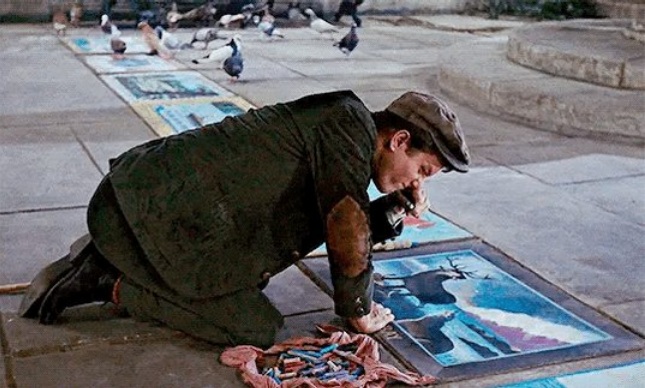
Who would have thought that Bert from “Mary Poppins” might have had a career in law firm marketing?
Trantolo & Trantolo, a small law firm in Hartford, Connecticut that also has offices in New York and Massachusetts, has been cited for more than a dozen “unauthorized sidewalk advertisements.” Put on the pavement using either power-washing or temporary chalk over stencils, the firm legal services marketing innovation violated a city ordinance that banned such messages without written consent. Hartford Mayor Arunan Arulampalam told the media that the city has discovered at least 15 sidewalk messages promoting the firm. Unauthorized law firm promotion from the firm also appeared on 24 Hartford crosswalks before the West Hartford Department of Public Works powerwashed them into oblivion. I bet it looked sort-of -like at the end of the Chalk World sequence where Bert, Mary and the kids ride on merry-go-round horses, participate in a fox hunt and sing “Supercalifragilisticexpialidocious” and then the rain washes Bert’s pictures away.
One message with the firm’s name attached said, “Look both ways before you cross.” Who could object to that public service message? But the firm has “an angle.” As Bing Crosby told Rosemary Clooney in “White Christmas,” everyone has an angle. Well, lawyers and law firms, anyway. Trantolo & Trantolo explained that one by explaining that Hartford “has a serious road safety problem.”
“Working with an outdoor advertising company that has executed similar temporary sidewalk campaigns in cities across the country, Trantolo & Trantolo recently placed a series of temporary stencils throughout Hartford and West Hartford highlighting important local and statewide safety statistics,” says the firm. Trantolo & Trantolo also promised that it would remove all the messages ” at the end of its campaign.”
You have to give the firm’s marketing department credit for creativity. However, the stunt violates the Kantian ethics test of considering what the world would be like if everybody did it, or even every law firm. Thank goodness this stunt didn’t occur to Morgan and Morgan.
I had a doctor’s appointment today. Taking the elevator from the 9th floor to the lobby, I encounter one you man riding in the elevator already, with his face buried in his phone. Two more riders got on at stops as we went down. All walked in already focused entirely on their phones, and their eyes didn’t move. I looked around for a friendly face, a smile, some hint of humanity. Nothing. I came this close to booming out, “Well, hello, everybody!” (I did that once.)
I regard this behavior as simply rude, and its slow but steady development into a social norm as ominous for society and the species. I was already pondering the problem earlier in the week after seeing another one of those Progressive ads about the coach who tries to stop young couples who have become home-owners from “turning into their parents.” It’s a funny series, but in this particular installment, most of the conduct from the young homeowner was simple friendliness to a stranger.
Indeed, my father was always prone to chat up strangers. Not my mother: if you weren’t Greek, a family member, or someone already known to her, you were presumptively an enemy agent or a disguised invader from outer space. In this realm, as with many others, I took Dad as a role model, and experience has taught me that it is the right approach to the world and society around us. For one thing, I have learned how a random act of attention and kindness can brighten an otherwise dreary day.
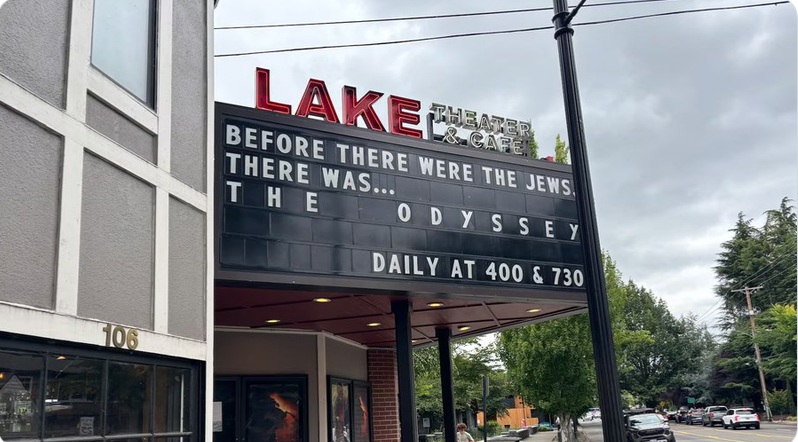
Following a theme that began with this morning’s ethics quiz, we now have the viral controversy over the obnoxious Lake Aswego (Oregon) Theater and Cafe marquee for “The Odyssey.”
On social media (and elsewhere), the theater’s owners are being accused of “disgustingly blatant antisemitism” as Hen Mazzig, an Israeli writer and senior fellow at the Tel Aviv Institute put it on “X.” I’m sorry I haven’t kept up on Lake Oswego movie theater marketing trends: apparently this one makes a habit of cheeky, politically provocative or otherwise controversial marquee messages. In February, for example, the theater’s message promoting “Melania,” the Amazon MGM documentary about First Lady Melania Trump, read, “To defeat your enemy, you must know them. Melania starts Friday.” Amazon pulled the movie from the theater, and the proprietors reacted with a “Who, us?” shrug.
That example is not irrelevant: Lake Oswego is heavily Democratic, reliably voting for Democratic candidates for all federal and state offices. The last time a Republican was favored by voters was in 2016, when it narrowly favored Republican Secretary of State candidate Dennis Richardson while the city and the state went into Hillary Clinton’s column in the Presidential race. Lake Oswego is in Oregon, one of the most fanatically progressive, Democratic and woke states in the union. 80% of Democrats, the Pew Research Center says, hold “an unfavorable view of Israel” as of June 2026, an 11-point increase from 2025.
How likely is it that the marquee in a place like Lake Oswego, was deliberately praising “the Jews” (You know, as in “the Jews made a heroic odyssey”to Canaan”) as opposed to cheekily denigrating them? Not bloody likely at all. Is the message an innocent comparison of the endless warring between Israel and Palestinians to the Trojan War? If so, then why only mention “the Jews”?
The online debate has seen a suspicious effort to deflect the real issue by arguing over whether “the Odyssey” was really before “the Jews.” Does the theater mean the actual voyage (there probably wasn’t one), or Homer’s poetic description of it? That’s not the real issue, and the debate over it is pedantic sophistry. The issue is whether the marquee is anti-Semitic, designed to appeal to anti-Semites (you know, progressives and Democrats), and cleverly composed to do so while giving the theater and fans of the smear plausible deniability.





 Ethics Alarms