The wild—and increasingly weaponized—hypocrisy among alleged feminists is not to be borne, and I’m happy to flag it as the unethical—but woke!—cultural poison that it is.
Perpetually unfunny comic Shane Gillis was back for the third (or is it fourth?) time as a host of the now totally ideologically-captured Saturday Night Live last week. During his rambling monologue to begin the show, Gillis said, “I haven’t been to the gym in so long I didn’t know women just dress like whores now? Look, I’m sorry, there’s no other way to describe it.” Gillis then went on to describe the ubiquitous tight short-shorts that dominate young women’s attire at the gym as featuring “wrinkles [that] go around the cheeks and all combine at the butthole,” adding, “You’re not allowed to look… because they are filming. I’m in the background of about 10 TikToks right now.”
The Hollywood Left’s explosion of fury, which sure sounds like mandatory feminist outrage from beta males to me, focuses on Gillis’s use of the word “whores”—I even saw it censored on Axis news sources as “wh*res.” Not to go back into the misty past, but as I will always remind readers here, Bill Maher called conservative women like Sarah Palin and others “cunts” and “twats” on his HBO show with nary a peep from feminists. Today, over a decade later, the same people who laughed at Bill’s hilarious misogyny want to cancel Gillis. Here’s Forbes virtue-signaling to the mob:
This issue, which I feel strongly about and have so written, more than once, reared its ugly metaphorical head again this week.
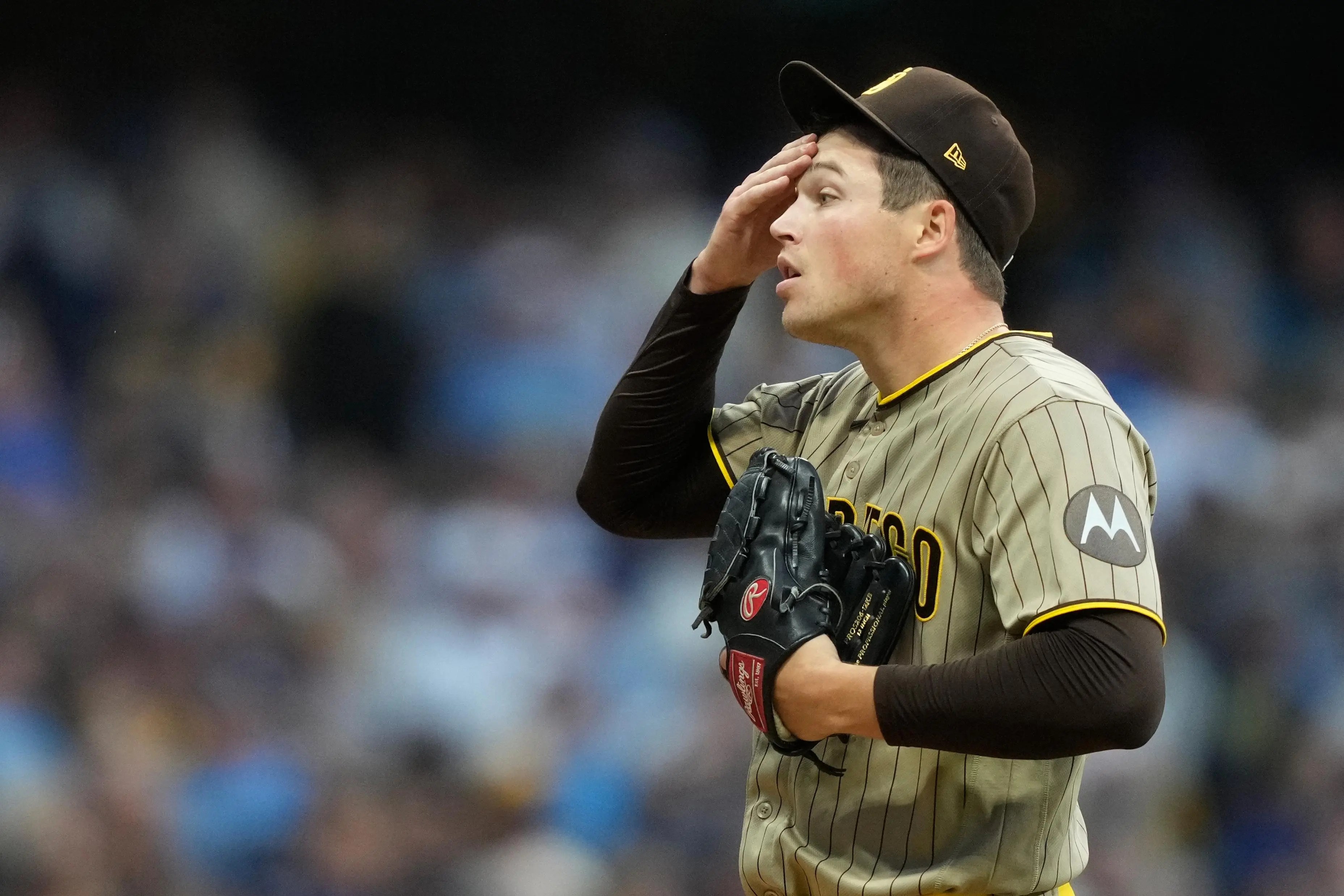
The San Diego Padres were added to the National League in 1969. The team has been in two World Series, losing both quickly; the last time was in 1996. They have only made the National League Championship Series three times. The team closed the season hot, and faced the best team in baseball, at least based on their record, the Milwaukee Brewers, with high hopes. Among the team’s many stars (more, in fact, then Milwaukee) is Mason Miller, by consensus the best 9th inning relief pitcher (aka “closer”) in the game.
The Padres lost the first game of the five game series due to a fluke, as described here. They lost Game #2 as well, and faced elimination in Game #3. It was “all hands on deck,” the Alamo, Custer’s Last Stand. Nevertheless, before the game, Mason Miller chose to take paternity leave, a privilege the players won in a contract battle with owners in 2011.
My ethics analysis of this conduct begins with “Just because you can do something doesn’t mean you should.” The entire season, 162 games, many millions of dollars, millions of fans, a city’s economy and community, players’ careers and income, managers’ and coaches’ jobs, team sponsors and more ride on which teams win in the post-season. My position is that Miller’s decision was selfish, irresponsible and a breach of duty. His team not only needed him, but depended on him. His wife’s pregnancy had had hit no crisis (I checked); she also had other support available. If I were a team mate or the management, I would conclude that Mason Miller could not be trusted. An employee who flees in a crisis is not a desirable employee, especially when the employee is paid $4 million dollars for eight months of service.
Moral Luck Alert! The Padres won the game without Miller, then lost the next one, ending their World Series quest.
Ethics Alarms hosted an intense debate on this exact topic in 2021. I wrote in part,
What would have been a go-ahead 2-run homer by the San Diego Padres’ Ty France in the top of the 9th inning in last night’s Padres-Brewers NLDS series opener was foiled by a cable in the retractable roof stadium at America Field Park. The huge fly ball (49 degree launch angle, the steepest ever recorded there) on the way over the fence in fair territory struck a cable and fell straight down into the waiting outfielder’s glove. By the ground rules in force, the ball was in play and it was an out. One batter later, the Brewers had won 3-2.
Batted balls used to hit parts of the roof a lot in the Ray’s awful park in St. Petersburg before its roof was repaired, but that’s because the beams, cables, catwalks and rails were too low (and too many). This had never happened in Milwaukee’s American Family Field to cost a team a home run before, and the former “Miller Park” opened 26 years ago.
Yet the only time a ball about to be a home run hit the roof happened in the 9th inning of a play-off game, saving the home team from a crushing loss! It could have happened in a mid-May game. It could have happened in the third inning of an 8-2 loss. It could have happened when the Brewers were playing an inter-league game against the Angels. The odds were that if the fluke were going to happen at all to any team, it would have happened TO the Brewers, since its their home field. And heck, the retractable roof could have been open, meaning that there wouldn’t have been anything for France’s ball to hit.
But no. The first and only time, this particular stroke of bad luck (well, good luck for the Brewers) happened on national TV, in a critical game. Meanwhile the Brewers, who had the best record in baseball, are trying to finally get back to the World Series for the first time since 1982.
Incredibly, the conservative website “Not the Bee” called that “an absolute masterclass in dealing with godless commies.” Where’s Extradimensional Cephalopod when we need him/it?
I know the EA herald of respectful disagreement would be all over this. On the other hand, Debra Lipstadt, the Holocaust historian, has maintained that engaging in debate with Holocaust deniers give them too much credibility, and I believe it is valid to hold that Communists warrant the same dismissive treatment. It is pretty funny that when asked to name an accomplishment of Communism, all the male Communist can come up with is “The Bolshevik Revolution.
However, shouting insults and talking over people is not an ethical debate practice no matter what the topic or who is involved.
Yeah, I’m a sucker for kids with lemonade stands, but especially children being disappointed when they had been excited about a new experinece. Few things tug on my metaphorical heart strings like seeing eager kids on a sweltering day, sitting behind a fold-up table with a pitcher of lemonade, a hand-lettered sign, and no hint of a customer. It’s a retrospective Golden Rule thing. I’ve been there.
Two adorable little girls, maybe 12 and 9, had one such struggling business set up on a nearby corner mid-morning this week. No shade, no hats, no chair….and there weren’t even any cars driving by. When I walked past them with Spuds, I asked if their stand had any business yet. No, they said. I promised to get my wallet and come back.
When I finally drove back to the stand, maybe an hour later, the girls had packed up and were walking down the street. I pulled along side them by the cyrb them and said, “Won’t you sell me some lemonade? I was looking forward to it.” They both smiled broadly. One of the girls brought me a Dixie cup of warm lemonade. “How much?’ I asked? “Oh, I don’t know, a dollar?”
I stopped the car, got out, and handed the older girl a five dollar bill and an old straw hat Grace had given me for a birthday years ago: I brought it along to give to the girls. “You need to wear a hat; it’s hot…share this,” I said.
“And don’t give up! Business is hard. Most important is finding the right location, and think about how you should advertise. Also, decide on a price! I ran a few lemonade stands myself. Keep trying!”
As I drove off, they were setting up their table again. Some workmen from the school expansion nearby were walking over to them. Maybe I had given them a good experience to remember instead of a disappointment. There would be enough of those in the years to come.
I had a doctor’s appointment today. Taking the elevator from the 9th floor to the lobby, I encounter one you man riding in the elevator already, with his face buried in his phone. Two more riders got on at stops as we went down. All walked in already focused entirely on their phones, and their eyes didn’t move. I looked around for a friendly face, a smile, some hint of humanity. Nothing. I came this close to booming out, “Well, hello, everybody!” (I did that once.)
I regard this behavior as simply rude, and its slow but steady development into a social norm as ominous for society and the species. I was already pondering the problem earlier in the week after seeing another one of those Progressive ads about the coach who tries to stop young couples who have become home-owners from “turning into their parents.” It’s a funny series, but in this particular installment, most of the conduct from the young homeowner was simple friendliness to a stranger.
Indeed, my father was always prone to chat up strangers. Not my mother: if you weren’t Greek, a family member, or someone already known to her, you were presumptively an enemy agent or a disguised invader from outer space. In this realm, as with many others, I took Dad as a role model, and experience has taught me that it is the right approach to the world and society around us. For one thing, I have learned how a random act of attention and kindness can brighten an otherwise dreary day.
The House this week passed a measure, the Sunshine Protection Act, that would set America’s clocks to daylight saving time permanently once it clears the Senate and is signed into law by the President. The bill itself raises no ethics issues at all: it is the reactions to it and the reasons, real and alleged, for those reactions that ping ethics alarms.
The headline is tongue-in-cheek, incidentally. Most of my life I heard that Daylight Savings Time was Ben Franklin’s idea. Ben was an amazingly prolific innovator and out-of-the-box thinker, but he was not the originator of the practice, so we can neither blame him nor praise him. Another myth is that DST was implemented for the benefit of farmers. Actually, farmers have been one of the strongest opponents of DST because the factors that influence farming schedules, like dairy cattle’s readiness to be milked, are dictated by the sun, so clocks going back and forth just complicates things. In general, Retailers, sports, and tourism interests like daylight saving, while agricultural and evening-entertainment interests do not.
Personally, I just want one time in place all year, because the changeover is traumatic for me whenever it happens. I have a long list of screw-ups, missed deadlines and meetings on my record. I bet no year has ever passed without one.
Like so many policies, the Daylight Savings Time tradition has had and continues to have all manner of unintended consequences, and those are controversial too. There is some data that shows that crime and accidents are reduced by DST, but precise causation issues make such data inherently dubious. A 2017 analysis of 44 studies concluded that DST leads to electricity savings of 0.3%, but we now know, or should, we can’t trust studies because we can’t trust the reseachers who perform them. Ditto for a 2017 study in the American Economic Journal: Applied Economics that estimated that “the transition into DST caused over 30 deaths at a social cost of $275 million annually,” primarily by increasing sleep deprivation. Another study claimed that hospitals see a 24% increase in heart attacks and a 6% increase in fatal crashes each year when the time changes.
President Trump has advocated permanent Daylight Savings Time, so that’s enough for the Axis of Unethical Conduct to oppose it. Predictably, the Washington Post rushed to publish “Why standard time is better for your health than daylight saving time:A proposed bill would make daylight saving time permanent. But standard time is actually better for your body, according to science.”
According to science! Even the Post’s readers tended to agree that this take was hooey. A typical reaction:
Six months ago an elementary and high school classmate whom I had not seen, spoken to or, frankly, thought about or missed in 50 years contacted me and said he and his family would be taking a cross-country road trip with his 86 foot long trailer in honor of the 250th Anniversary of our nation’s founding. For his D.C. stop, timed to take place on July Fourth, he was wondering if I could accommodate his monster vehicle. (He had checked my Alexandria home’s locale via Google satellite, and saw that there seemed to be a lot of space on my cul-de-sac.)
Let’s call him “Jeff.”
I said “Sure! It would be great to see you!” as a reflex, and promptly forgot about him as well as my commitment.
Well, Jeff arrived as planned after calling me for three days as he drove here. It was immediately clear that he expected me to be his family’s chauffeur, host and tour guide until they departed Monday afternoon. So I was. I took them to museums and D.C. area attractions. I accompanied them to restaurants. They left their trailer and knocked on my door early every morning—earlier than I would usually be up— assuming I was ready to start the day’s events.
This was a weird family. Jeff’s wife (his fourth, I learned) was an Armenian woman 25 years his junior who barely spoke English, and Jeff never indicated that he spoke her language. They had a delightful, happy four-year old boy (whom she dressed like a girl) whom the couple had adopted after his mother, Jeff’s wife’s niece, had been murdered by a serial killer.
I haven’t written much lately about my miserable existence since my wife of 43 years, Grace Elizabeth Bowen Marshall (who secretly commented here under the screen name “E2”) turned up dead Leap Year morning with no warning. Because I am at heart incompetent at anything other than the things that interest me and I am natively really good at, I am still struggling mightily with the wreckage of my life, home and business in the wake of her demise.
Just yesterday, I discovered an important task regarding legal obligations that I had completely forgotten about because it was in the category of “things Grace does so Jack can concentrate on other stuff.” I discovered it because a friend who is a talented operations whiz has been forcing me to go through files, papers, and accumulated memorabilia, especially in my office, something that I literally would never do without someone a) forcing me and b) telling me how to do it. This has been one of the most painful experiences of my life, because I don’t get enjoyment from nostalgia, only sadness, anger (at myself, mostly) and regrets.
The nasty surprises, especially from the financial side, have been arriving daily. (Sondheim’s “And Another Hundred People Just Got Off Of the Train” comes to mind). That important task I have completely whiffed on is typical of many: this was something Grace and I agreed would be her responsibility, and I happily left it in her usually capable hands for more than thirty years—never thought about it, in fact. Well, because of age, an illness that was worse than I knew and possibly other issues, she had just stopped taking care of this rather important matter for quite a while. Catching up now is going to be difficult, time consuming and expensive. I should have addressed this shortly after she died, but I was not exactly thinking clearly, and I didn’t know what I didn’t know, as Don Rumsfeld would say.
One reason I moved from a writing a website that had formal essays on ethics issues to a blog format is that I wanted my commentary to be more visceral and personal, even venturing into my personal relationships when it seemed appropriate, as when a situation I encounter is one that I believe is an enlightening part of the human experience.
I just had one of those. A woman I consider a close friend, one I have known for nearly 40 years, had a major change in her domestic arrangement and moved out to a more distant section of the Greater Washington area. I have always maintained periodic contact with her—lunch, dinner or drinks—but hadn’t seen her for over a year. I sent her an email inviting her to catch up.
I believe I am fair in saying I have played a substantial role in my friend’s life, beginning when I cast her in a major theatrical production I was directing at a time when she was lost, depressed and seeking a new course in her life. She had no experience but I saw talent: from a chorus part with no lines I encouraged her to take greater risks in theater and to expand her experience and abilities. Eventually she became a successful professional actress in regional theater.
Off the stage, she was one of my favorite people: funny, strong, gutsy. I do not believe we ever had a serious argument. When she needed my advice and intervention, I helped her cope with with a health crisis in her family; when she went through her divorce, I was supportive. (She had met her husband in that first show of mine that she auditioned for.)
Given this background, I was stunned when the answer to my friendly email arrived. It stated that her former life seemed far away now, and apparently I had been filed among “many of all the people” who were involved in theater with her in Northern Virginia. “I just don’t want to look back,” she said. “I wish all good things for you, Jack, I really do. And who knows? Perhaps our paths will cross again someday.”
Not if I see you first, bitch.
I must admit, I was hurt by this abrupt end to a long friendship. I have had the pleasure of making a positive difference in many people’s lives; I don’t expect flowers, demonstrations of ostentatious gratitude or testimonial dinners, but I don’t expect metaphorical kicks in the teeth either. The email was patronizing, and I have a low tolerance for that. It was cold, and I didn’t deserve that either. My response could easily have been “Bite me!” but instead I just expressed my amazement and disappointment. “I don’t reach out to people I’ve cared about out of nostalgia or to relive old times,” I wrote, ‘I reach out to people who I believe are special and who I would prefer to have in my life than not. I’m not sure what I did or didn’t do to warrant exile , but OK, I respect your choices and always have.”
To encapsulate the painful episode, someone I thought was a good friend and someone I know I had always been a good friend to summarily announced that she didn’t want to be friends any more. I find that gratuitously cruel, and cruelty is unethical. I have never done that to anyone, and I never would.
Has this ever happened to you? If so, how did you handle it?