Peyton Tolle is a Boston Red Sox rookie and already a team mate and fan favorite for his big extrovert personality that matches his huge frame (6’6,” about 260 pounds), highlighted by Tolle’s obvious joy at playing a kid’s game for a living.
In yesterday’s Red Sox 9-8 extra-innings win over the Seattle Mariners (The Red Sox are having one of their most entertaining seasons ever), Tolle, was Boston’s starting pitcher, did something that nobody could recall any previous major league baseball player doing. As you can see above, when the hulking Tolle went to tag out Mariners player Dominic Canzone on the first base line after fielding a bouncer back to him on the mound, he preceded his tag with a smile and a hug.
Some old timers gag when they see opposing team players even chatting cordially at first base. The unwritten rule of baseball was that on the field the other team was literally a mortal foe, and its players were to be treated as such. In the 1960s a player who did what Tolle did would be excoriated, fined, exiled to the manager’s “dog house” and probably demoted to the minors.
Last night the Red Sox players seemed to get a kick out of their exuberant rookie’s latest surprise—he also likes playing tricks on team mates—saying, “That’s Tolle!” as the agreed-upon answer when questioned by reporters after the game. The sports media was all positive, with ESPN calling The Hug “The most wholesome play of the season.”
I am something of a persona non grata on the Association of Professional Responsibility Lawyers (because I’m on to them, and they know it) listserv, but the list still has its uses. For example, one of the more ethical ethics lawyers circulated a question he received from a student in his legal ethics class regarding the use of artificial intelligence in class:
“[T]he majority misses the Government’s actual objective: to secure our imprimatur for its effort to foment chaos ahead of the November elections.”
—-Justice Justice Ketanji Brown Jackson, again putting into black-and-white her intolerable political bias and lack of judicial decorum in her dissent to the 6-3 majority SCOTUS decision, a 10-page, unsigned opinion staying an injunction by a federal judge against the implementation of President Trump’s executive order imposing restrictions on mail-in voting.
I won’t pretend to know enough about the substantive law underlying the majority decision, and after trying to read Justice Jackson’s seemingly endless dissent, my brain hurts. However, I can say with ethical certainty that a judge who is automatically inclined to ascribe sinister motives to an elected President’s actions should be disqualified from weighing in on any controversy regarding those actions.
I read Trump’s EO regarding mail-in ballots as consistent with his oath of office and the definition of his powers under the Constitution. Mail-in ballots threaten the integrity of Federal elections and therefore the Constitution itself. There are limits to state sovereignty in determining election regulations and procedures, something Justice Jackson refuses to acknowledge. Gee, I wonder why only 23 states have challenged the EO. Which states might they be?
Elsewhere in her “War and Peace”-length dissent, Jackson complains that the claim that mail-in ballots risk election integrity hasn’t been proven. In fact, some courts have taken judicial notice of the fact, and it is a fact and an obvious fact, that mail-in ballots are unacceptably vulnerable to fraud. But I digress. The ethics issue now is that a Supreme Court Justice begins her analysis of an Executive Branch controversy with the biased presumption that the President of the United States is not pursuing what he believes is in the best interests of the nation under the Constitution. Justice Ketanji Brown Jackson has again demonstrated that she is a dangerous blight on the Court, the Separation of Powers, and the functioning of U.S. constitutional government.
In Allegheny County Pennsylvania, the murder trial of SafonGump ( I swear that’s his real name) ended in a mistrial last week because a juror smoked or vaped marijuana in the jury room during a lunch break and the judge was unable to determine who.
Here I must interject my obligatory “I told you so!” note regarding my long-time insistence that legalizing pot after indoctrinating the public with the false message that it was harmless would prove to be a cultural and societal disaster undermining health, children’s socialization, the family, the economy, the workplace and more. All is unfolding as I foresaw, and it wasn’t all that difficult a prediction to reach either.
The selection of 12 jurors and two alternates had been completed and the jury empaneled as the prosecution called its first two witnesses. The judge adjourned the trial for lunch, but when court staff arrived at the jury room to release the jurors, the smell of marijuana was unmistakable. Smoking and vaping are not allowed in the Allegheny County Courthouse, and worse, all of the jurors had answered the question on their questionnaires about whether they were taking any medications that could impact your ability to sit on the jury had checked “no.”
The judge called each juror into his chambers and asked if he or she had been toking. He even summoned an additional criminal defense attorney to sit in to ensure that the jurors’ Fifth Amendment right against self-incrimination would be protected. That was unnecessary, because it had been agreed that no charges would be filed against the pot-puffing juror: everybody just wanted to ensure the integrity of the trial. The defense attorney, however, sounds like a woke, drug-loving jerk. “You have all of these privacy issues you have to worry about,” he told reporters.“The last thing we want to do is embarrass someone.”
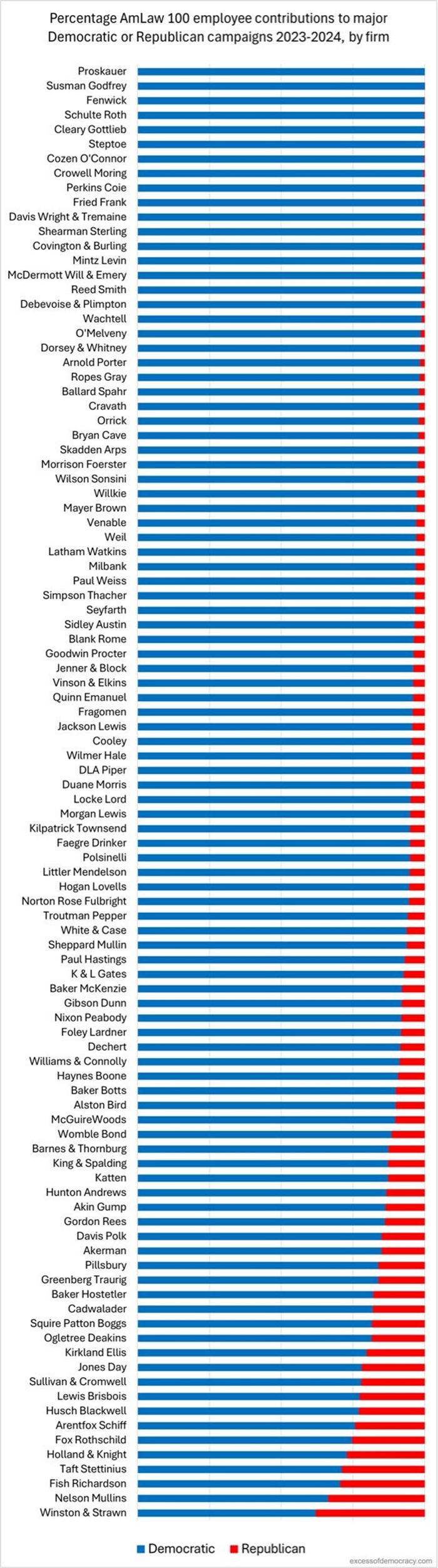
That chart represents the relative number of employees, including lawyers, in the largest U.S. firms to contribute to Republicans. I have written several posts about the “ideological capture” of major U.S. professions and institution, and opined that the extreme progressive bias in the legal profession is among the most threatening to U.S. society and democracy itself. Two examples are here and here.
Right now the D.C. Bar is fighting with the Justice Department over the Trump administration requiring some major law firms to demonstrate that they are not biased against the President and his policies, an effort the Axis (and the D.C. Bar’s staff) calls making them “bend a knee.” The major law firms are biased against this President and his administration, and are increasingly willing to show it. The civil justice system will not work if the legal profession is politicized. Increasingly, it is.
The reason is pretty clear: the vast majority of law schools have almost no conservatives or Republican on their faculties, and my alma mater, Georgetown University Law Center, is typical of the top tier law schools. You can peruse GULC’s disturbing EA dossier here.
Who would have thought that Bert from “Mary Poppins” might have had a career in law firm marketing?
Trantolo & Trantolo, a small law firm in Hartford, Connecticut that also has offices in New York and Massachusetts, has been cited for more than a dozen “unauthorized sidewalk advertisements.” Put on the pavement using either power-washing or temporary chalk over stencils, the firm legal services marketing innovation violated a city ordinance that banned such messages without written consent. Hartford Mayor Arunan Arulampalam told the media that the city has discovered at least 15 sidewalk messages promoting the firm. Unauthorized law firm promotion from the firm also appeared on 24 Hartford crosswalks before the West Hartford Department of Public Works powerwashed them into oblivion. I bet it looked sort-of -like at the end of the Chalk World sequence where Bert, Mary and the kids ride on merry-go-round horses, participate in a fox hunt and sing “Supercalifragilisticexpialidocious” and then the rain washes Bert’s pictures away.
One message with the firm’s name attached said, “Look both ways before you cross.” Who could object to that public service message? But the firm has “an angle.” As Bing Crosby told Rosemary Clooney in “White Christmas,” everyone has an angle. Well, lawyers and law firms, anyway. Trantolo & Trantolo explained that one by explaining that Hartford “has a serious road safety problem.”
“Working with an outdoor advertising company that has executed similar temporary sidewalk campaigns in cities across the country, Trantolo & Trantolo recently placed a series of temporary stencils throughout Hartford and West Hartford highlighting important local and statewide safety statistics,” says the firm. Trantolo & Trantolo also promised that it would remove all the messages ” at the end of its campaign.”
You have to give the firm’s marketing department credit for creativity. However, the stunt violates the Kantian ethics test of considering what the world would be like if everybody did it, or even every law firm. Thank goodness this stunt didn’t occur to Morgan and Morgan.
The American Bar Association’s own website says, “All of us have implicit biases.” I asked its president which groups she holds bias against. pic.twitter.com/Pebduv8lVL
— Congressman Brandon Gill (@RepBrandonGill) July 22, 2026
“This is embarrassing,” Rep. Brandon Gill said, as Michelle A. Behnke ( from Madison, Wisconsin—of course she is), the president of the American Bar Association (ABA) repeatedly refused to answer direct questions, was infuriatingly evasive and displayed nauseating hypocrisy and dishonesty as Rep. Brandon Gill questioned her regarding DEI, bias and discrimination. It was embarrassing, for Democrats, progressives, fans of permanent anti-white discrimination, members of the ABA (the largest American bar association, which I refuse to join expressly because of the organization’s lack of integrity ) so flamingly displayed by Behnke, and especially all lawyers. How can the public trust a “profession” that allows such a shifty, pusillanimous, dishonest individual to represent it by leading its members’ largest and most prestigious organization?
Trinity College has the gall to charge over $72,000 per academic year to students, and yet passes woke, divisive, fact-free mumbo-jumbo (aka. Authentic Frontier Gibberish) off as “education.”
“White supremacy and racial capitalism structure our world, setting in motion the systems of domination that Dr. Charisse Burden-Stelly describes as a ‘racially hierarchical political economy constituting war and militarism, imperialist accumulation, expropriation by domination, and labor superexploitation’…Students will learn to turn their anthropological gaze upon whiteness itself and understand its insidious modes of self-and-other construction thus destabilizing its ocular power to define others. We will pay special attention to how the white colonial gaze has operated in the liberal discipline of anthropology and explore ethnographic methods for studying whiteness and white supremacy,”
Oh. What??? And who the hell is Dr. Charisse Burden-Stelly, and why should what she says matter to me any more than what, say, Adam Sandler says? [I just checked. It shouldn’t matter. She’s an obscure anti-white ideologue. Dropping in an appeal to authority using an obscure race-baiting academic is pretty desperate; then again, would any respectable scholar say something like “racially hierarchical political economy constituting war and militarism, imperialist accumulation, expropriation by domination, and labor superexploitation” ?
Not to pile on too much, but gaze at her faculty photograph. A professor choosing to radiate such ‘tude—“Bring it on, whitey!” is to be avoided at all costs.
Ugh.
Nadja Eisenberg-Guyot,Assistant Professor of Anthropology, teaches “Unsettling the White Gaze,” and she is obviously an Authentic Frontier Gibberish master herself. She describes herself as a “white, disabled, trans anthropologist whose work focuses on how criminalized people who use drugs envision and experiment with abolitionist horizons of transformation, healing, self-determination, and solidarity beyond incarceration and forced-cure.” She also explains that she “participates in abolitionist, harm reduction, and transformative justice organizing projects in NYC and beyond.”
Okaaaaaay…
If students are willing to sign up to take such self-evident crap and parents will pay for it, there’s not much that can be done. There were really silly, obscure courses at my college too, but they weren’t political indoctrination courses. These offenses to common sense and democratic society won’t dry up and blow away until there is sufficiently competent secondary and primary education to ensure college freshman have a sufficiently solid foundation in critical thinking to recognize a course like this one for what it is: pseudo-social science contrived to fulfill a political agenda.
Several Ethics Alarms reader alerted me to this gobsmacking story, further evidence that the political left in this country is in the process of suffering a nervous breakdown. I am still not certain I am glad they did.
The court alluded to in the title is the Hawaii Supreme Court. That state needs to be given a bit of leeway for its excesses and delusions: Hawaii, even after more than half a century as our 50th state, is still a very different culture from the other 49. That’s part of its charm when you visit there, but it also has allowed a problematic mindset to linger. Hawaiians just don’t think the usual rules should apply to them, even in relation to the Constitution. Two years ago, in State v. Wilson, the Hawaii Supreme Court wrote that “[t]he spirit of Aloha clashes with a federally-mandated lifestyle that lets citizens walk around with deadly weapons,” and that Hawaii would read the Second Amendment “differently than the current United States Supreme Court.”
Oh. Except that a state can’t do that.
More recently, the same justice who wrote that defiant legal nonsense authored a full-on attack on the U.S. Supreme Court, tacked onto a rather mundane case about prosecutorial misconduct. I will re-publish the whole amazing section below, but KABOOM! It is head-exploding. The diatribe, because that’s what it is, covers voting rights, campaign finance, abortion, religious liberty, the Second Amendment, the major questions doctrine, Chevron deference, the spending power, the removal power, and birthright citizenship, while accusing the Roberts Court of being racist.
Such tangential rhetoric is known as dicta, parts of a legal opinion that carry no substantive legal weight at all since it is pure opinion without definitive case authority. Even dicta, however, is subject to certain professional and ethical constraints. The Hawaiian Supreme Court rantis a bright line breach of several tenets in state’s Code of Judicial Conduct.
Canon I states, “A JUDGE SHALL UPHOLD AND PROMOTE THE INDEPENDENCE, INTEGRITY, AND IMPARTIALITY OF THE JUDICIARY AND SHALL AVOID IMPROPRIETY AND THE APPEARANCE OF IMPROPRIETY.“
Under that banner are three mandates: Rule 1.1. Compliance with the Law, Rule 1.2. Promoting Confidence in the Judiciary, and Rule 1.3. Avoiding Misuse of the Prestige of Judicial Office. A statement that announces that a judge does not feel bound by U.S. Supreme Court decisions violates Rule 1.1. A judge attacking the integrity and motives of the U.S. Supreme Court undermines confidence in the judiciary, as prohibited by Rule 1.2. A judge using the prestige of his office to impugn a higher court is by definition an abuse of office, breaching Rule 1.3.
But wait! There’s more!
Canon 2 states, “A JUDGE SHALL PERFORM THE DUTIES OF JUDICIAL OFFICE IMPARTIALLY, COMPETENTLY, AND DILIGENTLY.”
The anti-SCOTUS section shows a judge giving priority to his partisan and political beliefs over his duties as a judge, violating Rule 2.1. His unhinged attack on past SCOTUS jurisprudence indicates that he is incapable of “upholding the law,” and that he is also incapable of “impartial” conduct. Moreover, the opinion constitutes a flagrant bias based on political affiliation, breaching Rule 2.3.
The outburst is even worse than the many rules violations suggest. The logic is tortured, the law is bad, and the arguments are hysterical as well as not based in reality; worst of all, the Hawaiian judges appear not to understand how SCOTUS fits into the Constitutional governance formula. The core goal underlying the tantrum is an arrogant belief in judicial activism and judges usurping legislatures, as the Warren court did habitually.
As a final rotten cherry on this putrid sundae of unethical judicial conduct, The National Review noticed that a bot probably wrote the text. Nice. My position is that judges using AI to write their opinions is impeachable conduct, but then so is issuing such an attack on the U.S. Supreme Court.
Here is the section, and I must add, having just read it through again, the naked Trump Derangement and partisan extremism is shocking. This isn’t just unethical. It is judicial insurrection. Luckily, progressives don’t read court opinions…
Has any conservative law professor—there aren’t many, but I can think of a few—ever argued that scholars, lawyers and legal commentators who advocate positions disfavored on the professor’s side of the ideological divide should be punished and “forced to recant” their stated opinion? If there has been any example of that, I must have missed it. Fordham University School of Law professor John Pfaff, however, did exactly that after the Supreme Court, in Trump v. Barbara, held that the 14th Amendment protects birthright citizenship.
After the decision, Professor Pfaff went on BlueSky—I regard posting on that platform prima facie evidence that the poster doesn’t believe in pluralism and freedom of speech— to announce his contempt for and desire to discipline any law professor who disagreed with his obviously unchallengeable analysis of the issue, writing,
“There MUST be repercussions for the lawprofs who advanced such untenable arguments. Their behavior is — and I mean this literally, not dehumanizingly — parasitic. They exploit norms of collegiality and presumptions of integrity to advance trash. Which undermines the work of ALL of us.”
Those “untenable arguments” and “trash” were supported by four Supreme Court Justices in the minority, but never mind. The fascists of the Left believe that it is in the best interests of society to enforce “goodthink” and punish “wrongthink;” to prevent dissent and open civic discourse from threatening its power.
Pfaff was responding to similar sentiments posted by Georgia State University Professor Anthony Michael Kreis, and he’s an Associate Dean for Faculty Research & Development. In his BlueSky posting, Kreis wrote that he considered it loathsome that any Justices disagreed with what he, like Pfaff, considers the only position on birthright citizenship that it is honorable and legitimate to hold:




 Ethics Alarms