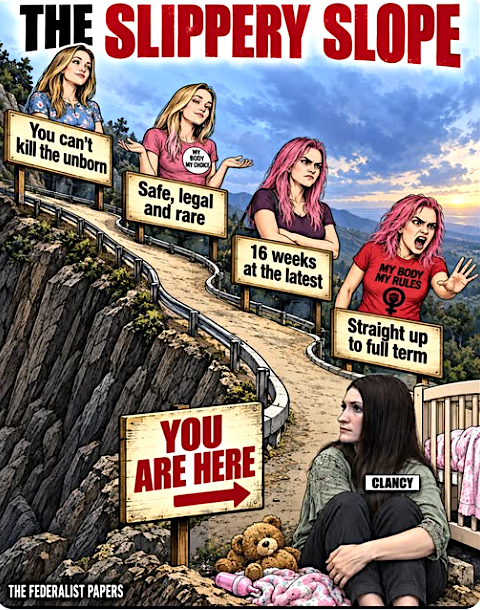
I wish I had the gust to post this on Facebook. And the fact that I know that it would upset so many of my long-time friends is itself an indication of how ethically warped the political Left has become. In fact, “ethically warped” is a euphemism for a far more damning and accurate term.
[This one is pretty funny too, but it’s not really an ethics meme…]
The recent discussion on the uselessness, and hence unethical nature, of advocating the impossible sent me back to Immanuel Kant. All Kant did was think and write: in 1795 he decided to muse about how there could be an end to war. Kant was not one to accept “Do something!”; he would always try to figure out what would or might accomplish the desired result. Of course, being a philosopher, he left it to others to execute his plan for the betterment of humanity.
His essay “Toward Perpetual Peace” proposes structural and moral conditions necessary if war is going to be eliminated from civilization. Kant, not being deluded, did not believe peace natural to humanity, rather he argued that peace must be carefully constructed through a clear legal framework. His six Preliminary Articles (immediate steps to prevent conflict) and three Definitive Articles (the long-term foundations required for permanent peace) were the magic formula.
The Six Preliminary Articles (Immediate Steps)
These are immediate prohibitions of legal, financial, and military conditions that make future wars inevitable.
1. No flawed peace treaties. No treaty of peace is valid if it is signed with a secret reservation or loophole that could restart a war in the future. A treaty must represent a genuine end to hostilities, not just a temporary truce.
2. Don’t treat states like property: An independent state must never be acquired by another through inheritance, exchange, purchase, or gift, because a state is a society of human beings with its own right to self-determination.
3. No standing armies, because, Kant argued, keeping standing armies threatens neighboring states and ensures a never-ending arms race, making pre-emptive wars more likely.
4. Governments must not create national debts to fund military buildup or foreign intervention.
5. No forcible interference in other nations, because violating a nation’s sovereignty is an offense against the independence of all peoples.
6. “Dishonorable tactics” during war must be banned. Atrocities that destroy the underlying trust required for future peace.
WSYX is the Columbus, Ohio ABC affiliate, and the reaction to that head-exploding tweet was so negative that the station took down the tweet as well as the article it was linked to. That doesn’t change the fact that to even suggest that U.S.schools shouldn’t teach the single most important event in the 21st Century and one of the most transformative events not only in U.S. history but modern world history is signature significance. To even ask the question demonstrates fealty to propaganda over truth, and a conviction that generations must be taught by withholding any information that might provoke non-conforming thoughts and belief.
The U.S. has a major broadcasting network—several, if we’re being honest— that employs people who want to manipulate the public, lying about the past through omission. Every now and then the aspiring totalitarians of the Left slip up and tell us who they really are. This is one of those times.
Yes, the 9-11 attacks should be taught in schools so Americans learn that Islam is not “a religion of peace,” and that unrestricted, unvetted immigration from Muslim nations poses an existential threat to our values, culture and democracy. It also should be taught in the schools because it is history, and those who want to obscure history never have good intentions.
[As an aside, my harsh response may have run off commenter kawaii65c843be72after he compared the Left’s tearing down statues of Confederate generals with the fact that there are no statues of Hitler’s henchmen in Germany. I certainly hope so.]
[Note: I am abashed that over the years Ethics Alarms has neglected formal ethics theory far more than it has focused on it. Thus I was thrilled to receive this excellent guest post, submitted by faithful Ethics Alarms reader James Rogers. JM.]
It is evident to many, perhaps even a majority, that we have been living through and are still in a substantially unethical period in US and world history. How can we objectively determine if this is true? The multiple ethics train wrecks highlighted by our blog host is certainly one. Another reasonable and slightly less subjective method would be to consider how an eons-old founder of our civilization measured ethical people and behaviors generally and in the realm of politics.
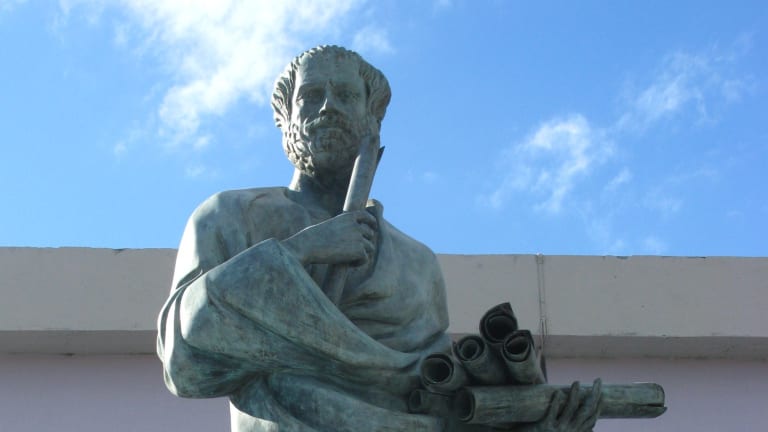
Recently, I took the opportunity to read two books on the matter by Aristotle (4th Century BC), ‘Nichomachean Ethics’ and ‘Politics’. In those readings Aristotle directly addressed both the individual and societal perspectives on ethics and ethical government. This perspective has additional appeal as it isn’t tinged by modern religious biases.
Since we are humans, tackling individual ethics seems foundational as societal ethics comprises humans behavior and interactions regarding governance and broader economic and social commerce. Starting there, Aristotle points out there are three essential reasons for human action:
Pleasure (personal gain or goal achievement),
Honor (public recognition, affirmation, or reputation), and,
Virtue (for the benefit of another or others though it may also benefit you) without expectation of any recompense or acknowledgement.
These are universal in our human motivations, regardless of a person’s status, wealth or education.
Finding a truly or purely virtuous person or people to interact with is more than tough to find. In fact, it is fairly certain that person or set of people do not exist. Potentially someone independently wealthy, who needs nothing, who simultaneously is pursuing virtue is possibly out there, but it would be more than challenging to find and identify them. If this is an accurate assumption, the human race is likely facing tough choices individually, as they strive to be virtuous themselves while finding others to engage with who will behave, at least in part, virtuously. As a result, we often make our own personal ethical compromises and also in our associations.
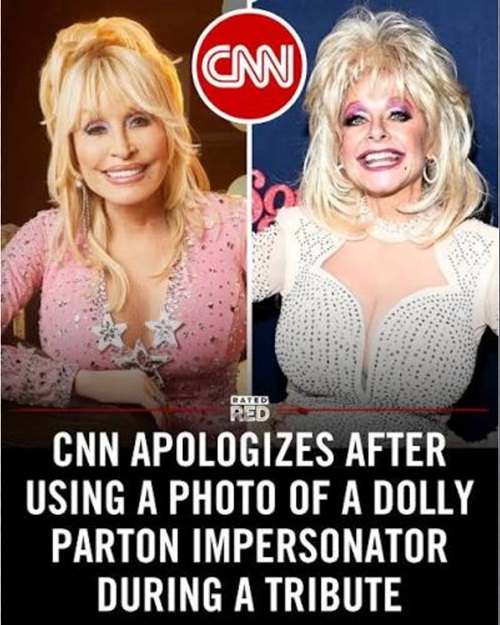
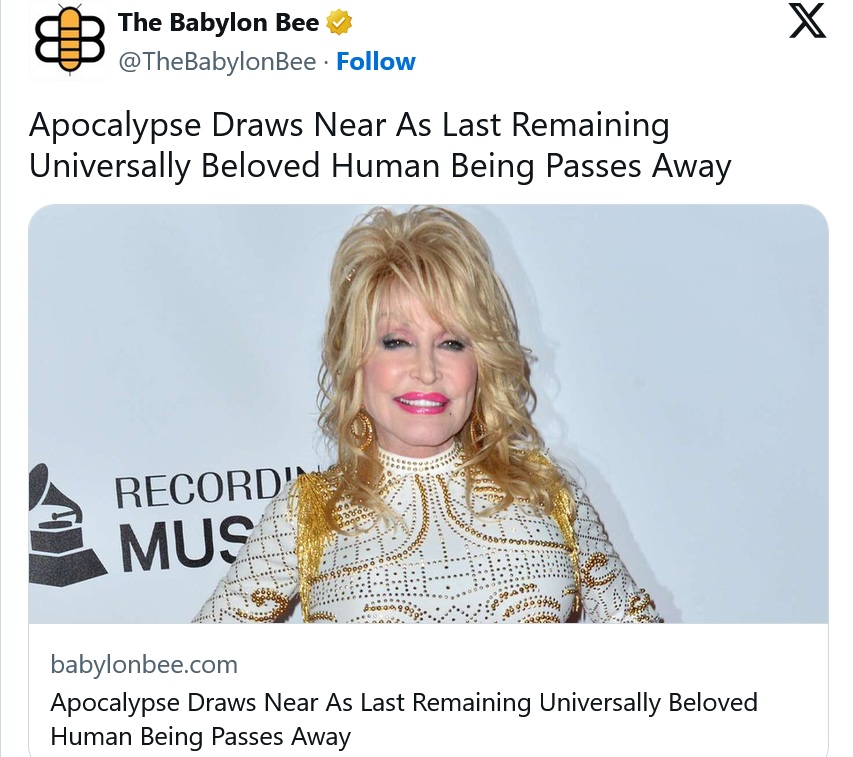
[This is CNN! I had to find an excuse to post this, but it is relevant to Paragraph 7 below.]
All over Facebook, my Trump Deranged friends have been egging me on to stuff their metaphorical heads up their metaphorical asses after they have used Dolly Parton’s demise to justify their own biases. My favorite was the one that began, “I don’t want to talk about Trump, but isn’t it interesting that the vile, bigoted asshole wrote nice things about Dolly even though she was woke and an LGBTQ supporter.”
Note: This woman doesn’t want to talk about Trump, but immediately turned an appreciation for a recently deceased, non-political country music superstar into an excuse to attack the President.
Remind me: how did I end up with so many friends like this?
Lie #1: Dolly Parton was not by any stretch of the imagination “woke.” She consistently refused to take political or culture war positions. “Live and let live,” “Trust in the Lord,” Love your Neighbor” are not woke talking points.
Lie #2: She was not an LGBTQ “supporter” other than to say she loved everyone. Claiming that Parton was a member of the Pride mob is now a viral near consensus on Bluesky, Instagram and Facebook, and even the bots on Google and “X” will confirm that non-fact. It’s the reverse of “If you’re not for us, you’re against us”; in Dolly’s case, that she didn’t support active bigotry against gays etc. and believed they should have the same rights and acceptance as everyone else, made her an LGBTQ+ activist.
Let’s examine this one a bit more. shall we? Dolly Parton never directly advocated same sex marriage. She once joked about gay marriage, “Why can’t they be as miserable as us heterosexuals in their marriages?” Bob Hope might have made that joke. (Maybe he did.) Bob was not “woke.” She gave the obligatory lawn sign pablum “I think love is love and we have no control over that” when pressed. I guess she also supported the Man-Boy Love group, then. “I think people should be allowed to marry,” was another of Dolly’s carefully worded ambiguities. Donald Trump’s comment was, “I have no problem with the gays.” Did that make him “woke”? An LGBTQ activist?
As you must know by now unless you have been in a submerged submarine with a broken communications system like the one in “Crimson Tide,” Dolly Parton died yesterday at 80. Why her death is being described as a shock is a mystery: as my father said when he hit 80, “It’s the Red Zone, son. I can kick off any second from here on!” Nonetheless, the public and official outpouring of grief, love and admiration is unlike anything we’ve seen at least since Princess Diana’s demise in 1997.
The tectonic reaction is certainly not based on Dolly’s singing, acting or song-writing. Personally, I was never a fan; Dolly’s singing voice always sounded to me like someone who has inhaled helium. Her songs were pleasant but unremarkable to my ear. As an actress, I place Dolly Parton in the large category of experienced public performers who can project their own personalities effectively into roles and stories where their personalities seem appropriate, a diverse group that ranges from the late Fred Thompson to the late Bob Newhart to the not-quite-late Ringo Starr.
Clearly, the reason Dolly is being mourned so vigorously is that her public persona was entirely benign, virtuous and lovable, even aggressively so. She literally gave nobody any reason not to like her. In 2020, as the Great Stupid was grabbing American society by the throat, Hollywood producer Rob Long wrote an appreciation of Dolly in “Commentary” exploring her universal popularity. He wrote in part,
Troy Jackson, the latest un-democratically selected candidate being offered to the public by Maine Democrats, is the Great White Male Hope for the unprincipled party as it tries to take over the U.S. Senate “by any means necessary.” You will recall that he became a necessary means after much-heralded lying, Nazi woman-abuser Graham Platner was revealed to be…well, a lying, Nazi woman-abuser. Oopsie!
Jackson has little in his record or character to suggest fitness to serve as a U.S. Senator, but what conservative critics are focusing their fire on is this, as the New York Post reports:
“Maine Democratic Senate candidate Troy Jackson is in a long-term relationship with his high school sweetheart — who is also his second cousin, according to a new report. Jackson, 58, and Lana Pelletier share two adult sons and the same great-grandparents, according to Thursday’s report by independent journalist Steve Robinson, who notes that such relationships are both legal under state law and not uncommon in the rural North Maine Woods region, near the Canadian border.While Jackson, a onetime logger and the former president of the Maine State Senate, has described Pelletier as his wife in the past, locals tell Robinson the couple has never been legally married.
“Jackson grew up in the village of Allagash (population 237 as of the 2020 census) and attended nearby Fort Kent High School with Pelletier.According to geneological records unearthed by Robinson, Jackson’s maternal grandmother — Albertine Pelletier O’Leary — and Pelletier’s paternal grandfather — Louis A. Pelletier Sr. — were siblings, making Jackson’s mother, Colleen McBreairty, and Pelletier’s father, Louis Jr., first cousins.Since 1985, Maine law has prohibited marriages to an individual’s parents, grandparents, children, grandchildren, siblings, nieces, nephews, aunts, or uncles.”
Your Ethics Alarms Ethics Quiz of this Weekend:
Is this a legitimate campaign issue?
Legal Insurrection concludes, “All Maine Democrats had to do after Platner dropped out was find a normal person to take his place. It’s amazing that such a simple task was a challenge.” The conservative site reposts many contemptuous tweets, such as conservative pundit Jim Treacher’s…
OUT: Third Reich
IN: Second cousins
and Stephen L. Miller’s “The plan? We convince them to drop an abusive Nazi and then replace him with someone married to his own cousin.”
My view? I find this the kind of right wing “gotcha!”pearl-clutching that loses conservatives credibility. It’s mainly (Mainely?) Ick rather than ethics. He didn’t marry his cousin, he sort-of married his second cousin, which isn’t illegal incest in Maine or as far as I can find, anywhere else. Franklin D. Roosevely married and had children with his distant cousin (you’ll notice that they had the same last names). Thomas Jefferson and John Adams married third cousins; John and Abigail’s line was eventually stuffed with geniuses and high achievers. I have a long-time friend (well, she used to be a friend until Trump Derangement caused her to cut me off, and I was a particularly good and generous friend…grrrrrr!) who chose her first cousin as her third husband, which my late wife found disgusting. They were past the children stage; I found it interesting but hardly scandalous.
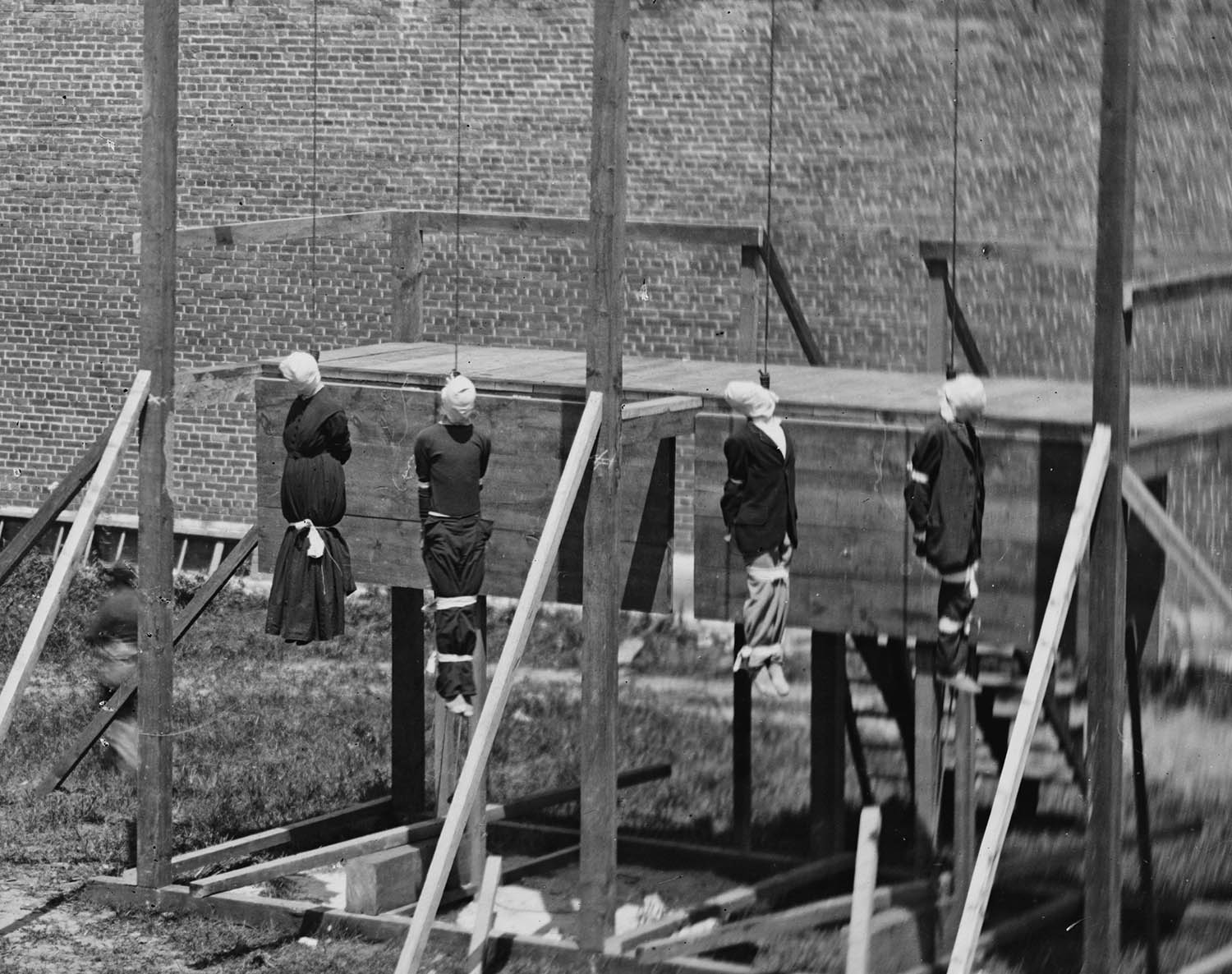
(That’s a famous photo of the execution of the John Wilkes Booth’s co-conspirators)
Ah, the ethical delusions of the woke and biased!
ProPublica is another one of those supposedly “non-partisan” watchdogs that somehow only finds the conduct of Republicans and conservatives worth criticizing, with enough rare exceptions to let them say, “But what about…?” to rebut that verdict sufficiently for those who aren’t paying attention.
Being reflexively progressive, ProPublica has long been an opponent of capital punishment, though the position is misplaced absolutism. Now it announces, “Early last year, Gov. Ron DeSantis began signing death warrants at a faster rate than ever before. What followed was the most intense period of executions the state has carried out in more than eight decades.”
This supposedly horrific “period of executions” meant that a grand total of 19 murderers who had forfeited their rights to live in a civilized society were dispatched instead of being kept alive at taxpayer expense. Let’s look at the killer ProPublica picked to have us weep for in the first half of the long article: Frank Walls, whom Florida executed last year.
Walls committed his first murder on March 26, 1985, at the age of 17. He noticed 19-year-old junior college student Tommie Lou Whiddon sunbathing at the beach, went over to her and slashed her throat. Walls then stole her car. Whiddon’s body was discoveredthe next day lying in a pool of blood on the beach. On September 16, 1986, he killed 24-year-old Cynthia Sue Condra by stabbing her 21 times. He left her body on the side of a road.[4] On May 20, 1987, Walls broke into the mobile home of 47-year-old Audrey Gygi. Walls raped her, left, but later decided to come back and murder her.He stabbed her to death, stole a fan and a radio, and left her nude body to be found after she failed to show up for work. On July 22 that same year, Walls committed a double murder. He broke into another mobile home inhabited by 22-year-old airman Edward Alger and his girlfriend, 20-year-old Anne Louise Peterson. Walls forced Peterson to tie up her boyfriend, then tied her up as well. Alger managed to get partially free and attacked Walls. In the fight, Walls cut his throat with a knife, but Alger bit Walls on the hand, causing him to drop the knife. Walls then shot Alger three times in the head. After sexually assaulting Peterson, he shot her in the head too, and when the first shot didn’t kill her, Walls put a pillow over her face and shot her again, killing her. The couple’s bodies were found the next day.
The story, as is de rigueur in such sobfests, is told from the perspective of death penalty activist Father Dustin Feddon, who has nothing better to do than “administer” to condemned prisoners like Walls. ProPublica never informs its readers of the details of why Walls was on Death Row. It just arrays the usual anti-death penalty rationalizations:
Once again, the position at EA is that the Pope—it doesn’t matter which Pope—is unethically abusing his authority and serving as gum in the works while fostering confusion when he presumes dictate national policy based on idealism and utopianism
A guy I never heard of who was an executive editor of The National Catholic Reporter and who, we are told, “directed coverage of the conclave that elected Pope Leo XIV,” was awarded an op-ed in the New York Times (Gift link, though it’s not much of a gift) to explain why he thinks the Pope thinks that “the age of artificial intelligence undermines the moral criteria for just war.” Ramalama ding-dong! Why is anyone listening to guys who have the luxury of dealing with the abstract and never having the responsibility of keeping a nation and a population safe and secure as they pontificate about the right way to do it? Why is anyone reading the analysis of an obscure functionary who has also never had to face the harsh human, military, geopolitical and practical realities of war as he rationalizes the basis for a Pope’s irresponsible interference with serious international matters?
The New York Times has demonstrated beyond a shadow of a doubt that it is fully committed to undermining President Trump, his policies and his popular support. The “just war” blather, another phase of arguing how many angels can gather on a pinhead, suddenly became useful to the Axis of Unethical conduct when it wanted to root for a murderous, anti-Christian Islamic regime while it was fighting the United States of America. Popes never support wars, and it isn’t news when the Vatican condemns one. Infamously, the Vatican refused to take sides in World War II, or take any substantive steps to try to end the extermination of Jews in Europe. Now the Pope doesn’t think a war that has among its goals making as certain as possible that Iran doesn’t have the ability to do what it has been promising to do for decades—destroy Israel— is a “just war,” or to be more precise, that we should redefine “just war” to eliminate Israel’s and the U.S.’s justification for neutralizing Iran.
It’s especially appropriate to ponder this phenomenon today, because the manufactured “Black Independence Day” holiday with the obnoxiously precious name “Juneteenth” is one of the most glaring examples.
However, the focus of this post is “Pride Month,” when everyone is supposed to say “Yay!” about what special people do with their hoo-haas as long it doesn’t square with conventional mores or biology. We’ve already discussed some of the more annoying examples of this pandering, as in this post, and certain organizations’ unethical (but not illegal) efforts to punish individualists who object to being forced to celebrate something their faith, good tatste or brain cells tell them shouldn’t be celebrated. To choose an analogous example, baseball players shouldn’t have to promote masturbation on “Masturbation Day” because masturbation enthusiasts banded together and bullied the teams into the promotion
Two ethics tales on this topic:
1. A flag comes down.
It is an ethics tell that some of the groveling organizations find themselves under attack when they finally decide not to grovel.
For the first time in the history of Webster, New York, on June 1 the Rainbow flag at went up the flagpole at the Town Hall and Webster issued a “Pride Month” proclamation. Republicans on the town board, however, voted to adopt a policy that limits flags flown on town property to Old Glory and New York state flags. The “Pride” flag came down after just four days, and LGTBQ bullies and their supporters freaked out. Protesters screamed at the flag removal. One woman shouted that the flag coming down would get children killed.
This is the predictable result when a special benefit adopted for a specific purpose at a specific time in a specific context no longer is appropriate, and therefore is ended. The end of a positive for the affected group is immediately and deliberately treated as a rejection, so the special status must remain in perpetuity. The LGTBQ community is no longer closeted nor widely discriminated against, nor treated as second class citizens. If that community has to have its “flag” flown over government property, what group doesn’t have a claim that their tribe warrants equal status? Notes Victory Girls,
“The American flag does not belong to one political party, one religion, one race, or one sexual orientation. It represents every citizen equally. Gay Americans are not excluded from that symbol. They are included within it, just as every other American is. That is why many people are perfectly comfortable with government buildings displaying the American flag and little else. The flag already represents the entire community. It does not become more inclusive simply because someone hangs extra flags next to it. Nothing about Webster’s decision prevents anyone from advocating for LGBT causes. People remain free to organize events, hold rallies, raise money, celebrate pride month, wear rainbow clothing, and express their views publicly. None of those activities depend upon a town hall flagpole. That is what makes some of the reaction so curious. A movement that enjoys widespread corporate support, extensive media coverage, political backing, and cultural prominence should not be endangered by the absence of a single government-displayed symbol. At some point, the demand stops looking like a request for acceptance and starts looking like a demand for official endorsement.”
It starts looking like that because that is exactly what it is. Days later, the American flag at Town Hall was discovered at the bottom of the flagpole, and a Rainbow flag was flying far above it. U.S. Flag Code dictates that no other flag should be flown above the American flag when they are displayed together. The vandalism was addressed, and currently the American flag is the only flag flying at Webster Town Hall, with padlocks added to the flagpole.
The result of groveling to various tribes, splinters and interest groups is that their members come to regard division as more important than union, and eventually other sectors demand equal submission.




 Ethics Alarms