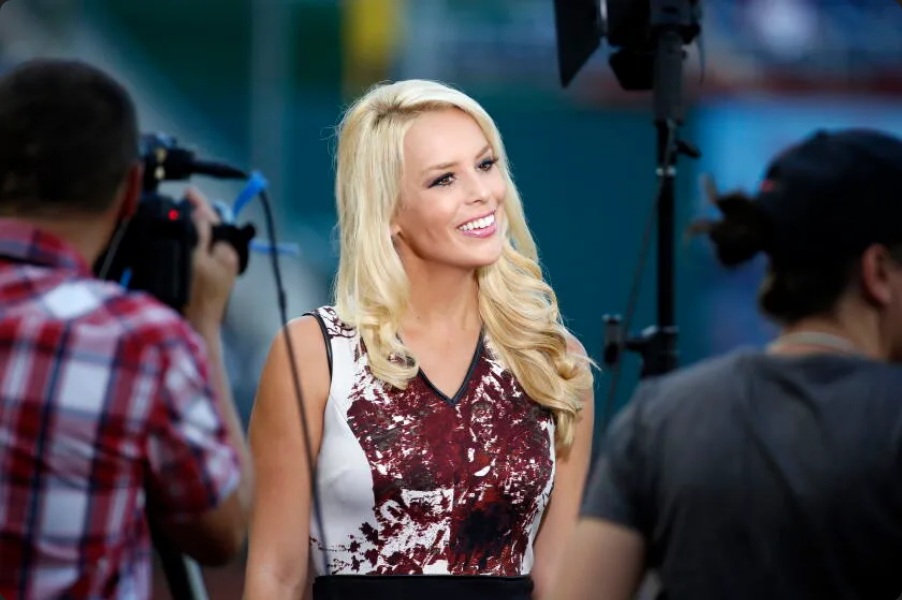
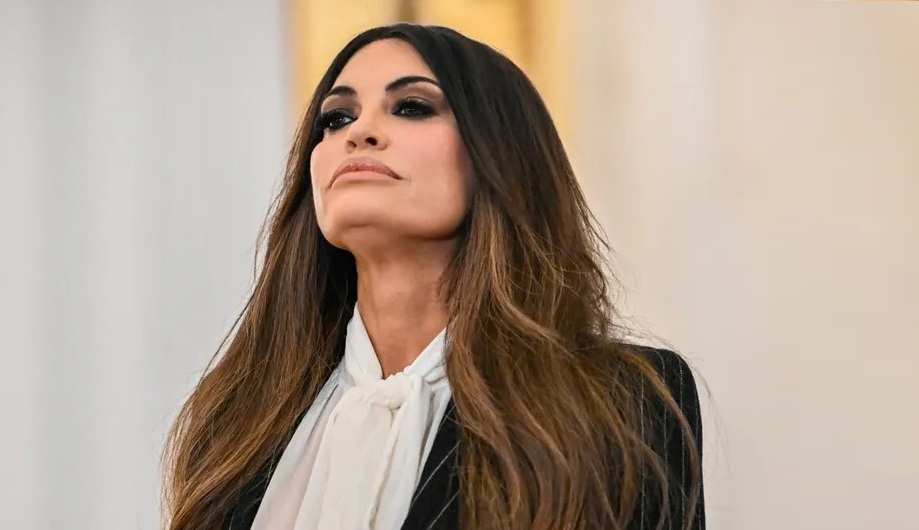
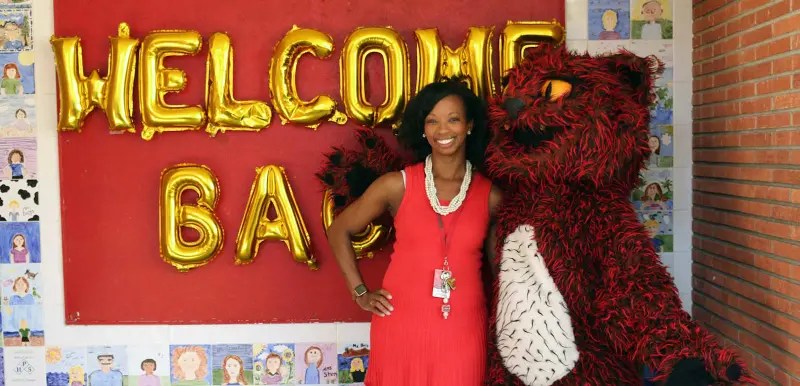
Wait, isn’t that Kristi Noem? No, too young; it has to be Pam Bondi, right? No? It can’t be Kimberly Guilfoyle, she’s a brunette. I’ve got it: that’s Katie Zacharia! No?
I don’t know about you, but I’m pretty sick of this pattern. The Biden administration may have put a lot of incompetent, unqualified women in various positions based on DEI bias, but hiring women because somebody thinks they are hot and have sexy hair is just as unethical, and arguably even worse.
“MAGA Barbie” is a derisive moniker these days used to describe Indiana Fever WNBA guard Sophie Cunningham, but she’s actually very good at her job (playing women’s pro basketball) as well as her avocation (calling out the racist, anti-white lesbian thugs in her league and reminding the public that biological males have no right to play women’s sports). I think it would be wise to apply expand the employment of the term to professional bimbos like former ESPN reporter and Fox News personality Britt McHenry, who was just fired as a US State Department press adviser.
How hard is it to behave in a dignified, professional fashion when you know you represent the United States and also know that everyone has a camera at the ready to record your behavior in public? Too hard, I guess, for people like McHenry—you know, morons.
McHenry, 40, was hired as the Trump State Department press adviser covering Europe and Africa. Despite the fact that she also was responsible for handling press for Kimberly Guilfoyle’s text message scandal (Heluva job, there, Britt!), she was promoted three days ago to a new job managing External Affairs & Press for Under Secretary Jacob Helberg’s team. Then she did this, according to the New York Post:
[From your host: Something’s in the air. Today’s opening post featured a long list of “antis” and this recently submitted guest post by Steve Witherspoon also built to a similar array, with neither of us being aware of the other’s text.I almost posted on the “Is we getting dummer?’ story that triggered Steve’s essay then, like him, I decided that the revelation was superfluous.]
The first thing that popped into my mind when I read that there was a website “purporting to feature a recent ‘major study’ showing that Americans were getting dumber” was , “Someone actually thought the public needed some kind of major study to figure that out?” I wonder how many of our tax dollars were spent via federal and state grants to come up with that shocking new major study that anyone with a shred of common sense, critical thinking skills, and basic power of observation could have deduced?
Seriously, who didn’t already know that Americans were getting dumber?
Personally I think that using dumb (stupid, unwise, or lacking good judgment) and stupid (a lack of intelligence, poor judgment) have been a little overused in the 21st century. It’s not that they’re generally incorrect, I just think their overuse has undermined their cultural and literal value, much as using the word racist or fascist has over the past two decades. When words are not used as literally intended but instead become targeted insults to deflect from a specific topic(s) and shut down unwelcome discussion, their communication value is degraded. Thus we see ignorant anti-American bigots (people who are stubbornly, unreasonably, and utterly intolerant of people, beliefs, races, religions, genders, sexual orientations, or political views that differ from their own) using damning insults to crush speech and opinions that may impede their agendas.
The word we should be using to describe what’s going in our society is “ignorance,” which is lacking knowledge, education, or awareness about general topics or specific subjects. Narrowing the focus a little bit more, “willful ignorance,” exemplified by the “don’t confuse me with facts” reflex, is apt. “Indoctrinated ignorance” is better still.
We are seeing across the USA multigenerational indoctrinated ignorance that has targeted our entire system of education. Downstream from educational indoctrination are our social interactions, which infect and affect just about everything. They are like poisonous tentacles into our culture. Once, most ignorant people knew they were ignorant: they had made a choice to learn just enough to make them reasonably effective in their chosen niche in life, they put what they actually knew to some kind of productive use, and moved on with life learning what they needed as they went along. What we’re seeing now are Americans so indoctrinated into their ignorance that they don’t know they’re ignorant. They think they’re smart; they think they’re always correct, and that everyone should listen to them.
How did we get here?
Many years ago, Charlotte Thomson Iserbyt warned about the impending demise of our society, both culturally and politically, in her book “The Deliberate Dumbing Down of America.” Iserbyt recognized the process taking place in the conglomeration of schools, the centralization of school districts, and what the Departments of Education both in the federal and state governments were likely going to do to public education and subsequently to society. She concluded that the public was willingly relinquishing the power of education to a few chosen people who were taking advantage of that power by embedding political correctness and participation trophy mentality into the minds of generations of children while intentionally lowering education standards to the lowest common denominator.
President Trump posted an AI-generated video last week that showed him chasing, tackling and befriending a Siberian tiger, obviously inspired by the horrible incident at the Yorkshire Wildlife Park in Doncaster, England where a mentally disturbed young man, William Chapman, entered a tiger enclosure and was mauled to death. Trump posted the fake video, which was accompanied by The Tokens classic, “The Lion Sleeps Tonight.”
That might be excusable for a junior high school student today, but since a man died in the tragedy it should be obvious to anyone at least as mature as Ralph Malph that the video is in terrible taste, and would be even for a sanitation worker. This is the President of the United States posting such junk, however. I don’t care if it’s “trolling,” or if it’s ‘just a joke,” no American can feel secure and confident about the leader of their nation when he acts like that.
What’s wrong with him? Whatever it is, it’s been wrong with him for a long time, and he’s clearly not going to get over it. The same instinct that served Trump well when he did his McDonald’s bit during the campaign undermines his authority, trust and support when he slips down several notches to this, having fun with a the death of a troubled man. I’ve been trying to imagine any previous POTUS who, given the technology, would behave similarly in his most rash and irresponsible moments. There isn’t one. Reagan, Lyndon Johnson and even Calvin Coolidge were known to play practical jokes on friends and staffers. Silent Cal was fond of pressing his desk buzzer to summon Secret Service agents and then hiding under his desk. But none of them would think posting the tiger video was wise, or anything but harmful to both the office and Trump’s policy agenda.
I’ll take this opportunity to comment on the “No Kings” protests yesterday. Several friends posted photos of themselves, family members and others embarrassing themselves, apparently unaware that anyone, like me for example, would conclude that their participating in this foolishness reflects terribly on them all. It does seem that the majority of these protesters are seniors, and I suspect that many of the geezers participate out of boredom. They meet other wokified, Trump Deranged Democrats, and maybe hook up for a canasta date or an early dinner at Ruby Tuesday’s.
I sure hope that’s the reason, because I care about some of the people participating in these rallies, and I have to fight myself tooth and nail to avoid losing respect for them completely.
UPDATE: Literally minutes after I posted this, I saw reports that she is “transitioning” out of the White House Press Secretary role. Good.]
***
There’s no excuse for this.
The new details on the latest White House paid liar’s misrepresentation of herself as a “lawyer” or “attorney” make her (and the decision to appoint her) appear worse and worse; she’s either a fraud or an idiot. In either case, she has lost all credibility. A paid liar must have credibility, as strange as that sounds.
Katie Zacharia confirmed yesterday that she had never passed a bar exam or and has never been an “attorney.”Then she claimed that she had not misrepresented her legal career by saying she “is” a lawyer. As I have explained already, she’s not. If many members of the public—you know, morons—think that a JD or LLB degree means one is a lawyer, that doesn’t excuse the holder of a law degree thinking or saying that. “Lawyer” means one can act as a lawyer—Duh!—and a mere law school graduate cannot. It is against the law for such a person to practice law, which is what lawyers do—again duh.
In interviews with The New York Times and Real America’s Voice, Zacharia said she had consulted Pepperdine’s president and “others” about how to describe her qualifications before appearing on television, and was told she could use the term “lawyer,” but not “attorney” or “esquire.” Zacharia hasn’t said which “president of Pepperdine” advised her. She graduated from law school there in 2011. Andrew K. Benton was the university’s president at that time. In 2019, Jim Gash became the president told the Times that he was not the one who advised her, though he did call her “a young woman of high integrity.” You know, a a young woman of high integrity who represented herself a lawyer without having a law license. Gash’s representative said “he does not comment on private conversations,” but a statement from Gash said: “Pepperdine is proud to count Katie among our alumni, former colleagues and friends. As she takes on this significant responsibility, we pray that God will grant her wisdom and courage. We look forward to seeing her use her incredible gifts and extensive experience in service to our nation.”
Got it. A non-responsive answer. A law degree from Pepperdine isn’t worth the paper it is printed on, and the school’s presidents are cowards and suck-ups.
Democratic candidate for the U.S. Senate in Texas James Talarico, in response to a questioner (a Catholic theology professor) during CNN’s “town hall” featuring the Texas House member and divinity school student (he has yet to graduate despite starting at the Austin Presbyterian Theological Seminary in 2018.
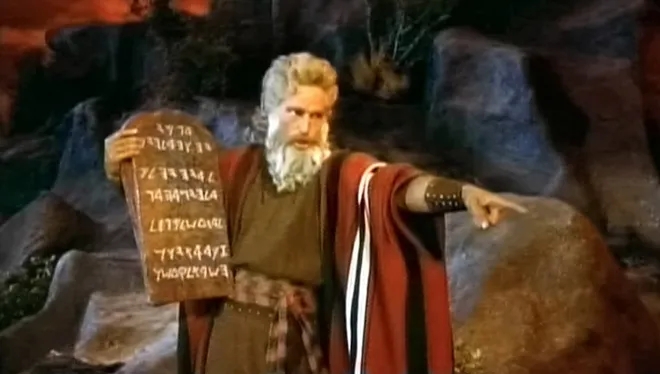
The answer was appropriately contradicted by the questioner, Jody Hunt, who shot back, “I just want to add that the Bible is not silent on abortion. There is the 10 Commandments: ‘Thou shall not kill.” She added, “And as Catholics, we take great insult, I guess sometimes, when [the Bible is] described that way.”
It didn’t take a theology professor to come up with that response: a relatively astute 12-year-old who has seen “The Ten Commandments” should be able to do it. Talarico’s answer is not only a lie, it’s offensive. This is the “invisible baby” dodge again. No one, nothing, is being killed! Abortion just involves the woman. It’s a choice, not a killing!
Talarico lied and flip-flopped throughout the session, with no push-back from the moderators. (“This is CNN!”) He denied saying that he wanted to abolish ICE, but Talarico is on video saying “It is time to tear down this secret police force.” Asked about the SAVE America Act, he said that he didn’t know enough about the bill to have a firm opinion about it. In August, he said, again on video, “With the SAVE Act, they are trying to rob our neighbors, strictly our black neighbors, of those God given rights.”
That’s a lie too. Just as Bernie Sanders assured radical progressives that Kamala Harris was just pretending to be moderate to get elected and then would show her true colors (you know, like “moderate” Abigail Spanberger in Virginia), Talarico’s woke pastor has said of her devout flock-member, “I can guarantee you that once he gets elected, he’ll change his tune back to where he was.” Have I mentioned that Democrats cheat?
Talarico isn’t even good at lying. I bet Bill Clinton is embarrassed for him.
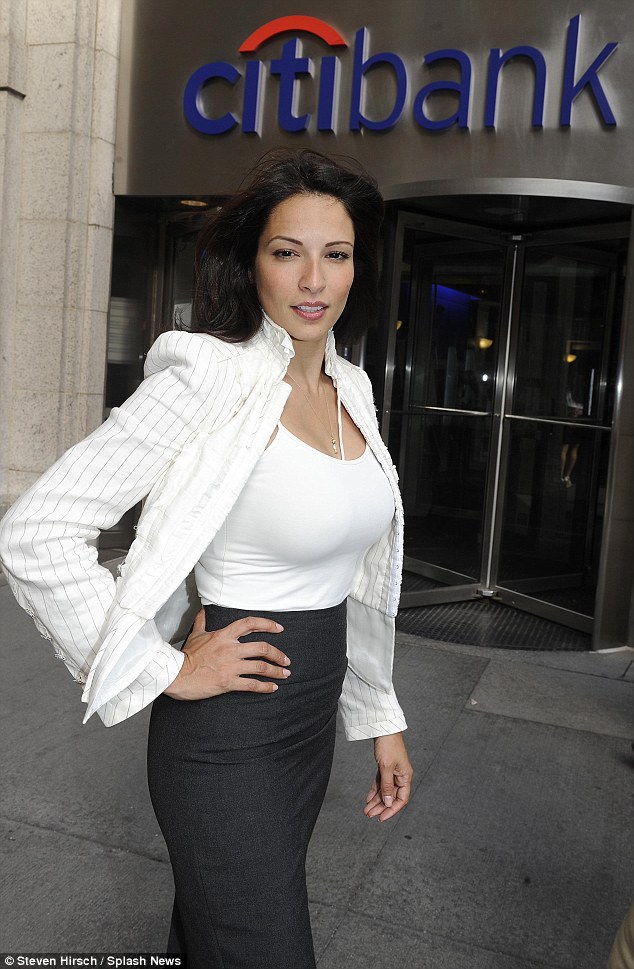
Beginning with a quote from the post, Cees Van Barnevelt delves deeper into the issue. Her comment also reminded me of the Debrahlee Lorenzana affair, which I wrote about way back in 2010. [That’s Debrahlee above.] She was a Citibank employee fired because she was deemed to be dressing too “provocatively.” She sued and lost. The post discusses some ethics issues germane to Cees’ Comment of the Day on the post, “Stop Making Me Defend Shawn Gillis!”
***
No, Gillis’s point, and he is accurate, is that many women at co-ed gyms dress to attract the male gaze while the official narrative is that they are just “expressing themselves.” “Observational humor” is supposed to reveal taboo truths.
Women at the gym may dress to attract the male gaze but not from every male. If the wrong man (unattractive to her) looks at her one second too long it may cause problems for him (complaints to gym management, public shaming).
Gym influencer Joey Swoll has many TikTok videos shaming women in tight clothes filming themselves, publishing the video at TikTok while shaming the men who walked into that video looking one second too long; these men might have looked wondering why somebody was filming at the gym!
At work you have a similar dynamic. Recently there was a TikTok generated trend of dressing up as an “Office Siren”, with women wearing clothes more suitable for a night club. This trend is getting people fired (e.g. dress code violations, risks for sexual harassment claims).
Shaming men for the “male gaze” and excusing women who dress inappropriately has undesirable social effects. Males are getting overly cautious around women, to protect themselves from creep shaming and claims of sexual harassment. At work this may mean that women have trouble receiving one-to-one mentoring from male colleagues who do not want to be alone with a women in one room. At the gym men do not volunteer to help a women who is stuck under gym equipment. A women gets a heart attack, and a man thinks twice about doing CPR or using an AED considering the potential for accusations. Men are getting afraid to ask a lady out in person, do to the potential for creep shaming and #MeToo accusations. You can lament about the dating crisis and the loneliness epidemic; shaming men for being and acting like males is one of the main causes.
Meet Jaime West, a Democrat running for Fayette County Council in Indiana.
I am not at all sure this is the “most embarrassing clip” from a Democratic candidate interview, but her smug demeanor does make West a contender for Dunning-Kruger victim of the decade.
Professional kudos to the interviewer for not dissolving into giggles.
President Trump has “asked” the ludicrous Ambassador to Greece, Kimberly Guilfoyle, to resign, says Katie Zacharia, the new White House Paid Liar.
Good, sort of. This political grifter should never have been appointed in the first place, and never should have been confirmed when she was. She was a solid bet to become a walking, talking black eye to the Trump Administration and the U.S. and sure enough, that’s what happened. Never mind! Appointing assorted incompetents, narcissists, liars, crooks and scumbags isn’t this President’s worst flaw, but it is a bad one. It is also one that he’s never going to shake.
It is true that sending incompetent, corrupt and persons of otherwise dubious character as ambassadors to nations that are allies and relatively stable is a tradition as old as Betsy Ross, but “Everybody Does It” is no excuse, especially when the practice ends up letting someone like Kimberly Guilfoyle represent the U.S. in anything more weighty than a pig-calling competition.
Her qualification for the job was that she is the former fiancée of Donald Trump Jr. She is also the former wife of Gavin Newsom, and I will eschew the temptation to expound on the significance of that. She’s a professional trophy wife.
Guilfoyle recently made headlines by asking Trump donor Eric Deters to wire $100,000 to her American Express account. “She was so desperate for that $100,000. It was a quid pro quo,” Deters said in an interview with NBC News. “She said I could ask her for anything and everything in Trump world. There was no request too big.”
Anything?? When an infamous bimbo like Guilfoyle says that…well, the imagination runs wild. My imagination, anyway. Too bad about the cosmetic surgery, Kim.
“We have asked Ambassador Guilfoyle to resign,” Zacharia said during her first briefing yesterday. “She has been a wonderful asset to the team, and we wish her well.” What a debut! Three lies in 21 words:
Being asked to resign by POTUS is being fired.
She has been a festering sore on “the team” and everyone knows it.
They wish she would sink into the earth and stay there.
So should we all.
***
This Kimberley’s resignation statement, posted on Twitter/X:
Arielle Curry, the principal of Washington Elementary School in Santa Barbara (she’s the one on the left) rigged the vote count in the student election results to elect two losers, including giving her own daughter the post of sixth-grade president. The principal was foiled by a whistleblower, put on administrative leave, and then, incredibly, allowed to resume her job.
Take that last part in slowly. This is the culture in schools. This is the culture in California.
In a letter to parents, Curry wrote that she ” led deliberations after the student votes were tallied that resulted in overriding the outcome of two positions.” She apologized “for allowing this practice to persist” while acknowledging that “our school’s process for selecting student officers lacks transparency and fairness.” She added, “I am committed to making this right moving forward.”
By resigning? Nothing else will do.That letter is all by itself justification for dismissal. What disgusting weasel rhetoric! Altering vote totals to benefit a family member is “deliberations”? She allowed a practice to persist by engaging in the practice…it wouldn’t have persisted if she didn’t engage in it. The school’s process for selecting student officers lacks transparency and fairness? No, she lacks transparency and fairness, also honesty, respect for students, shame, trustworthiness,accountability, and ethics generally.
There are tangible benefits in being elected a student officer at the gifted and talented education magnet school in Santa Barbara’s Mesa neighborhood. Student government members receive privileges like leaving class to attend meetings, while the president gets the opportunity to deliver the graduation speech at the end of the school year. The student body also helps select school activities, including themed events such as “Crazy Hat Day.” (Do they have a “Sociopath Principal Day”?
Cuury tried to steal these perks from deserving students and bestow them on her choices regardless of the election results. How can the school, the district, and the parents allow Curry to keep her job? What possible justification could they cite? (Don’t say it!)
“District officials confirmed the expected policy was for the actual vote totals to determine the winners” one news source says. Ya think? “The district expects that for student/ASB elections, the candidate with the most votes wins,” assistant superintendent for human resources John Becchio said. Really? Then why do you continue to employ a principal who doesn’t get the “most votes win” thingy?
Curry has worked in the Santa Barbara Unified School District for several years, previously serving as principal of Santa Barbara Junior High and as an assistant principal at Washington and Franklin elementary schools. This is how your young are being aculturated, America. These are the people shaping their conduct and values. Do you care? What are you going to do about it?
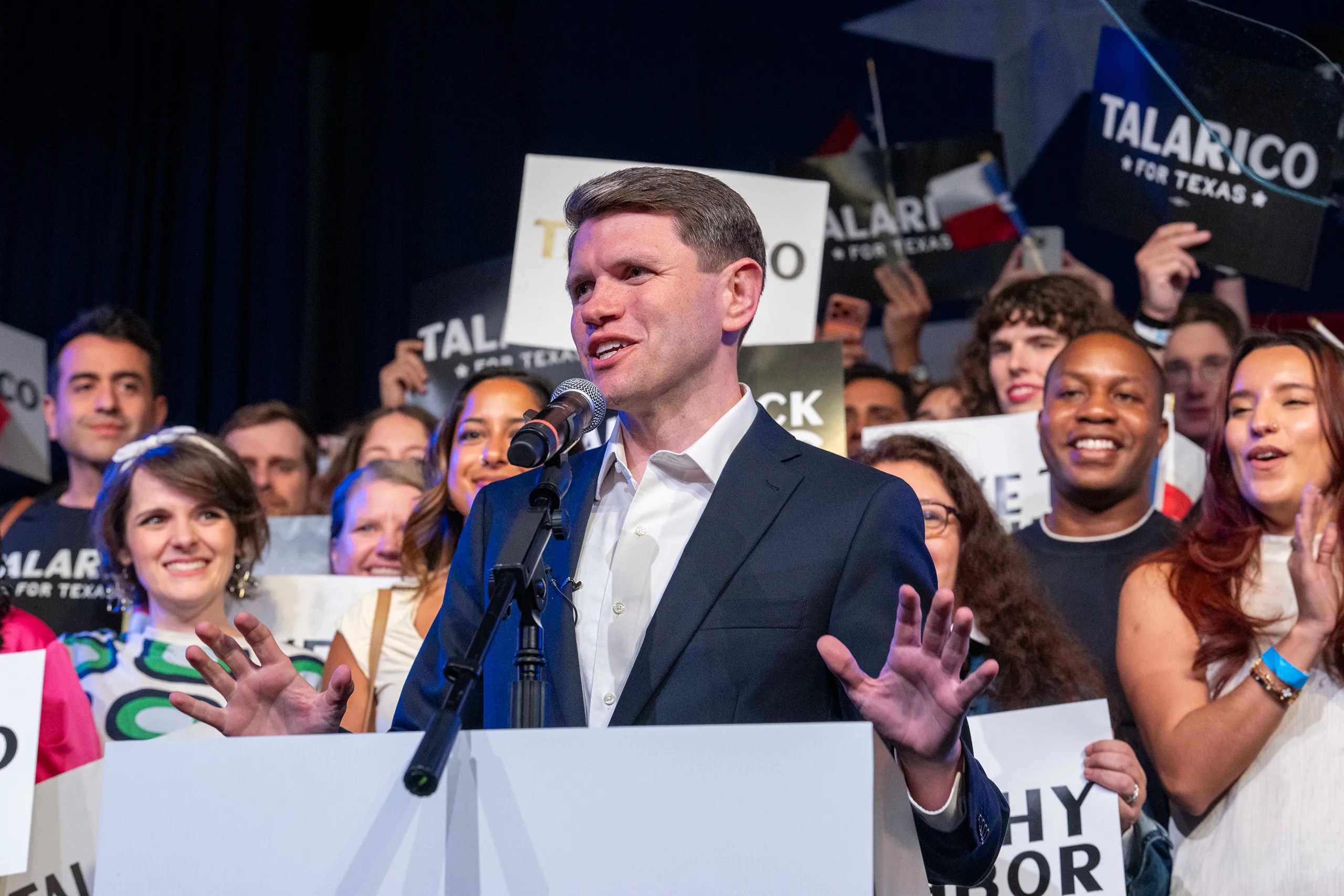
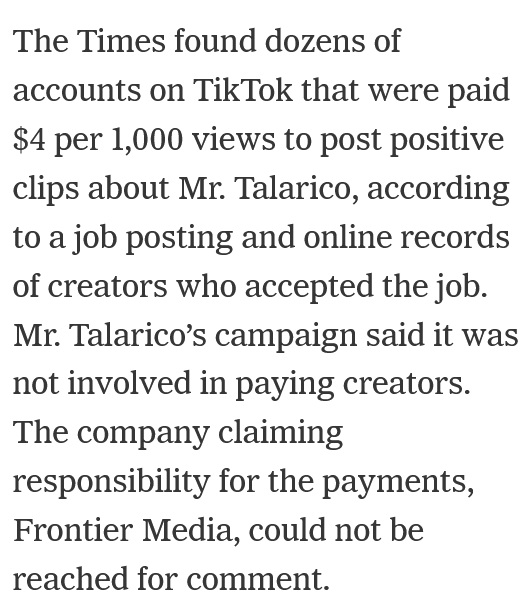
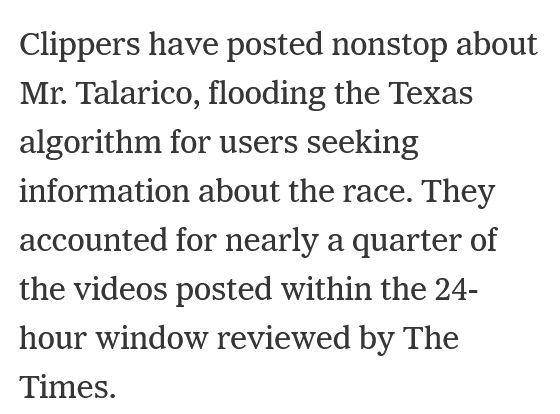
The New York Times revealed yesterday that a group called Frontier Media has paid TikTok “influencers” to post pro-James Talarico content on social media. Talarico is the Democratic challenger for an open Texas U.S. Senate seat deemed crucial to his party’s chanced of taking the Senate in November. But Talarico’s campaign told the Times regarding the discovery,
.
…so I guess they are as innocent as little lambs. You will recall paying for celebrity endorsements was part of Kamala’s “we go high” campaign strategy. Just for the record since I’m sure you don’t need to be told, this is lying. Such conduct falsely represents to the public that a trusted individual has independently concluded that a candidate deserves to be elected, while the payers do not reveal their influence and the payees don’t reveal their incentives.
This latest cheating to elect Talarico has surfaced nearly a month after an employee for a pro-Talarico PAC was caught on video explaining that the group was “paying people for their votes” through a “paid relational program.” The undercover video resulted in the employee’s firing (for getting caught).
Two related notes:
Lest you be overly impressed that the Times reported this story (“SEE?” I can imagine banned commenter and loyal Times bias-denier “A Friend” bellowing in his bunker), the paper buried the lead as best it could. The headline was “On Texas TikTok, it’s all about Talarico,” and there was no mention of the pay-offs until 18 screens into the article.
The Times piece also revealed that despite TikTok’s emergence as a social media power (and that young voters increasingly use it as a primary source of news), Republicans lag absurdly behind Democrats in using the videos as a marketing tool. Morons. Being slow to embrace technological and web innovations is how the party managed to lose the 2012 Presidential election. For these mid-terms Democrats have handed them so much ammunition that the GOP should be lapping them in the polls. “The Stupid Party” sobriquet remains as accurate as ever.