On Baseball Players Flipping “The Finger” To Obnoxious Fans

No, Bill Maher isn’t a professional athlete, but that’s my favorite graphic of a celebrity middle finger. Besides, it reveals Bill’s essential ugliness.

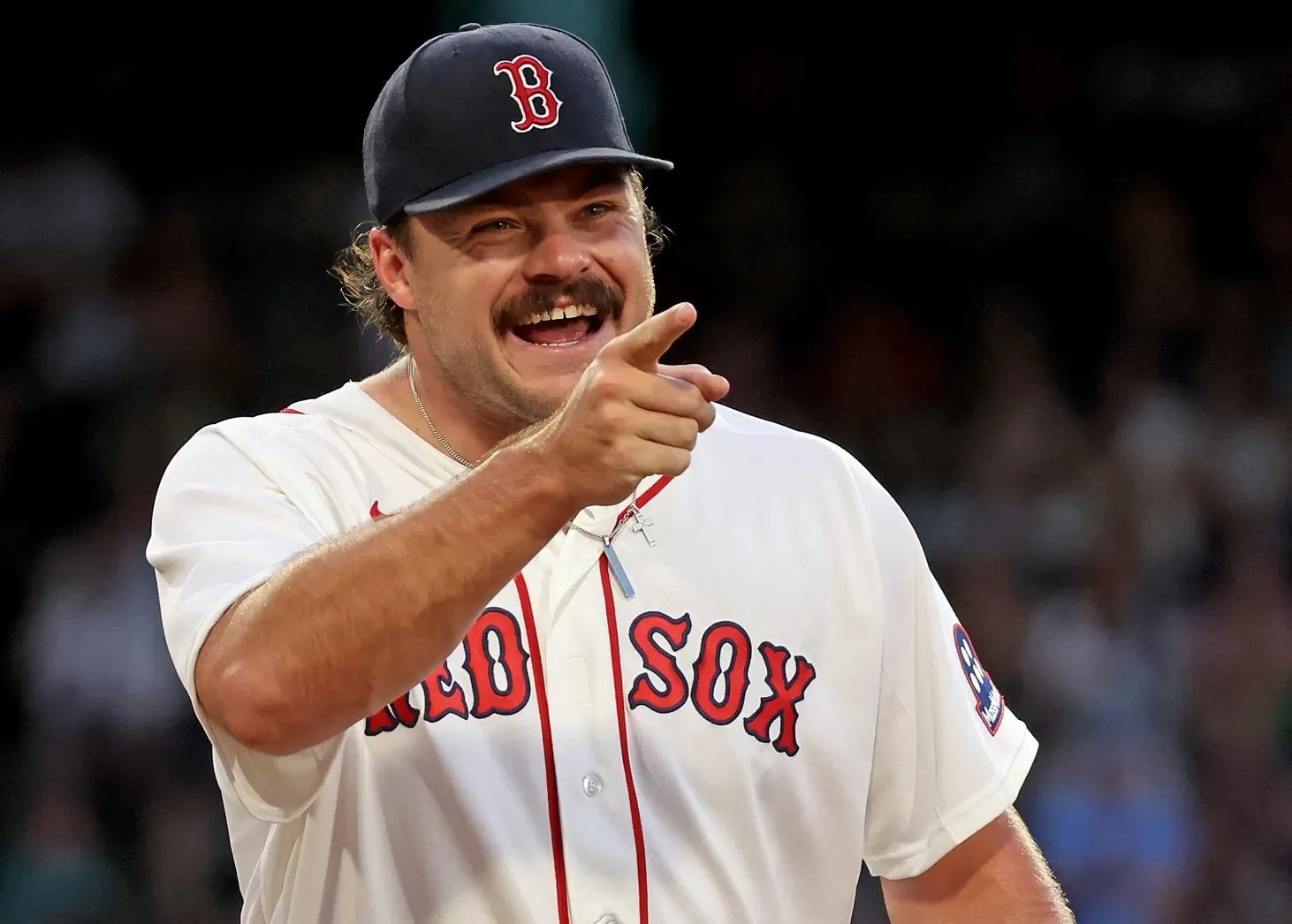
Red Sox outfielder Jarren Duran talked about his 2022 suicide attempt in a Netflix docuseries about the Red Sox released last year. He received a lot of praise for his openness, which he said was intended to increase awareness among others struggling with depression and mental health issues.

But jerks reign supreme, especially in sporting event crowds. Last night, as the Sox played the Twins at Target Field in Minneapolis, a Twins fan sitting in field box seats shouted at Duran that he should kill himself after he grounded out in the fifth inning.

The player responded with the obscene middle finger gesture. “I shouldn’t react like that,” Duran said after the game. “That kind of stuff is still kind of triggering. It happens.“

Flipping off a fan during a game is typically an automatic suspension and fine. Should it be in this case?

“What’s Going On Here?” Saturday Continues: Why Is The President Signing Obviously Unconstitutional Executive Orders?

President Donald Trump yesterday signed a second executive order aimed at regulating college sports. It lays out specific transfer and eligibility rules, limits how athletes can be compensated for their name, image and likeness, and threatens schools that violate rules with financial penalties. The EO comes less than a month after the President attended a roundtable of college sports and business leaders convened by the White House collegiate sports-related issue and potential federal legislation.

Yesterday’s executive order is flat-out unconstitutional. It directs the NCAA to create rules that mandate college athletes can play for “no more than a five-year period” and allows them to transfer schools only once before they graduate without having to sit out a season. A school that plays an athlete who doesn’t meet these new limits could risk losing its federal funding. The NCAA is also commanded to update its rules to create a national registry for player agents while establishing policies that prevent schools from cutting scholarships or other opportunities for women’s and Olympic sports in order to pay their athletes.

The rule changes are scheduled to go into effect August 1. Fat chance.

The EO will be challenged in court and can’t possible survive constitutional scrutiny. The theory is that Trump, who has always been a big sports fan, is trying to spur legislative action or push (bully?) the NCAA into making changes he thinks are prudent. But this is none of his business, or any President’s. It is also an abuse of the Executive Order. Is he just trolling? Trying to kill Trump Deranged Americans by making their heads explode?

The “No Kings” nonsense is spectacularly silly, but Trump deciding to act like a king by sending out toothless and illegal edicts is no way to respond to it. The President should use his power, influence, position and “bully pulpit” on matters of state, not matters that reside firmly and undeniably within the discretion of private bodies and organizations, like the NCAA.

The EO on college sports isn’t just obnoxious, stupid, illegal and politically obtuse, but obviously so. Even the President has to know that: he’s remarkably constitutionally obtuse, but he can’t be that ignorant, can he? And he’s surrounded by lawyers: surely all of them can’t be incompetent. Can they?

What’s next? An EO declaring that everyone should wear their underwear on the outside? A declaration that pineapple doesn’t belong on pizzaa? An order that people should stop saying, “No worries?”

It’s “What’s Going On Here?” Saturday! First Up…

“What’s going on here?”

Instapundit re-posted this, and for the life of me, I don’t know what the hell the conservative critic is alleging. I’ve watched or attended almost every Fenway Park opener in the last 40 years. Some things change, but not the crowd’s spirit or the nostalgia of being in a ballpark where so little has changed since 1912, when it had its first opening day (and The Titanic sank).

Yeah, I miss Curt Gowdy (that’s him narrating in the video), but the Red Sox have been blessed with terrific play-by-plat announcers over the years. The Green Monster hasn’t changed much: it still has the hand operated scoreboard. The team wore its classic gleaming white home uniforms as they always do on Opening Day.

What’s “radicalizing”? There are no blacks in the crowd or on the field, because it was 1950, the Red Sox were the last team to break the color line, and Boston was then and is still a largely segregated city. I saw the Red Sox opening game yesterday on TV: there still aren’t many black spectators. A black Broadway performer, born in the area, performed the National Anthem (and sang off-key): So what?

Is the “radicalizing” feature the fact that nobody wears suits and dresses to baseball games anymore? Seriously? Sure, the fashions at the 1950 game seem quaint, but “radicalizing?” I like to be comfortable at baseball games.

The only hint of politics at yesterday’s game came when Boston’s woke mayor Woo and the Bay State’s Governor, Maura Healey were booed by much of the crowd. (Good!).

What am I missing here? What was so upsetting about the brief clip of the Boston baseball opener 76 years ago?

Ethics Quiz: Freaks in Sports

Olivier Rioux is a 7-foot-9-inch college basketball player for the Florida Gators. Rioux is a freshman center weighing approximately 305 lbs. Born in Canada and already known as the tallest college basketball player in history, he also holds the Guinness World Record for tallest teenager.

He raises issues related to the transgender sports controversy as well as some that Ethics Alarms has discussed in earlier posts. Several involved intersex runner Caster Semanja, who has always identified as female but who regularly crushed female competitors in sports competitions because of an unusual amount of male hormones. When she was required to artificially lower her natural hormone mix to compete against women, I wrote,

“We can’t have special leagues and categories for however many gender categories science identifies and activists fight to have recognized, and there is no justification for creating artificial standards to eliminate outlier performers. The “solution” imposed on Caster Semenya—force her to take drugs that eliminate her natural advantage—is horrifying. How is this different from banging brilliant kids on the head until they have brain damage and no longer dominate their less gifted fellow students in school? What right do the sports czars have to declare an unprecedented, unique competitor unfit to compete because her, or his, unique qualities are advantageous? Why are so many woman condemning Caster as a cheat, when they should be defending her as a human being with as much right to compete as she is as anyone? Because she’ll win? Because it’s unfair that God, or random chance, or her own dedication rendered her better at her sport than anyone else?”

A Crucial Baseball Ethics Fix That Worked (and I Missed It!)

Tyler Kepner wrote today that any baseball fan looking for optimism about next season, which is currently imperiled by a looming player strike or owner lock-out over the lack of a collective bargaining agreement, can look to the results of an under-reported rule change for hope that MLB and the union can find creative compromise solutions that work.

That’s nice, I thought. Wait—WHAT under-reported rule change?

For many years before the 2022 collective bargaining agreement between players and the owners, it was standard practice for a team to keep a promising rookie in the minors until after the date passed that would have given the player credit for a year of MLB service. Since young players are bound to their signing teams for a set number of seasons before they have arbitration rights and finally free agent rights, that extra year of control teams got by leaving a minor league stud in the minors was worth millions to the team who owned him. Never mind that it made the team keeping a potential star down less competitive and gave the team’s fans a lesser product. Never mind that it cheated a rising star out of contract that recognized his true worth: it was all about the team’s money.

But in 2022, a new rule was negotiated to discourage service-time manipulation. If a player finishes first or second in Rookie of the Year voting, he gets a full year of service time no matter how much time he spent on the roster. If such a player wins Rookie of the Year or finishes in the top three for MVP or Cy Young before becoming eligible for arbitration, his team receives an extra draft pick.

There have been only four days of games in the 2026 season so far, and several rookies who in past years would have still been languishing in the minor leagues as they teams played the “he needs a little more seasoning” game came out of the gate blazing. In the first weekend (three or four games for every team), rookies batted .309, compared to .226 for veteran players! They also hit 15 homers with a .622 slugging percentage and a 1.008 OPS. Those are all records since 1900 through every team’s first three games.

The games were better. The teams were better. The rookies weren’t being manipulated by the teams, and the teams have a chance to benefit too. This was a smart and fair compromise that epitomizes exemplary ethics at work: everybody wins.

There is hope.

Baseball Ethics: More ABS Notes [Corrected]

The major ethics issues animating discussion early in the baseball season are arising from the new computer ball and strike calling system, or ABS. Each team begins with two challenges. A batter, pitcher or catcher may challenge any strike or ball call at home plate, but must do it immediately by announcing “Challenge!” and touching his cap. Challenges that are made after two seconds elapse may be disallowed by the umpire. If a challenge results in a changed call, that challenge is preserved. If not, it is lost.

Already, game results have been affected by the rule. That’s not a surprise at all. Major League Baseball (MLB) umpires miss an average of about 10 to 15 calls per game; the overall accuracy rate was around 92%. in 2025. Every game generally includes at least one incorrect call, and it is estimated that 8.5% of all games have bad calls that alter the score. The accuracy of the umpires has increased since computers started double-checking them, but umpires still made 26,567 incorrect ball and strike calls during the 2025 MLB regular season, and any one of them might have altered a game’s outcome. Some early results:

1. The younger players are better at challenging than the veterans, because the system was used in the minor leagues the last couple of years. Red Sox player Trevor Story was called out on strikes on a pitch that looked well out of the strike zone, but didn’t challenge. Sox TV color man Lou Merloni, an ex-player, said that after a career of thinking that an umpire’s call was final, veteran players are likely not to remember that they could challenge until the two seconds have passed. Now players are being criticized for their strike-challenging skills.

Ethics Musings As The Baseball Season Begins…

Technically the baseball season began last night, but that was just a Yankee game so I decided to hold this post until this morning.

As I wrote to my email pal, the excellent MLB correspondent for the Boston Red Sox Ian Browne, “Well, the new season is upon us! Here’s how sappy I am: just played “Tessie” and got choked up, then looked at my photo of Tony Conigliaro from 1967, and got more choked up. Where the Sox are concerned, I’m always 12-years-old.” And I posted this iconic photo…

… from legendary Game 6 of the 1975 World Series. I was there, but I didn’t see Carlton trying to guide his game-winning blast fair. I was watching, as everyone else was, that ball sail into the night and over the Green Monster.

Baseball takes up a lot of my time, and it’s time I cannot afford, one could argue. Yet I have learned as much about ethics and life from the sport, and particularly the Boston Red Sox’s epic journey through it, than from all other aspects of my experience combined. I have learned about loyalty, bravery, sacrifice, honesty, duty, responsibility, coping with disappointment and finding solace in failure, nobility, respect, the chaos of existence, and that there is always hope, promise and redemption in the future—maybe.

The Umpire’s Wish

As explained here, this baseball season the new ABS system is in play, meaning that batters, catchers and pitchers can challenge ball and strike calls by the home plate umpire and have an electronic plate coverage system instantly reveal if the call was correct or wrong. No longer does the ancient rationalization protecting umpires who have botched crucial pitch calls provide cover: “The pitch is what the umpire says it is.” Not necessarily.

During a spring training game in Scottsdale, Arizona, the San Francisco Giants were leading the Cleveland Guardians 3-0 in the fourth inning. Giants pitcher Robbie Ray faced Guardians third baseman Alex Mooney with two outs and runners on first and second. After Mooney took an 0-2 sinker that home plate umpire Bill Miller called a ball, Giants catcher Patrick Bailey tapped the top of his helmet to signal for a challenge.

“San Francisco is challenging the ‘ball’ call,” Miller announced to the crowd on his microphones. Then the crowd heard him say, “Please be a strike!”

The ABS system confirmed that the pitch was a ball, as Miller had said. The guessing is that the umpire wanted his call to be over-turned because the temperature was over 100, this was a meaningless exhibition game, and he, like everyone else, wanted to get out of the sun.

That raises questions about the integrity of umpires, though maybe not Miller’s, who called the pitch a ball even though a strike might have allowed him to escape the heat sooner. His ad lib also could have been interpreted as a sign that he wanted the Guardians to win, except that nobody cares who wins Spring Training games. Even gamblers don’t bet on them.

The incident brings up a question about the challenge system that I have been musing about lately: why can’t umpires challenge their own calls?

I agree that you don’t want to have umpires second-guessing their pitch calls, saying, “Steee-rike THREE!…well, wait a minute…I think that was a ball. Yeah, let me change that. Ball three.” But former players all have anecdotes about umpires confessing to a batter or a catcher after a missed call, “Yeah, I missed that one.” If an umpire thinks his call was wrong, why shouldn’t be get to challenge his own call?

A Brief But Trenchant Baseball Ethics Note…[Updated]

Above you can see the final pitch of the USA-Dominican Republic semi-finals last night in the ongoing World Baseball Classic. That 2-out, 9th inning pitch was called a strike on a 3-2 count, meaning that the Dominican shortstop Perdomo was out, and the U.S. had won a tight 2-1 victory sending it into the championship game against either Venezuela or surprise “Cinderella” squad Italy.

Winning is nice; winning legitimately is better. That pitch was a ball, as you can see. if the umpire had called the pitch correctly, Perdomo would have advanced to first, and the DR’s best player in the tournament, Fernando Tatis, would have come to the plate with the tying run on third base and the winning run on third.

In the 2026 MLB season that starts soon, the new ABS system will be underway. After a botched call like that one, the batter will touch his cap and say “Challenge!” and the image of where the pitch was relative to the strike zone will flash on a screen, showing that the umpire was wrong, reversing the call.

No baseball game, especially an important one, should end on a terrible call like the one that eliminated the Dominican Republic team. If this doesn’t convince the bitter-enders and “traditionalists” who oppose getting ball and strike calls right when the technology exists to do so, nothing will.

UPDATE: ESPN’s Jeff Passan just posted,

“That was a wonderful baseball game. Tension. Drama. Passion. Pride. Everything baseball can be. Everything you want baseball to be. So, for it to end on a called strike three by home plate umpire Cory Blaser on a Mason Miller slider that was clearly below the zone was such a gut punch, not just to the Dominican Republic players, whose country cares more about the WBC than any, but to a game that deserved better. ABS cannot come soon enough because this should be about the quality of the game, which was tremendous, and not the bitter taste left due to human fallibility.”

Comment of the Day: “Ethics and Human Nature Observations on Ethics Mega-Dunce Jurickson Profar”

The recent post about a highly-paid baseball player recently being suspended for the entire next season after being caught using forbidden PEDs (performance-enhancing drugs) inspired a fascinating comment by Ryan Harkins that examined an entirely separate aspect of the incident than any I had considered.

There is another angle on the case that I missed too. I had focused on how foolish it was for a player who had already achieved a guaranteed contract to risk it by cheating; so far, offender Jurickson Profar has forfeited over $20 million. But in today’s Athletic, Brittany Ghiroli observes that even though he has been revealed to be a cheat and that the one outstanding season he had that caused the Atlanta Braves to sign him to a three-year, $42 million guaranteed contract was likely the result of “juicing,” Profar still will receive all of his salary for the final year of his contract, $15 million. She writes in part, regarding why players risk taking steroids in the first place, what she has been told by other players:

“Guys didn’t take performance-enhancing drugs thinking they were risking their careers. Many of them did it so they could have careers — so they could elevate their stats, sign a big multiyear deal and set themselves and their families up for life. Sure, there was a risk of getting caught and forfeiting some pay. But baseball contracts are guaranteed. So as long as they didn’t get caught three times, teams were on the hook to pay them. Big risk, big reward. And until that reward goes away, the risk will always be worth it to certain players.”

Her solution, which she says the players union will never allow, is to make a rule that being caught using steroids allows a team to cancel the rest of a players’ contract.

Ryan’s focus is on human nature’s trap that may have snagged Profar after he had won his rich contract. Here is his Comment of the Day on the post, “Ethics and Human Nature Observations on Ethics Mega-Dunce Jurickson Profar”:

***