Comment of the Day: “Dear AIG: I’m Not Going To Be Able To Keep Criticizing Occupy Wall Street For Destructive Class Warfare If You Act Like This”

Michael, who now leads the field in Comments of the Day, picks up another with his commentary on my post about AIG’s continuing habit of living large on taxpayer funds. Here are his reflections on the post  Dear AIG: I’m Not Going To Be Able To Keep Criticizing “Occupy Wall Street” For Destructive Class Warfare If You Act Like This:

“A company can allow any expenses they want. That being said, since they are now majority owned by the US government, we need to ask who is giving the go ahead to things like this? Why haven’t they been fired? The Wall Street culture is so entitled and so out of touch with the reality of the common Americans that it is almost beyond belief.

“The Occupy Wall Street group could have a lot of legitimate gripes, but they don’t seem to have anyone with half a brain in the group. Instead of hearing “I want them to take the money from rich people and give it to me” form a college aged girl wearing $500 worth of clothes or “I have gone to every protest I can find for the last 40 years” from the aging hippies, why not try one of the following angles: Continue reading

Ethics Quiz: Is There An Ethical Obligation To Help An Actress Lie About Her Age?

An actress who is, so far, unidentified is suing Amazon.com in federal court for over $1 million in damages for disclosing her age on its Internet Movie Database website, and refusing to remove the reference when she requested, then demanded, that it do so.

She says that IMDb misused her personal information after she signed up for the “industry insider” IMDb Pro service in 2008. Soon she saw that her legal date of birth had appeared on her online acting profile. IMDb refused to remove it.

Now, she says, she is being discriminated against in Hollywood for her age (40), as is its custom. Producers won’t hire her for younger roles, because she’s now regarded as “too old.” Yet she can’t get older roles either, because she still looks much younger. The lawsuit seeks $75,000 in compensatory damages and $1 million in punitive damages.

Your Ethics Quiz question of the day:

Did the Internet Movie Data Base do anything unethical by publishing the actress’s real age without her permission? Continue reading

Occupy Wall Street: Unethical Demonstration, Unethical Supporters

If this is the level of your comprehension, I really don’t care what you think.

“Ethics Bob” Stone recently posted about the ethics of mass demonstrations like “Occupy Wall Street,” noting that long-term, open-ended demonstrations begin crossing ethical lines once they accomplish the goal of sending a message and hang around anyway, creating fertile ground for violence, and, though Bob doesn’t mention this, inconveniencing the public, wasting scarce municipal funds, and tempting pundits to make fools out of themselves.

Even with this, Bob is giving the Occupiers more credit than they deserve. A group that imposes its presence on the public, law enforcement, and local governments is entitled to express a minority and even a crackpot viewpoint. There is an ethical obligation, however, not to abuse the right of assembly and the precious time of everyone else by creating a big disturbance that means nothing, conveying a message that is irresponsible because it is based on ignorance.

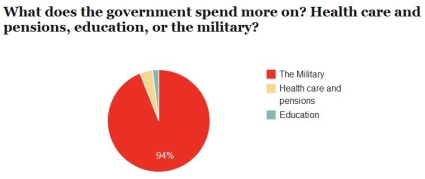
New York Magazine quizzed the Occupy Wall Street demonstrators, and discovered that: Continue reading

Dear AIG: I’m Not Going To Be Able To Keep Criticizing “Occupy Wall Street” For Destructive Class Warfare If You Act Like This.

Pelican Hill...where wealthy insurance executives can spend taxpayer funds like it was Monopoly money!

American International Group Inc. (AIG), the huge insurer—too big to fail!— that is now majority-owned by the U.S. after a 2008 bailout of $85 billion, has resumed its arrogant, irresponsible habit of living like sultans on the money of taxpayers, many of whom are getting kicked out of their homes and who can’t find jobs.

Back in October 0f 2008, the House Oversight Committee nearly had a collective stroke when it discovered that, just one week after the federal government bailed out AIG because it was too vital a part of the shaky world financial markets to let go belly-up as it richly deserved, company executives went on a wildly-expensive retreat to a luxury resort. The executives “spent nearly $500,000 on manicures, facials, pedicures, and massages,” among other things.  Rep. Elijah Cummings (D-MD) was incredulous, and he wasn’t alone: Continue reading

Genome Sequences, Consent, and Scientist Ethics

What...you don't trust this guy???

Few things are scarier than when scientists start debating ethics.

A current debate in the scientific community involves whether it is ethical to publish your genome sequence without asking permission from family members. It is increasingly common for people to pay to have their genome scanned for the presence of traits, including genetic diseases. Scientists agree that releasing this information without the permission of the individual whose genes are described would be a clear ethical breach. The controversy involves whether an individual is ethically obligated to get consent from family members before publishing his or her own genome sequence, since to some extent that means publishing theirs as well.

The argument proceeds from the unauthorized release of someone’s genome sequence by a third party to the plight of an identical twin whose sibling wants to publish his own sequence, which, of course, also describes his twin’s.  This is ethically clear too: it would be wrong not to seek permission. But what about the rest of the family? Continue reading

Stacy Crim, Ethics Hero…and the Hardest Choice

Last week in Oklahoma, Ray Phillips fulfilled a promise to his sister Stacy, taking home from the hospital 5-pound Dottie Phillips, born prematurely in September, to become the newest member of his family.  Stacy died last month of brain cancer, just three days after holding her infant daughter for the first and only time. Dottie was able to come into the world only because Stacy, 41, had made the choice to reject chemotherapy for her rapidly spreading cancer that was diagnosed after she learned that she was pregnant.

When life places one of us in a “Sophie’s Choice” dilemma like Stacy’s, no one has standing to question or challenge whether the ultimate choice is “right.” There is no right choice. Stacy was faced with deciding whether to sacrifice the unborn child she had never met, a child whom many in America choose to regard as a neither a life or a being with any individual rights, but rather only as an ephemeral potentiality made of cells, similar to a pay-off at the races or a stock dividend. Even those who take the opposite view, that Dottie was a human life even at the earliest stages of her development in the womb, would never assert that a mother would be wrong to choose life-saving cancer treatments for herself at the risk of the unborn child. In such a case the right to choose is nearly unanimously accepted, and it is the hardest choice of all. Continue reading

An Ethics Question From Ethicist Peter Singer

Princeton University philosophy professor Peter Singer is that rarest of species, the ethicist whose name many people actually recognize. This is because of his knack for raising important ethical issues in provocative ways, making enough people upset to create productive and sometimes transformation debate.

In a recent interview with the Carnegie Council’s Julia Taylor Kennedy, Singer touched on many of his most publicized themes, including global poverty. Here he poses a thought exercise designed to raise a question of conscience:

“I ask you to imagine that you are walking across some park that you know quite well, and in this park there is a shallow ornamental pond. Let’s assume that you know that it’s shallow, because on summer days you see teenagers playing in it, and it’s only waist-deep. Continue reading

The Intern, The Lawyer and The Recycling Bin: A Cautionary Tale

We entrusted the job to our intern: what could go wrong?

Here is a story that should frighten all lawyers who employ non-lawyers to assist with various tasks in their practice, which is to say, every one of them. If you have a lawyer, or ever expect to hire one, maybe it should frighten you, too.

A young woman dumped documents containing private information from the clients of Ashley Bell, one of Gainesville, Georgia’s most respected attorneys, in a newspaper recycling bin at The Gainesville Times. The Times said that a majority of the documents remained in their original file folders, and no effort had been made to conceal the contents or redact sensitive information. The files included phone and Social Security numbers of former clients, information on juveniles and reports and evaluations conducted by the Department of Family and Children Services and Court Appointed Special Advocates regarding the physical and sexual abuse, which state law requires be kept confidential.  From the Times: Continue reading

Quick Thought: Here’s a Potential Occupation For Jeremy Hollinger…

…after his school realizes that he has no business teaching special needs kids.

Or could it be that Jeremy has a soul mate across the pond…?

Unethical Quote of the Week: Rep. Jesse Jackson, Jr.

“I hope the President continues to exercise extraordinary constitutional means, based on the history of Congresses that have been in rebellion in the past. He’s looking administratively for ways to advance the causes of the American people, because this Congress is completely dysfunctional. President Obama tends to idealize — and rightfully so  — Abraham Lincoln, who looked at states in rebellion and he made a judgment that the government of the United States, while the states are in rebellion, still had an obligation to function…On several occasions now, we’ve seen … the Congress is in rebellion, determined, as Abraham Lincoln said, to wreck or ruin at all costs. I believe … in the direct hiring of 15 million unemployed Americans at $40,000 a head, some more than $40,000, some less than $40,000 — that’s a $600 billion stimulus. It could be a five-year program. For another $104 billion, we bailout all of the states … for another $100 billion, we bailout all of the cities.”

—– Rep. Jesse Jackson, Jr. (D-Ill.), telling the Daily Caller how he thinks unemployment should be addressed. Jackson inexplicably left out the part where Superman gives President Obama a magic lamp, and the President uses his three wishes to turn all his political opponents into beef jerky, banish the national debt, and make money grow from beans that get delivered to every American daily by a suddenly solvent postal service, transported around the country in Santa’s sleigh. Continue reading