Thanking Dick Williams…Finally

The late Dick Williams, doing what great leaders do

If you are not a baseball fan, or under the age of thirty, you probably never heard of Hall of Fame manager Dick Williams, who died yesterday at the age of 84. I never met Williams myself, but I have been indebted to him for four decades. I never told him the immense difference he made in my life, just by doing his job.

In the winter of 1967, I was a devoted fan of my home town team, the Boston Red Sox, and had been since 1962.  Over that period I had listened to every single baseball game on my transistor radio when a game wasn’t on TV, which was most of the time, or when I wasn’t at the game, which was almost always the case. I was the only person I knew who followed the team, and for good reason: it was torture. The Red Sox were hopelessly mediocre on the way to awful, and hadn’t had a winning season in more than ten years.

It is a great character builder to follow the fortunes of a terrible baseball team. Almost every day, for six months, you are let down, and yet return to the scene of your despair the next, attempting to muster hope while steeling yourself against likely disappointment. You find yourself finding things to appreciate other than winning: the gallant veteran player who “plays the right way” (Eddie Bressoud, shortstop, 1962-1965); the exciting rookie who gives promise of a better future (Tony Conigliaro, right fielder—rest in peace, Tony); the unique talent who is worth watching for his own sake (Dick Radatz, relief pitcher, 1962-1966). These things help, but following a perennial losing team and caring about them is like being punched in the gut four or five days a week without knowing which day you’re getting it.

Since 1965, I had always reserved seats for the first day of the season and one of the last two home games, just in case those last games would be crucial to a (hahahaha!) Red Sox pennant drive. This was especially pathetic, since the team was getting worse. They had finished in a tie for 9th place in 1966, and as the 1967 season loomed, Vegas had them installed as 100-1 underdogs to win the American League pennant. In truth, the odds should have been longer. Nonetheless, I wrote the Red Sox and got my tickets, this time for the next to last day of the season.

The team was full of rookies and near rookies, and appropriately had hired a minor league manager, Dick Williams, to be the new skipper. Williams was something else, however: he was a gifted leader. One day, in the middle of Spring Training, a Boston scribe asked the new manager what the prospects were for the upcoming season. Would the team escape the cellar? Would there be forward progress? Williams’ answer was instant front page news:

“We’ll win more than we lose.” Continue reading
Perspicacious Ethics: The Media Has A Duty Not To Make Us Dumber

Gore Vidal once said, “As societies grow decadent, the language grows decadent, too.” Certainly the media is accelerating the decadence of society; does it have to intentionally do in the language as well?

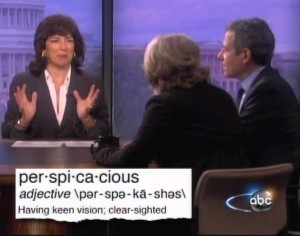
On ABC’s This Week, host Christiane Amanpour casually used the word “perspicacious.” Discussing the Constitution,  one of Amanpour’s guests mentioned that Benjamin Franklin wrote that he wouldn’t mind being preserved in a vat of Madeira wine in order to see if the Constitution held up 200 years later. Amanpour responded that Ben was amazingly perspicacious when the Constitution was signed.

Apparently  the word perspicacious stumped the 7th grade drop-outs in the booth, because suddenly a box appeared with the definition and pronunciation of the word under Amanpour. Then, commenting on the incident, the web site Mediaite wrote that Amanpour “might avoid using such fancy language so that viewers in the future don’t mistake her show for a Rosetta Stone class teaching the English language.” Continue reading

A Harsh Lesson We Must Learn From Atlanta’s Teachers

There isn’t much enlightening to say about the unfolding Atlanta teacher cheating scandal, but its implications must be faced, as difficult as that is.

Georgia Gov. Nathan Deal revealed this week that award-winning gains by Atlanta students were based on widespread cheating by teachers and principals. The Georgia Bureau of Investigation identified 178 teachers and principals – 82 of whom have confessed – in the biggest cheating scandal in US history. Not the first one, however; there have been a lot of them recently, across the country. The media is pointing to the U.S. education system’s increasing dependence on standardized tests as “the problem.”

I see: the testing made them do it. Continue reading

Comment of the Day: “New Jersey Lottery Ethics…”

Tom Fuller, who can be perceptive when he isn’t peppering us with the quotations of others (all right, even sometimes when he is) makes a useful distinction in the Comment of the Day, on today’s post about the New Jersey Lottery:

“Don’t get me wrong. I’m no fan of government-sponsored lotteries, and I share all of the concerns about them mentioned above. But a facile slogan like “lotteries are a tax on people who don’t understand math” is, like most facile slogans, too simplistic a way of making the arguments. There are plenty of psychological and economic reasons why even people who understand the math buy lottery tickets that are, quite literally, bad bets. There is lots of research on this; one of the better articles is now 21 years old, but is still cited as a good, brief, and comprehensible overview.”  [You can read it here.]

“Every gamble is a losing bet in the long run; otherwise it wouldn’t be a gamble. The trouble with state-run lotteries is not so much that they exploit those who “don’t get it”; they exploit anyone, even a mathematical genius, who is drawn towards what society generally regards as undesirable actities, thereby sending the same mixed messages as taxes on tobacco and alcohol.”

The Ethics of “No-Body” Murder Prosecutions.

Oh! THERE's the body!!!

Texas lawyer Robert Guest has opined that a Texas jury would have convicted Casey Anthony in a heartbeat, and cites as proof the February conviction of Charles Stobaugh in Denton County. He was accused of killing his  estranged wife, though no body has ever been found at all.

Maybe.  There are a lot of differences in the circumstances of the two cases, not the least is that finding a badly decomposed body with a piece of electrical tape across her mouth has a big advantage over never finding any body at all: at least you are certain that the victim is dead.  Stobuagh, like Anthony, engaged in a pattern of lies and strange statements; for example, he suggested that his wife, who suddenly vanished and stopped using her bank account, credit cards and cell phone, was “playing a prank.”  He also began seeing a new girl friend more or less the moment his wife vanished. I’d say the biggest difference is the presumption of a motive: husbands killing their wives, especially their estranged wives, is a common and well-recognized form of homicide, with a motive that any married person immediately understands. A mother killing her young child, in contrast, is very unusual, and the presumption is that no mother would do it. The Anthony prosecution was more difficult than the prosecution of Stobuagh, even with Caylee’s body. Continue reading

New Jersey Lottery Ethics…Well, Not Exactly

New Jersey has taken the live drawings for the state lottery off of television and placed it on the internet. Many regular lottery players are upset about this, it seems.

“I like to see them pull it so they don’t have the chance to switch it,” said one eighty-year-old player. “Older people don’t trust the system. We know what happens.” She doesn’t own a computer, nor do her friends, and they all say they won’t play the lottery again until they can watch the drawings on their televisions. Indeed, the New Jersey Lottery is getting many such complaints, and expected them.

Why?

Because the people most likely to play the lottery are poor, badly educated, ill-informed, dumb, or all of the above, that’s why. Continue reading

Comment of the Day: “Unethical Blog Post of the Week: ‘But What About Caylee?”’

As comments, accusations and retorts featuring the Ethics Alarms All-Stars were flying around on the blog in reaction to the Casey Anthony verdict and my reaction to some of those reactions (here, here, here, and here), Lianne Best came through with an  especially measured take, one that was immediately cheered by other commenters.

There is nothing wrong with feeling deeply, and emotions are important; after all, Mr. Spock had limitations as a leader. When emotion rather than analysis drives public opinion, however, there is a risk of real harm: those attempting objective analysis may be vilified, marginalized or ignored, and rash, reckless decisions and consequences can result.  (I could, but won’t, argue that the 2008 presidential election was a classic case in point.)  Lianne cuts to the real issue deftly. Here is her Comment of the Day:

“I too often find myself embroiled in emotional opinion, with no basis in facts. It’s easy here: an adorable and completely innocent, dependent little girl was killed. Virtually every human, particularly parents, want to see that vindicated, justice found and brought. That somehow makes it better. But you know what? It doesn’t make it better to go racing off on just a blazing gut reaction, not when people’s lives are affected by our lack of thought and analysis. I was a juror in a kidnapping and murder trial. It was an immensely difficult two weeks, and the decision was agonizing. Luckily, it was also popular; it would have been awful to suffer through loud, manic public criticism of our reasoned decision on top of the process … loud, manic public criticism by people who weren’t there, who knew less (or at least differently) than we did. We have a jury system for a reason, 12 people found Casey Anthony not guilty (13 if you count the alternate juror) and we have to trust them.

“Personally, I appreciate Jack’s cooler head prevailing when my mother’s heart is shrieking.”

Marcia Clark, Exploiting the Anthony Verdict for Her Own Sake

Marcia Clark. OK, this really isn't Marcia, but the real picture of her doesn't look like her either.

Marcia Clark’s article on the Casey Anthony verdict is so tainted with obvious conflicts of interest that it should have been rejected by The Daily Beast…or rather would be rejected by any website more selective and less shameless than the Daily Beast. This would be any fair site that does not deal in over-the-top opinion as a matter of course.

Marcia, like her colleague Chris Darden, is a rather tragic figure these days. The former lead prosecutor in the O.J. case is struggling to make it as a pundit, freshly botoxed and rendered almost unrecognizable so as to be fetching in those close-ups. After she sold the inevitable cash-in book about the Trial of the Century, she has wandered in the C-List celebrity wilderness, and will soon join Newt Gingrich and William Shatner as a celebrity novelist. She will be remembered, quite correctly, as the prosecutor who botched the O.J. murder trial, even if we give Darden an assist for the gloves debacle. (Why cable news shows insist on recycling failures as experts is an enduring mystery, the mystery being “how can the producers look themselves in the mirror after choosing recognizable flops over less well-known but more accomplished authorities?”)

But Clark apparently saw an opportunity in the Casey Anthony verdict to rehabilitate her tarnished reputation, and grabbed it. The result is “Worse Than O.J.!”, a new low in self-serving analysis. Continue reading

Unethical Blog Post of the Week: “But What About Caylee?”

Sad but true: the trial's purpose was not to find justice for Caylee.

If I responded to even one out of a hundred ethically muddled, logically addled posts by the hoard of bloggers in cyberspace, I’d have time for nothing else. Now and then, however, I am directed to a post that typifies the kind of free-floating, fact-starved gut sentiment that rots public discourse in America and that helps keeps the public confused and panicked.

In this case, I was directed to the post by the blogger herself, who managed to annoy me by accusing my post on the Casey Anthony jury of being callous to the victim in the case, two-year old Callie. I re-read my post; there wasn’t anything callous toward the child in any way. Puzzled, I went to the blogger’s page, a blog by someone who calls herself wittybizgal, and called Wittybizgal. Sure enough, there it was: an anguished lament about the verdict in the Casey Anthony trial entitled, “But What About Callie?”

The post is frightening, because I am certain that this kind of non-reasoning is epidemic in the United States, nourished by touchy-feely bloggers, pundits and columnists and made possible by the ingrained habit of having opinions without knowledge. Since their opinions are not supported by facts or reasoning, they can’t be debated. If you aren’t persuaded, you’re just mean, that’s all. That’s no way to decide what is right and wrong, but it certainly a popular way. Here is wittybizgal’s argument, one fallacious step at a time: Continue reading

“Professionalism?” What’s THAT? Julie Chen, CBS and the Descent of Broadcast Journalism

Walter could keep it together. Not Julie Chen.

The Casey Anthony verdict is doing some good: it is exposing the awful deficit in objectivity and professionalism in the broadcast media.

The latest example: while CBS’ “The View” rip-off, “The Talk,” was underway,  viewers saw co-host Julie Chen break down as she tried to read the news that Casey  Anthony had been found not guilty of killing her daughter Caylee. Chen attempted to read the verdict, but was overcome with emotion  and was unable to continue, asking her co-hosts,  “Help me out here.”

In 1937, radio broadcaster Herbert Morrison was correctly criticized for being unable to keep his composure and report the flaming destruction of the zeppelin The Hindenburg without weeping and becoming unintelligible. In 2011, a woman described in her official bio as a “news anchor; reporter; and journalist” couldn’t compose herself to read the news of a not guilty verdict. Continue reading