Why NPR’s Wrongs Don’t Make James O’Keefe Right

James O'Keefe, Ethics Corrupter

And the NPR Ethics Train Wreck continues

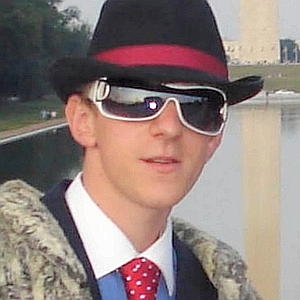
Between union hysteria in Wisconsin, carnage in Libya, and tsunamis, the fact that James O’Keefe’s fake Muslim billionaire act exposed more NPR integrity issues was drowned out by shouting, gun shots and water. In fact, the second victim of O’Keefe’s sting may have taught us more about NPR than the first.

In the surreptitious audiotape of  NPR’s continued encounters with the fake potential big bucks donor, NPR’s director of institutional giving, Betsy Liley, is heard advising the supposedly wealthy Muslim donor how the network could help “shield” his group from a government audit if it accepted the $5 million he was offering. It seems pretty clear from the tape that this was not what the sting was set up to prove: what the “Muslim donor” really wants is to get a promise from NPR that it will slant the news content the his way if the gift is big enough. Liley stood her ground on this core journalistic principle admirably—so much for the claim that George Soros bought NPR’s advocacy with his recent gift—but fell into another trap of her own making.

NPR spokeswoman Dana Davis Rehm said in a statement that Liley’s comments on the tape “regarding the possibility of making an anonymous gift that would remain invisible to tax authorities is factually inaccurate and not reflective of NPR’s gift practices. All donations—anonymous and named—are fully reported to the IRS. NPR complies with all financial, tax, and disclosure regulations.” That’s undoubtedly correct; Liley was not merely ethically wrong but also literally wrong, for what she was suggesting almost certainly couldn’t happen. However, the fact that she would say such a thing believing it could happen, or think it was acceptable if it did happen, or try to acquire a large donation by persuading a donor to believe it could happen, all point to the one conclusion: NPR’s culture is ethically compromised, and the organization’s leadership has failed to meet its obligations to create an ethical culture  there. The sting is more disturbing than the earlier one that caught an outgoing NPR executive taking extreme partisan positions that belied NPR’s position that it is objective and unbiased. The comments of Ron Schiller just confirmed what many, including me, thought was already apparent in the tone of NPR’s work. I had also always assumed, however, that the place was professionally and ethically run (excepting the tendency to fire employees for expressing politically incorrect opinions on Fox News).

So this settles it, right? O’Keefe is a hero?

No, he’s not. James O’Keefe, in fact, is an ethics corrupter, an individual who weakens the public’s ethics by encouraging it to accept his dubious values. Continue reading


So Let me Get This Straight: Tera Myers Has To Quit, But This Jerk KEEPS His Job?

"You gave your students WHAT????!!!"

I write this not only aware that the story might be a hoax, but hoping against hope that it is.

Teacher Frank Rozanski gave the students in his advanced placement psychology class at Dwyer High School in Palm Beach Gardens what he called “The Sexual Tension Quiz.”

The test, which was given to the class for a grade, is a sophomoric gag quiz in which sexually suggestive questions have innocent answers. Har. Har. As humor, it is something that one might expect to see in a college magazine (for a not-so-great college), or maybe Playboy in a weak month. Continue reading

Unethical Vanity Plate of the Year

Maybe it was Mr. Peabody! No, wait, he's not from Alaska...

It was an Alaska plate, and I followed it all the way into Washington, D.C. this morning, gritting my teeth all the while. It read:

HIGHIQ

What kind of person puts a message like this on his or her car? It isn’t witty. It isn’t cute. It is gratuitously boastful, immodest, and lacking in humility. The message is very likely to annoy other drivers, as it did me, for its sheer bad taste and arrogance, and because displaying such a message is stupid in the extreme, it is also deceitful. The driver may indeed have an objectively high I.Q., but if so the message is literally true but misleading—-since anyone who would think this fact belongs on a license plate is an prima facie idiot.

Besides…if he’s so smart, why is he driving a 2003 Camry?

Ethics Alarms Presents: The Top Ten Thought Fallacies That Undermine Our Ethics

Don't expect this list from Dave. ESPECIALLY not from Dave...

Today I’m teaching two ethics seminars for The Washington Non-Profit Tax Conference in D.C. One is on accounting ethics, the other is for lawyers. One segment in the accountants’ program involves the sub-conscious and genetically programmed human tendencies that can interfere with our better judgment and perceptions, warping our ethics, and causing our ethics alarms to sound faintly, if at all. There are a lot of them:  I have a list of more than thirty, and it’s growing. Here are my current Top Ten to be especially alert to, in your own thinking, and for understanding the behavior of others: Continue reading

Now THIS is Incivility…

The Victim

University of St. Thomas math professor Douglas Dokken is a devoted University of Minnesota fan, but the school mascot’s hijinks became just a little too annoying for him during  a men’s gymnastics meet Saturday night. When Goldy Gopher tapped him on the shoulder one time too many, Dokken wheeled around in his seat and punched him right in the kisser.

The  professor, though sincerely remorseful over his stuffed-animal abuse and bad manners, has been banned from the University of Minnesota’s Sports Pavilion and Williams Arena for a year. Goldy’s face needs some stitches, and he was left speechless. But then Goldie never says anything anyway. After all, he’s a gopher.

Physical violence is not the answer, even to a dumb question like, “How do you stop a guy in a 7-foot gopher suit from bugging you?”

Ethics Dunce: The Delaware State Human Relations Commission, et al.

Justice finally prevailed in a disturbing Delaware case that took hyper-sensitivity to racial bias to absurd extremes. You can read the court opinion here. In essence, the Delaware State Human Relations Commission found that a theater manager who supplemented an on-screen request for patrons to turn off their cell phones, not talk during the film and not mill around in the theater with his personal announcement to the same effect was engaged in racial discrimination, because most of the audience was black and some felt that his tone was condescending. Continue reading

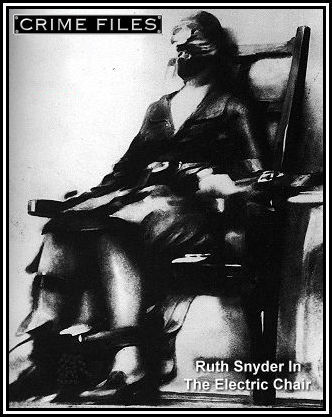
Illinois’s Death Penalty Ban: Defensible Decision, Indefensible Reasoning

Justice.

Illinois Gov. Pat Quinn  signed legislation abolishing capital punishment in the state and commuted the sentences of the 15 inmates still on death row to life in prison without parole.

I disagree with the decision, and have stated my reasons for not abolishing the death penalty here and here. Never mind: this is a topic on which ethical and reasonable people can disagree with honor. But if one is going to abolish an important law enforcement tool, the official justification for it ought to be coherent and persuasive, and not just facile rhetoric. That, unfortunately, is what Gov. Quinn gave us.

Here is the relevant segment of Quinn’s statement after signing the bill into law during a private ceremony: Continue reading

Wisconsin Wars: The Democrats’ Unethical Ethics Complaint

Wisconsin Democrats have filed an ethics complaint against Governor Scott Walker.

The complaint, and the filing of it, are unethical. Really, really, really unethical. Here’s why. Continue reading

The Missing Ethics Alarm: Spending Other People’s Money

How did I get HERE??

I confess: I honestly don’t understand this problem. From the first time I had an expense account, it never occurred to me to use it for my own pleasure. If I had to eat out on the road, I picked an inexpensive restaurant. I didn’t charge hotel room movies to my employer—he wasn’t sending me there to be entertained. I flew coach, and paid for any personal long-distance calls. Why? Because it wasn’t my money. I was a fundraiser for a non-profit, and I knew that whatever the donors were giving money for, it wasn’t for me.

It became apparent over the years that few of my colleagues or bosses saw it that way, when it came to their own expenses, and that elected officials and corporate officers not only readily use other people’s money extravagantly, but also that few people object when they do. The conduct is clearly irresponsible and unfair; I would call it dishonest. But those in high positions seem to regard it as their right. Continue reading

Unethical Quote of the Month: Newt Gingrich

“There’s no question at times of my life, partially driven by how passionately I felt about this country, that I worked far too hard and things happened in my life that were not appropriate. And what I can tell you is that when I did things that were wrong, I wasn’t trapped in situation ethics, I was doing things that were wrong, and yet, I was doing them. I found that I felt compelled to seek God’s forgiveness. Not God’s understanding, but God’s forgiveness. I do believe in a forgiving God. And I think most people, deep down in their hearts hope there’s a forgiving God.”

Former Speaker Newt Gingrich, preparing for a presidential run by attempting to explain and apologize for his serial marital betrayals, the most spectacular of which was visiting his first wife while she was in the hospital recovering from cancer surgery to announce that he was divorcing her to marry his mistress. Then he cheated on his second wife, the former mistress, with a member of his staff. He ditched Mistress #1, Wife #2, for Mistress #2, who became Wife #3. This is why he needs a forgiving God, or at least a forgiving electorate.

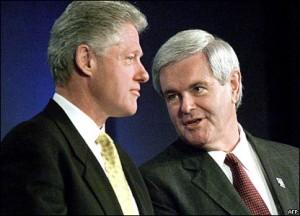
Newt’s defense now is that he felt so passionately about his country that it caused him to dump his cancer stricken wife (so much for all that “in sickness or in health” stuff), and later, while he was leading a party that was making the case that a U.S. President shouldn’t be having on-the-job sexual encounters with interns, using his staff and appointees to cover it up, and lying about it under oath in court, to commence a second extra-marital affair of his own. This, naturally, helped let President Clinton wiggle of his well-earned impeachment hook, and also helped cement the socially destructive public perception that 1) everyone cheats on their spouses, so it’s okay, and 2) you can’t trust any of our elected leaders.

Thanks for nothing, Newt.

God is welcome to forgive you; I won’t. You are obviously untrustworthy. Once cheating on a spouse may be a mistake; cheating on a second spouse is a behavior pattern. If a politician who likes to invoke God will lie to and betray two women who he swore, before God, to take “’til death us do part,” not to mention his children, I see no reason to assume that he won’t betray voters who has never met, loved, or lived with.

God’s forgiveness is irrelevant to the central issue of whether New Gingrich has the reliability of character and core values to justify entrusting him with great power. As his self-serving quote demonstrates, he does not.

But good luck with God, Newt.