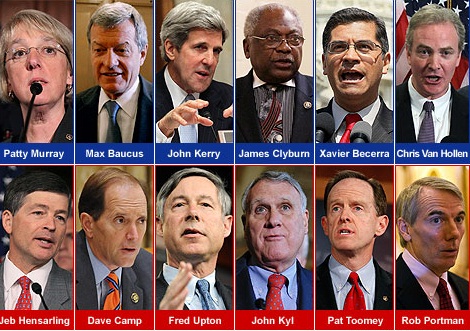
 The names are in.
As part of the pathetic, cynical and inadequate budget deal to raise the nation’s debt ceiling, Republicans and Democrats were called upon to assemble a bi-partisan “super committee” of twelve House members and Senators, chosen by the respective leaders from both parties, to come up with a way to close the deficit. Now that the S&P ratings downgrade has embarrassed the nation, destabilized foreign markets and sent an unambiguous message that the United States has to get serious about balancing the books and fast, have our political leaders responded to the challenge by choosing elected representatives of states and districts who have track records of collaboration, political courage, truthtelling and placing the best interests of the nation over narrow electoral fundraising and ideological objectives?
Naaa.
What, are you surprised? The leaders of the House and Senate have met our lowest expectations, and have chosen a hyper-partisan group to make up the super committee, guaranteeing that it will be super-contentious and super-ineffective. The degree to which this represents an abdication of their duties of leadership and responsible government is impossible to exaggerate.
The twelve chosen for the committee are a lock to produce nothing that will address the problem. You can read a good, if mild, overview of them here. The best of the Senate Democrats is, horribly enough, Sen. John Kerry, feckless and irresolute as always and none too bright, but at least capable of coalition-building. Sen. Max Baucus, who has had ethical problems, was on President Obama’s debt commission, which produced a recommendation that was balanced and did make tough sacrifices. Sen. Baucus refused to support it. The worst is Sen. Patty Murray, who is responsible for getting Democrats elected to the Senate in 2012. Is there any chance that she would support a compromise that might anger the Democratic base? Harry Reid essentially sabotaged the super committee by her appointment alone.
Not that Republican Minority Leader Sen. McConnell did much better; in fact, two of the Republican three are arguably worse than any of the Democratic Senators. They include extreme partisan Pat Toomey, a Tea Party Senator who can be counted on the refuse any tax increases, and Sen. Jon Kyl, he of the infamous “that statement was not intended to be factual” gaffe. Great. The GOP trio does included the star of the Senate committee member, Sen. Rob Portman, who was once Director of OMB and has shown signs of being pragmatic and capable.
Over on the House side, Speaker John Boehner appointed Rep. Jeb Hensarling of Texas, a hard right ideologue; Rep. Fred Upton, a relative moderate who has a special hatred for environmental regulations, and Rep. Dave Camp, another moderate. But Boehner’s comparatively reasonable and promising appointees are rendered futile by the unconscionable picks of House Minority Leader Nancy Pelosi, none of whom will accept the fact that U.S. entitlements have to be cut, and cut significantly, if the nation isn’t going to go down the road of fiscal disaster. Pelosi promised such a group, and delivered.
There are four Ethics Dunces on the committee: Pelosi appointee Rep. James Clyburn, Kerry, Kyl, and Baucus. No representatives from the so-called Gang of Six, however, the bi-partisan group of Senators who have reached across the aisle to try to forge budget compromises. That would have made too much sense.
Thus the super committee gimmick is doomed before it even begins, simply serving, as perhaps it was designed to, as a stalling device to allow President Obama to continue his cowardly and almost criminally passive approach to the debt and deficit crisis. A competent President would present a comprehensive and balanced plan after negotiations and consultation in good faith with both parties. He would rally public support, and exercise his own form of “extortion” over the process, as envisioned by the Constitution, by threatening to veto any legislation that doesn’t meet responsible standards for getting the budget out of control…his way.
We don’t have such a President, however; that is one reason we are in the position we are in today. Instead, he has delegated leadership on fiscal issues to political hacks who are unworthy of it, and who immediately betrayed their duties as national leaders for narrow political gains.
 Ethics Alarms
Someone please tell me there is going to be a primary challenge to Obama this year. Please, please tell me I don’t have to choose between him and a Republican.
I hate the fact that no one is talking facts, only ideology. In such an atmosphere, these selections make sense. The S&P statement said our downgrade was because we failed to tacked long-term indebtedness especially the main drivers of long-term debt: Medicare and SS, but no one really wants to deal with that. To talk facts, you really need some tables, figures, and analysis. I’m not just talking about politicians, here. Isn’t this the reason we tolerate the media? Aren’t they supposed to keep us informed of about things like this so we can then get outraged by such a stupid selection of people to ‘fix’ our problem.
Why can’t we find a news outlet that will break things down like this:
Revenues:
If you look at the trend in revenues, the federal government’s revenues roughly doubled from 1995-2007. This is probably in line with inflation, and ahead of people’s pay raises. The current revenue is lower than a steady trend would expect, but it is not that much lower. So, some increase in taxes may be supported, at least until the economy improves.
http://www.gpoaccess.gov/usbudget/fy10/hist.html
http://www.usgovernmentrevenue.com/downchart_gr.php
Expenditures:
What do we spend money on and what has been increasing faster than our revenues and inflation. This is what we need to focus on fixing when we cut spending.
Social Security:
Someone needs to admit that this is a pyramid scheme. Funds collected are not set aside for those who contributed, but are redistributed to those receiving benefits now. I have paid between 27 and 30% of my income to retirement in the last 30 years. Unfortunately, only 12-14% went to MY retirement. I should not have to worry about my retirement when I have been putting in over 27% of my income. Making this system sustainable is not an impossible thing, but some hard decisions need to be made. If you can’t make the tough decisions as President or in Congress, you should do us all a favor and resign.
Medicare:
The problem with healthcare isn’t that everyone doesn’t have insurance, but that it is increasing in cost at 5-10x that of inflation. They also should look a little deeper and find that the big cost is salaries, not ‘tests’ and ‘technology’. The British system has achieved universal healthcare by paying the average dentists $80,000/year and doctors $99,000/year (currently). Our averages are close to 4x that amount. We also have to face the fact we have a doctor shortage that requires us to import physicians. This shortage is caused by the AMA’s refusal to allow more physicians to be trained at our STATE medical schools.
Print media is dwindling and they can’t seem to figure out what they can do to get people to read their papers. Why not just report the news instead of trying to sway the American public to accept their political/social agenda?