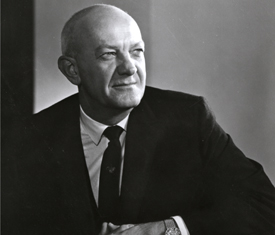
Good ol' whatshisname. We'll never forget him.
…also ingratitude, venality, and crassness.
Baseball’s Kansas City Royals are putting the name of their ball park, now Kauffman Staudium, up for corporate bidding. Soon the stadium that stood as a monument to the late Kansas City community leader Ewing Kauffmann, who owned the Royals in their very first season (1969), built the state-of-the-art home for them that is still a source of civic pride, and turned the team into a model franchise and perennial pennant contender in record time, will be named “Kansas City Masterpiece Stadium” or something else that makes it a giant billboard. Meanwhile, little will be left to remind future baseball fans and Kansas City residents of the life and dedication of the man who was responsible for the city having a major league team at all.
Some things should mean more than money. Honor, recognition and gratitude to an institution’s founder are among them. Ewing Kauffman earned the right to have his name on the stadium he built for the team he created until it crumbled into dust. The Kansas City Royals have chosen to teach the community that in sports, as in business, there is a price tag on everything…even loyalty, gratitude, and tradition.
Yechh.
 Ethics Alarms
Well, they’d better be careful as to what corporate entity they attract to plaster their name over that of Mr. Kaufman. In Houston, we still remember the (former) Enron Field!
Yes, I’m reminded of an incident a few years ago when Wake Forest University renamed their medical school from Bowman Gray School of Medicine to the more generic Wake Forest University School of Medicine. It seems that although Mr. Gray donated the funds to establish the medical school, his money was tainted by the fact that he was chairman of the RJ Reynolds Tobacco company.
His money was still good.
People will probably try to paint Kauffman with that brush, too, since he made his millions from pharmaceuticals. But I live in Kansas City, and he has done untold good for this community. My daughter even got a job with his foundation when she got laid off her teaching job! I’m glad you brought this up–maybe it’s not too late to start a grassroots movement to prevent the name change.
Better yet; that money went to something good.
Did he explicitly state that he wanted the stadium named after him? Why, besides that it “feels icky,” does the organization have an obligation to maintain the name (moreso than it already has)? Why does the deceased Mr. Kaufman have a “right” to this (or, more specifically since I doubt you’re giving the deceased rights, why does his family)? Why does the name of the stadium have to honor him – couldn’t they just have a very nice display in the front entrance/create some other acceptable form of tribute?
There’s plenty of assertions, I think, that lack any basis except “icky feelings.”
I think part of it is that the Kauffmans owned the Royals, promised to keep them in Kansas City, and kept that promise. The whole family is very revered here. I will admit there are already a bunch of other things named for him, but I think this was one of the first. Plus I miss stadiums having names that mean something personal and not a corporation that came up with the most money. If it was named “Marion Labs Stadium,” I wouldn’t care so much.
Surely you don’t think there’s a moral issue, then?
The reasons you just gave are:
* The family is very revered
* You miss having stadiums with personal meaning behind the names
Do you think that these are persuasive enough arguments to keep the name of the stadium?
A pretty crass attitude, I’d say. Does someone have to ask for gratitude to receive it when it is appropriate? If you want to disavow gratitude and recognition of past good deeds that benefit an organization and its community, be my guest…I think it is a coarse approach to life. Kauffman’s right to have his name forever associated with the team and city institution he founded isn’t an inalienable human right—it’s simply the right to be treated justly.
A city can be classy, or it can be a municipal jerk. In San Diego, they named the baseball stadium after the sportswriter who saved the ball club, Jack Murphy, professing the public’s gratitude forever. Then a better deal came up, and the park is named after an outfit that sells dog food. In New York, the Stadium was named after Bill Shea, who single-handedly brought a National League team back to New York after the Giants and Dodgers fled. When they tore down Shea Stadium, it would have been an easy time to forget about the team’s debt to Bill Shea, but the new stadium is called Shea too.
A city and a franchise doesn’t have to show class and gratitude, but it’s more ethical when they do.
There’s a reason why doing otherwise feels ‘icky.” It’s wrong.
“Crass” in what way? It might offend your sensibilities, but that’s what a devil’s advocate is supposed to do.
Why has he not received gratitude? Why must the stadium’s name BE that tribute to him? You aren’t answering what I’d think are very pivotal questions to this ethical issue.
Why is it more ethical to show gratitude (specifically in this way)? *Why* is this so “wrong”? Offending you or me or anyone else probably isn’t a good way to judge what’s “wrong.” I think you were on this the other day about the cadet who was offended by that email. Which is it going to be? That email made a cadet feel “icky” – I suppose you might now agree that it is wrong?
I get it. You’re saying that the franchise is breaking loyalty to its founder by renaming the stadium. What if they are having intense financial troubles – would it be a better tribute to him to sell the entire franchise to someone with no loyalty whatsoever to Kaufman… some company that might eliminate all ties to his name, whatsoever? What if they put a giant mural of him in center field – would that be an acceptable tribute?
Please try not to accuse me of being crass when I merely asked a series of very pertinent questions.
Your suggestion that gratitude, when clearly earned, needs to be requested to be obligatory is crass, in my opinion. Kauffman should not have to ask to be treated decently and with respect, and not asking doesn’t relieve the recipients of his dedication and generosity of their obligation. Gratitude is triggered by the favors that earn it.
The Royals aren’t in dire financial straits, and in fact, they don’t spend what they should on the team. It’s just a greedy operation.
You haven’t answered many vital questions, and kind of went tangent. I will condense:
1. Why is the name of the stadium the only acceptable form of gratitude?
2. What, if anything, would appease your sensibilities for what constitutes gratitude – APART from the stadium name?
3. *Why* does the franchise need to forego X million dollars in an act of gratitude that could potentially be given in another way?
4. Why do Kauffman’s actions in life demand gratitude and expressions of it?
5. What *amount* of gratitude is necessary – since apparently having the stadium named after him for whatever period of time has transpired is not sufficient?
6. *Why* is an expression of gratitude morally obligatory?
7. As a follow up: “A city and a franchise doesn’t have to show class and gratitude, but it’s more ethical when they do.” – Justify this statement, especially the terms determined solely by your opinion (what “class” and “gratitude” amount to).
Thanks. And by “crass” I only mean unjustly insensitive, not the more insulting definitions.
1. It isn’t. It is the best of the likely ones, and the most visible. Taking it away, therefore, is a greater show of disrespect and ingratitude. You can anme a street after the guy, but that is ultimately nothing.
2. For an individual whose most notable contribution was a baseball team and tradition? There is nothing. Wrigley Stadium memorializes the family that owned the Cubs for decades. Shea Stadium keeps William Shea’s name alive. Jack Murphy, who was responsible for saving the Padres, is now nearly completely forgotten since his name was taken off of the stadium.
3.See #2. There really isn’t another way. If the US government, desperate for funds, sold “naming rights” to the Washington Monument to Volkswagon, would that be OK with you? Or would it symbolize a core lack of respect and recognition for Washington? “After all, the city’s named after him!”
4. Simple quid pro quo: a baseball team is cultural institution, a center of prestige and civic pride, an source of community cohesion, and an economic engine. Kauffman gave the city a ball team and did not make a profit off of it..it was a community contribution, and a massive one. Organizations and communities that do not maintain their connections to their key figures, founders and rescuers weaken their foundation.
5. A founder is always a founder, and the debt is continuing and never extinguished. The US owes honor and recognition to Washington, Adams, Jefferson and Lincoln (and others) as long as the US exists. This was what was so offensive about the San Diego scenario—the stadium was dedicated in Murphy’s name to symbolize the city’s gratitude “in perpetuity”—which meant “or until a better deal comes along.”
6. It’s ethically obligatory. I’m not sure it’s morally obligatory, but I’m not a moralist. It’s the right thing to do. Ask King Lear.
7. Why would you need to ask this question? Human tradition and experience indicates that saying “thank-you” and reciprocating for kindness and generosity encourages more of the same, and makes a more humane society. Gratitude, like all ethical values, is designated as such because it works—a world with gratitude is less Hobbesian than a world without it. I assume you wouldn’t dispute that.
1. (below)
2. Wait. You just said that it isn’t the only acceptable form of gratitude, just “the best of the likely ones.” So, having an enormous mural of him in center field, along with a guided tour complex in the same area documenting his life and accomplishments would *not* be acceptable in comparison to the stadium name, correct? I have to wonder if you’re being honest with yourself here for the sake of a point. An appeal to tradition is beneath you – I think you’d agree with that. How is the man – who’s name you *just* mentioned – “completely forgotten.” Seems as if at least some remember him. How many people could actually identify a person or contributor based solely on a stadium name, anyway? Ask the average fan what family supported the Cubs – I imagine you might not see as much “gratitude” as you like. Additionally, I see no reason that the stadium couldn’t be called “Miller High LIfe – Kauffman Memorial Stadium” or something like that.
3. Yes and no. I don’t really *care* what the name of the monument is. The difference is, the Washington Monument has no other intended purpose than to recognize George Washington, so naming it otherwise seems antithetical to purpose. The baseball stadium, however, has myriad purposes besides honoring Kauffman, including supporting a baseball franchise. There’s a very clear distinction here that I feel you are avoiding.
4. Ok. I get that. Why does his deceased body, however, need gratitude? I don’t simply accept that “doing good deserves gratitude.” I want to know *why*. Why is gratitude in the form of a stadium name a fair quid-pro-quo? If I gave years and millions to a city to produce a baseball team, I wouldn’t particularly care if they named things after me when I died. I’d prefer that they put my great grand-kids through college, and give them better opportunities. But then, I don’t assume that I will be conscious following death.
>Organizations and communities that do not maintain their connections to their key figures, founders and rescuers weaken their foundation.
This should have the enormous caveat of “in my opinion.” What of organizations that eliminate connections to founders who, though they were certainly responsible for some good, contributed some other heinous act? (I’m thinking of organizations severing ties to violent white supremacists, separatists, etc.).
5.That didn’t answer the question. What *amount* of gratitude is necessary? Is it – a stadium name, a museum, continuing contributions to his family, multiple statues, parks dedicated to him, all of the above or some combination of the above?
6. Apologies for my confusion of terms. Why is it ethically obligatory? Why do we have a duty to express gratitude – especially in this way?
7. Yes. A “thank you” and continued reciprocity are very apparently ethical. Why is a monument to a deceased man in the same vein? If this was a foundation to support his family, I would totally agree… but we are talking about the name of a baseball stadium. A world without gratitude to the deceased seems no closer to a state of nature than anything else.
I suppose I may be evoking the ethical issue of respect for the dead, which may be an issue too diverse and complicated to handle in this thread. I will avoid touching on it in further replies.
Steven—apologies. This post got in the spam folder, and I was occupied with all the Paterno comments, on the road using my slow and irritating netbook, and didn’t find it until now. I was actually looking for it. I’ll read it carefully tonight, and hope to replay tomorrow. I know you take great care with these, and i’m sorry for the delay; it’s not out of lack of respect, just lack of time.
Damn. I had a long response typed up and it is now lost in cyberspace. I haven’t the will to type it again, but may revisit if I have free time later.
Arrgh! I hate that. I’m genuinely sympathetic—that has prompted me to draft all long responses in WORD, because it makes me want to run out in public with a bloody machete, and that’s almost never ethical.
Almost? When is it ethical barring zombies?
Pirates. Nazi death squads.
Nazi pirate death squads..
I don’t see how someone who started a company in their basement with a few $1000, who started charitable foundations to further education of children and entrepreneurship to provide jobs and build wealth has a tainted name. The stadium was Royals’ Stadium until 1 month before Mr. Kauffman’s death and he made sure in his will that the Royals would stay in KC. He really cared for the city, the Royals, and people. By renaming the stadium, KC would be losing the memory that Kauffman was the Royals. There would be no Royals and there would have been no stadium without Kauffman. While he was alive, there was no need for the stadium to be named after him, with him gone, the loss of the name is the loss of that tangible reminder of history.
Dislcaimer: I met Mr. Kauffman once in the 1980’s. I was impressed by how patient he was with a group of high school kids and how much he seemed to care about people, including his players. He was wise, authoritative, commanding, and kind, all at the same time. I have met few people in my life who exude that combination of traits, perhaps why he was so beloved. I remember someone asked him about Bo Jackson. He said he was going to allow Bo to play football if he wanted to, but he had cautioned Bo that although he could have a few great seasons in both football and baseball, he could have a great career if he stuck to baseball. Maybe Jackson should have listened to him.
Brand that buidling! They rename everything here every few years based on who is writing the cheque today. Capitalism at its finest… everything is for sale. It keeps the sign and print people here busy and it is really the least of the damage done with that mindset. History is meaningless because if it was given weight, it would be impossible to justify telling whole segments of the population to get over the past and get with the current program. I like the idea of renaming cities to raise government money. It would give the map people something new to do and give the vain something useful to spend their money on.