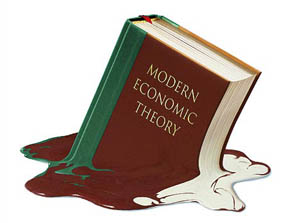
 Charles Fergusen’s documentary about the 2008 financial collapse, “Inside Job”, chronicled the maze of deceit, conflicts of interest, greed, recklessness and self-serving maneuvers across multiple professions and sectors of the economy that led to the meltdown. Among the professions that were implicated in the account was that of economists, who in many cases advised Congress and others regarding economic policies without disclosing their own ties to special interests and various players in the drama. The debacle was a severe blow to the credibility of economists as a group and economics as a discipline. Many have since called for the profession to put in place conflicts of interest rules to guide practitioners and to build public trust.
For my part, I was surprised to learn that there was not such a code already in place. As a lawyer, I am spoiled—the legal profession, as with judges, doctors, researchers, psychiatrists, accountants, legislators and government workers, has recognized the need for formal ethics guidelines for a very long time. The number of fields without ethics codes continues to amaze me, although one of those professions is…ethics.
Economics, however, is making strides. At its annual meeting in Chicago last week, the American Economic Association issued principles for disclosure of potential conflicts of interest and conflicts related to published academic papers. Here they are:
STATEMENT OF PRINCIPLES
1. Every submitted article should state the sources of financial support for the particular research it describes. If none, that fact should be stated.
2. Each author of a submitted article should identify each interested party from whom he or she has received significant financial support, summing to at least $10,000 in the past three years, in the form of consultant fees, retainers, grants and the like. The disclosure requirement also includes in-kind support, such as providing access to data. If the support in question comes with a non-disclosure obligation, that fact should be stated, along with as much information as the obligation permits. If there are no such sources of funds, that fact should be stated explicitly. An “interested” party is any individual, group, or organization that has a financial, ideological, or political stake related to the article.
3. Each author should disclose any paid or unpaid positions as officer, director, or board member of relevant non-profit advocacy organizations or profit-making entities. A “relevant” organization is one whose policy positions, goals, or financial interests relate to the article.
4. The disclosures required above apply to any close relative or partner of any author.
5. Each author must disclose if another party had the right to review the paper prior to its circulation.
6. For published articles, information on relevant potential conflicts of interest will be made available to the public.
7. The AEA urges its members and other economists to apply the above principles in other publications: scholarly journals, op-ed pieces, newspaper and magazine columns, radio and television commentaries, as well as in testimony before federal and state legislative committees and other agencies.
These principles, so far, are just guidelines. They have no teeth or enforcement mechanisms; they are not binding on organizations or individuals outside the AEA. There are no sanctions connected with them, and no body assigned to oversee implementation of oversight. Nonetheless, this is how ethics standards get established, with some professional organization with prestige and credibility taking the initiative by recognizing the profession’s need and articulating principles. It is a beginning, but its significance should not be overlooked.
You can watch “Inside Job” here.
[Thanks to the Legal Ethics Forum for the news.]
 Ethics Alarms
But will this explain and eventually invalidate the First Law of Economics?
“For every economist, there is an equal and opposite economist”.