Two photography technology ethics cases erupted this week.
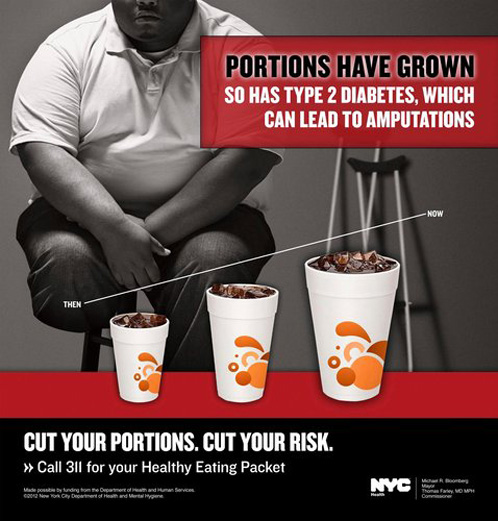 The Case of the Fake Amputee: A recently unveiled New York public health campaign warning against Type 2 diabetes uses a photo of an overweight man who is missing his leg. The man, however, had both legs when the photo was taken. One was digitally removed to make it appear that his right leg had been amputated. The American Beverage Association, fighting the city’s efforts to reduce consumption of sweetened soft drinks and fast food, seized on the photo to press its case. “Clearly, the straight facts don’t support their singular attacks on our products, so they keep falling back on distortions and scare tactics that are over the top,” association spokesman Chris Gindlesperger said in a statement. “That’s disappointing.” Well, diabetes does increase the risks of amputations, and a fake amputee is no more scary than a real amputee. Real amputees do exist; having a graphically-created one doesn’t change the accuracy of the ad’s message one bit. What does the association’s argument have to do with the photo-manipulation? Nothing.
For its part, the Health Department had an equally silly response. “Sometimes we use individuals who are suffering from the particular disease, other times we have to use actors,” department spokesman John Kelly said. “We might stop using actors in our ads if the food industry stops using actors in theirs.” Oh, behave! I see nothing unethical about using actors in food ads, and nothing unethical about using graphic techniques in health ads. The point of the ad is that diabetics often have to have amputations, so try to avoid diabetes. The message is not “This particular man is a diabetic and lost his leg to diabetes.” Would the association cry foul if the man was an amputee, but didn’t have diabetes? If he had diabetes and was an amputee, but actually had his leg bitten off by a crocodile? Probably. It would still be silly, and the current flap over the photo is silly.
Verdict: Ethical
 The Case of the Fake Sunset Flight: Washington Post readers saw a photo on the front page of last week’ Friday’s newspaper depicting a plane taking off from Reagan National Airport with the 14th Street Bridge in the foreground and the orange glow of the setting sun in the background. The photo accompanied a remembrance of the Air Florida jet that crashed into the bridge 30 years ago. The caption included an unusual technical note: “This image is a composite created by taking several photos and combining them with computer software to transcend the visual limitations of standard photography.”
“Huh?”
The explanation referenced HDR (high dynamic range) photography, which combines images with multiple exposures into a single image. The Poynter website explained that using the technology offers “a broader dynamic range in tone and detail, and does not change the authenticity of the scene or situation.” Post photographer Bill O’Leary used HDR to combine five images with different exposures. The Post included the confusing explanation as a nod to ethics and full disclosure; nonetheless, readers complained. Sean Elliot, president of the National Press Photographers Association, told Poynter that the technique violated the ethics of photojournalism.
Again, I don’t see how. The photo was not intended to show the doomed Air Florida flight, nor was this a photo designed to show what the 14th Street Bridge looks like at sunset. It was meant to be a graphic that dramatically illustrated the story, and was in the realm of art rather than news. There was no attempt to misrepresent anything, because the Post explained, if a bit obscurely, that the photo had been enhanced using technology. Who was deceived? Who was misled? I think we need to keep a short leash on any kind of photographic manipulation by the news media, but this one, I believe, is well within ethical bounds.
Verdict: Ethical
 Ethics Alarms
I am reminded of the “This is your brain on drugs” commercial campaign.
I can’t recall anyone worrying about whether or not the eggs were real, or freshly cooked. The message was perfectly clear, and not about the messenger.
RE: Sunset photography
It’s even less of an issue than you make it here. One of the reasons for HDR is to overcome the basic limitations of modern digital cameras because they can’t capture as wide a range of bright and dark images as the human eye can. (The technical term is “dynamic range”.) So they use a series of shots with different settings that are optimized for dark scenes at one end of the spectrum and for light scenes at the other. These multiple images are digitally mixed together to produce an image that looks more like what it actually would to the naked eye, but which the camera technically can’t capture.
–Dwayne
Good to see someone who understands exactly what high dynamic range photography is. Regrettably, HDR is also a term hijacked by countless Flickr users. I’ve encountered more people who associate it with images that have been over-processed in Photoshop to look obnoxiously stylized and decidedly un-authentic.
The Washington Post example should be no more controversial than a panorama stitched together from multiple photographs.