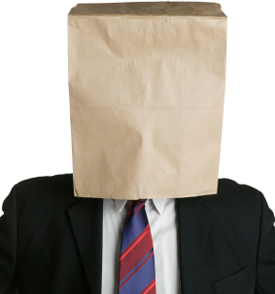
"I am wearing this bag for the benefit of my former employer while I rip him to shreds."
“A person involved in Paul’s businesses, who spoke on condition of anonymity to avoid criticizing a former employer, said Paul and his associates decided in the late 1980s to try to increase sales by making the newsletters more provocative. They discussed adding controversial material, including racial statements, to help the business, the person said.”
—The Washington Post, in a story by Jerry Markon and Alice Crites (“Paul pursued strategy of publishing controversial newsletters, associates say”) that contradicted Rep. Ron Paul’s denials that he was aware of or endorsed racially offensive content in newsletters published under his name during the 1990s.
The inherent dishonesty of the anonymous source of the Post’s story apparently didn’t register on the paper’s reporters or editors. It wasn’t that the source wanted anonymity to avoid criticizing Paul; he, she or it wanted anonymity to avoid accountability for the information being revealed in order to attack Paul.
How credible is a source whose anonymity is justified by an obvious lie? Not very, but apparently credible enough for the Washington Post to base a 1700 word story on anonymous allegations, essentially branding Paul as a liar without giving its readers any basis on which to assess the motives or credibility of the accuser.
[Ethics Alarms thanks James Taranto for the point.]
 Ethics Alarms
What is it with the use of anonymous sources anyway? Are there any ethics rules regarding anonymous sources?
There are. Anonymous sources have their time and place (think watergate), but they can be overused.
They are also ripe for abuse, and should be avoided whenever possible.
As all major media news ethics guidelines declare without equivocation. But “avoid whenever possible” has come to mean, “Avoid unless you need them to have a story.” It’s like all the other ethics in journalism..they apply when convenient, and the rest are “exceptions.”