The Runway and The Snowy Owl: An Ethics Conflict Tale

“One showed up at the airport in Hawaii, and they shot it,” Denver Holt, director of the Owl Research Institute in Montana, told the New York Times.“It’s the first ever in Hawaii and they shot it!” Holt was expressing his dismay at the sad news that a snowy owl, one of the most magnificent of all American birds, had journeyed from its Arctic home all the way to Hawaii and been shot dead for its effort. He was quoted in a Times story about the sudden, mysterious surge in snowy owl sightings all over the country, giving people a chance to see the huge, white predators in places where they had never appeared before. Like Hawaii.

“Aloha!”

Bang!

Here is a lesson in the value of waiting to get the full story before making assumptions. I saw the Times story, and had sketched out a post on the doomed Hawaii visitor, something about mankind’s unethical impulse to destroy beautiful living things to make beautiful dead things like fur coats, trophies and stuffed snowy owls. But my travel travails made it impossible for me to finish it, and it’s a good thing. Honolulu Civil Beat had the rest of the story. Continue reading

Celebrity Encounter Ethics

You're welcome. But now I'll never know what Eddie Murphy is really like!

I run into a lot of celebrities when I travel. I assume everybody does who travels very often; I know that I am better at recognizing them than the average person because my celebrity knowledge spans multiple generations, I have a good memory for faces, and I have always watched way, way too much television. And it happened again today: I was having my usual battles with an airport self-service check-in kiosk, this one in Atlanta, when I realized that the traveler enduring similar annoyances (“We have no record of your itinerary. Please enter the code that we call something other than what it is called on your ticket receipt before you get frustrated and have to wait in line to speak with an agent, because you know that’s what is going to happen.”) was the young actress-singer, Raven-Symone.

She was traveling alone, and it seemed clear that nobody around us had any idea who she was. Strange: doesn’t everyone watch “The Cheetah Girls,” “Dr. Doolittle 2” and re-runs of “That’s So Raven” on the Disney Channel? The encounter immediately sent me into Marshall Celebrity Recognition decision mode: what is the ethical way to treat the rich and famous if you are insignificant and lowly, and close enough to assassinate them? Continue reading

Yuri’s Tweets, Flawed Analogies and the School’s Defenders

[Why is it that when I’m traveling and stuck in airports where the supposedly free WiFi doesn’t work and on airplanes that can’t keep on schedule, some post that I assumed was fairly straightforward turns into the Battle of Antietam? I apologize to the various commenter’s whose work product languished waiting for moderation—I just didn’t have the chance. This odyssey ends tonight; I apologize for slowing things down. On the other hand, it’s good to know that my presence is not required for there to be lively and interesting discussions here…thanks, everyone. Good work.]

Don Bosco Prep High School, Class of 1917-1918

That is not to say that sending gross, obscene, or abusive tweets is exemplary conduct; obviously it is not. I have concluded, however, that the proper and ethical use of social media is something that people, including minors, have to learn for themselves by trial, error, research, observing the mistakes and experiences of others, making dumb mistakes and suffering because of them.  Parents and schools, as well as the popular media, have roles to play by giving advice and calling attention to cautionary tales, but heavy-handed attempts to manage social media conduct attempted by authority figures who, as a general rule, neither use nor understand what they are attempting to regulate are both irresponsible and doomed to failure. Like it or not, social media is a primary, and growing, means of communication and interaction in American society, and students are wise….that’s right, wise...to learn how to use it. I was just speaking to a room full of lawyers, and asked them how many used Twitter. The answer: none. But their clients use Twitter, and their client’s adversaries use it, and certainly their children. Their bar associations are making rules about what these lawyers and judges should and shouldn’t be able to do on social media, and most of those bar committee members don’t use Twitter either.As a result, the various jurisdictions have inconsistent rules, based on a lack of knowledge, that are already archaic.

It is fine and responsible for any adult to try to warn a young person that comments on social media need to be considered carefully, that they have a reach far beyond any intended audience and are essentially broadcasts, and that messages or photos can reach people who they hurt or upset, or cause to have a poor opinion of the sender. Ultimately, however, the pioneers in this new frontier of personal expression and mass communication are going to have to learn their own lessons, and better that they learn them now than when they are members of Congress. All punishing students for their tweets teaches them is that people with authority abuse it, and that adults just don’t understand. Because, for the most part, they don’t.

Now the analogies and comparisons:

Public schools vs. Private schools: I gather that the theory here is that if a student voluntarily attends a private school, the student has voluntarily submitted to whatever the school regards as proper discipline, whereas public schools, since they are mandatory and creatures of the government, are constrained by the Constitution. I think I may have encouraged this by a careless reference to the ACLU, which was, of course, a mistake (and I have removed it.) This is ethics, not Constitutional law, and the values are autonomy, fairness, respect, privacy and abuse of power and authority, not Freedom of Speech. I have dealt with several private schools and one Catholic school, and none of them suggested in their printed materials or regulations that they reserved the right to punish my child for what he said, wrote, or communicated during non-school hours, or when he wasn’t physically on school grounds. Neither does Don Bosco, which states as its “philosophy”:

“Don Bosco Prep educates young men so that, through a process of self discovery, each student will come to recognize and acknowledge his talents and limitations, while pursuing academic, athletic, artistic and personal excellence.

“Mindful of both our role and responsibility as a Salesian college prep school, we respect each student as a unique individual. Through active presence in his life, we promote a joyful spirit, intellectual curiosity, self-esteem and emotional maturity. We encourage the development of character and personal responsibility, love for one’s fellow human beings, a concern for the environment and an active commitment to social justice, all of which serve as the cornerstone of each student’s spiritual growth.”

I take none of that, including references to being “an active presence” in a student’s life, “promoting” emotional maturity, and “encouraging” development of character to mean “we can punish your child for absolutely anything he does or says that we disapprove of, no matter where or when it occurs.” It, the school, does all of the things relating to its philosophy in the school, based on the student’s activities and interactions in the school. Any other reading is giving a group of strangers whose biases, background and motivations I can only guess at a blank check to manipulate a child’s life, thoughts and personal activities.

When one teacher from a private school called me to tell me that she felt it was cruel of my son to exclude a classmate whom he did not like from his birthday party, I told her that it was none of her business, and filed a complaint with the school.. Private school does not mean “we can meddle in your child’s private–as opposed to school—activities.

Catholic vs. Secular: All schools should teach character; it happens that Catholic schools do it with more fervor, but that gives them neither a greater obligation nor additional authority. Schools teach good conduct and civility by insisting on appropriate conduct and deportment in school. Are people really prepared to argue that a Catholic school can justify punishing its students for not doing household chores, not washing their hands after using the bathroom in their homes, being cruel to a younger sibling or being disrespectful to a parent? Not only is personal social networking use as unrelated to the school  as any of these, it is also far less significant. How much of a blank check do we want school administrators to have? The right answer to that is that they shouldn’t have a blank check at all, and being a Catholic school changes nothing.

High schools vs. Military Academies: This is just a bad analogy. The student at a military academy has no personal life, and has no privacy. The academy is in loco parentis; the student lives there; authority is total. There is an honor code and a code of conduct, and it applies to everything a student does, including communications. That’s the military. That’s not high school.

High Schools vs. College: Several commenters have referenced the incident from last March when Brigham Young University suspended a star basketball player for having pre-marital sex. Brigham Young is famous for its strict and far-reaching conduct code, which bans drinking, pre-marital sex and many other activities that are virtually courses at other schools. If a student agrees to attend B.Y.U., the student has also agreed to certain conditions unique to the university. Should a more typical college be applauded for suspending a student who has sex with his high school girl friend over Christmas break, in his parents’ home? No; this is none of a college’s business, and attempting to extend its authority beyond the campus and even over state lines in such a fashion is intolerable. If Yuri Wright and his parents signed a document promising that Yuri would never send an offensive tweet during his years at the school, I withdraw my condemnation of Don Bosco’s punishment.

High schools vs. the Workplace: It is true that if an employee engages in conduct outside of work that embarrasses or reflects badly on an employer, ot that interferes with the employee’s ability to do his or her job, the employer is behaving ethically if it chooses to terminate the employee. It is not ethical for an employer to terminate an employee for any private conduct it happens to disapprove of, however. It can’t tell me that I can’t drink or smoke or have sex with men in my own home. It  better not tell me that I can’t vote for Ron Paul or root for the Red Sox, either. The Naked Teacher Principle applies, of course: if I’m a Coca-Cola VP and a Facebook picture shows me chugging Pepsi, that image could undermine my effectiveness at work, and Coke can can me; it’s ethical. If I write an ethics columns for a newspaper and I am caught in an adulterous affair with Marianne Gingrich, the newspaper is only being responsible to fire its unethical, untrustworthy ethicist. None of this applies to Yuri’s tweets. They don’t reflect on the school, or shouldn’t, because the school shouldn’t have any control over his personal communications. They  don’t interfere with his studies, or make him a worse football player.

Expression vs. Conduct: Tweets aren’t conduct. Even if I accept the proposition that a school may, in extreme situations, have some legitimate role in attempting to control student conduct outside of school (and I’m not sure I do), allowing a school to punish a student for the content of his words, uttered or written away from school, is a slippery slope with no braking. If sexually and racially objectionable tweets can get a student expelled, why not tweets critical of President Obama, or cheering on Newt Gingrich? Does Don Bosco’s commitment to “social justice” mean that Yuri can’t tweet that Occupy Wall Street is a crock?

Attention Schools: You Do Not Own Your Students

This must stop.

Yuri? Your school just called; they want slightly more understated smile from you in the future. Or else.

Yuri Wright, a top ranked high school football player who is being sought by schools in the Big Ten, Pac-12, ACC, SEC and Big East, was expelled from Don Bosco Prep High School in Ramsey, N.J.for sending sexually graphic and racial Twitter posts to his more than 1,600 followers. The action jeopardizes his chances of getting a big-time football scholarship. Continue reading

Unethical Quote of the Week: Jerry Sandusky

“Joe preached toughness, hard word and clean competition. Most of all, he had the courage to practice what he preached. Nobody will be able to take away the memories we all shared of a great man…”

My advice, Jerry? Skip the funeral.

Former Penn State assistant football coach Jerry Sandusky on the passing of Joe Paterno, whose failure to take the necessary steps to prevent Sandusky from sexually molesting young boys (<cough!> allegedly) on and off the Penn State campus scarred the iconic coach’s legacy, not to mention setting up children for a (<cough!> allegedly!) sexual predator’s smorgasbord.

This might be the creepiest tribute in the history of mankind. Why did any reporter ask Sandusky for a statement in the wake of his former boss’s sad end? Who cares what Sandusky thinks about Paterno’s legacy, which Sandusky played a pivotal role in ruining? Continue reading

Ethics Dunce: Sen. Rand Paul

Sen, Rand Paul, protester.

Sen. Rand Paul, libertarian and Republican U.S. Senator from Kentucky, has a choice: he can be a high elected official of the United States government, or he can engage in civil disobedience. He cannot do both.

Sen. Paul was detained today by the Transportation Security Administration in Nashville, Tenn., after refusing a full body pat-down following an image scan that did not clear him through security. I feel his pain. But a United States Senator must obey the law and cooperate with all lawful activities of the U.S. government and its agencies. If he objects to pat-downs so much, he has the power and influence to wield to try to change procedures and policies. Apparently they were not so burdensome while thousand of other citizens endure them every day.  Now that Sen. Paul is facing a feel-up from a gloved stranger, he is suddenly over-come with principle. Easy for him, too, since unlike us mortals, Senators are exempted by the Constitution from being detained while on the way to work.

For a U. S. Senator to defy a TSA agent who is attempting to keep the skies safe in the manner determined to be appropriate by the U.S government encourages and implicitly endorses defiance by everyone else.  That is a breach of Paul’s duty as a high elected official of the United States.

The Corruption Problem

“Maybe, just maybe, the legislative and judicial systems have been corrupted, by, dare I say it, corporations?”

—Ethics Alarms commenter and OWS warrior Jeff Field, in his comment regarding the weekend post, The Marianne Gingrich Ethics Train Wreck

I don’t know how Jeff reaches the conclusion that the judicial system has been corrupted by corporations. Judges, unlike legislators, do not grow rich as a result of their inside knowledge and corporate connections. Judges, unlike revolving-door Congressional staffers and lawyers, do not generally come from corporate backgrounds. The fact that a judicial decision benefits the interests of some corporations, and many do not, does not mean that the decision was not just or was influenced by more than persuasive legal arguments. Those who believe that begin with the biased and untenable position that any decision that benefits a corporation must be, by definition, wrong.

So let me put that dubious assertion aside as the result of excessive reformer’s zeal and crusader’s license, and deal with the general proposition that corporations corrupt the legislative system, and society generally. Well, sure they do, but the statement is misleading, and, I would argue, meaningless because it places disproportional importance on the corrupting influence of this one, admittedly important, societal force.

Yes, corporations can be corrupting influences. So can government, and the lure of public office. The news media is a corrupting influence on the legislature, and upon society generally. Religion corrupts; as does popular culture, with its celebration of empty celebrity, glamor and wealth. Non-profits and charities are corrupted by their tunnel vision of specific worthy objectives to the neglect of others; the civil rights movement corrupts, as does feminism and all other advocacy efforts, which often, if not usually, succumb to an “ends justify the means” ethic, which is unethical. Indeed, freedom corrupts, as does dependence. Cynicism corrupts, and corrupts with a vengeance. Ignorance corrupts; so does the belief, however well-supported, that one knows it all. Ideological certitude and inflexibility corrupts.

Education, and the cost of it, corrupts. Sports, both professional and collegiate, corrupt people, students, and institutions. Science corrupts; technology corrupts. Heaven knows, the internet corrupts. Leisure and success; triumph and defeat; wealth and poverty, love and hate, desperation, patriotism; kindness, loyalty, sex, lust; intellectual superiority, beauty, physical prowess, passion. Talent corrupts. Kindness and sympathy too.

Self-righteousness. Fear. Worry. Envy. Stupidity. Zealotry.

And, as we all know, power and the love of money.

All of these and more corrupt human beings and the institutions, organizations and governments that they make up. If individuals are corruptible, something will corrupt them, as sure as the sun rises and the quinces ripen. To focus upon any one of the limitless and abundant sources of corruption and to say, “This, above all, is the cause of our problems” is naive and unfair. By all means, we must seek ways to limit the opportunities for corruption and the damage it can do, but we must also recognize that the ability to corrupt does not mean that something or someone does not or cannot contribute much good to society as well. Heroes can corrupt, as we saw in the tragedy of Joe Paterno, but we need heroes. Leaders can corrupt, and often do, but we still need leaders.

Ultimately,  the best way to stop people and things from corrupting us is to understand what corruption is and how easy it is to be corrupted. Our inoculation is ethics, understanding right and wrong and how to recognize both, and learning to recognize when we are biased, conflicted, or being guided by non-ethical or unethical motivations. Shifting the blame for corruption away from ourselves is comforting, but intimately counter-productive. We have the power to resist corruption, just as it is within out power to select public servants who are not likely to be corrupted. It is our responsibility to do so.


Comment of the Day: “Let’s Have An Open Debate on Both Sides …”

Blameblakeart’s comment to my post about the school district that condemned a student’s high school newspaper anti-gay adoption column, part of a “pro vs. con” feature approved by the editors and faculty advisor, illustrates a point that was the subtext of my post but never explicitly stated.  It should have been, but blameblakeart shows how it’s done. The productive, educational, fair and persuasive way to rebut any argument is by using facts and logic, not to just condemn it as “offensive” or “bullying,” or to discourage future expressions of unpopular points of view. That is true in school and out of it.

Here is his Comment of the Day on the post, “Let’s Have An Open Debate on Both Sides of This Controversial Issue. Wait…Your Side Offends Me. Shut Up. You’re A Bully.”  I’ll have a comment at the end: Continue reading

Better Late Than Never Dept.: Rep. Giffords Finally Does The Right Thing

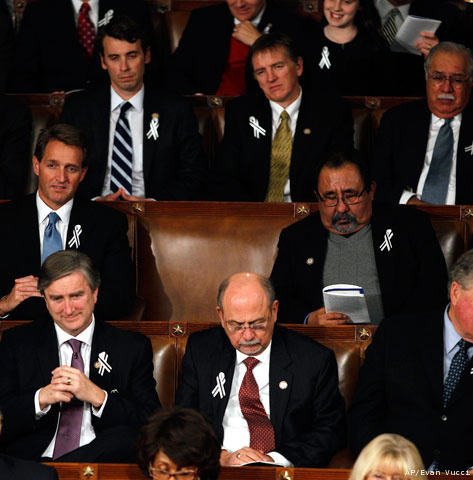
That's the Democratic Congresswoman from Arizona in the center.

Ethics Alarms first stated that Rep. Gabrielle Giffords was seriously disabled and needed to resign from the house on January 17, 2011. I wrote:

“Almost no medical experts foresee a woman with such massive head injuries being able to return to work within a year, if she can return at all. She only has a two-year term. Is it fair to the people of Arizona, not to mention the country, to have a member of Congress who is unable to work during the days ahead, which are critical to the nation on so many fronts?”

Although the answer to this question was obvious at the time, Rep. Giffords did not resign. I returned to the topic in March, June, September and November, but not only did the Giffords camp and Democrats continue to ignore the issue, the media largely did as well. Never mind that during a contentious and important year of critical legislative issues, one Congressional District in Arizona was essentially unrepresented.

Today, finally, Rep. Giffords announced that she had resigned, more than a year after being shot in the head. Her friend, Democratic National Committee Chair Debbie Wasserman Schultz, told the press that her friend’s recovery was likely to take years, not months. WOW! That’s a bulletin! Who had any idea that the Congresswoman was that seriously injured? Continue reading

“Let’s Have An Open Debate on Both Sides of This Controversial Issue. Wait…Your Side Offends Me. Shut Up. You’re A Bully.”

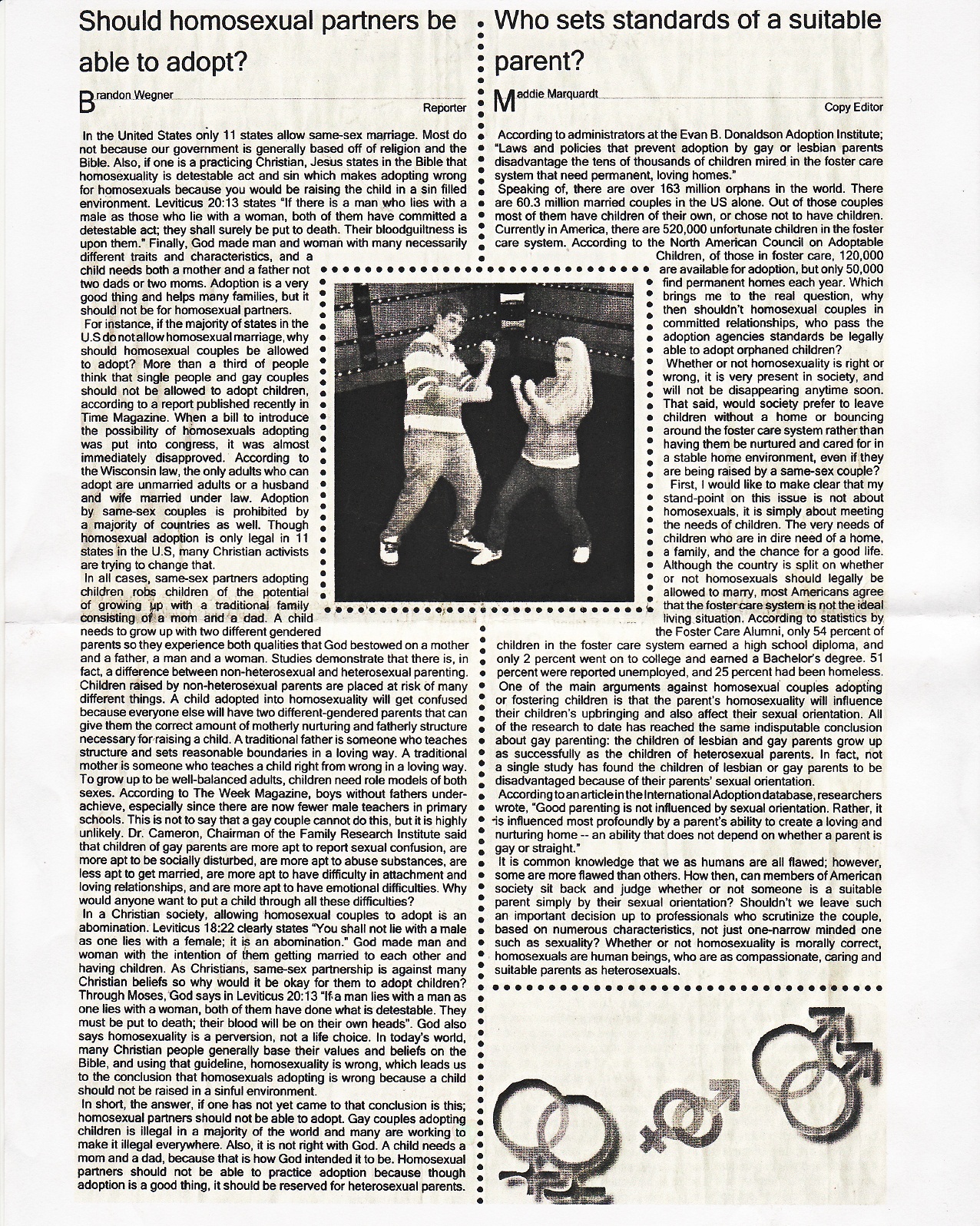
The Shawano (Wisconsin) High School’s student newspaper decided to publish a “Pro vs. Con” feature on the contentious issue of gay couples adopting children. A student wrote a column advocating each position.

In his column headlined “Should Gay Couples Be Allowed To Adopt?” student Brandon Wegner catalogued various arguments against gay adoption, and included this:

“If one is a practicing Christian, Jesus states in the Bible that homosexuality is (a) detestable act and sin which makes adopting wrong for homosexuals because you would be raising the child in a sin-filled environment….A child adopted into homosexuality will get confused because everyone else will have two different-gendered parents that can give them the correct amount of motherly nurturing and fatherly structure. In a Christian society, allowing homosexual couples to adopt is an abomination.”

A male couple raising a child who goes to the school saw the paper, and strenuously objected to school administrators, saying that the piece was hateful and would encourage bullying. Naturally, the school district immediately caved and threw the student, the paper and the column under a metaphorical bus, because that’s what school administrators do. If an anti-gay bigot had objected to the pro-gay adoption feature, it is even money that the school would have done the same.

An official mea culpa was immediately released: Continue reading