Ethics Quiz: Disclosing Information We have A Right To Know But May Not Want To Know

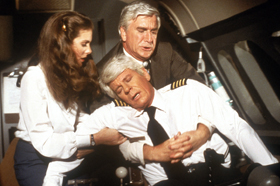
Travel blogger Margie Goldsmith has a provocative post about a nightmare flight she experienced on American Airlines. You can read it here. The plane had one problem after another, all of which were
How much about what's happening in that cockpit do we really want to know?

described in terrifying detail by the captain, who cheerily informed them that:

  • The plane’s hydraulic system was leaking and had to be repaired
  • During the delay, the pilot was going to watch a video about how to take off from that airport, which was especially tricky.
  • The new plane the passengers were later moved to had been really foul-smelling, and needed to be completely cleaned and deodorized
  • The new plane’s hatch wouldn’t close properly, and..
  • They finally sealed it with duct tape, and were going to fly that way.

Goldsmith ends her story with this: “The next time I’m on a delayed flight and the Captain does not announce the reason for the hold-up, I think I’m going to be one happy passenger.”

Your Ethics Quiz for today poses this question:

“Is it more ethical for an airline pilot to detail all the problems an airplane is having in the interest of candor and full disclosure, or should he or she just deal with the problems and not increase passengers’ anxiety over matters that they neither understand nor can do anything about?Continue reading

The Great American Hindsight Hero

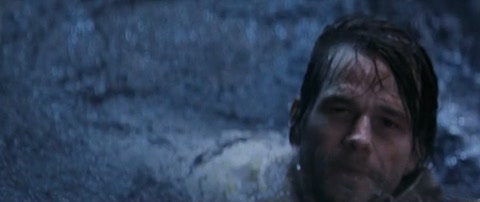
Mark Wahlberg, awash in delusions of competence

Actor Mark Wahlberg has already apologized, but it’s too late: he has ascended into the Valhalla of Ethics Alarms icons, and henceforth those who repeat his offense will be referred to here, and undoubtedly elsewhere, as having “done a Wahlberg” or perhaps, for simplicity’s sake, “wahlberged.”

The act of proclaiming, after a disaster or misfortune, how an individual involved could have prevented the situation has always been infuriating. My father’s favorite term for the practice was “Monday morning quarterbacking,” and he despised it. Psychologists identify the roots of the phenomenon as hindsight bias, but it’s more pernicious than that. What Mark Wahlberg did, however, is worse still: not only second-guessing those involved, but announcing that he personally would have saved the day if he had been there. Mix Monday morning quarterbacking and hindsight bias, blend in a distorted belief in one’s own ability to handle difficult situations that caused others to fail, add the eagerness to blame someone and make them feel as guilty and incompetent as possible, and add dashes of arrogance, lack of empathy and unfairness, and you have it: a perfect Wahlberg soufflé! Continue reading

Ethics Dunce: Greta Van Susteren

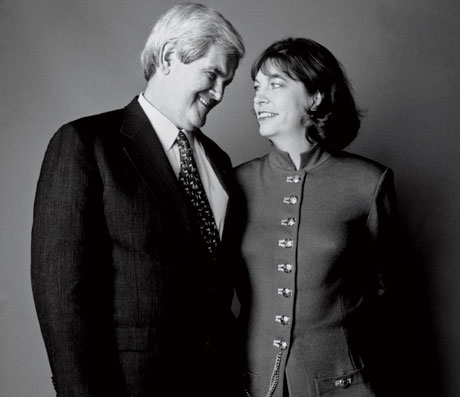
Newt: ” Honey, I’m divorcing you to marry the woman I’ve been cheating on you with for the last 6 years.” Marianne: “Fine. Just wait til you run for President. I’ll be ready.”

Newt Gingrich’s second (of three) wife, Marianne Gingrich, has said in the past that she had it within her power to  end her ex-husband’s career with a single interview. This is not as remarkable as it sounds; just consider how many political spouses past and present have or had that power regarding their own power partners. Let’s see: Eleanor Roosevelt…Jackie Kennedy…Coretta Scott King…Lady Bird Johnson….Pat Nixon…Hillery Clinton, of course…Bill Clinton…Laura Bush…Tipper Gore. That’s just for starters. I have no doubt that Marianne Gingrich might be able to tell tales that would make any of these women feel fortunate by comparison, but on the other hand, what could she say that would be a surprise? Anyone who doesn’t know by now that Newt is about as miserable an excuse for a human being as one can be and avoid being shot or imprisoned hasn’t been paying attention.

This is the problem, however. People don’t pay attention, and have the memories of Eric Holder under Congressional questioning about Fast and Furious. After Gingrich’s deft response to Juan Williams’ accusatory race-baiting question at the last South Carolina debate sparked a standing ovation, you would have thought that he was the new star on the scene to hear callers on conservative talk-radio rave.* Yes, yes, Gingrich is smart and articulate. So were Richard Nixon, Tom DeLay, Huey Long and Joe McCarthy. So were Professor Moriarty and Goldfinger. We know Newt is smart; we also should know other things about him by now, like the fact that he’s an untrustworthy narcissist and a cur.

Apparently Marianne Gingrich has decided to do America a favor and to remind amnesiac Republicans once and for all who they were cheering this week. She has taped a two-hour spill-the-dirt interview with ABC News. The Gingrich camp is in a panic, and supposedly there is an ethics debate at ABC about whether the interview should air before the critical South Carolina primary, possibly Newt’s last chance to stop the Mitt Romney juggernaut, or after. Fox host and legal analyst Greta Van Susteren comes down on the side of holding the interview in the can until Monday. On her blog, she writes: Continue reading

Phony Smile Ethics

From David Foster Wallace’s hilarious essay in Harper’s about a luxury cruise that did not (exactly) end in disaster:

This is related to the phenomenon of the Professional Smile, a pandemic in the service industry, and no place in my experience have I been on the receiving end of as many Professional Smiles as I was on the Nadir: maItre d’s, chief stewards, hotel managers’ minions, cruise director-their P.S.’s all come on like switches at my approach. But also back on land: at banks, restaurants, airline ticket counters, and on and on. You know this smile-the one that doesn’t quite reach the smiler’s eyes and signifies nothing more than a calculated attempt to advance the smiler’s own interests by pretending to like the smilee. Why do employers and supervisors force professional service people to broadcast the Professional Smile? Am I the only person who’s sure that the growing number of cases in which normal-looking people open up with automatic weapons in shopping malls and insurance offices and medical complexes is somehow causally related to the fact that these venues are well-known dissemination-loci of the Professional Smile?

I too hate the Professional Smile, which is, at its core, a lie. It is a mask, a fake-friendly message that may of may not have any truth behind it, and that at its worst has the frightening menace of  Sen. John McCain or Nancy Pelosi, both of whom specialize in the obviously false grin that has seething anger behind it, the smile that says, “I’m going to put you at ease and then, if you give me a chance, slit your god damned throat.” Continue reading

The “I Have A Dream” Speech Ethics Train Wreck

Dr. King's familiy says this was a "performance" not a speech. Funny: I thought he was just speaking the truth. I guess I was dreaming.

Take Martin Luther King Day, turn right at the “Stopping Online Piracy Act” (SOPA/ PIPA) protests, and you get to the ridiculous fact that you are breaking the law anytime you circulate a recording or video of the Martin Luther King’s immortal “I Have A Dream” speech.

Through a baroque combination of expediency, legal maneuvers, luck and greed, this vital part of American thought, rhetoric, culture and history is restricted by the copyright laws, and will not be in the public domain until 2037, or more than 70 years after King’s words were spoken in front of the Lincoln Memorial. Now, under SOPA/PIPA, if it passes, any educational website that includes a video of the King Video could be taken down by the Feds, but that’s a side issue. I am no expert on the bill, but you can brief yourself on what all the fuss is about here, here, here, and here, the bill itself. Similarly, if I tried to explain the legal process by which courts agreed that a critical chapter in American history should be unavailable to Americans unless they pay a fee, it would 1) bore you stiff, 2) confuse you, and 3) probably be wrong. So I recommend this post by Alex Pasternak over at Motherboard, who does a great job laying out the whole, tortuous, tragic story.

I’ll concentrate on the ethics train wreck feature, of which the basic elements are these: Continue reading

Creating Captain Costanzas

Metaphor

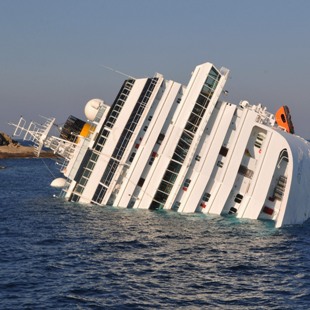
I think I stopped finding George Costanza funny when I saw the “Seinfeld” episode in which he panicked at a kids party after smelling smoke and trampled the children rushing to be the first out the door. (His callous reaction to his fiancée’s death from licking envelopes had paved the way for my inability to laugh at George.) The thought of a real-life George Costanza, the most unethical character on a show about unethical characters, serving as the captain of an imperiled ship full of passengers is horrifying, but that’s basically what befell the unsuspecting tourists on board the cruise ship that tipped over after hitting a rock off the coast of Italy. Having caused the accident, it appears, by irresponsibly changing course, captain Francesco Schettino hit the life boats before most of his passengers, and claimed to be directing the evacuation from the relative safety of a lifeboat as he defied orders from the Italian Coast Guard to return to the ship. Continue reading

Ethical Lawyers? There’s an App For That!

At least in New York.

The New York bar has launched a Mobile Ethics App that allows judges, lawyers and law students to access legal ethics advice from their smartphones.

The State Bar has made its catalog of more than 900 legal ethics opinions,available on an app for iPhones, Android phones and BlackBerrys, as well as iPads, through their respective app marketplaces. “Ethics questions can arise in many different contexts. The NYSBA Mobile Ethics App will allow judges, lawyers and others to access the opinions of the Association’s Professional Ethics Committee on the spot from the convenience of their mobile devices,” said Association President Vincent E. Doyle III of Buffalo (Connors & Vilardo). “The State Bar is pleased to provide this service to its members and the legal community.”

This is a terrific idea, and it is to be hoped that other bar associations follow suit.

Now if someone will  develop an app for government ethics…

[Thanks to Robert Ambrogi for the news]

UPDATE: Shortly after this was posted, I learned that another bar association has an app for ethics: the Alabama Bar, which launched the first organized code of professional responsibility that was adopted by the American Bar Association in 1908.

Mitt’s Gift

South Carolinian Ruth Williams says she was praying for divine guidance as to how she would pay a late electric bill when she found herself in the crowd around the Mitt Romney campaign bus. When she told the Republican presidential front-runner about her plight, he reached into his wallet and handed Ruth around $50 to help her keep her power on.

That bastard!

He only did it for the publicity, of course. (Though there were no cameras present.) Or he did it to show he was better than her. Romney gave her the money because he’s such a rich SOB that it was throwing crumbs to a peasant. Yesterday on CNN, a Democratic operative cited the incident as proof of how out of touch Romney is with the needs and feelings of regular Americans. After all, she said, he just carries all this cash around with him—it was like his betting Rick Perry that $10,000. (Williams says Romney emptied his wallet and gave him everything he had. Wow…the tycoon carries 50 bucks around.)

Over on MSNBC, where every act by a Republican is evil personified,  guest Joy-Ann Reid, a blogger for theGrio.com, was furious; she said that the hand-out proves Romney is a racist. Continue reading

Ethics Quote of the Day: Drew Curtis’ Fark

Mitt Romney is not a player.

“The stupid tax just doubled.'”

Drew Curtis’ Fark, in a typically perceptive jibe, at the announcement by Powerball officials that in order to increase the attractiveness of the multi-state super-lottery, it will be raising the levels of jackpots, lowering the odds against winning, and to make more money, doubling the cost of a ticket.

Fark. com was a guilty pleasure before I started an ethics blog, but is now a daily assignment, as Drew Curtis’s clever link collection where he simultaneously uncovers interesting news items and attaches one-line jokes to them has proven to be a rich source of ethics stories.

The various lotteries are all unethical, as state governments too cowardly to pass taxes on those who can afford it duck their duties by enticing the desperate, the poor, the  gambling addicted, and, as Fark correctly notes, the stupid, to spend money they should be saving or spending on necessities. Their foolish objective, nourished by state promotions, is to buy a remote chance at a life-changing stroke of luck—which, statistics say, is more likely to ruin their lives than to fix them. The original argument for these cynical and degrading devices was that they would balance state budgets and improve the schools. You can see how well that is working out.

So, times being tough, the biggest government pocket-picking scheme of them all,  Powerball,  is trying to suck in more people who shouldn’t be playing and who are grossly irresponsible to waste their money, while charging them more to do it. It’s unfair to have a tax on being stupid—being stupid in the 21st Century costs too much already.

But Fark is right. That’s exactly what Powerball is.

Ethics Quote of the Day: Rev. Martin Luther King (January 15, 1929 – April 4, 1968)

“On some positions, Cowardice asks the question, ‘Is it safe?’ Expediency asks the question, ‘Is it politic?’ And Vanity comes along and asks the question, ‘Is it popular?’ But Conscience asks the question ‘Is it right?’ And there comes a time when one must take a position that is neither safe, nor politic, nor popular, but he must do it because Conscience tells him it is right.”

—-Rev. Martin Luther King Jr., in his Feb. 6, 1968 speech in Washington D.C. entitled “A Proper Sense of Priorities.”