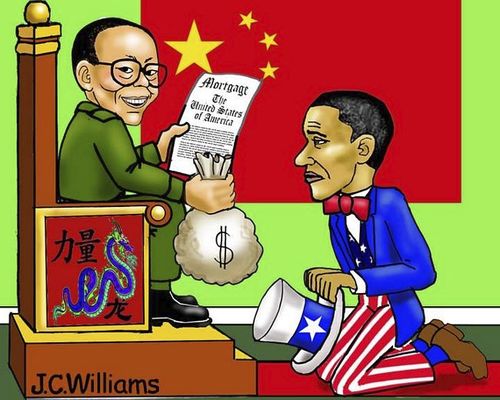
 “I arrived in the United States a month ago, thinking I had escaped the reach of Beijing, only to realize that the Chinese government’s shadow continues to be omnipresent. Several U.S. universities that I have contacted dare not invite me for a lecture, as they cooperate with China on many projects. If you are a scholar of Chinese studies who has criticized the Communist Party, it would be impossible for you to be involved in research projects with the Chinese-funded Confucius Institute, and you may even be denied a Chinese visa. Conversely, if you praise the Communist Party, not only would you receive ample research funding but you might also be invited to visit China and even received by high-level officials. Western academic freedom has been distorted by invisible hands.”
—Yu Jie, Chinese dissident and author recently relocated to the U.S., in an op-ed column in the Washington Post, exposing how America’s dependence on China for trade and financing has not only made the nation vulnerable, but is also eroding its integrity and values.
Every budget cycle that the United States permits to expand its debt makes the nation more indebted to China, and places more power in the hands of its leaders to exert influence over American policies. Yu Jie’s disturbing article shows how our values are being undermined as well. China’s is a repressive, undemocratic and often brutal regime that the United States has foolishly allowed itself to become dependent upon. What will the consequences of this be? How can the United States lead the free world while being under the thumb of the Chinese? Corruption is inevitable. Yu Jie writes,
“…For working on human rights with Liu Xiaobo, after he was awarded the Nobel Prize, I was tortured by the country’s secret police and nearly lost my life. Since then, dozens of lawyers and writers have been subjected to brutal torture; some contracted severe pneumonia after being held in front of fans blowing cold air and then being baked by an electric furnace. The secret police threatened me, saying that they had a list of 200 anticommunist party intellectuals whom they were ready to arrest and bury alive. Over the past year, the number of political prisoners in China has increased, and the jail sentences have become longer — yet Western voices of protest have become weaker…”
Small surprise. Today President Obama is hosting…and sucking up to…the next leader of China, Xi Jinping, who holds Obama’s marker. The urgency of getting free of China’s financial dog collar is as great or greater than the urgency of bringing our finances under control, yet the government is hardly making any progress accomplishing either. As a result, the US risks becoming an unwilling puppet of a very unethical puppeteer.
Yu Jie should know.
 Ethics Alarms
This isn’t really a matter of debt but of economic opportunities. If current trends continue, the economic prosperity of the developed world will depend on how well they can integrate their economies with the developing world (including China). For this reason, no-one who has an interest in making money in the future (or right now, for that matter) has an interest in annoying China. This includes universities (which always want funding) and governments (which want their citizens to make money). This would remain true whether the United States owed China $2 trillion or $0.
That’s an interesting take, Eric, but I think that’s a little flip. Obviously that kind of debt puts the US in a position of weakness.
Sort of. Remember the old saying “If you owe the bank $100, that’s your problem. If you owe the bank $1 billion, that’s the bank’s problem.” The US debt is a bit like that. China owns a lot of it and it wants it to remain valuable. If it were to suddenly sell a large share, the value of its holdings would drop because it would be massively increase the current and expected future supply of t-bills on the market. It would also drive China’s currency up against the dollar, which would hurt their exporters.
It is true that China could use US indebtedness as a geopolitical bargaining chip, but it would be something like a “nuclear option”. Both China and the US would lose from a big Chinese sell-off, but there may be some issues on which the Chinese would be willing to threaten a sell-off in the hopes that the US would “blink first” and back off (akin to what Eisenhower did to the British during the Suez crisis).
When it comes to the ordinary, everyday kowtowing to the Chinese, that’s a sign of their economic power, not their debt ownership. Look at Australia, which has very little debt. China is Australia’s biggest export market and the Australia treads carefully when dealing with China. Alternatively, look at Canada, which has debt but not, as far as I know, a significant amount to China. Canada’s current PM came into office promising not to sell out Canadian values for “the almighty dollar”, yet just last week he was in China, trying very hard to boost Canada’s trade to China and keeping rather quiet (at least publicly) about human rights (mind you, this came after Canada was snubbed by the US over the Keystone pipeline, so he was trying to remind the US that Canada has other trading partners).
Yes, that perspective is worth keeping in mind, but it is based on assumptions that another ideology and culture reasons like we do, and that has backfired on the US before. Tom Clancy has a scary novel in which Japan uses its economic leverage to cripple the US. IF China decides to take back Taiwan, do you not think China’s financial sword of Damocles will be a consideration in deciding whether to meet our traditional obligations to that democracy?
Yes, it would be a consideration for the US (this would be similar to what happened during the Suez crisis). China has financial leverage outside of debt, though (it would hugely damage the world economy if China and the US entered into a cold war style confrontation). If China and the US (and its allies) got into a hot war, the consequences for the world would be so grave that debt would probably be low down on our list of worries.
Our bonds our owned by Chinese interests. That’s a completely different situation than what Yu Jie was talking about.
That you think we’re under the thumb of the chinese and that we have a financial dog collar shows that you are not qualified to discuss the ethics of the situation. Those statements don’t match the actual economics of the situation.
Clarification:
Your logic is solid, but one of your major premises is false, so your conclusion is junk.
I think China’s economic power, its global influence and its ownership of US debt are related, so Jack is not wrong, but I think that there are issues that go beyond debt (as I have said).
The debt relationship I have with BoA gives them absolutely zero influence into how I do things…and that’s a direct debt with a single company, instead of the indirect bond debt that the U.S. currently has.
Compare that with if BoA was giving out grants to build additions to houses. Then they’d have influence over the people relying on those grants.
The ethical considerations I see coming out of this quote are considerably less broad than Jack claims.
Sometimes lenders do have leverage over their borrowers, especially if the borrowers want to roll over their loans in the future. No-one would deny that the lenders to the European Financial Stability Facility have leverage over Greece. What leverage China has over the US is a speculative matter. My argument is that, so far, the leverage is hypothetical.
I grant you the Greece situation, but, again, that’s not parallel to the U.S.’s debt.
I also agree that the leverage is hypothetical and nothing more than speculation.
Tgt, as is occasionally the case, it just isn’t as cut and dried as you think.
This research suggests uncertainly about how Chines leverage might be used. Uncertainty suggests risk. Ergo, the US is probably less likely to contend with China for the reasons I suggest, as well as the different reasons the dissident referred to.
Click to access RL34314.pdf
I haven’t read the whole thing, but the summary doesn’t suggest uncertainty about how the Chinese leverage might be used, or even that China has leverage. It notes that members of congress have raised such as an issue. If the paper matches the summary, then it’s completely worthless for defending your point.
The summary also doesn’t not back your belief that the US is less likely to contend with China. It actually talks about what Chinese interests could do to alleviate their reliance on US debt.
Have you read the paper? Is it just that the summary is not representative of the paper, and the paper actually supports your position?
My position is that the situation gives China leverage over the US if enough people in power think it does. The key sentence in the report is: “It is difficult to determine whether China’s holdings of U.S. securities give it any leverage over
U.S. policies.” If Biden is moved to shrug off one-child policies (and resulting baby killing) when he speaks in China because he is afraid the Chinese have leverage, it makes no difference whether it does or not. Yes, he’s an idiot. So are a lot of our policy-makers. I think you’re quibbling.
Your key sentence doesn’t in the least imply that we should change anything. This is the same logic:
—It’s difficult to determine if whether Jack’s parenting causes harm to his child, therefore we should remove Jack from his child’s life.—
Even if I grant you that the issue is belief theire is leverage, that problem can be solved in different ways. Your option is remove what peope believe could cause leverage, but I think spreading information so this misconception is removed would be just as effective.
You’re letting your dislike of debt color your opinion of this situation.
(As an aside, I think Biden ignored the bad chinese policies when he speak in China not because of economic leverage, but because that’s the political reality of foreign speeches in major countries in general.)
Another reason for shrugging off China’s one-child policy is because there is no direct benefit to foreign politicians who talk about it. China isn’t going to change its internal policies just because Joe Biden (or another foreign politician) criticizes them. American companies are still going to want to do business in China, so any criticism of China from Biden (or any other major politician) is likely to only going to make their lives harder and annoy them. American consumers will still want to buy Chinese goods. Staying quiet makes life easier for many and doesn’t harm anybody (those harmed by the policy will be harmed regardless).
Your argument supports non-commentary. Biden’s comments–“I get it!’ in essence—was widely interpreted as a near-endorsement.
At this point, you’ve dropped the bar from what is to what politician’s believe to what we think polititician’s believe.
My, you are existential today. We never know what politicians believe. We only know what we think they believe.
I think this was a large shift. I can see that it matters what politician’s think (as that’s what governs their conduct), but it’s less obvious to me that it matters what we believe they think. At that point, you’re arguing that if congressmen don’t believe there’s any leverage and so won’t be affected by such in their actions, it’s still unethical just because we interpret their behavior as if it’s compromised. I’d rather my government do right, even if the populace thinks it’s wrong than do wrong to satisfy their constituents.
Being afraid of the Chinese using their debt as leverage would also support non-commentary. It is hard to believe that the Chinese would threaten to sell US debt if Joe Biden (Joe Biden!) didn’t endorse a controversial policy, given how much doing so would hurt them. If you truly believe that Biden said what he said because of threats, it could just as easily have been that the Chinese threatened to make business difficult for US companies in China if Biden didn’t endorse the one child policy. Both of these possibilities are fanciful. I think the most we can conclude from what Joe Biden said is that Joe Biden likes to say odd things.
I think is comments on the Universities has been missed in this discussion. No matter how craven our federal government has been, why are the Universities allowing themselves to be censored by the Chinese? There are two reasons:
(1) We have too many colleges in this country. The old fallacy that you have to expand or die has been embraced enthusiastically by colleges and boards of trustees across the US. Although the number of college aged children have not increased much, many (probably most) schools have added fancy new buildings and added a lot of students. There aren’t that many schools left who reject any but the most obviously unqualified students. In my state, the average ACT score for their incoming students is 2 points BELOW the national average of people who take the ACT! These students have almost no college funds so they have to have discounted tuition. How do the schools stay afloat with reduced state spending? Foreign students! They pay full, out-of-state tuition (unless they are illegal aliens, in which they pay in-state, but that is another issue). One foreign student is worth 4 in-state students, possibly more. A small number of Chinese students can make or break a budget. They may only be a small part of the budget, but they can exert an extreme amount of pressure on the administration.
(2) The demise of tenure and academic freedom. Tenure doesn’t mean what it used to. Academic freedom is often reserved for the administrations and is only theoretically present for the faculty. In the past, faculty would be free to invite speakers regardless of the administrations wishes. As long as it served an academic purpose, it could be done. Faculty used to run the speaker services and decide who to invite. That power has been usurped by the administrations. Faculty used to be able to disagree and argue with administration positions. Any faculty member who publicly disagrees with an administration position risks being charged with insubordination and fired, tenure or no tenure. I think we partially brought this on ourselves. So many colleges became liberal bastions, vocally contemptuous of the values an view of the majority of Americans that people wondered what this ‘academic freedom’ was for. It seemed mainly to allow ‘high-paid’ professors to scoff and mock the taxpayers and promote Communism, sexual promiscuity, and drug use all while teaching 3 hours of classes/week. In light of this view, people didn’t object to a reigning in of the faculty. I think if University faculty hadn’t become so ideologically out of balance with American society, I’m not sure we would have the current situation.
The Comment of the Day, Michael! Thanks.