Yum-yum!
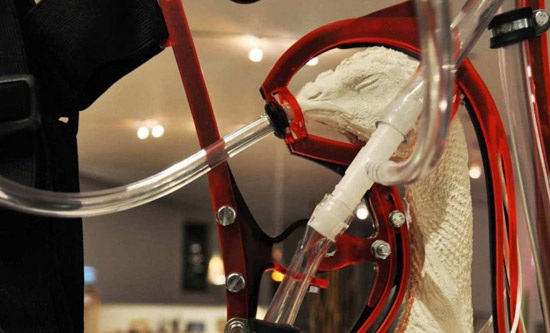
Architecture Student and artist André Ford has sparked an ethics debate after proposing that chickens be raised for meat in vertical racks after their frontal cortexes have been severed, rendering them brain-dead and essentially growing meat. The question is, would this practice be more ethical than current factory farming, less ethical, or does it make no difference?
Ford’s system would have the chickens suspended and immobile, with their feet removed. Tubes would supply water and nutrients directly into them while other tubes would carry away their waste. The chickens, of course, wouldn’t feel a thing, which one could argue is a superior state to the well-documented stress and misery they would experience in traditional chicken farms. Meanwhile, the costs of raising chickens would be (theoretically) reduced, in part because far less space would be required, and the process would also be cleaner—again, theoretically.
Ford acknowledge similarities to “The Matrix,” but notes that the chickens, unlike the human victims of “The Machines” in the Keanu Reeves cult classic, won’t be provided with an alternate chicken reality to keep them happy and content. It is fun to speculate on what an alternate chicken reality might be, however.
Science blogger Tibi Puiu is horrified by the whole idea, writing,
“While lobotomizing the chickens will certainly spare them of great suffering, the act itself is cruel. The concept is terribly disturbing, and if applied, it would surely be passed along to other livestock currently raised for meat, like pigs and cattle. This prospect alone is enough, for me at least, to ban such idea from fruition. It might actually spread to a real-life Matrix scenario in which humans, clones most certainly, are raised for body parts, organs and stem cells. There’s no such thing as a “small-compromise” – it always leads to another, and the lesser evil isn’t necessary the best solution.”
A better example of mistaking the Ick Factor for ethics it would be hard to find. There is nothing about Ford’s proposal that is inherently unethical. “Dignity” is a nonsensical concept when we are talking about chickens being raised in a factory for food: if the chickens suffer less with lobotomies, then the practice cannot be called “cruel.” If the practice worked and was adopted for pig and cattle, so what? Again, it is no crueler than what they have to endure anyway, and it isn’t as if cattle are being deprived of an inner life. Then Puiu inexplicable leaps to dystopian slippery slope horror, as critics of technological advances often do. New procedures are not unethical because they might be employed unethically in the future, and that applies to the zombie chicken scheme more than most. You’re right, Tibi—we always see livestock-raising methods carry over into the treatment of humans. When human clones are raised for body parts (this was the plot of “The Island,” you may recall) then I think we’ll have to watch out for the Matrix approach, but it won’t be because we “compromised” regarding chickens. Small compromises do not always lead to greater ones; society can and does draw hard lines and make absolute prohibitions. That’s part of society’s job.
There’s nothing unethical about Matrix chicken farms that isn’t unethical about raising chickens for human consumption in the first place.
On a side note, I would like some credit for resisting about twelve good chicken puns out of respect for the topic.
It wasn’t easy.
 Ethics Alarms
I’m not sure it’d give as good meat. If the chickens aren’t moving around, even a little, they aren’t really developing as much muscle mass.
They barely move around in the current system, though.
The bulk of market-desirable chicken meat is in the breast, which is already remarkably over-developed in an animal which doesn’t fly. Genetics would seem to matter more than exercise to modern chickens, and lack of movement may contribute to whiter, more tender meat.
I think the slippery slope is one to be careful of, but even with its objections I would agree that this would be better overall. Most people would come to accept this I feel. 1. It cuts down the cost of food. What family or person doesn’t want to save money when possible? 2. It eases the suffering of the animal. For those who have seen Food, Inc. this is a big deal. Interesting post. Enjoyed reading it.
I can’t believe I get to pass on this story on this site and have it be relevant:
http://www.miketheheadlesschicken.org/story.php
How do you lobotomize a creature that has a brain the size of a runt flea? Remember the chicken that survived for two months after being beheaded? They’re already essentially brainless, so leave ’em alone!
Yeah, they said the same thing about Christine O’Donnell, and look what happened.
Bah-DUMP-bump!
Okay, you’ve gotten in a cheap one liner, which should free you up for the chicken puns you so scrupulously avoided in the post. Deal ’em out, dude, and let’s see how your list compares with mine.
Time to put the dog back on your head, Jack!
What? What did I say???
Sayeth the dog, “He started out as a wart on my butt!”. Poor Christine couldn’t help it that she was from the wacky, county-sized state that gave us Joe Biden. Compared to the current Delawarean political lineup, she still comes across like Margaret Thatcher… broomstick and all!
Your chivalry is touching. Christine O’Donnell couldn’t come across as Margaret Thatcher if she had a debate with the Pussycat Dolls after THEY were lobotomized (out-patient surgery in their cases.)
Who are the Pussycat Dolls? Do I want to know??
Of course not.
Am I wrong to rank brainless chicken farming as far more ethical than harvesting organs from comatose humans, or am I falling victim to sentimentalistic speciesism?
The latter, Nill!! LOL
Not wrong at all.
Yeah but even then the chickes will be better actors then Keanu Reeves
It’s not necessarily a linear calculation.
Raising farm chickens can be thought of as ethical, lobotomizing the chickens beforehand can be clearly better than the farm raising method by most ethical considerations, but we can still consider raising lobotomized chickens as unethical. There is no problem with that. There is no contradiction.