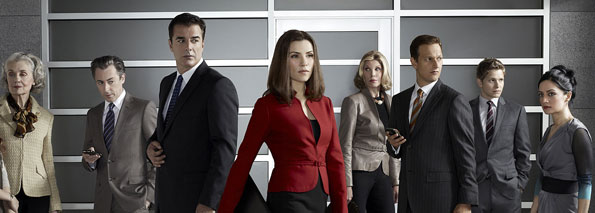
CBS’s “The Good Wife” remains ensconced in my Hall of Fame for TV lawyer dramas, but last night the series committed the kind of “what the hell?” blatant legal ethics gaffe that causes many lawyers to avoid such shows.
The situation is one that may be dramatic but hardly unusual: the client who lies on the witness stand. Unlike a lot of the ethical conundrums that are concocted in the fevered brains of TV scriptwriters (“Your client leaves a human head in your office—what do you do?”—“The Practice”), this is one that is thoroughly explored in law school and one which every competent litigator has to be prepared to face, because 1) it happens and 2) the legal ethics rules about how a lawyer is supposed to handle it have bounced all over the place, like William Shatner.
In the latest episode, “Long Way Home,” Good Wife Alicia Florrick finds herself examining her client on the stand as he seeks an injunction that will retain his business empire. I should mention that the client, Colin Sweeney, is a recreational liar and the personification of evil incarnate, and that any law firm that would willingly represent such a client as anything but a criminal defendant is asking for exactly the kind of grief that occurs in the episode, making Alicia’s puzzlement when it occurs even more implausible. The injunction involves the question of whether Sweeney has been falsely accused of sexual harassment by a former employee, and Sweeney emphatically testifies under oath, in response to his attorney Alicia’s direct question, that he never had sex with the woman making the accusation—she wasn’t his type, he says. smirking.
Afterwards, however, Sweeney happily divulges that he was given oral sex by the woman on five occasions. Despite his quaint Clintonesque argument that this wasn’t “real sex,” he has obviously misled the judge and made a material misrepresentation in court.
For any real lawyer, this sets the ethics alarms ringing like in a nine alarm fire, and a lawyer’s first response to those bells should be to check her jurisdiction’s Rules of Professional Conduct, in Alicia’s case, Illinois. Not our heroine, however. She decides to consult her senior partner and occasional lover, Will Gardner, whose legal ethics expertise might be considered juuuuust a bit suspect these days since he is currently suspended from the practice of law for serious ethical misconduct. So TGW asks Will what the proper course is if a client testifies under oath to certain facts and afterwards reveals that he was lying through his teeth. Will’s answer is, to be kind, nonsense. He says that because she didn’t know the statement was a lie when it was being made, she did not suborn perjury (that wasn’t her question, Will) and that since she has a duty to protect the interests of her client, she should not divulge the fact of his perjury to the judge and can even continue to use his false assertion in her arguments as the hearing proceeds.
This isn’t just wrong, but mind-blowingly, crazily wrong. Maybe Will just wants a partner in that McDonald’s franchise he’s going to have to open as his new career path, because following that advice should get Alicia disbarred. Here’s what the Illinois Bar says Alicia is supposed to do—it’s right in Rule 3.3, Candor Toward the Tribunal:
(a) A lawyer shall not knowingly:
…
(3) offer evidence that the lawyer knows to be false. If a lawyer, the lawyer’s client, or a witness called by the lawyer, has offered material evidence and the lawyer comes to know of its falsity, the lawyer shall take reasonable remedial measures, including, if necessary, disclosure to the tribunal.….
Don’t you think that’s pretty clear? SHALL NOT knowingly offer evidence the lawyer knows is false—there goes Will’s theory that Alicia can keep referring to her client’s lie in the hearing. SHALL take reasonable remedial measures, including, if necessary, disclosure to the tribunal…where did Will get the idea that Alicia can ethically become an accessory to perjury after the fact?
The Rules elaborate on what the appropriate remedial measures are for a Good Wife who wants to be an Ethical Lawyer:
- “Having offered material evidence in the belief that it was true, a lawyer may subsequently come to know that the evidence is false…” [This is exactly what happened in the episode.]
- “…In such situations… the advocate’s proper course is to remonstrate with the client confidentially, advise the client of the lawyer’s duty of candor to the tribunal and seek the client’s cooperation with respect to the withdrawal or correction of the false statements or evidence.” [This Alicia didn’t do. When Sweeney revealed his lie, she just looked exasperated and ran off to consult her ethically-shamed partner.]
- “…If that fails, the advocate must take further remedial action. If withdrawal from the representation is not permitted or will not undo the effect of the false evidence, the advocate must make such disclosure to the tribunal as is reasonably necessary to remedy the situation, even if doing so requires the lawyer to reveal information that otherwise would be protected by Rule 1.6. [Rule 1.6 is the core ethical Rule forbidding an attorney from revealing a client’s confidences and secrets. Once, pre-Enron and Sarbanes-Oxley, many of the jurisdictions forbade a lawyer from revealing a client’s perjury even in this situation, but no longer. ]
- “…It is for the tribunal then to determine what should be done-making a statement about the matter to the trier of fact, ordering a mistrial or perhaps nothing….”
The Rules, in its Comments to 3.3, go on to say…
“The disclosure of a client’s false testimony can result in grave consequences to the client, including not only a sense of betrayal but also loss of the case and perhaps a prosecution for perjury. But the alternative is that the lawyer cooperate in deceiving the court, thereby subverting the truth-finding process which the adversary system is designed to implement...Furthermore, unless it is clearly understood that the lawyer will act upon the duty to disclose the existence of false evidence, the client can simply reject the lawyer’s advice to reveal the false evidence and insist that the lawyer keep silent. Thus the client could in effect coerce the lawyer into being a party to fraud on the court.”
There is no question about it: “The Good Wife” misrepresented the ethical obligations governing the conduct of Illinois lawyers who learn that their clients have lied on the witness stand as badly as Colin Sweeney misrepresented his sexual exploits.
I love ya, Alicia, but next time, read the Rules!
 Ethics Alarms
Now you know how an engineer or scientist feels when watching most Science Fiction shows, only those casually violate basic laws of physics, not just man.
Cop shows do it to me too…
Think of the scientists in TV and movies. I think “Medicine Man” eventually became a graduate school drinking game (how lucky he found a tree with built-in 110V AC outlets in the middle of the jungle!).
Let’s see. Three-to-five blogs a day (plus research-ante and responses-[post to posts). Audition, rehearsal, performance. Visual strip-search, flight, to-from, lecture. Family minutes. Sleep hour. Whatever else you do during your average day . . . . . .
No. I’m not asking why you watch stupid stuff on TV. That’s what it’s for. I just wondered why you choose to watch programs that you know to start with are going to raise your blood pressure. It’s a busman’s suicide.
No, “the Good Wife” has been, up to recently, one of the better legal-themed TV shows of all time in its exploration of the nuances of legal ethics. “Harry’s Law”…now THAT’s a stupid lawyer show.
I am a bit worried about Alicia and the gang, though. They’re heading into “Boston Legal” territory.
“But… ever’body duz it.”!