Ethics Quiz: The Case of the Unauthorized Clean-Up

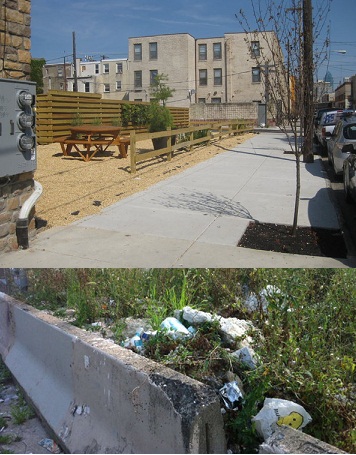
The photo on top is how the lot looks today, thanks to a generous citizen. Philadelphia wants it put back to the way it looked in the lower photo. Wait…WHAT?

Can an act that benefits everybody still be unethical? That’s the underlying conundrum in this week’s Monday Warm-Up Ethics Quiz.

In the Point Breeze neighborhood of Philadelphia, a city-owned lot was in nightmarish condition, filled with trash, weeds and rats. Ori Feibush owned a coffee shop that backed onto the lot, and had repeatedly petitioned the city to do something about it, like clean it up. Feibush, who also is a real estate developer, says he submitted seven written requests to buy or lease the land, calling the Philadelphia Redevelopment Authority about it 24 times. There was no response to any of this, and the city claims that it has no record of any inquiries.

Finally, Feibush couldn’t stand the mess any more. He spent more than $20,000 of his own money to clean up the lot, removing more than 40 tons of junk, garbage, and trash. Point Breeze residents are thrilled.

The city, however, is threatening to take legal action against Feibush for trespassing, explaining through a spokesman that “Like any property owner, [the Philadelphia Redevelopment Authority] does not permit unauthorized access to or alteration of its property. This is both on principle (no property owner knowingly allows trespassing) and to limit taxpayer liability.” It is demanding that Feibush return the land to its original condition—that is, fill it up with garbage so it is an eyesore, dangerous, and useless again.

Your Ethics Quiz:
Who is in the wrong, the city, or Ori Feibush? Continue reading

CNN and the Ambassador’s Journal: Unethical or Ick?

Answer: Ick

Ambassador Chris Stevens, murdered in Libya in what is now finally being described as a planned terrorist attack (and not spontaneous film criticism, as the Obama Administration successfully persuaded the media to claim for more than a week), left a brief hand-written journal behind that somehow was retrieved by CNN instead of the U.S. government. When Anderson Cooper revealed that the journal had been reviewed by reporters and used to cover the story of the Benghazi attack, both the slain diplomat’s family and the State Department criticized the network, which said,

“We think the public had a right to know what CNN had learned from multiple sources about the fears and warnings of a terror threat before the Benghazi attack which are now raising questions about why the State Department didn’t do more to protect Ambassador Stevens and other US personnel.Perhaps the real question here is why is the State Department now attacking the messenger.”

Well, there are interesting theories about that, since what the late Ambassador had written suggests that there was fear of a terrorist attack in the vicinity of the 9/11 anniversary, yet both Secretary Clinton and President Obama went to great lengths to characterize the Benghazi violence as prompted by spontaneous and legitimate rage over an American’s exercise of his right of free speech. There is a rebuttable presumption that the State Department was prepared to bury the implications of what Stevens wrote, since everything else it has done in relation to his murder has been misleading or pusillanimous. In the latter category is using Stevens’ family as its excuse for bashing CNN for delivering on its duty to provide what the public “has a right to know.” Continue reading

Ethics Heroes: Papa Roach

Ethics Alarms’ 2011 Commenter of the Year tgt, who found this story and passed it on, asks,

“How is a horrible stoner rock band more ethical than everyone in politics?”

It’s a great, if sorrowful, question.

A.V. Club has a feature (which could be called “Start a Feud”) in which it asks a rock performer what song he or she hates, and why.  Jenn Wasner, one half of the Baltimore indie-folk duo Wye Oak (“a blend of Southern culture and Northern sensibilities…”) submitted to this invitation to get in trouble, and fingered the song in the video above, “Scars,” by Papa Roach.

Criticizing the work of other artists in the same field is unprofessional at best, gratuitously unkind and disrespectful. Papa Roach’s members would have been within their rights to fire back something less than complimentary in defense, at very least the observation that ethical musicians don’t take gratuitous shots at one another. What the band did however, was this: it sent Wasner flowers. Wasner was convinced it was some kind of diabolical trap, and tweeted as much. The band tweeted back: Continue reading

Romney’s “Worst Weeks” and the 27th Rationalization

Yeah, yeah, but did you hear what Mitt said to raise money?

Normally I would consider the surreptitious taping and then publicizing of a quasi-private meeting unethical, writes a lawyer colleague, “but these are not normal times.”

I thanked him profusely for alerting me that I had inexplicably allowed a hoary, classic rationalization for unethical conduct with a distinguished pedigree to escape the Ethics Alarms list, though this was not, I gather, his original intent. I just remedied the embarrassing omission, dubbing this The Revolutionary’s Excuse.” Here is the entry:

27. The Revolutionary’s Excuse:

“These are not ordinary times.” Continue reading

The Ethics Incompleteness Dilemma and MLB’s Melky Cabrera “Solution”

Who cares what Melky wants?

[ When we last visited the messy Melky Cabrera situation, people were clamoring for baseball to rule Cabrera ineligible for the National League batting championship he seemed destined to win because the Giants outfielder had been suspended for the rest of the season for testing positive for steroids. The suspension froze his average, then as now leading the NL, and because he had already amassed sufficient at bats to qualify for the title, this meant that 1) he would benefit from what was supposed to be a punishment and 2) the most prestigious of all baseball season titles would be won by a proven cheater. I explained why taking the title away from Melky would be unethical as well as unwise:

“…There is a very good reason why the Constitution bans ex post facto laws—laws that make something illegal retroactively, so someone can become a criminal for something they did that was legal when they did it. Allowing such rules is an invitation to an abuse of power, culminating, in the worst case scenario, with the modern day equivalents of the Russian or French Revolutions, where people are executed for “crimes” that were not crimes at all. Even cheaters have rights, and one of them is to know what their risks are when they cheat. Cabrera knew that he risked suspension, a loss of millions in income, and permanent harm to his reputation and career. He did not know that he risked not winning a batting championship if he qualified for it, or being put in the stocks, being exiled to Portugal, or having his children subjected to human medical experiments. Should a player suspended for performing enhancing drug use after testing positive be disqualified from winning a batting championship that season? That seems fair and reasonable, but because Major League Baseball didn’t think of it when they were making the rules, it would be unfair for Cabrera to be subjected to such a penalty, which would embody the inherently unfair principle of an ex post facto law. Some people just can’t process this. People just shouldn’t get away with intentional bad conduct, they say. …Such people are unwittingly willing to dismember the bedrock principle of due process, which requires that we know by what rules and laws our conduct society will use to judge our conduct, and that we know what the penalties for violating them will be, or at least have a the opportunity to find these things out. No, of course it’s not fair for Melky Cabrera to win a batting championship by cheating, but a society that allows him to be penalized in ways he could not have anticipated using a rule imposed after the fact is an unfair society, and ethics is ultimately about building a more ethical society.”

Bud Selig, the Commissioner of Baseball who is always as likely to make a terrible decision as a good one, said that he would not take any action on the matter. But that was not the end of the story…]

Yesterday, Major League Baseball announced that Melky Cabrera would not be eligible for the batting title after all. Continue reading

Cruelty and the Comers: At a Certain Point, Being Nice Just Makes It Worse

Meet the Comers

The nauseating news story of the week comes from L.A., where 18-year-old Mitch Comer was seen looking emaciated and confused in a downtown Greyhound bus station. A hundred pounds and 5’3″ tall, the boy seemed lost, and a security guard questioned him. Comer explained that he had just arrived from Georgia, where he had been imprisoned in his parents’ basement since his father pulled him out of an 8th grade class four years ago. Then, on his 18th birthday, they released the boy, and his stepfather took Mitch to the bus station, where they had a touching goodbye

“The story we got was that the stepfather took the kid to the bus depot, said ‘Here’s $200, here’s a list of the homeless shelters in Los Angeles, you’re a man now and don’t come back,'” said LAPD Commander Andrew Smith. This won Paul and Sheila Comer, who live in an affluent Georgia suburb, child abuse and false imprisonment charges as well as a nomination as 2012’s Monstrous Parents of the Year. Continue reading

The Part of Legal Ethics The Public Will Never, Ever Understand

Sen. Brown has the pulse of the public on this issue, and like the public, he’s ignorant.

Especially since politicians like Scott Brown keep making sure that they misunderstand.

In this week’s Massachusetts Senate debate between Sen. Scott Brown and Democratic challenger Elizabeth Warren, Brown slammed the anti-corporate crusader, the self-styled intellectual catalyst for the Occupy Movement, for accepting $250,000 from the Travelers insurance company to help the company deny claims for asbestos poisoning. He said:

“You chose to side with one of the biggest corporations in the United States: Travelers Insurance. When you worked to prohibit people who got asbestos poisoning, and I hope all the asbestos union workers are watching right now. She denied, she helped Travelers deny those benefits for asbestos poisoning, made over $250,000 in an effort to protect big corporations….”

Brown is accurately stating the way most people look at lawyers and what they do. But he is absolutely mistaken. His characterization of what Warren did is incorrect, and his inference of hypocrisy is unfair.  It is all the worse because he is a lawyer himself. If Senator Brown, as a lawyer, doesn’t understand what’s wrong with his accusation, he should. If he does know, then he is undercutting his own profession for political gain. [NOTE: The original version of the post incorrectly stated that Brown was not a lawyer. My thanks to Mass lawyer James Flood III for flagging the error.] Continue reading

Ethics Dunce: Major League Baseball

MLB Wild Card play-off, 2020

I dislike baseball’s play-offs, especially the fact that a team that finished second over a 162-game season can still win the World Series and be called a champion. I really dislike the addition of a second “wild card” team to the post-season formula this year, which theoretically means that a team can finish third and end up as a champion. Yes, I know this is the way it has been for decades in football, basketball and hockey, but they are lesser sports, after all.

Baseball’s rules for the new one-game play-off between the wild-card teams, however, marks a new low in baseball’s integrity. Since it the single game is a separate play-off round, the suits who run the game have decided that managers can devise a unique 25 player roster for that game alone, and reconstitute the team if it goes on to the next round, a three-out-of-five series. The practical effect of this rule is that two teams will face each other not only bearing insufficient resemblance to the teams that actually earned the play-off slot, but will also play with a roster that would be disastrous over the course of  a season. Continue reading

Someone Please Explain to Soledad O’Brien That Attorney General Holder is NOT “Exonerated” Regarding Fast and Furious

So much attitude, so little comprehension…

[I apologize to all for not posting anything yesterday. I was handling back-to-back seminars, and had to drive a long distance in-between. by the time I got back home late afternoon, I was too wiped-out to write anything coherent, and that state persisted until I went to bed. I’ll be trying to catch up today.]

CNN’s partisan hack morning anchor Soledad O’Brien was smirking and raising eyebrows to beat the band yesterday morning, as she announced to her audience that the Inspector General’s report on the Justice Department’s deadly botch of its so-called gun-walking scheme, codename Fast and Furious, had “exonerated” Attorney General Eric Holder. I suppose I am giving O’Brien the benefit of a considerable doubt here in assuming that she knows what the word means, but to exonerate is to free from blame or responsibility. The 471 page report does state that there is no evidence that Holder knew about the operation before it had gone horribly wrong, as some Republicans had maintained. On the other hand, it also states that there is no evidence that Holder knew about the operation before it had gone horribly wrong. Continue reading

Ethics Quiz: You Now Know That Your Neighbors Are Irredeemable Creeps—Now What?

“Now that you are all grown up, I want to tell you about the Duffs, and you can decide what to do…”

And you think you have rotten neighbors! Meet the Duffs.

Scott and Roxanne Duff of Leechburg, Pennsylvania found their neighbor’s Golden Retriever and new Rottweiler puppy  wandering in their yard. They called the police, who said to describe the dogs and hand them over to a local animal shelter. They finally returned the Golden to the owners, who lived on the same street, but told the police and the owners that the puppy had run away. Actually, the Duffs were in the process of trying to sell the Rotty on Craig’s List.

The next day, the owner of the dogs called police to say he had heard that the puppy was still at the Duffs’ house, as someone reported seeing it in their yard. Police inquired, only to be told, “Puppy? What puppy?”  Eventually the Dastardly Duffs confessed to selling the dog for $50. The puppy was duly retrieved from a Pittsburgh woman who police said was unaware of the theft, and reunited with its owner. Continue reading