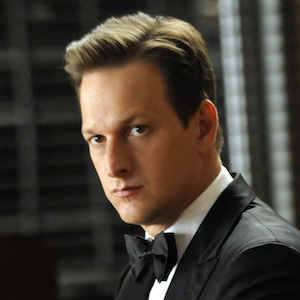
For God’s sake, Will! A) You just got off one suspension for unethical conduct—what are you DOING? B) They had to have taught you better than this at Georgetown Law!
“It” is misleading Americans who may be in litigation requiring settlement and who don’t know that lawyers cannot, must not and largely do not agree to financial settlement terms without getting the approval of their clients. I have dubbed this “The Hollywood Lawyer Fallacy,” and Will (Josh Charles) just did it again.
I know—every lawyer TV drama skips this part, as does virtually every movie about lawyers. Yes, I know it is done for pacing and dramatic purposes, that having a scene where the lawyers asks her client, “They’ve offered this amount, and I think we should take it, OK?” and the client says, “Sounds great!” just slows things down. But here is what repeatedly watching this inaccurate portrayal of lawyers breaking one of the cardinal rules of the profession does: it sets up clients of incompetent lawyers to be misled, manipulated, and cheated. As I wrote the last time the otherwise ethically astute CBS drama did this while I was watching:
“Lawyers have to communicate settlement offers to their client; they cannot, must not and dare not accept or reject an offer without doing that. This is so frequently misrepresented on TV and in movies that most Americans don’t know that it is required, allowing unethical lawyers to deceive them. I hate it when I see this. The all-time worst example: “A Civil Action,” where lawyer John Travolta turns down a multi-million dollar offer from Robert Duvall, the attorney for a big corporation, after Duvall makes an inexcusable speech about how they, as two lawyers, can settle the matter between them, as if their clients don’t exist. I walked out of the movie. Now they are doing it on “The Good Wife.”
Rule 1.2 in every jurisdiction (except California, which has a different rule with the same requirements) insists that a lawyer “shall abide by a client’s decision whether to settle a matter. In a criminal case, the lawyer shall abide by the client’s decision, after consultation with the lawyer, as to a plea to be entered, whether to waive jury trial and whether the client will testify.” This has been held to mean, by courts and bar associations, that a lawyer must not settle cases on his own authority, just as lawyers must not decide how their clients are going to plead in criminal trials, or whether a criminal defendant client will take the stand in his own defense. Violate these rules, and if you are a lawyer, you face a long and possibly permanent vacation.
Yet there are bad lawyers who do violate these rules, and they don’t get caught because their clients, mostly indigent or uneducated ones, don’t know that they have been mistreated…because every lawyer TV show they have ever seen tells them it is normal and proper for the lawyer to call the shots. I was riding in a cab driven by a middle-aged, female driver. She asked me where I was coming from, and when I said that I had just given an ethics seminar to lawyers, she said, “Boy, I need to find a better lawyer, I think.” Then she told me about her lawsuit, and how she had been bullied at every turn by her attorney, who was insisting that she take the settlement that had been offered. He had told her that she should leave the decision up to him, because she “didn’t understand.”
“I think he’s going to make that deal,” she said. “And it’s not enough.”
“He can’t make that deal, you know,” I said. “Not without your consent. It is entirely your call. 100%.”
“I didn’t know that!” she said. “I though the lawyer decided. That’s what my lawyer said.”
“Yes, that’s how lawyers are on TV,” I told her. “It’s just not true. Call the bar association, and get the name of an ethical lawyer.”
If a medical TV drama airs an episode, perhaps authored by Todd Akin after he finds employment outside of Congress, that shows a woman’s body rejecting male sperm because it was the result of a “legitimate rape,” doctors, journalists, ethicists, elected officials and activists would erupt in protest, with good reason. Legal dramas, however, have led naive clients into the clutches of incompetent and unethical lawyers for decades by misrepresenting the obligations of lawyer to their clients, with nothing but a shrug from the legal profession.
It is not the duty of “The Good Wife” to do the legal profession’s job for them. I do think it is irresponsible of the show’s writers, however, to affirmatively mislead the public to its detriment.
____________________________________________
Graphic: Comcast
 Ethics Alarms
I did learn about the rule that it is up to the client to decide on ‘LA Law’, I guess the quality of law shows has gone done since then.
The vast majority of what I know about the law comes from tv shows, and although that is supplemented with a little reading from the internet, a 1980 Readers Digest Guide to the Law, and serving three times on a jury, I would like the tv shows to get it right.
And as for medical shows, I’ve noticed a few errors there too.
LA Law did occasionally do it right, but not always. It was better than most, however. Thanks for reminding me.
Professional allegiance seems to trump ethical conduct in my experience Jack. Lawyers are a lot like real estate agents: 1) quick settlements are a desirable endpoint and 2) they work both both sides of the fence. While it may be true that good representation offers a client a choice – laying out pros and cons – the client’s decision is often motivated or coerced by the pros. At the end of the day, these guys and gals want to move on … and collect their paycheck. And they’ll continue to interact with each other collegially and socially long after the client is gone.
The take home message when dealing with professionals (lawyers, doctors, agents of any stripe, educators, and contractors) is that if you pay for their services, you (the client) call the shots.
The word used in the rules is “abide”…the lawyer must abide by the clients’ decisions regarding settlement. Abide is a strong word–it precludes opposition.
It is widely ignored.
This is an old post, but I’m behind on my TV watching and just started this episode. I assume Will winds up accepting an offer later in the show, since you were prompted to write about this, but what reminded me to come back to find this post was the scene early on where the bankruptcy trustee played by Nathan Lane told the partners to accept the offer because the firm needs the money they’d get as their fee. Will was the one to tell him that it’s not his call, it’s the client’s. Which, if he does wind up accepting an offer without discussing it with her first later in the show, just makes it worse, since he clearly knows he does not have the authority to do so.