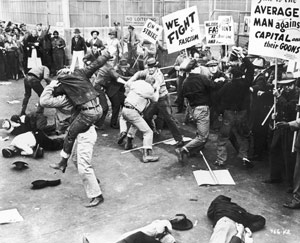
Ah, those were the good old days!
There is a strong likelihood that the Michigan state legislature will pass “right to work” legislation that limits the political power of labor unions, preventing unions cannot from requiring members to pay dues as a condition of employment. Twenty-four states have such measures, all passed through the democratic process, with voter-elected representatives debating and approving the legislation, and bills being signed by duly elected governors. State Rep. Doug Geiss (D-Taylor), however, a union-supporting legislator in Michigan, has a provocative alternative strategy to offer when debate and democracy fail to reach the result he and his supporters desire: threaten violence.
“We’re going to pass something that will undo 100 years of labor relations and there will be blood, there will be repercussions, we will re-live the battle of the overpass,” said Geiss ominously. Translation: “Do what we want, or we’ll beat you up.”
Jerk.
I don’t care what the law is, how unwise you think it is , or how much you think it harms your constituency. If you are an elected official in a republic, your only responses to losing on a policy issue is either to convince the public that the measure is wrong, or to give up politics and open a bait shop. One of your legitimate options is not to threaten your opposition and the public with “blood” and “repercussions” if they don’t decide your way.
For those who aren’t elected officials, such statements are the calling cards of bullies and a thugs. For a legislator, it is the mark of an irresponsible, incompetent autocrat whose presence in a position of public trust is a danger and a disgrace.
_______________________________________
Pointer: Best of the Web
Facts: CBS Detroit
Graphic: Libertarian Republican
Ethics Alarms attempts to give proper attribution and credit to all sources of facts, analysis and other assistance that go into its blog posts. If you are aware of one I missed, or believe your own work was used in any way without proper attribution, please contact me, Jack Marshall, at jamproethics@verizon.net.
 Ethics Alarms
http://en.wikipedia.org/wiki/Battle_of_the_Overpass
Or, he could be referring a particularly vile example of business-on-labor violence from the 1930s showing concern that the vilification of unions may lead us back to that kind of violence.
Rep. Geiss may be guilty of imprecise language, but that’s all.
“Imprecise”? How is “there will be blood” imprecise? It sounds extremely precise. How does making a law allowing people to work without paying tribute to unions qualify as “vilification”? The unions are (and usually are) the ones doing the vilifying these days, as in Wisconsin.
That’s threatening language, by any fair interpretation.
Or maybe he was referring to tactics employed by Ed Boyce, or the violence exemplified by the IWW during the Centralia Massacre, or maybe when an anarchist in support of a union strike attempted to murder Carnegie’s stand-in during the Homestead Strike of 1892.
Both “sides” have proven to be violent when pushed.
Your phrase “showing concern that the vilification of unions may lead us back to that kind of violence.” could easily read:
“showing concern that the vilification of management may lead us back to that kind of violence.”
Jack is correct in this case, the labor ‘side’ of this argument is the one giving veiled threats of violence.
More to the point, it is also the side currently engaging in violence, which makes the claim that anti-union violence is the threat fanciful, if not intentionally dishonest.
Completely.
I think Eric’s take is more accurate. He gave the link, but the violence in the “Battle of the Overpass” was perpetrated by Henry Ford’s security thugs (some 40 of them) against 3 union organizers posing for pictures before handing out leaflets. Rep. Geiss’ remark could have been taken as a warning rather than a threat, by any fair interpretation.
Absurd. Warning based on what? Only one side is mentioning violence. Case closed.
Those who fail to learn from history are doomed to repeat it.
I have no idea what this has to do with anything.
We’re not talking about Pullman Town here. We’re talking about letting people who choose to work in a field without paying dues to a union in order to do so. That, I believe, is called “choice.” If industry makes it oppressive for non-union workers, then there won’t be any. There is a reason why union membership has been declining. Like the civil rights movement, the labor movement has devolved from a crusade of conscience into a political and corrupt racket. THAT’s also history, as Eric Hoffer famously observed. You’re talking nostalgia, not history.
Seems like the state’s failure to step in and enshrine choice for employees would lead to “viewpoint discrimination” in favor of the unions. (Just remembering a term used recently by a judge in another unrelated (or related? It did have something to do with “choice”) case, where the state stepped in and actually created such discrimination, said the judge.)
You messed up the terms. Viewpoint discrimination doesn’t deal with the positions themselves, just the abilty to show anti-X/pro-X sentiment. If the government said that the Right-to-Workers couldn’t protest in a given spot but the union reps could, that would be viewpoint discrimination.
Not only that… you can warn someone of weather that is threatening. You can warn someone of a disaster that is threatening to strike.
Warning someone of potentially violent human behavior (which is a conscious choice) IS a threat.
Like when Muslim’s *warn* us of potential violence when a cartoon of Mohammad is draw. The proceed to carry out the violence of their own initiative.
Using the word “warn” here as an attempt to sugar-coat the nature of “threaten” is academically irresponsible.
Try this on for size “If we disarm our military, there will be blood in the streets. Remember this weak country that was invaded by a stronger one.”
That’s the parallel. It’s clearly not a threat that the “we” will cause violence. It’s a warning that the other side has behaved badly in the past when they were in this situation.
Except you have to make a million mile connection for that to work in this instance. A strategy you utilize often.
Given the actual DOCUMENTED activities of the unions in this instance, it is clear what Geiss meant. The spin doctors certainly deserve kudos this time for their quick dig into the bag of history to pull out the justifications utilized above, which your loose analogy defends..
What million miles? Let me make it even clearer for you.
“We’re going to pass something that will undo 100 years of labor relations and there will be blood, there will be repercussions, we will re-live the battle of the overpass,”
vs.
“We’re going to pass something that will undo 100 years of international military relations and there will be blood, there will be repercussions, we will re-live the first world war”
Think of it from Belgium or France’s point of view. Maybe change it to 20 years and go from Kuwait’s perspective.
Considering the event that was picked, this was clearly not a threat. There are plenty of instances where union members started (or are credited with starting) violent conflicts. The event used wasn’t one of them.
Your analogy still fails, because for it to be properly analogous, such a quote would need to come from a foreign power.
In which case, we would consider such a comment a veiled threat.
That refutation of your flawed analogy alone requires no further addressing of your post, as the remainder is invalidated, but I will continue.
“The event used wasn’t one of them” -TGT
Again, just like your defense of the Administration’s Dishonest Benghazi narrative, you are now latching on to what the spin doctors are using to defend Geiss’s threat. Keep spinning for the State-mind TGT.
Your analogy still fails, because for it to be properly analogous, such a quote would need to come from a foreign power.
“Think of it from Belgium or France’s point of view. Maybe change it to 20 years and go from Kuwait’s perspective.”
In which case, we would consider such a comment a veiled threat.
I still don’t see the veiled threat. What I see is a worry that the group/country will be vulnerable like they were previously when others abused them.
Again, just like your defense of the Administration’s Dishonest Benghazi narrative, you are now latching on to what the spin doctors are using to defend Geiss’s threat. Keep spinning for the State-mind TGT.
You didn’t say anything that was wrong with my comment. That you think the response is “spin” doesn’t mean its not accurate. The idea needs to be judged on its merits, not on your opinion of who said it.
Additionally this analogy doesn’t live up to the mark. Unless the person making the quote were a foreign leader of some sort.
In which case, yes, that ‘warning’ would also be seen as a veiled threat.
Additionally this analogy doesn’t live up to the mark. Unless the person making the quote were a foreign leader of some sort.
In which case, yes, that ‘warning’ would also be seen as a veiled threat.
When a group of workers gets together and attempts to set the price of the services it’s members provide, it is called a Union.
When a group of business owners gets together and attempts to set the price of the services it’s members provides, it is called a Cartel.
One of these are taught to students as evil, anti-competitive and certainly not in the best interest of the consumer (which is the end objective of industry).
It’s called context. Let’s look at his statement very carefully….
“We’re going to pass something that will undo 100 years of labor relations…” Clearly a hyperbolic statement, but also clearly referring back to a time when
“…and there will be blood, there will be repercussions, …” Oh, he’s threatening to injure and maybe kill… Only if you stop reading here and ignore you just read the first part of the quote.
“we will re-live the battle of the overpass [sic],” Ah, it’s clear now. He’s clearly threatening violence. He’s threatening… to be the victim of business-on-labor violence similar to that which happened… oh, about 100 years ago?!?
Rep. Geiss’s only failure in this situation is he did not make it crystal clear that he was talking about an historical event. The phrase “Battle of the Overpass” has a vastly different meaning than “battle of the overpass.” He should have made it clear he was talking about the former and not the latter.
There is enough bad blood on both sides of the labor-business argument with blame to be shared by both sides. Let’s not exacerbate the issue by making false claims of incompetence based solely on lack of understanding of historical context.
Second paragraph should end…
… labor was facing very poor pay and very poor working conditions.
Rationalizations. I knew what he meant, and the translation is “there will be union members fighting you guys.” Who started the original historical fight is irrelevant to the threat. “Thanks to you, we will be back to bloody fights.” That’s a threat, and also utter crap. If passing legislation causes violence, obviously its the losing side that causes it, and sure enough, it’s the (likely) losing side reminding us of that.
Any legislator whose response to losing on an issue is to threaten violence has disqualified himself from office by violating the implicit values of the system. That is exactly what happened here, no matter how you try to spin it.
If the union bullying in Michigan isn’t enough to validate what I had predicted in the event President Obama had not been re-elected, nothing is. We’ve got the best government that might makes right.
You know what you want him to mean. Pure confirmation bias. Rep. Geiss was referring to an incident where the union organizers were the victims of an unprovoked attack. Eric has nailed it: he failed to realize that no one understood the historical context and therefore assume that he was encouraging violence. Because I now know the context and have a favorable view of unions, I interpret it to mean he is warning of either literal or metaphorical violence on the labor movement. Because you see unions in an unfavorable light, you see him calling union members to arms. He was guilty of no more than assuming that we are more educated than we are.
You can’t be serious. That is ridiculous on its face. “I warn you! If you pass this legislation, you’ll beat us up!” Right. Followed by a union thug pounding a reporter in the face, and others tearing down a right-to-work tent. Unbelievable. You insult your own intelligence by making an argument like this.
And if you did your research, you would know that I do not see unions in an unfavorable light, other than the light they have put themselves in by documented conduct. Did you read my Labor Day post? Presumably not. But the corruption and violence of current day labor unions is hardly debatable.
“I warn you! If you pass this legislation, you’ll beatus up!”
That wasn’t the statement anyone has suggested. It’s more accurately: “I warn you all, if you pass this legislation, THEY’LL beat us up. Just like they did before.”
And if you did your research, you would know that I do not see unions in an unfavorable light, other than the light they have put themselves in by documented conduct.
You just admitted that you view the unions unfavorable. Why you view them that way is irrelevant.
There you go expanding to a generalization a comment made in a specific context.
He clearly does not look down on the unions except particular union behavior or particular unions that behave in such ways consistently.
That’s what his comment says.
Jack doesn’t list the “particular union behavior” here, but my memory says that it includes violence on the part of unions. Ergo, even if your argument was valid, Jack is biased on this point.
You are just continuing trivial objections now. Quit quibbling. Further diversion on your part– you knew what Jack meant, but felt you had an inroad by splitting hairs.
I know what Jack said and what that implies. If Jack meant something other than what he said, he can correct himself. If I’m misinterpretting Jack’s comments, then you, Jack, or anyone else can point out the flaw in my logic. Calling it quibbling does not show a flaw.
Your flaw is attributing meaning to Jack’s statement that is not there.
Again, Jack’s statement:
“you would know that I do not see unions in an unfavorable light, other than the light they have put themselves in by documented conduct.”
“you would know that I do not see unions in an unfavorably light” – direct statement meaning “I do not automatically consider unions wrong”
“other than the light they have put themselves in by documented conduct” – direct statement meaning “there are subsections of unions and specific examples of union behavior I do consider wrong”
You are reading into his statement and adding meaning claiming he has said: “The light they have put themselves in shows ALL of their behavior to be wrong, therefore I think unions are wrong”.
You have then Generalized this Specific (a flaw), you then Exaggerated his Claim for him (a flaw), then you have . I retract the identification of Splitting Hairs (AKA quibbling)… I misinterpreted your other flaws… Splitting Hairs is raising trivial matters to high levels of importance.
The flaw is in your failed attempt to quibble out of it, TGT. Tex has you by the short hairs!
@Tex,
I missed this last month until SMP commented.
Fortunately, for reply, I can just quote my previous comment:
Jack doesn’t list the “particular union behavior” here, but my memory says that it includes violence on the part of unions. Ergo, even if your argument was valid, Jack is biased on this point.
As I noted before, my statement doesn’t need all behavior. A specific union behavior that Jack has a problem with is violence, and that’s the behavior he’s improperly imputing on the unions here.
A warning of the repetition of history, when management resorted to violence to prevent union organizing. I realize the violence went both ways, but the historical reference here is to a specific episode of an unprovoked attack of management on unions. Only ignorance of the event would lead you to think otherwise. My intelligence doesn’t feel insulted at all; I learned something.
The authenticity of the video is already under question. Heavy editing, Breitbart style, and possible sabotaging of the tent by right to work supporters, with the union people trying to release the people inside. Do you know which story is true? I don’t.
My research shows an overwhelmingly negative view of present day unions on this blog. One post on the history of the labor movement doesn’t make a dent. This view could be deserved or not, but it definitely influences your interpretation of the representative’s remarks, just as my view does.
Quick spin doctor treatment of a veiled threat. Congrats!!
Possible sabotaging of the tent by the tent’s very own proponents?
Lordy, your just one step away from applying Godwin to this thread….
“Only ignorance of the event would lead you think otherwise”
The ‘event’ the spin doctors are associating his statement with is VERY UNKNOWN to MOST PEOPLE. He’s intelligent enough to know that and would have clarified his statement.
I’m sorry it hurts your world-view, but it takes 1 or 2 logical connections to say his comment was a veiled threat while it takes 10-15 to say it was a vague reference, shrouded in poetic metaphor, of an instance when some union leaders were roughed up (let alone under questionable circumstances anyway). Occam’s razor.
Possible sabotaging of the tent by the tent’s very own proponents?
Committing self sabotage in the name of your opponents is a well established tactic for attempting to make your opponents seem unreasonable.
The ‘event’ the spin doctors are associating his statement with is VERY UNKNOWN to MOST PEOPLE. He’s intelligent enough to know that and would have clarified his statement.
Really? It seems like an event that would be well known by people who do their homework on union-industry history (and people who talk with alot of union lobbyists). I know I’ve been guilty of using jargon and referring to events that I thought were common knowledge but were just common knowledge to people like me.
Also, Hanlon’s razor would apply here.
but it takes 1 or 2 logical connections to say his comment was a veiled threat while it takes 10-15 to say it was a vague reference, shrouded in poetic metaphor, of an instance when some union leaders were roughed up
It takes an invalid connection, and an assumption of ill-intent to get to your understanding. To get to Jan’s/Eric’s/my understanding, it takes, well, knowing what occurred during the event.
“Committing self sabotage in the name of your opponents is a well established tactic for attempting to make your opponents seem unreasonable.”
I’m fully aware of what was subtly asserted. The opposite statement, and more believable one, goes like this: Committing sabotage in the name of your ideas is a well established tactic for attempting to terrorize your opponents from continuing to oppose you.
“Really? It seems like an event that would be well known by people who do their homework on union-industry history (and people who talk with alot of union lobbyists). I know I’ve been guilty of using jargon and referring to events that I thought were common knowledge but were just common knowledge to people like me……
……It takes an invalid connection, and an assumption of ill-intent to get to your understanding. To get to Jan’s/Eric’s/my understanding, it takes, well, knowing what occurred during the event.”
.
Your knowledge of the incident does not prove it is well known. Additionally, Jan even admitted to learning of the “battle” of the overpass from this post. So even she wasn’t aware of the incident.
Also, Hanlon’s razor would apply here. But Occam’s makes more sense. If it is any consolation, I do attribute stupidity to Geiss. So at least part of Hanlon’s razor applies.
[i]Your knowledge of the incident does not prove it is well known. Additionally, Jan even admitted to learning of the “battle” of the overpass from this post. So even she wasn’t aware of the incident.[/i]
tgt was using “well’, along with the commas, as a linguistic pause in the sentence. As in, “well, you know, i really like him but don’t want him to know.”
Furthermore, no one saying the Battle of the Overpass is well known. The position held by me/Jan/tgt is that Rep. Geiss was talking about an event that was NOT well known. So yes, I agree with you which only bolsters our argument that is was Geiss’s failure to frame the historical context that has lead to this whole discussion.
Sabotage
You missed the point. Both should be believable because both are known to occur. The tactic of self sabotage works because people like you assume that sabotage is more likely.
Misreading me
I didn’t suggest my knowledge makes the situation well known. I didn’t even suggest the situation was well known generally. I suggested that it was likely well known in a specific community of people, and people with knowledge common to their community often unintentionally assume the knowledge is common more generally.
Razors
Why does Occam’s razor make more sense than Hanlon’s? I don’t see you finding any problems with my takedown of your reasoning for using Occam’s razor.
1. It IS more likely, given the history of the unions up to the present day. If Trumpka’s sweet little sayings don’t make their intentions plain, what can?
2. Misreading you? READING you is like wading through the Dismal Swamp looking for the highway. That’s deliberate on your part, of course, to allow yourself “wiggle room” if someone sees into your sophistry too well.
3. Hanlon’s Razor states clearly, “Never attribute to malice what is perfectly explicable by stupidity”. What we’re talking about here literally drips with malice. These people may be stupid as well, but they are no more lacking in malice than a video from Osama bin Laden.