The Campus Sexual Assault Witch Hunt Ethics Train Wreck, Complicated By The Fact That The Witches Are Real

"Wait...are you raping me, or am I raping you?"

“Wait…are you raping me, or am I raping you?”

There is no question that there are sexual predators on college campuses, or that some colleges let them get away with raps on the knuckles for sexual assault or worse. There is also little question, though various parties and activists deny it, that what constitutes genuine sexual assault and even rape has been so thoroughly politicized and muddled by irresponsible rhetoric, dubious statistics and cynical political maneuvering that addressing the problem of actual campus sexual assault is becoming impossible without harming, indeed destroying, the innocent in some cases.

At Stanford, women are rallying for a more stringent process and harsher punishment after student Leah Francis protested in an e-mail to the campus that she had been “forcibly raped” by a fellow student and he was permitted to graduate. Of course, Stanford didn’t find the she had been raped: her assailant was found guilty of sexual assault. The loose use of “rape” to describe sexual assault for political purposes is one of the reasons universities seem incapable of finding a satisfactory balance in handling such cases. At the risk of getting ahead of the post, I would say this: if it is alleged to be rape, then turn the matter over to the police and the justice system. Schools are not allowed to use internal procedures to investigate and punish murder; it makes no sense to permit them to do so with the serious crime of rape. The fact that the standards of proof and the requirements of due process are less stringent in a campus procedure is what simultaneously leads to inadequate sanctions for the guilty and railroading of the innocent. The solution to this problem has always been available: treat allegations of campus rape like any other kind of rape.

Unfortunately, colleges are often in thrall to the political agendas of feminists and their allies, so “rape” can mean many things, as can “sexual assault.” In the casual, morality-free sexual atmosphere now not merely tolerated but nurtured on college campuses, lines of consent are blurred, and missteps are inevitable. At the same time, the permissive sexual environment is a playground for predators, exploiters and manipulators. How are the genuinely culpable sexual assailants to be distinguished from the clumsy, the confused, the misled, or the drunk and overly aroused? Continue reading


Animal Abuse, Law, Ethics…And More Cognitive Dissonance

Gothic pets

Some animal abuse issues are ethics slam dunks, some should be, and some are more complicated than the wo people posture over them seem to think. Here are three examples from the news:

1. Tattooed Kittens?

A law about to be passed in New York, S.6769, will make it illegal for pet owners to inflict tattoos or piercings on their pets except for medical purposes or when a tattoo is used strictly for identification purposes. Violations would carry fines of up to one year in jail and a $1,000 fine.

“I believe that if given the choice, animals would decline to having themselves undergo a painful procedure of being either tattooed or pierced,” said New York State Senator Mark Grisanti, a Republican who is supporting the measure introduced by Democratic Assemblywoman Linda Rosentha in 2011.

Ya think? The fact that a law would even be necessary to articulate that tattooing or piercing a pet for the owner’s amusement is horribly wrong and obvious cruelty foretells the approaching apocalypse.  That such a law would take three years to pass also tells us something bad about, oh, New York, politics, partisan warfare, human intelligence…just about everything. The problem, was brought to public attention by the prosecution of this idiot.

2. The Opossum Drop Continue reading

Laser Pointer Abuse: Why Ethics Gets Complicated

laser pointerThis month, the FBI announced that it was expanding a program rewarding anyone who reports an incident of an individual aiming a laser pointer at an airplane with $10,000. ( This use of the cheap lasers is a federal crime.) The bounty was previously offered in a handful of cities, but because it seems to have reduced the number of laser strikes on planes, it is being expanded nationwide.

Wait…is this really a problem? It’s several problems, in fact. The main problem is that laser pointers can, if the wielder of one gets “lucky,’ bring down an airplane. The related problem is that this country is littered with so many unbelievable assholes that we even have to discuss this….and imagine what other stupid, dangerous, irresponsible things they do when they aren’t trying blind pilots thousands of feet in the air.

Incidents where laser pointers interfered with the operation of commercial airliners have increased a ridiculous 1000% rate since 2005, when federal agencies started compiling statistics. Last year, there were 3,960 laser strikes against aircraft reported, an average of almost 11 incidents per day.

Some ethics-related thoughts:

1. There is no way around it: sociopaths, who are essentially ethics-free, are a constant threat and blight on society. Aside from the children involved, whose conduct can be chalked up to immaturity and flawed reasoning, the people who would aim a laser pointer at an airplane just for the hell of it are kin to those who set fires, vandalize buildings, create computer viruses and generally make life ugly and dangerous for the rest of us because they can. You can’t educate them or give them a sense of right and wrong. All you can do is make laws with harsh punishment for the stupid, destructive conduct these individuals engage in to give themselves a sense of power and importance. Ethics is irrelevant; their ethics alarms can’t be repaired, because they don’t exist. The laser-abusers  illustrate the maxim often quoted here that “When ethics fails, the law steps in.”

2. Anyone who uses a laser pointer this way and who is aware of the potential results is capable of much worse. This is signature significance, don’t you think? It is tempting to use such a crime as a justification for pre-crime: anyone who would do this is too stupid or too inherently anti-social to be trusted in a free society. Pre-crime, however, is a concept too prone to abuse, a slippery slope that the Constitution wisely precludes. I would, however, see no reason not to require a conviction of this crime to be disclosed to every potential employer, for all time. Nobody should trust someone who even once would risk causing an airplane to fall out of the sky because it would be cool, and I don’t care if the reason for the act was the lack of brain cells, IQ points, the sense God gave a mollusk or a missing conscience. I don’t want you in my neighborhood, near my family, or in my workplace. I don’t trust you. and I never will. Does this place a burden on you, if others feel as I do? Good, and too bad for you. Don’t try to shoot 757s out of the sky for laughs, and you won’t have the problem. Continue reading

Ethics Quiz: The Overly-Trusting Law School

The almost lawyer, learning about the justice system...

The almost lawyer, learning about the justice system…

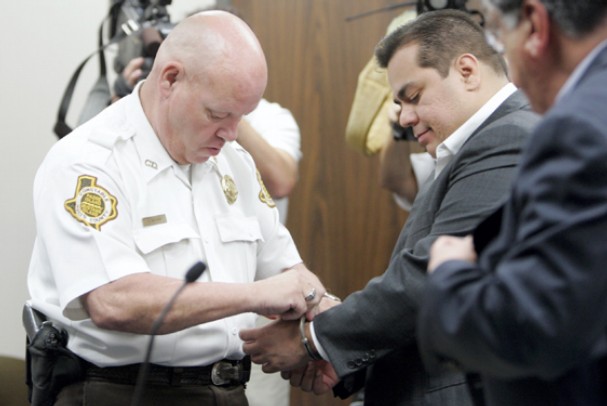
Mauricio Celis, 42,was expelled from Northwestern Law School, just before he was due to graduate, for not telling the school when he applied that he was a former felon in Texas,  convicted there for falsely holding himself out as a lawyer and also for  impersonating a police officer. Northwestern confirmed that it never asked him to disclose any criminal history, but argued that Celis should have known that his criminal record was material.

The school didn’t check on his background; it didn’t even google him. If it had, it would have learned that Celis was infamous in Texas, and called “The Great Pretender.” A prosecutor called him “the biggest con man in the history of Nueces County.”  He certainly was audacious, opening law offices in multiple cities, raking in fees, using his success as a fake lawyer to raise money for Democrats. Compared to his scam, Northwestern was timid. It just took his money, $76,000, and then expelled him without giving him a diploma.

Your strange Ethics Alarms Ethics Quiz:

Was it ethical for Northwestern to expel Celis?

Continue reading

Unethical Quote Of The Month: Hillary Clinton On Government Control Of Non-Conforming Viewpoints

mind-control-tests

“I believe that we need a more thoughtful conversation, we cannot let a minority of people — and that’s what it is, it is a minority of people — hold a viewpoint that terrorizes the majority of people.”

—-Hillary Clinton, forcefully inserting her leg in her mouth up to the knee during a CNN town hall as she talked about gun control, and, apparently, the new Democratic-progressive goal of government censorship of words, thoughts and beliefs.

Yup, Hillary really said that we cannot allow a minority to hold viewpoints the majority objects to. Oh, I know: she just said “terrorizes.” But if you can stop people from holding terrorizing viewpoints, there will  no longer be any prohibitions on barring other viewpoints that “the majority” believes are unwise.  This is the progressive paradise, I guess: all dissenting thoughts, opinions and viewpoints banished. I can almost feel the electroshock treatments now.

This is just a gaffe, right? I doubt it. I don’t think someone committed to free speech, open discourse, liberty and pluralism makes such a gaffe. The Left has been working over-time to suppress opposing opinion, dissent and non-conforming views for much of this President’s administration. Why should we believe this is a mistake?

Hillary will, and should, have this quote shaken in front of her face from now on. It is disgraceful, and terrifying (but I’m probably not part of Hillary’s “majority,” so what terrifies me doesn’t matter) for a former U.S. Senator and Secretary of State to assert such an un-American sentiment.

And immediately, the news media has begun trying to clean up the mess. The Huffington Post, realizing most people read headlines, not full posts, titled its report this way:

“Hillary Clinton On Gun Control: We Can’t Let ‘A Minority Of People’ Terrorize The Majority”

That is, you will notice, a lie. That is not what she said, and it is not up to journalists to decide for us what she “meant.” She said, very specifically, “holding viewpoints” is what we cannot permit, although the Constitution and a long line of Supreme Court cases says quite specifically that viewpoints are exactly what the government must permit. Later she said,

“I don’t think any parent, any person, should have to fear about their child going to school or going to college because someone, for whatever reasons — psychological, emotional, political, ideological, whatever it means — could possibly enter that school property with an automatic weapon and murder innocent children, students, teachers.”

This is less totalitarian, arguably, but dumber. “Could possibly” enter that school? I guess we have to lock them up, then, right, Mrs. Clinton? Can’t take any chances.

_____________________________

Pointer: Democratic Underground


Apology Not Accepted: This Principal Needs To Be Fired

roosevelt_high_school_yearbook_0618

There are so many things ethically offensive about this story that I hardly know where to begin.

From NBC:

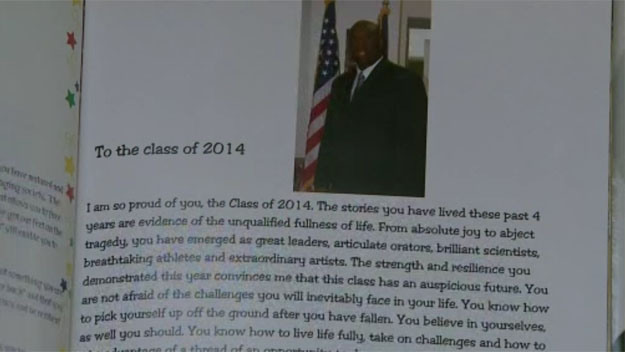
In a statement released Wednesday, Roosevelt High School principal Stephen Strachan said that an unedited draft of the message had been published in the yearbook, rather than the final version he intended to appear. The message borrowed heavily from one penned by a principal in Albany, California, to his school’s class of 2013. Strachan’s message even includes the sentence, “Congratulations to the Albany High School Class of 2013.”

“I sincerely apologize to the Roosevelt community and to the class of 2014 for the inadvertent clerical error causing mistakes to be printed in the 2014 yearbook,” he said. Strachan said that a new version of the yearbook with the correct message and will be given out to students on Friday. The new yearbooks will cost about $800 and will be paid for with funds from the principal’s discretionary fund, Newsday reports.

“I take full responsibility for this oversight,” Strachan said.

According to Newsday, the first and third paragraphs were nearly identical to the California principal’s, with only the second paragraph differing. Strachan told Newsday that he received permission to quote one of his colleagues.

Wait…WHAT?? Continue reading

Passenger List On The Deadly General Motors Ethics Train Wreck

"Oops! There goes G.M again!"

“Oops! There goes G.M again!”

That great, big, all-American motor car company that the Obama Administration took bows for saving five years ago has been revealed as a thoroughly corrupt, incompetent and deadly enterprise. As the full extent of the General Motors safety scandal unfolds—and it could get worse—this is a good time to take stock of the ethics lessons and miscreants involved, on the off chance that we are interested in learning something.

Did that sound bitter? It is. There is little in this terrible story of corporate ineptitude and corruption that wasn’t known and understood decades ago. Yet here we are again.

The manifest:

  • G.M. management. It pursued the policy of paying large settlements with confidentiality agreements to those injured by ignition switch defects in their cars, never fixing the defect itself. This is the old Pinto calculation, reasoning that if it is cheaper to pay for the deaths and injuries from a design defect than to fix the defect itself, then it makes good business sense to keep doing that, indefinitely. There are three problems with this logic, of course. First, it kills people. Second, it is stupid: eventually the facts will get out, and the whole company will be endangered. Third, it is wrong.
  • The plaintiffs’ attorneys. The trial lawyers association, way back when I worked for it two decades ago, adopted the unofficial position that the practice of accepting settlements from large corporations in product liability cases that included agreements not to reveal the damages and the defects involved to regulators, the news media, and endangered consumers was unethical. Members were urged to make a rejection of such terms a condition of agreeing to represent injured parties. Speeches were given, pledges were made. All agreed that the practice undermined the mission of the plaintiffs’ bar to make America safer through the civil justice system. What happened? Greed, that’s what. Just as every plaintiff has a price, so do many trial attorneys, who received up to 40% of those secret settlements. Every single one of the lawyers who guided their clients to accepting hush money in exchange for letting unsuspecting owners of G.M. cars risk their lives and those of their families were members of the American Association for Justice, which changed its name from the Association of Trial Lawyers of America because a survey showed the term “trial lawyers” was too negative. This is why the term is negative.

Continue reading

Of The Great Noodle Ordeal, Sweeney Todd, Stressors, and The Importance Of Ethics In Stopping Mass Killings

http://www.youtube.com/watch?v=Pl9XSLbpdEg

I have a theory about mass killings, and it is neither original nor exclusive: in fact, it has been proposed in various forms for at least a  century But I think it is worth considering.

I think that the smart, creative, intense, ambitious, restless and entrepreneurial people in this country keep designing an environment, and forcing it on us whether we like or need it or not,  that is increasingly, and ultimately unbearably, hostile to those who are not smart, creative, intense, ambitious, restless and entrepreneurial. I think that as life becomes increasingly stressful and confusing for average people—remember, about half of the public is below average intelligence, and even average intelligence is nothing to jump up and down over—they are more likely to reach what the serial killer profilers on “Criminal Minds” call “stressors”—the final straw, the moment when they see red, and deadly fury takes over. On the TV show, of course, the stressor is the death of a child, or a firing, or the onset of an illness, or financial setbacks. But I can see it simply being the realization that life is hopeless…that it is always going to be a miserable, frustrating struggle, and that powerful, rich, meddling people are at work always finding ways to make sure it gets harder and harder, and ultimately futile, for normal human beings to get through the day.

I entertain delusions that I am smarter than the average bear, and I can barely stand it myself. Yesterday, stuck at La Guardia, I wanted to get some food in the a terminal’s food court. The place I chose had just added computerized self-ordering on iPads. I’m not intimidated by iPads; I use one. The woman in front of me, however, stared at the device—there were no readily available employees to guide her through it—as if it were a space alien. She pushed some buttons, sighed, and gave up. Continue reading

Five Ethics Observations On The Redskins Trademark Decision

Washington-Redskins

1. Several commenters predicted that the ruling of the U.S. Patent Office cancelling the registered trademark of the Washington Redskins would warrant a “Kaboom!” here, the Ethics Alarms designation reserved for occurrences or statements so outrageous that they make my head explode. Please. Even pre-weakened by previous cranial fireworks, my head isn’t that unstable. The decision was neither a major surprise, nor was it as momentous as the ignoramuses in the media, social media, and Harry Reid pronounced it to be.  (More on the decision here.) The Redskins retain their federal trademark registrations until all appeals have been exhausted, and that process could take years. The registrations will be canceled only if the team loses all appeals, and if I were owner Dan Snyder, I would appeal up to the Supreme Court if I had to. This should be done not to preserve the Redskins name, which is archaic and at this point more trouble than its worth, but to beat back the forces of government censorship of thought and words, of which the anti-Redskins campaign is a significant, if relatively trivial, part.

2. Washington Post sports columnist Sally Jenkins, not a fan of the name, beat me to a column about what is really troubling about the decision, as she wrote… Continue reading

When Ethics Alarms Fail: The (Almost Deadly) Return Of “Johnny”

justkidding

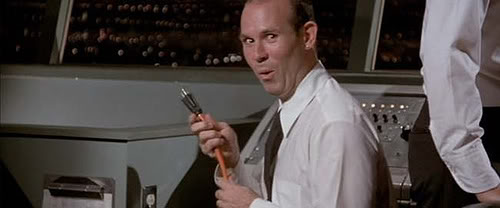
In “Airplane!,” the late Stephen Stucker created an iconic comic character as the chaotic “Johnny,” a deranged but relentlessly cheery air traffic control employee who treated the life-and death emergency of an endangered airliner as an opportunity to pull practical jokes, like pulling a plug to shut off all the runway lights just as the plane was making its desperate approach with a volunteer pilot at the helm. “Just kidding!” he says. This week, we learned that Johnny, or at least his copycat, was alive and well. An air traffic controller at Hartsfield-Jackson Atlanta International Airport instructed the pilot of Delta Flight 630, just over 1,000 feet off the ground and preparing to land, to abort the landing and circle the airport. Seconds later, Johnny II said, “I’m kidding, Delta 630. After you land, I’ve got no one behind you. Expect to exit right.” Continue reading