For You, Dad.

Jack Marshall Sr Army portraitI lost my dad, Jack Marshall, Sr., five years ago today, and for some reason the loss feels especially sharp right now. This has been another miserable birthday, but not so miserable as that one, and I found myself once again revisiting my father’s favorite poem, which was a personnel credo for him and which has often served me well in hard times too. It is linked in the “Inspiration” section on the  Ethics Alarms home page, as well as quoted in my post here on the day my father was buried in Arlington National Cemetery.

Nonetheless, I am going to post Rudyard Kipling’s “If” once again. My father’s favorite line was…

If you can meet with Triumph and Disaster
    And treat those two impostors just the same;   
That was Dad to the core. He never looked back, never cursed his luck, never thought too highly of himself (or anyone else), always believed in tomorrow, and that no victory was final, and no defeat was forever. And I know he was right, though it doesn’t often feel like it. So this is for you, Dad. Thanks for everything.

“If”

If you can keep your head when all about you

Are losing theirs, and blaming it on you,

If you can trust yourself when all men doubt you,

But make allowance for their doubting too;

If you can wait, and not be tired by waiting,

Or being lied about, don’t deal in lies,

Or being hated, don’t give way to hating,

And yet, don’t look too good, nor talk too wise:

If you can dream – and not make dreams your master;

If you can think – and not make thoughts your aim;

If you can meet with Triumph and Disaster

And treat those two imposters just the same;

If you can bear to hear the truth you’ve spoken

Twisted by knaves, to make a trap for fools,

Or watch the things you gave your life to, broken,

And stoop, and build ’em up, with worn-out tools:

If you can make one heap of all your winnings

And risk it on one turn of pitch-and-toss,

And lose, and start again at your beginnings

And never breathe a word about your loss;

If you can force your heart and nerve and sinew

To serve your turn, long after they are gone,

And so hold on when there is nothing in you

Except the Will which says to them: “Hold on!”

If you can talk with crowds and keep your virtue,

Or walk with Kings – nor lose the common touch,

If neither foes nor loving friends can hurt you,

If all men count with you, but none too much;

If you can fill the unforgiving minute

With sixty seconds’ worth of distance run,

Yours is the Earth and everything that’s in it,

And—which is more—

You’ll be a Man, my son!
 

Contest Entry For Most Unethical Column, Post Or Essay About The Ferguson Ethics Train Wreck: Vanity Fair and W. Kamau Bell

Large, male, black...also irresponsible and dishonest.

Large, male, black…also irresponsible and dishonest.

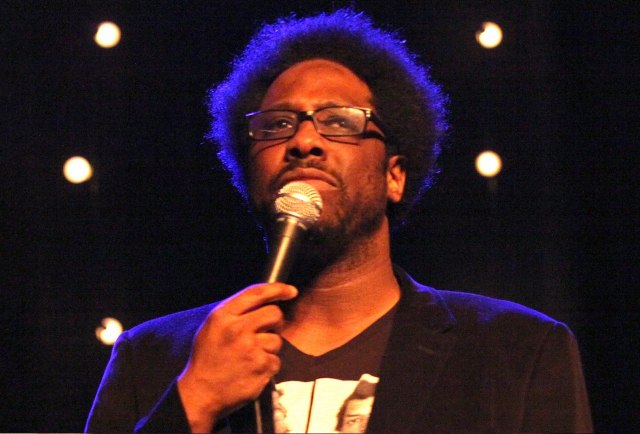
My nominee for the contest: Vanity Fair’s “On Being a Black Male, Six Feet Four Inches Tall, in America in 2014” by comedian W. Kamau Bell.

Maybe Bell thinks the extra face-time on cable news this despicably deceitful essay gets him does enough for his career to justify adding to the false narrative about the Michael Brown shooting.  It isn’t. Nor is it worth the ignorance, hatred and fear he is sowing by intentionally misrepresenting what happened to Mike Brown as simply the natural consequence of his race, gender and size. Conduct had a lot to do with it too.

The article is really sinister, repeatedly comparing the author, who is about the same height as Brown was, to the slain teen, implying but never quite saying that Brown was killed simply because he was, in the author’s words, black, male, and large. Here’s a typical passage:

“I am afraid of the cops. Absolutely petrified of the cops. Now understand, I’ve never been arrested or held for questioning. I’ve never been told that I “fit the description.” But that doesn’t change a thing. I am afraid of cops the way that spiders are afraid of boots. You’re walking along, minding your own business, and SQUISH! You are dead.  Simply put, I am afraid of the cops because I am black. To raise the stakes even further, I am male. And to go all in on this pot of fear, I am six foot four, and weigh 250 pounds. Michael Brown, the unarmed Missouri 18-year-old shot dead by police this summer, was also six foot four. Depending on your perspective, I could be described as a “gentle giant,” the way that teachers described  Brown. Or I could be described as a “demon,” the way that Officer Darren Wilson described Michael Brown in his grand-jury testimony.”

He doesn’t exactly say that Brown was “walking along, minding his own business,” but that’s his intent, and he knows that’s what thousands have chosen to believe. He says that he, like Brown, could be described as a “gentle giant,’ but omits the detail that Brown was obviously not accurately described as “gentle.” If he were gentle, he would be alive. He also, being intentionally misleading, fails to mention that Wilson described Brown as looking like demon when the teen was attacking him.

Michael Brown wasn’t shot because he was large, black and male. He was shot because he attacked a police officer, twice, and because his size made that attack more legitimately threatening.  Because of his size and what he was doing with it, no reference to Brown’s color is necessary or relevant.

Bell’s perceptions of white reactions to a law-abiding, civil citizen because he happens to be a large black male  have added some useful perspective  to the national discussion of racial bias and police conduct, had he not chosen the path of using the topic to insinuate an innocent victim’s status for Michael Brown that does not comport with facts, slanders Darren Wilson, and fans the flames of ignorance and hate.

No responsible publication should publish something like this.


President Lincoln’s Misunderstood Ethics Crisis: The Great Sioux Uprising

Dakota hanging

As part my so-far futile efforts to leave Ferguson in the rear view mirror, let’s revisit one of the Abraham Lincoln’s great ethical dilemmas during the Civil War, in which today’s date, December 1, was pivotal.

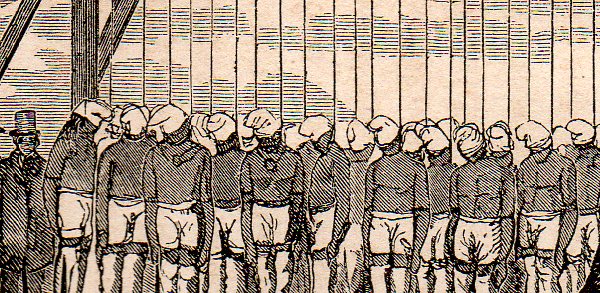
Minnesota’s Great Sioux Uprising, now usually called the Dakota-U.S. Conflict, was among the bloodiest Indian wars in the West, with hundreds of Native Americans, settlers and military casualties. The Sioux were defeated soundly, and the U.S. Army tried 303 Native Americans by military commission, finding them guilty of war crimes and sentencing them to death by hanging. Federal law required Presidential approval of the death sentences, and this was a problem Abraham Lincoln, the President at the time, did not need.

For it was 1862, and the Civil War was raging. This was a year full of Union defeats, indeed, disasters, like Fredericksburg, and both the war and Lincoln’s ability to lead it were in peril. Lincoln was also calculating all the political angles before issuing the Emancipation Proclamation. On top of the burdens of war and politics, he was coping with personal tragedy: his young son Willy had died nine months earlier, and Mary Todd Lincoln was teetering on emotional collapse from grief.
Now he had to decide whether to allow the execution of more than 300 Indians convicted in trials that were no better than kangaroo courts. Few Americans were concerned about the fate of the Native Americans, but Lincoln, with all of his other worries, took on the task of reviewing the trial records. What he found was manifest injustice.  Continue reading

Deval Patrick’s Indefensible, Terrifying Admission

Welcome to my nightmare...

Welcome to my nightmare…

It is 4:30 AM. I can’t sleep, and among the reasons are not, as you might think, the fact that my father died five years ago today and I miss him terribly, or that this is my birthday, and I am that much closer to my own death. No, the cause for my tossing in bed is that I read  Massachusetts Governor Deval Patrick’s comments on “Meet the Press” about the Michael Brown shooting (yes, those eleven Ferguson posts still weren’t enough) just before retiring, and they have been giving me nightmares.

What Patrick’s remarks suggest to me  is that this incident is quite literally driving Democrats, civil rights activists and African-Americans crazy, causing them to lose their grip on basic principles of ethics and democracy. Here is what Patrick said, in part, in his interview with Chuck Todd, who, incompetently, did not ask properly probing questions in response (falling over in a dead faint would have also been appropriate):

“Look, without knowing all the facts, of course I wanted to see an indictment. And mostly because I think a trial and the transparency of a trial would be good for the community. And because so many of us have the supposition that police officers are not going to be held accountable and not going to have to answer for the shooting of unarmed, young, black teenagers.”

I challenge any civil libertarian to defend this statement. Continue reading