KABOOM!* Our Hyper-Sensitive Future Lawyers

headexplode

Well, friends, for the second time this month my brains are on the ceiling, walls and floor again, and I’ve had to gate the dog so that…well, you know.

Columbia Law School announced that it is permitting students who are so devastated by recent non-indictments in the Michael Brown and Eric Garner matters to postpone taking their final exams. Isn’t that nice?

By “nice, “I mean stupid, irresponsible and embarrassing. You can read the Dean’s nauseatingly delicate statement here: I don’t want it polluting the blog, so I’m not going to quote it. Besides, if I look at it again, who knows what else might be on my walls. Continue reading

Transparency, Causation, Eggshells, Trust : Seven More Ethics Issues In The Eric Garner Case

jigsaw-puzzle-record

1. There is near unanimity in the response to the non-indictment by the Staten Island jury in the Eric Garner case. In light of the graphic video, it is hard to see how there wasn’t probable cause to indict. The coroner verdict of “homicide” would see to provide sufficient evidence all by itself. However, in the absence of the complete record of what the grand jury heard and saw, nobody can be certain that this was a miscarriage of justice. However, given the context of the case and its deleterious impact on faith in the justice system, that is no solace and scant mitigation. As in Ferguson, it is prudent and essential that the public see what the decision was based upon. It is true that those who are determined to see injustice, bias and racism will do so regardless of what the evidence shows–again, as in Ferguson—but the only evidence that has been made public, the various videos and the officer’s testimony–only makes the non-prosecution more suspicious.

2. Can the non-prosecution be justified? If so, the only reason I can see would be lack of proof of causation. Causation is tricky, and  juries get confused about how to analyze it. Since it is fair to assume Daniel Pantaleo did not intend to kill Eric Garner, the issues are a) whether his actions during the arrest were negligent, and b) whether they were the proximate cause of Garner’s death. That his conduct was negligent is not enough to sustain and indictment—that negligence had to be the reason Garner died. Remember, he was not choked to death. The medical examiner ruled that Garner died from a collection of factors: compression on his chest and throat, the position he was forced into, his obesity, weak heart, and asthma, all causing asphyxia.

  • If Pantaleo’s actions alone would not have caused Garner’s death, then it could be legitimately argued that he was not guilty of a crime. The other officers were given immunity for their testimony, which seems like either a bad decision by the district attorney, or intentional sabotage of the case against Pantaleo’s. If it was the collective action of the police that caused Garner’s death, it would be unjust to make Pantaleo the sole officer punished. If some of the testimony from the unchargeable cops made the case that it was another officer, or several, who really caused Garner’s death, that would explain the no indictment result.

In the widely seen video of the arrest, Pantaleo can be seen with his arm around Garner’s neck as Garner is taken to the ground and for some time thereafter, but in watching the video it’s difficult to determine whether Garner was in fact choked. And if he was, it did not appear it was long enough even to render him unconscious, much less kill him…I saw nothing excessive in the manner in which the officers subdued Garner. He was neither beaten with batons nor even punched. To me, it appeared to be a fairly typical scuffle with a large man who had clearly demonstrated his unwillingness to be arrested peacefully.

He misses the point. The question is whether the take-down was excessive for Garner, not some theoretical average arrestee. It is true that with a normal, healthy subject, what the officers did would not typically cause death….but Garner was obviously not normal, nor healthy. He was morbidly obese, and 350 pound middle-aged people tend to have the kinds of heath issues Garner in fact had. Nobody would argue that an elderly woman or a ten-year old girl or someone in a wheelchair should be manhandled like that. Such treatment was negligent for Eric Garner, and the deadly result could and should have been anticipated.

It is true that the officers couldn’t know that Garner had a weak heart and suffered from asthma, but it doesn’t matter: the rule in negligence is that “you take your victim as you find him.” If your negligence is the proximate cause of someone’s death, the fact that it wouldn’t have caused anyone else’s death is no defense. This is the so-called “Egg-shell Skull” rule.

Garner was an egg-shell perp. Continue reading

The Wall Street Journal’s Uncultured Culture Critic

Joanne Kaufman was here...

Joanne Kaufman was here…

In a jaw-dropping essay for her employer, The Wall Street Journal, alleged culture critic Joanne Kaufman proudly and candidly disabuses readers of any misconceptions they might have had regarding her qualifications for her job. She is not merely unqualified, but willfully, shamelessly, spectacularly unqualified. In a smug screed in which she admits to habitually walking out on Broadway shows at intermission, Kaufman reveals herself as lazy, arrogant, disrespectful of artists, and most crippling of all, to be afflicted by the attention span of the average Twitter addict.

“Don’t ask me what happened during the second acts of “Matilda,” “Kinky Boots,” “Pippin” and, reaching back a few seasons, “Boeing-Boeing” and “Billy Elliott, ”  Kaufman boasts.  “Really, I have no idea. But I am nothing if not cosmopolitan in my tastes, or distastes—French farces, English musicals set in gritty industrial cities, and American entertainments involving Charlemagne ’s Frankish kin.”

You can read her entire piece here; if the Journal doesn’t fire her, it is run by fools. “I’m of the “brevity is the soul of wit” school and of the belief that only a few bites are required to determine that you just don’t like a particular dish,” she happily admits. “My ideal night in the theater runs 90 minutes without an intermission (it is best not to put temptation in my path), which means that Shakespeare and I don’t tend to see a lot of each other.” This is the culture writer, remember. Yet she is admitting to membership in the lazy, sound-bite, bumper-sticker, multi-processing, distracted, ADD-addled public that has caused writers, playwrights, producers, book publishers, film-makers and song-writers to dumb down, redact, trivialize and simplify entertainment in an accelerating death cycle: plots don’t make sense, explosions start early, subtlety is forbidden, and no issue, thought or topic that can’t be fully explored in the time it takes to do a load of laundry is going can find its way on stage or screen. The Journal’s culture writer doesn’t have the time or interest to sit through King Lear, Hamlet, The Ice Man Cometh, or Death of a Salesman,  or to view all of “Seven Samurai,” “A Man for All Seasons” or “Gettysburg”—hey, a movie about one of those short Civil War battles for Joanne, please: she’s got a 15 minute segment of “Robot Chicken” to catch. Continue reading

Ethically Incoherent Statement Of The Month: Van Jones

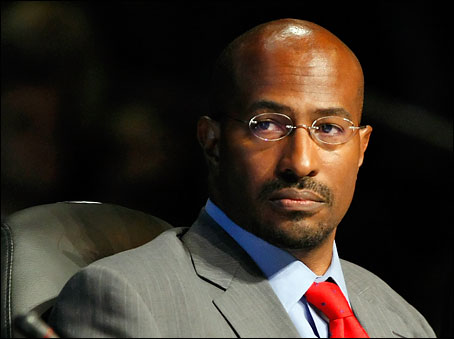
Van Jones: Reasonable or biased?

Van Jones: Reasonable or biased?

Van Jones, the former White House “czar” of something or other turned smooth-talking racialist warrior on CNN’s “Cross-Fire” and various TV panels, was arguing for frank racial dialogue on ABC’s “This Week With George Stephanopoulos,” in the context of the protests over the Ferguson and Staten Island police grand jury decisions. Sounding reasonable as he often does, Jones then said that what should be an area of agreement is the need for a special prosecutor whenever police misconduct is before a grand jury, noting that it was an “obvious conflict of interest”for prosecutors who work with police as a core element of their job.

I have addressed this argument before, but let me be clearer. This is a conflict of interest that a competent and ethical prosecutor should acknowledge and be able to deal with as the legal ethics rule require. The prosecutor should get a waiver from his or her client—not the victim’s family, but the government the prosecutor represents—and honestly assess whether the fact that the police serve the same client will prevent the prosecutor from being fair and objective. If the answer is yes, then the prosecutor must recuse, but I see no reason why the answer should be yes, if the prosecutor is ethical and worthy of the position.(Jones and other advocates for this “solution” have a bias against prosecutors, whom they view as presumptively unethical.)

Theoretically, every case in which an officer’s credibility determines whether a citizen should be charged poses the same conflict: it is endemic to the prosecutor’s job. Indeed, prosecutors have a very good reason to want bad cops punished and removed from the police force; I’m not at all certain that there is a necessary bias on the part of prosecutors in favor of letting such cops escape legal consequences of their actions. That assumption is based on the assumption that prosecutors don’t care about  justice. Nobody who doesn’t care about justice becomes a prosecutor. Why would they? It is a hard, frustrating job and the pay isn’t anything special.

The strongest argument for a special prosecutor is a different ethical problem, the appearance of impropriety. If the decision to prosecute or not is tainted with suspicion of bias, then the justice system is compromised and breaks down. This is why, for example, it is terrible that the Justice Department, a super-politicized one at that, is supposedly investigating the I.R.S. scandal.

As George moved to another topic, Jones blurted out a final statement that caused me to spit-take a mouthful of coffee. It undermined all of his finely tuned rhetoric about fairness and non-partisan dialogue about race, and exposed, ironically, his own biases. He said;

“If there had been a special prosecutor in Ferguson, we would have had a different result.”

AHA! Continue reading

The Perils Of Over-Regulating The Police: A Case Study

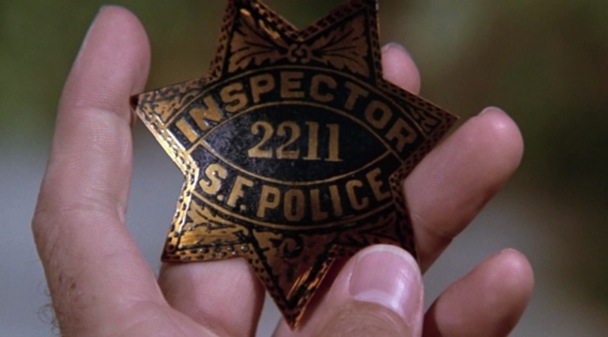
This is Dirt Harry's badge. Seconds later, he throws it into a river. Lots of other police will be doing the same.

This is Harry “Dirty Harry” Callahan’s badge. Seconds later, he throws it into a river. Lots of other police officers will soon be doing the same.

Yesterday, for the third time in my life, I was the first one on the scene after a fellow human being’s death. This time, it was a very close friend and, though it has little to do with this post, a wonderful man. I had headed out to his home because I was worried: an unusually reliable and conscientious individual, he had missed several appointments the last few days and hadn’t been answering e-mails and phone calls. When I was told about this, I immediately suspected the worst, and sadly, I was right.

His car was outside his house, and though it was mid-day and he was supposed to be somewhere else, I could see that the TV was on. In front of his door, getting soaked in the rain,  was a package: it had been delivered there on December 2. I got no response to my bangs on the door. It was time to call 911.

The police responded quickly. I’m not going to name the department, which has an excellent reputation here, and I do not fault the officers, who were diligent and polite, and who set about investigating the scene professionally and quickly. Nonetheless, after a full 90 minutes, after which they could not discern any more than I had before they came, they would not enter the house.

They told me that they could not risk being sued, and that there were elaborate policies and procedures that had to be checked off first. The officers had to track down their supervisor (it was a Saturday), and, they said, more than one official would have to sign off, to protect the department

“He could be drunk; he could be shacked up; he could just want to be alone,” they told me. “The law says his privacy can’t be breached, even by us.”

“But he’s not any of those things,” I said. “He doesn’t do any of those things, and if he were OK, there wouldn’t be a four-day-old package outside.”

“Maybe he took a trip on a whim.”

“He would have called and cancelled those commitments,” I said. “Look, you and I both know that he could be inside, on the brink of death, with every second bringing him closer. The only alternative is that he’s died already. If you won’t do it, let me break in, chase me, and you’ll find him legally as you pursue me. How’s that?”

The police weren’t sold. Finally, after a full 90 minutes, they requisitioned a ladder from a neighbor and were able to see into a second floor window. My friend was visible on the floor, and then they moved quickly, breaking down the door. They were too late by days. They might have been too late by minutes though. All those procedures and policies that forced the police to avoid taking action that in this case, under these circumstances, were prudent and that might have saved a life imperiled.

The lesson is only this: if we cannot trust police to make decisions like this, we obviously are not going to trust them to decide when to fire their weapons. Laws, rules and procedures are rigid, and have to be examined slowly; real life operates in the shadows of uncertainty, among the loopholes, gray areas and ambiguities, and it moves fast. The protests and demands in the wake of the recent police controversies will undoubtedly result in more regulations, policies and laws, but there is good reason to believe that they will also make us less safe rather than more safe, and make it difficult to find reasonable, dedicated, ethical men and women willing to serve as police, a job which, we seem to be deciding, should be subjected to strict liability whether the officer acts too quickly, or not quickly enough—judged, of course, after the results are in. Continue reading

Journalism Ethics Reality Check: What The Entire News Media Did To Darren Wilson With Dorian Johnson’s “Hands Up” Story Is EXACTLY Like What Rolling Stone Did To UVA With “Jackie’s” Rape Account, Just Worse.

Am I the only one who sees this?

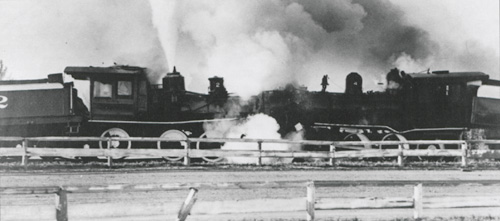
Two train wrecks, same track...

Two train wrecks, same track…

I discern that I was too subtle—imagine that!when I wrote,

In light of all this, it seems that women really have done a relatively poor job at intimidating the left-biased media as well as its progressive pundits and elected officials. If they had sufficiently pressured journalists into believing that to challenge their accounts of rape, substantiated or not, was proof positive of malicious animus, like the civil rights machine has regarding narratives of police racism, they could depend on much of the media continuing to repeat the Rolling Stone account as truth even if it is completely discredited. This is, after all, what we are witnessing right now, as the recent grand jury decision in the Eric Garner death has allowed columnists, reporters, and broadcasters—and thus protesters and politicians—to continue to represent what happened to Michael Brown as if Dorian Johnson’s discredited description of his friend’s death was fair, accurate and unbiased.

So let me be clear….

We are told the the news media is furious with Rolling Stone over its discredited and anonymously sourced gang rape accusation against the University of Virginia’s chapter of the Phi Kappa Psi fraternity. Why is it not similarly critical of itself for publicly and far more widely accusing a single, named Ferguson police officer, Darren Wilson, of a race-motivated, cold-blooded execution of an unarmed man based on the allegations of Dorian Johnson? They are, from a journalism ethics perspective, equally irresponsible and unprofessional, and predictably more harmful. It is, we can stipulate, worse for a police officer to be accused of first degree murder than for unnamed members of a fraternity to be accused of rape.

Note:

1. Both Rolling Stone and the mainstream media were eager to accept the stories being told as fact because of their own ideological biases.

Rolling Stone is committed to the current campaign of the left to portray college campuses as perpetuating a “rape culture.” The mainstream media, as it had already proved in its slanted and incompetent coverage of Trayvon Martin’s death and the trial of George Zimmerman, is a shameless ally of the cynical Democratic Party’s tactic of representing the nation as racist. Continue reading

Unethical Tweet Of The Month (Or Eternity?), “Jackie’s” UVA Gang Rape Ethics Train Wreck Division: Melissa McEwan

Melissa McEwan's profile photo. I'm not going to say a thing. No, really. Not a thing.

Melissa McEwan’s profile photo. I’m not going to say a thing. No, really. Not a thing.

“I can’t state this more emphatically: If Jackie’s story is partially or wholly untrue, it doesn’t validate the reasons for disbelieving her.”

Melissa McEwan,  feminist proprietor of @Shakestweetz, an-all tweet blog, responding to the meltdown of the Rolling Stone story accusing a University of Virginia fraternity of gang rape.

Look, I’m not going to insult you by explaining what’s wrong with the assertion that those accusing others of horrific crimes shouldn’t be held to strict standards of credibility.

What is more significant than McEwan or her tweet is that this frightening and dangerous state of denial is moving from the status of self-evidently insane to acceptable. As I suggested in the previous post about the Rolling Stone retraction of its explosive story by Sabrina Rubin Erdely, the Ferguson demonstrators, the “Hands up!” protestors, the Congressional Black Caucus, and  pundits like Eugene Robinosn who are still arguing that Officer Wilson should be indicted are doing essentially the same thing. Having decided that the Ferguson narrative pressed by civil rights activists communicated a deep truth about America, they refuse to accept that it was false even in the face of overwhelming evidence because they are intellectually and emotionally committed to that “truth.”

The tweet also forces me to upgrade the Rolling Stone fiasco to Ethics Train Wreck status. Continue reading

The “Rolling Stone” UVA Gang Rape Botch

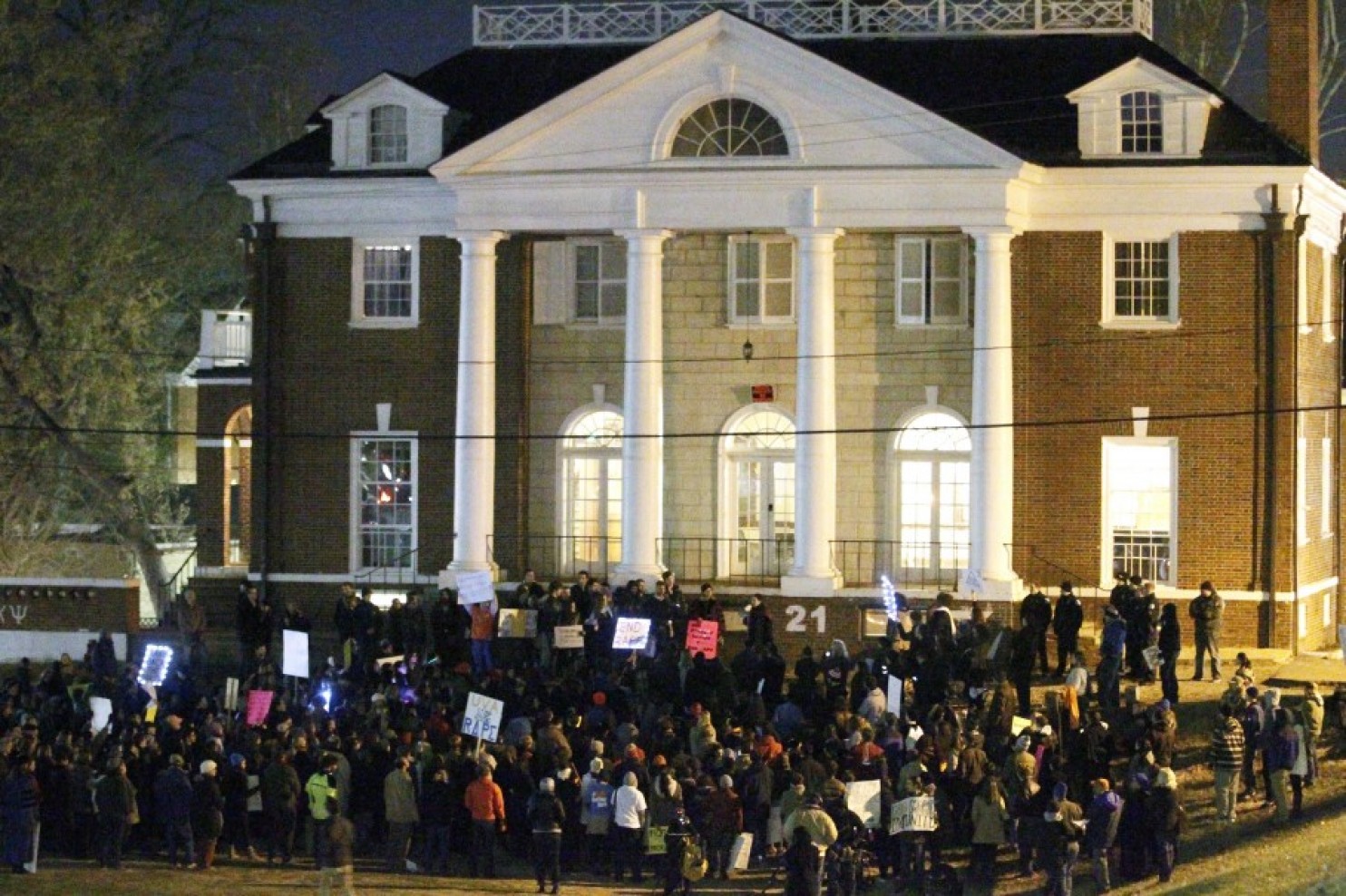
Student protest against campus rape at UVA. And if the rape didn't happen? Take a cue from the "hands up!" crowd: keep protesting. The news media won't notice.

Student protest against campus rape at UVA. And if the rape didn’t happen? Take a cue from the “Hands up!” crowd: keep protesting! The news media won’t notice.

Hardly making it to the headlines (except where I live) is the latest example of 1) irresponsible journalism and 2) the results of the Obama administration threatening colleges with sanctions of they don’t presume every male student accused of sexual assault is guilty.

On Nov. 19, Rolling Stone published a sensational report—sensational, mind you—by reporter Sabrina Rubin Erdely, telling the tale of a vicious  gang rape at the  Phi Kappa Psi fraternity at the University of Virginia. The victim and the source of the story, a young woman called “Jackie,” said that in 2012 she was forced into a room in the fraternity  and raped by seven men, as her date and another man  cheered her assailants on.

In response to the uproar triggered by the story, the university, which was loathe to be a target of investigations and sanctions by the Obama administration if they did not act with appropriate haste and severity,  suspended all the campus fraternities until January as the media went into a feeding frenzy. Meanwhile, the alleged crime is under investigation by local police. [UPDATE: Here is a call to suspend the UVA President Teresa A. Sullivan:  “Her decision was arbitrary, rash and wrong. Even Delta House got some semblance of a trial in the movie, ‘Animal House.'” I do not disagree.]

Several journalists diplomatically raised questions about the account, especially the fact that the story was often phrased in terms that left  no hint that these were allegations only. In an environment where the party in control of the White House maintains that any hesitation to regard a rape accusation as inherently reliable is proof of a “war on women,” one unnamed woman’s  unconfirmed accusation presented as truth by a female reporter was sufficient to trigger adverse consequences for male UVA students with remarkably little reflection: this was unfair, an example of punishing all the horses because someone said that one of them left the barn.

It should be no surprise that the other shoe has dropped. Continue reading

Cellphone Videos Of Stand-Up Comedy Routines Are Unethical: Ban Them

no cell phonesVulture features an interview with Chris Rock, on which he waxes forth on many topics.I don’t especially care what Chris Rock has to say about Ferguson, but I care a lot about his views on stand-up comedy, where he qualifies as an expert, and the disastrous effect unauthorized videos are having on his art.

Rock has walked off the stage in appearances when he couldn’t stop audience members from filming him, and for very good reasons. He doesn’t want untested, half-baked material to get out to the public via YouTube:

“There are a few guys good enough to write a perfect act and get onstage, but everybody else workshops it and workshops it, and it can get real messy. It can get downright offensive. Before everyone had a recording device and was wired like Sammy the Bull, you’d say something that went too far, and you’d go, ‘Oh, I went too far,’ and you would just brush it off. But if you think you don’t have room to make mistakes, it’s going to lead to safer, gooier stand-up. You can’t think the thoughts you want to think if you think you’re being watched.”

On Elahe Izadi’s Syle Blog in the Washington Post site, other comics voiced similar concerns. Continue reading

Are His Accusers’ Lawyers Blackmailing Poor Bill Cosby?

Poor Bill!

Poor Bill!

From ABC, as the Bill Cosby horror continues:

The 77-year-old comedian filed a lawsuit today against Judy Huth, who claims Cosby forced her to perform a sex act in 1974 at the Playboy Mansion, when she was 15.

In documents obtained by ABC News, Cosby alleges that not only is Huth lying but that she filed the lawsuit after failing to extort money from him. Cosby is asking a judge to dismiss the lawsuit and is seeking monetary damages from Huth and her attorney.

In his filing today, Cosby says Huth’s lawyer approached the comedian’s attorney, Marty Singer, last month and made “ominous references” to ‘criminal penalties.'” According to the lawsuit, Huth’s lawyer demanded $100,000 for her silence, and later increased the amount to $250,000 as additional women came forward.

“Through her lawyer, Plaintiff made extortionate claims to Mr. Cosby (through his counsel) about criminal penalties, coupled with ever-increasing demands for a six-figure payday to keep quiet about her long-since-expired claims,” the documents state.

The suit claims that after Cosby’s attorney rejected Huth’s claims and accused her of extortion, her attorney filed a lawsuit two days ago against the comedian.

In relation to this development, my indispensable story scout, Fred, asks:

“The legal profession must have some ancient and passionately held standards for how to offer a confidential settlement without sliding into blackmail, which Cosby’s lawyers accuse the plaintiff of doing. How do those work, and which side’s lawyers (if either) are most likely to be acting ethically?”

The issue is pretty ancient, all right, but it’s also murky, and has become murkier with passing years. Once upon a time, the American Bar Association had an ethics rule that said, “A lawyer shall not present, participate in presenting, or threaten to present criminal charges solely to obtain an advantage in a civil matter.” Later the provision was dropped, on the theory that it was too vague and could constrain legitimate negotiation. Some jurisdictions, like the District of Columbia, New York and Connecticut, retained it, but they also emphasize the word “solely.” That means that a lawyer who says, “Pay my client $25,000 or we’ll get you charged for rape, and that will ruin you!” has probably breached the rule, while one who says, “Look, we want to handle this as quietly as possible, but if you won’t be fair, you’ll leave us no choice but to seek a criminal indictment. Just thought you should know” has tiptoed within the rule’s bounds. What’s the difference? Not much. Continue reading