No “Stand Your Ground” For Domestic Abuse Victims? Law vs. Ethics Strikes Again!

Domestic violenceA hoary statutory destruction debate that hails from the Fifties centered on the simple prohibition, “No Vehicles in the Park.” The question is whether the reasonable and proper interpretation of such a prohibition should rest on the clear meaning of the words alone, or whether the underlying purpose and reasoning behind the rule or law must be taken into account. A tank is a vehicle: does the rule mean that a WW I tank can’t be placed in the park as a memorial? Is a baby stroller a vehicle (the dictionary says yes)? If we accept the literal approach—the school of jurisprudence championed by scholar L.A. Hart that is called legal positivism—we take legal interpretation out the realm of ethics and morality, and give judges only the power to apply laws as written, results be damned. The other approach, more popular with non-lawyers and many judges but not necessarily correct, is identified with Hart’s contemporary Lon Fuller, and called the natural law approach.

This conflict has arisen in intriguing fashion in a South Carolina dispute over the application of that state’s Stand Your Ground law in domestic abuse cases. In 2012, an abusive boyfriend, Eric Lee, dragged Whitlee Jones down a street by her hair. She got away, and Lee returned to the apartment they shared. A 911 call prompted by the hair-dragging spectacle brought a policeman to visit, and Lee put him at ease, saying that all was well.

It wasn’t. Jones, having retrieved her hair weave that didn’t survive the drag through downtown Charleston, returned to the apartment to pack her belongings and move out. As Jones began to leave the apartment, Lee blocked her way, and according to Jones, began to shake her. She pulled out a knife and stabbed him once, and once was enough. Lee died. Jones was arrested for murder. Continue reading

Ethics Heroes: 28 Harvard Law Professors

Campus sex is returning to the '50's....the 1850s.

Campus sex is returning to the ’50’s….the 1850s.

In 2011, the Obama Administration threatened universities with a loss of funding if they did not adopt a new “preponderance of the evidence” standard in evaluating alleged student sexual assault and sexual harassment. This was, few doubt, a sop thrown to the combative feminists among the Democratic base, those who detect a culture-wide “war on women” and who seek to cast co-eds as imperiled naifs even as the proclaim themselves the equals of men. Within three years this really bad idea has metastasized into the Campus Sexual Assault Witch Hunt Ethics Train Wreck, which would be getting more media attention but for the fact that the world is falling apart in chunks. Among its weirder effects is the proliferation of new “yes means yes” regulations, effectively taking all spontaneity, romance and fun out of sex, all in the service of dubious and cynically employed campus rape statistics. Take this, for example:

“Consider the sexual consent policy of California’s Claremont McKenna College, shared almost verbatim with other schools such as Occidental College in Los Angeles. Paragraphs long, consisting of multiple sections and subsections, and embedded within an even wordier 44-page document on harassment and sexual misconduct, Claremont’s sexual consent rules resemble nothing so much as a multilawyer-drafted contract for the sale and delivery of widgets, complete with definitions, the obligations of “all” (as opposed to “both”) parties, and the preconditions for default. “Effective consent consists of an affirmative, conscious decision by each participant to engage in mutually agreed upon (and the conditions of) sexual activity,” the authorities declare awkwardly. The policy goes on to elaborate at great length upon each of the “essential elements of Consent”—“Informed and reciprocal,” “Freely and actively given,” “Mutually understandable,” “Not indefinite,” “Not unlimited.” “All parties must demonstrate a clear and mutual understanding of the nature and scope of the act to which they are consenting”—think: signing a mortgage—“and a willingness to do the same thing, at the same time, in the same way,” declare Claremont’s sex bureaucrats.”

Cheers, then, are due to 28 Harvard Law professors, who authored and signed a letter protesting Harvard University’s capitulation to the Obama Administration’s blackmail and urging the University to reject the new standards:

Some highlights: Continue reading

Ebola in Dallas: No Excuses For the CDC

doctor_stooges_2

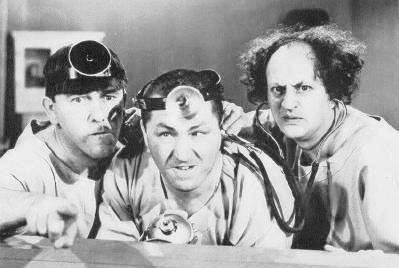
The statement by the nurses union in Dallas describing the Three Stooges level breaches in safety protocols surrounding the treatment of Thomas Duncan, the nation’s first Ebola fatality is shocking, but it should be no surprise, ironically. By now, Americans should be used to being told that our benevolent overseers in the government have matters well in hand, our best interests at heart, and the expertise and resources to do the job governments are supposed to do.  They are also used to discovering, especially lately, that the expensive systems and professionals we have been instructed to trust are in truth lazily administered, incompetently run, staffed with too many sluggards just waiting for a paid retirement, and most of all, well aware that failure carries little or no accountability.  In the recent past it has been the Secret Service, the Veterans Administration, the State Department, Homeland Security, the IRS, HHS and our military that have shown deficits in management, oversight, planning, professionalism and common sense undermining our trust. Now it is the Center for Disease Control. Continue reading

Ethics Observations Regarding The “Little Thing” Letter

Mail call!

Mail call!

Let me begin by stating that I doubt that the now viral “Little Thing” letter is genuine. It may well be bait put on the web (it was first published on Reddit) to trap the worst unethical hypocrites of the pro-abortion movement. If so, it worked, for some pro-choice advocates have received it with deafening, nauseating, self-indicting applause. If, on the other hand, the letter is genuine, it is a chilling confirmation of the ethical gymnastics some abortion apologists put themselves through to rationalize what in their hearts they know to be wrong.

If abortion is ethically tolerable, it cannot involve the willful and unnecessary killing of a human life. Only then is “pro choice” a fair description of the legal and the ethical issues involved: the choice of a woman to end a her pregnancy without ending what she believes to be the life of an innocent child. There are many complex and logically dubious aspects to this. The magic moment, still moving, individually variable and often determined legislatively or judicially with the precision of a coin flip, when “undifferentiated cells” suddenly become a human life worthy of society’s respect and protection, is sometimes defined by the mother’s belief. If she believes she is with child, someone else killing that child may be charged with some form of murder. If she decides that it is no more human than a wart or a tumor, she is given leave by the law to kill it without regret or consequences. This means that it is in the interests of a woman who wishes an active sex life and wants to control the timing of motherhood to fit her life plan to tend toward the wart point of view.There is no integrity to defining a key factor in a life and death decision after we have already decided how we want that decision to come out. It is like the Bush administration, having decided that waterboarding is useful, creating legal arguments asserting that an act that had always been regarded as torture wasn’t torture after all. To  many women on the pro-abortion side, unwanted or inconvenient babies are as much enemies as terrorists were to Dick Cheney. Thus life is defined in such a way as to make their war winnable.

This self-delusion, legal fiction, essential myth or convenient belief—pick your favorite—has obviously been very successful, and many women appear to accept it without thinking very deeply about it. If the option of an abortion makes one’s life infinitely more manageable, why begin questioning the ethics of the procedure, especially since about half the public, most of the media, prestigious organizations, the law, a political party and political correctness tenets tell you not to, that the issues are settled? Nonetheless, some women do question it, and do reach the conclusion that it is not a wart or tumor or enemy within them, but rather an innocent, growing, human life.

If and when a woman reaches that conclusion, as inconvenient as it may, then to go ahead with an abortion is unethical, and is, in fact, the ethical equivalent of murder. It is not the legal equivalent of murder, but when a mother believes that she is, through abortion, taking the life of an unborn child that she regards as an individual, I don’t see how it can be termed anything else.

And that is clearly the state of mind of the anonymous author of this letter, if it is genuine: Continue reading

A Media Health Fick! Now Nancy Snyderman Has An Unethical Apology To Go With Her Irresponsible Conduct

.

Dear NBC: Why does this woman still have a job?

First Dr. Nancy Snyderman endangered the public by defying a voluntary quarantine for possible Ebola exposure, apparently because she just couldn’t bear to be without her favorite soup. Now she eliminates all doubt about her trustworthiness and character—none to the first, not much of the latter— with a terrible, blame-shifting, non-apology apology:

“While under voluntary quarantine guidelines, which called for our team to avoid public contact for 21 days, members of our group violated those guidelines and understand that our quarantine is now mandatory until 21 days have passed. We remain healthy and our temperatures are normal. As a health professional I know that we have no symptoms and pose no risk to the public, but I am deeply sorry for the concerns this episode caused. We are thrilled that Ashoka is getting better and our thoughts continue to be with the thousands affected by Ebola whose stories we all went to cover.”

1. “Members” violated those guidelines? SHE did! The statement is deceitful and misleading.

2. “As a health professional I know that we have no symptoms and pose no risk to the public”—she can’t possibly know—yet—whether she and the rest of the exposed group pose a threat. And her conduct in this matter has been anything but professional.

3. Oh, she’s sorry for the “concerns.” She doesn’t apologize for sending someone who shared a car with her into a restaurant, risking the infection of large numbers of people, or violating the quarantine, or causing her group to have to be formally quarantined because she was too full of herself to eschew her favorite soup, or embarrassing the news media, NBC, and two professions: journalists and doctors. She’s just sorry all the uneducated hysterics out there got worried when she, the great Doctor Snyderman, just knows in her infinite expertise that silly precautions like quarantines don’t apply to her.

This episode certifies Snyderman as a fick, the Ethics Alarms designation for someone who is a mega-jerk and wants everyone to know it.  As for the yecch-worthy apology, it ranks at the very bottom of the Ethics Alarms Apology Scale. It is a Category 10: “An insincere and dishonest apology designed to allow the wrongdoer to escape accountability cheaply, and to deceive his or her victims into forgiveness and trust, so they are vulnerable to future wrongdoing.”


A Proposed Enforceable Campaign Pledge To Reject Corruption

OathRichard Painter is a distinguished, ethics-savvy attorney of a progressive bent who teaches legal ethics and who is a frequent contributor to the Legal Ethics Forum. He has formulated a legally enforceable candidate’s pledge requiring a member of Congress, once elected,not to accept campaign contributions except from natural persons residing in a congressional district and a promise, after leaving Congress, not to accept a lobbyist job that would entail lobbying former colleagues in the Capitol.

Painter was inspired to do so, he says, when contacted former student  who is managing the John Denney for Congress Campaign in Minnesota’s Sixth Congressional District.  Denny wants to take such a pledge, and Painter obliged with the document below.

What do you think? Continue reading

Three Republican Candidates: Gaffes, Disqualifications, Or Something Else?

shooting-yourself-in-the-footI felt badly about piling up three posts recently on unethical female Democrats running for office, and was inspired by the Washington Post’s Greg Sargent to do some analysis of Republican candidates who, at least according to Sargent, deserve equivalent criticism to what has been leveled at Alison Lundergan Grimes for refusing to say whether she voted for President Obama. [She did it again last night in her debate with Sen. McConnell.]

Sometimes finding Republican candidates who deserve an Ethics Alarms slap is hard, unless they say something bat wacky like, say, Richard Mourdock. If a Democrat is flagged by The Daily Beast or the Post, I can be pretty sure there was something said or done that was objectively troubling, because the mainstream media will bury anything from a Democrat that is vaguely defensible. A Republican, however, might be accused of certified insanity for a statement that offends progressive cant. Fox and many of the right wing websites, meanwhile, will ignore any Republican whose pronouncements don’t rise to “I am the Lizard Queen!” level of derangement, and will find fault with Democratic candidates on dubious grounds. Here are the GOP candidates for today’s ethics audit: Joni Ernst (U.S. Senate in Iowa); Tom Cotton (U.S. Senate in Arkansas); and Greg Abbott  (Texas Governor race): Continue reading

Jack Ohman’s Cartoon and Desperate Obama Defense Derangement

Ebola cartoon

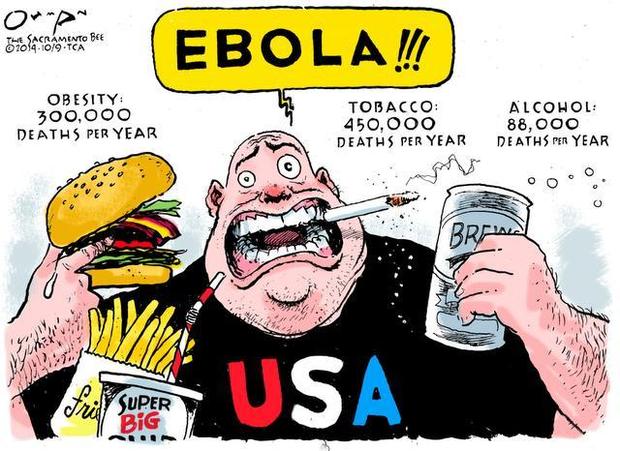
This cartoon, which should cause editorial cartoonist Jack Ohman to hang his head in shame, has made me realize that there is an odd and pervasive parallel today with the familiar Clinton Derangement Syndrome and Bush Derangement Syndrome of yore, which caused the mouth-foaming political opponents of these polarizing Presidents to make ridiculous claims undermining the many more legitimate criticisms available to them. In the case of Barack Obama, it is Desperate Obama Defense Derangement (DODD) that we are seeing. So horrible is the prospect of having to admit that this President is an unequivocal, incompetent flop by almost every measure imaginable that disappointed, panicked partisans in the media, the President’s party and bitterly disappointed hope-and-changers are resorting to obvious rationalizations, absurd analogies and insane arguments to avoid facing the miserable, depressing truth.

This cartoon can stand as a graphic symbol of the malady. In order to preemptively duck accountability when yet another government agency, in this case the CDC, proves inept and another national policy–the measures designed to keep Ebola out of the U.S— proves ill-thought out and poorly managed like so many other agencies and national policies under this administration’s stewardship, DODD sufferers like Ohman and the sad Democrats posting it on Facebook are making the argument that Ebola is no big deal.

You know, like AIDS was no big deal. When the Reagan administration was being justly criticized for its tardy and in inadequate response to AIDS, I don’t recall any cartoonists listing the stats for all of the other causes of death to ridicule gays, humanitarians and sane people who were saying that this was a national crisis. But then, there aren’t very many conservative cartoonists, for which, in that instance, at least, we can be grateful.

Look at Ohman’s cartoon, and try to translate it into a coherent statement that makes any sense at all: Continue reading

Ethics Dunce: NBC Medical Reporter Dr. Nancy Snyderman

Snyderman in the process of being infected. Nah, just kidding. What are the odds? Go get your soup, Nancy!

Snyderman in the process of being infected. Nah, just kidding. What are the odds? Go get your soup, Nancy!

Not surprisingly, since it describes jaw-dropping arrogance, stupidity, recklessness and irresponsible behavior from one of its own, the story of NBC’s health reporter violating a quarantine designed to minimize the risk of the spread of Ebola has received light coverage from the news media. If that were not true, I wouldn’t be posting the story here, because there is nothing about its ethical content that a 13-year-old shouldn’t be able to discern without my coaching.

Not Snyderman, apparently.

When the New Jersey Health Department  learned that NBC News reporter Dr. Nancy Snyderman had been spotted sitting in her car outside of The Peasant Grill, a restaurant in Hopewell, N.J., last week, it was not pleased. At the time she was subject to a voluntary quarantine placed on her and her crew after a cameraman contracted Ebola while working in Liberia. Why only voluntary? Sounds stupid and dangerous to me, but maybe they thought they could trust an M.D. who presumes to explain medical issues for a major network.

Nope.  Snyderman, 62, NBC’s chief medical editor, really likes The Peasant Grill’s yummy soups, we are told, and really, what’s the risk of a deadly outbreak of Ebola compared to a great bowl of soup? She was in a car, wearing sun glasses and with pulled-back hair—a disguise maybe?—while someone picked up her order for her. After she sneezed on him in the car. Well, that’s just speculation on my part. Never mind. I’m sure he was uninfected when he was in the restaurant.

Snyderman and her NBC News crew had been flown back to the U.S. after Ashoka Mukpo, a 33-year-old freelance cameraman, showed symptoms of the virus. Snyderman and the other NBC employees were asked to isolate themselves for 21 days. Snyderman’s a big shot, though, so she decided that the quarantine didn’t apply to her. The virus wouldn’t dare.

Unbelievable.

And undoubtedly, NBC will go right back to putting this foolish woman on TV to tell trusting viewers how to take care of themselves.

________________________

Pointer: Michael Jordan

Facts and Graphic: Daily News

Ethics Alarms attempts to give proper attribution and credit to all sources of facts, analysis and other assistance that go into its blog posts, and seek written permission when appropriate. If you are aware of one I missed, or believe your own work or property was used in any way without proper attribution, credit or permission, please contact me, Jack Marshall, at jamproethics@verizon.net.

“CSI” Ethics: Now THAT Was An Unethical Fictional Lawyer…

CSIWow. That was one unethical lawyer on CBS’s “CSI” last night, and I mean even before we found out that he had stolen a vile of an Ebola-like virus and used it to murder a doctor, almost setting off a viral epidemic in Las Vegas. (Gee, I wonder where the writers got the idea for that story? See, we don’t have to argue about politicians causing panic over Ebola: the entertainment media is way, way ahead of them.) Among the lawyer’s ethical transgressions:

1. He set out to use his law degree to gain access, through employment, to a company he blamed for allowing a deadly virus to wipe out his family in South America. Needless to say, this is a blatant conflict of interest, indeed, the worst one for a lawyer I have ever heard of in fact or fiction. He wanted to represent a corporate client so he could destroy it.  This is a clear breach of Model Rule 1.7:

(b), a lawyer shall not represent a client if the representation involves a concurrent conflict of interest. A concurrent conflict of interest exists if:

(2) there is a significant risk that the representation of one or more clients will be materially limited by… a personal interest of the lawyer.

Now, that conflict could be waived if the client were fully informed of the fact that its lawyer wanted to destroy it, and the client didn’t mind. That seems unlikely to me.

2. When it looked like his murder was going to set off a deadly epidemic, the lawyer decided to let CSI know that his client the biotech firm had lied about none of its supply of the virus being missing. He knew it was missing, because he had stolen it. The failure of a lawyer to remedy a client’s lie to police about a crime isn’t unethical in a criminal defense setting, but it is unethical if the lawyer would be aiding in another crime by doing so, which was the case here. Moreover, he is involved in the crime, unknown to his client. This would be a disqualifying conflict even if the one described above didn’t exist.

3, He also has an obligation under the ethics rules (Model Rule 1.4) to inform his client about matters relevant to the representation that the client needs to know, like “By the way, about that missing vial of deadly hemorrhagic virus you don’t want to tell the police about? I took it.”

4. THEN, he surreptitiously taped an employee and representative of the company who thought he was also representing her (if he wasn’t, he has an ethical obligation to make that clear—it’s called a “corporate Miranda warning.”) While it is legal in Nevada to secretly tape a conversation you are participating in, it is virtually never ethical for  a lawyer to do this with a client (That’s misrepresentation, violating Rule 8.4 in Nevada) , who is assured that her communications with her lawyer will be privileged, and held in strictest confidence under the attorney-client relationship.

5. Now, if the reason for the lawyer making the recording and handing it over to Ted Danson had been what CSI first assumed it was—that he was trying to save lives in imminent danger and deemed the revelation of a client confidence the only way to prevent it—he would have some support in the ethics rules, for there is an exception to the duty of confidentiality that can justify that.*  That wasn’t his motive, however, at least not all of it. He was also trying to make sure that the company—his client, which he was trying to destroy in revenge for his family’s deaths—was blamed for the virus that he had released. He had no justification for violating Rule 1.6, which says that a lawyer must keep client confidences.

6. Also, since he was representing both the employee he secretly taped and the company itself, he would have been obligated to report what she told him—evidence of a crime implicating the company–to his corporate client before reporting it to authorities, so the corporate client could report the lost vial itself, or at least have that option. If the attorney was going to exercise the “death or serious bodily injury” exception, he needed to tell the client that, too.

Yes, this was a very unethical lawyer.

Then there was that killing part…

* There was no reason to make the recording at all. This was a lame plot manipulation by “CSI.” Danson and his team used the biological residue on the recorder to prove that the same person who made the recording also stole the vial. But the lawyer could have just told the police about what his client admitted regarding the missing vial. No recording was necessary.