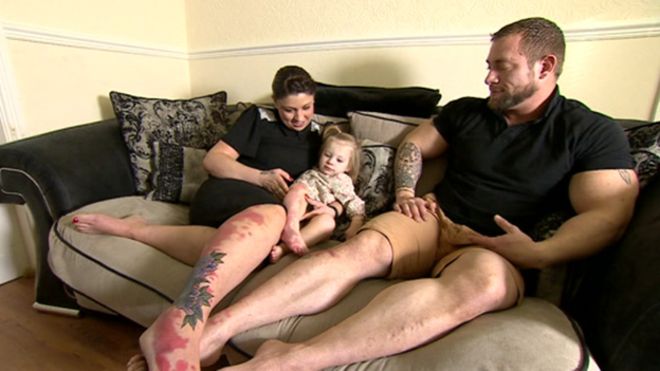
I’ve been searching for Ethics Heroes of late. They seem to be candidates for the endangered species list. Now a qualified couple, Adam and Tanya Phillips, has surfaced in the town of Grimsby, in Great Britain. Their 18-month old daughter, Honey-Rae, has a port wine birthmark running from her right foot to her lower back. After they noticed shoppers staring at their child at a local supermarket, the parents both got tattoos the color and shape of the mark on their own right legs. Each took two-and a half hours, and was painful.
When Honey-Rae saw them for the first time, she said “match.”
Loving, selfless, kind…and clever.
And one of the best uses for tattoos I’ve heard of yet
.___________________
Pointer: Althouse
Facts and Graphic: BBC
 Ethics Alarms
One of the few GOOD uses for a tattoo.
Meh, so people stared at a birthmark, is that a crime or something?
If it was a crime, then the parents would have tattooed the ones who stared…
The description of this action as ‘ethical’ or even worthy of emulation seems sentimentalist. If we accept that the little girl suffered a misfortune, can it be said to be a good, and thus ethical, that the parents mark themselves with an imitation misfortune, which only purpose is to help the little girl feel better? It could be argued that this will inculcate in the girl the understanding that others must suffer as she has suffered or because she has suffered. It may inclucate in her a sense of skewed relationship to misfortune generally. It would seem to me more ethical to help the girl (and anyone else) to accept misfortune even when others do not share it. It is more ethical that someone, anyone, well-wish the good fortune of others (to be born free of blemishes) than to ask others to blemish themseves in solidarity. If this sentimental sense of ‘ethicalness’ is applied in other areas perhaps we would damage our brains in solidarity with a retarded child? Or not send our children to fine schools because others have only bad schools to go? Better to teach the little girl to deal with the hand she was given as that will help develop a stronger position in her personality.
good reasoning Gustav & good advice !
Now hurry on over to the Hillary Clinton thread & explain to them why
the ethical dilemma is not giving uranium to Russia & possibly Iran but
the fact that Clintons believe ethical behavior is for the little people not them .
No, no, no.
People stare at a child, which sends the message “You are different.”
Parents eliminate that difference, which sends the message “You are NOT different. You are one of us.”
Also, “You are loved.”
Is it really that hard to see?
–Dwayne
Bingo, Dwayne.
‘Sentimental ethics’ is collaborative! Plays to an audience. ‘Bingo’ indicates a winning emotional number. Again, this is less ethics than practical emotionalism. 😉
On the other hand, the birthmark could be seen as a rare and wonderful thing that her parents want to share and celebrate. After all a birthmark is hardly comparable to retardation.
Ethics makes me happy. Sue me.
Quite plainly.
Parents cannot eliminate misfortune. Their effort was (in one aspect) collaboration in inculcating a wrong relationship to misfortune. Thus, less ‘ethical’ than it seems on the surface.
I don’t condemn them, I understand them, but the issue has a higher philosophical dimension, in my view.
Quite plainly the birthmark is what the parents chose to portray as an asset rather than a defect, and is to my mind a relationship to fortune. Misfortune is also in the eye of the beholder. Why not choose the way that brings joy and optimism?
Have kids?
With two words you have managed to cut right to the heart of the matter.
wyogranny: If the birthmark were—really—an asset and not a defect, there would be no reason to attempt to change the perception of it it to something else. It is possible to fool the child—for a time—but when the child grew up she would, one way or another, have to deal with the misfortune.
I suggest that it is more ethical—in any case more in accord with principled ethics (which can be explained and defended)—to have helped the child to accept her blemish as it is. It seems to me that doing so, and the general ethic it would likely represent, is better in the long run for all concerned.
The parent’s choices seem strangely convoluted to me. Not their empathy of course. Anyone can understand that.
“After all a birthmark is hardly comparable to retardation.”
What if she had been born, say, without a left thumb and her parents—as an expression of ethicalness (as you all seem to define it)—were to cut off their thumbs? Take any example.
Jack wrote: “Ethics makes me happy. Sue me.”
Again, a reference that brings to light the emotional and sentimental underpinning to many examples that you bring forward in these pages.
If your ethics is founded in sentimentalism or emotionalism or what feels good, it seems questionable. The question is: On what base do you construct this ethic? I can’t take it as a given that it is ‘good’.
I am suggesting a ‘harder’ ethic and I suggest it is better and in that sense (only) of higher value.
The reason why I would not make the choice of the two parents is not because I would not have desired to help the child to feel better—that is almost instinctive—but to instruct her in a deeper axiological principle:
Be stronger than the hand that fate deals you. Overcome. Resolve to accept ‘what is’ as it is.
My sense is that this expression of an ethic—speaking of the parents—demonstrates a common cultural attitude that I question: that of an indulging attitude toward self and others for the various misfortunes we must all confront and overcome: the hand that fate deals.
I see their act as exactly saying find strength and power in the ability to define for yourself what you experience. That is certainly ethical as well as a powerful lesson in being stronger than fate. Why would what you feel not be important. Even more important than the definition other people give it. My sister was born deaf. My parents made sure she learned to lip read and had access to the best hearing aid technology they could afford. Should they have said “Oh well, she’s deaf might as well teach her sign language and forget about being part of the hearing world?”
Hello there wyogranny. I see your point. I can’t think of more to say on the topic that I have not said.
(You will appreciate this marvellous documentary called ‘Thursday’s Children’ on an institution for deaf children, made in 1954 and narrated by Richard Burton: https://www.youtube.com/watch?v=9xIbSI1RRPg)
—GB
Port wine stain birthmarks are (now frequently capable of) being removed by laser procedures. Why isn’t it ethical for her parents to research the medical state of the “art”?
As an individual with polysyndactally, I am happy my mother didn’t undergo surgeries to make her hands more like mine. Instead, she arranged for me to have surgeries that minimize the difference, even if gloves to this day are problematic since the geometry of the one hand isn’t “correct”.