I’ll admit it: I have about as little interest in photography and photographs as it is possible to have for a human living in this century. I regard the mania for taking photos of oneself constantly and posting them on-line as strong evidence that crippling narcissism can be transmitted electronically, and as we have been discussing in comment to this recent post, if you try to use me as a prop in your cellphone camera-warped quest to make every your waking hour the object of public gawking, you had better ask permission first, or else. I realize this attitude is fighting the “everybody does it” tide, but I’m right, everybody is wrong, and that’s all there is to it.
This story out of Argentina, in addition to being disgusting, shows just how unbalanced the selfie-craze is making human priorities. I know—Argentina. This couldn’t happen here, right? Not in a country where Bernie Sanders and Donald Trump are surging in the polls….we’re too smart.
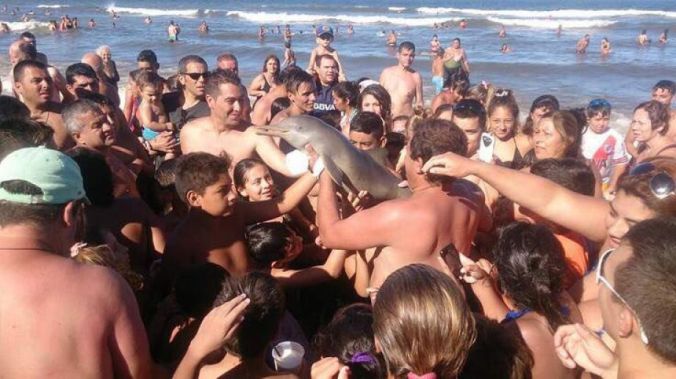
Two La Plata dolphins, members of a rare and endangered species, got to close to shore in their playfulness near an Argentinian resort last week. Some bathers plucked the small cetaceans out of the waves, and they were passed around a smiling, brain-dead mob containing selfie-mad amateur photographers. One of the dolphins died of stress and exposure, and was just dumped on the beach. But never mind: it will live on in online shares and Instagram. What’s the problem, dude?
“At least one of these dolphins suffered a horrific, traumatic and utterly unnecessary death, for the sake of a few photographs,” a spokesperson from the World Animal Protection group said. “This terribly unfortunate event is an example of the casual cruelty people can inflict when they use animals for entertainment purposes.”
Activists groups just cannot help themselves, can they? They must squeeze every episode into their own agenda. This is one of many reasons why they aren’t trusted. This episode was about reckless, selfish, ignorant people who don’t have respect for living things, not Sea World.
Well, the crowd got their selfies, so it’s all worth it to them. Meanwhile. as for their once living, breathing, prop…
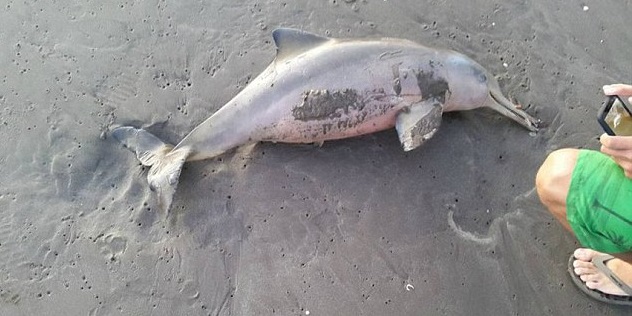
Fortunately, the carcass was still good for one more photo.
 Ethics Alarms
These are the same kind of people who would pluck wings from living dragonflies.
Maybe they are worse than that…they’ve convinced themselves so thoroughly that plucking the wings off of a dragonfly is wrong that they think they’ve mastered the principle involved, blinding them to even worse instances of cruelty in their lives.
But of course, much of this sickening episode has to do with herd mentality.
Sad; so very, very sad. 😦
I am a photographer by hobby, actually. I’m also strong on the First Amendment, and I’ve thought some of this stuff through. Frankly this conduct, taking a wild animal out of its habitat and passing it around for selfies until it dies, is appalling. Shooting dolphins playing in the water from shore, no problem, although good luck getting it right without superfast shutter speed. If you have to hurt or damage something, or take a risk to get your picture, it’s not worth it.
For the record, I see absolutely no problem taking any picture of anything or anyone in public as long as they are out in public. A big chunk of my shooting is of non-sentient stuff (statues, flowers, etc.) or animals, so it’s not an issue. A lot more of it is people out and about or participating in a public display: stunt pilots in action, parading musicians or military units, emergency vehicles rushing somewhere (yes, I am a bit of a fire buff), political figures giving public speeches. These are people who should expect to be photographed, and if they don’t they aren’t in the right line of work. I also think anyone at a public event in costume is pretty much fair game: Renaissance Faire knights, WW2 or WW1 weekend soldiers or pilots, Comicon cosplayers. It shouldn’t come as a surprise to anyone who puts on a costume designed to attract attention that they get photographed.
Ordinary people doing ordinary things in public is a little different, but quite honestly, if you’re walking in a big city, you’re probably already on a surveillance camera and really have no basis for an objection. Same deal if you’re in a public park and just sitting, sunbathing, etc. where everyone who walks by will see you. You want to sit and read or bake where no one will see you, do it in your yard that doesn’t front the street. Double that if you’re in an area where there’s stuff people are going to be photographing like the Capitol rotunda. If I’m shooting a particular statue or painting and I peripherally get someone else who’s also gawking (or worse, gabbing on his cell and oblivious) then that’s his damn problem. Triple that if I ask you, politely of course, to please move out of my shot of the statue, painting, etc., and you shine me on.
Oh, and as for kids, I’m frankly not interested in your precious snowflake that you post 8 pictures a day of on social media, down from twenty when she was a baby and you had to share every moment. But if your kid is standing by the barricade with the parade passes, or in the rotunda with thirty classmates when I’m trying to shoot the statuary, or insists on making a spectacle of herself in front of the stage where the Irish dancers are performing by trying to ape their moves, I’m not going to refrain from taking my shots.
1. Ordinary people doing ordinary things in public is a little different, but quite honestly, if you’re walking in a big city, you’re probably already on a surveillance camera and really have no basis for an objection.
Wrong. If the city takes your photo and uses it in a PSA, or releases it to the Onion, damn right you have a basis for objections. Yes, we give implied consent to security cameras because we participated in the election of the officials who put the cameras there supposedly for our safety. NOT true of private cameras.
2. Same deal if you’re in a public park and just sitting, sunbathing, etc. where everyone who walks by will see you. You want to sit and read or bake where no one will see you, do it in your yard that doesn’t front the street.
That’s consent to be SEEN. Not consent to be an unpaid photographer’s model. Not the same thing, not remotely.
3. Double that if you’re in an area where there’s stuff people are going to be photographing like the Capitol rotunda. If I’m shooting a particular statue or painting and I peripherally get someone else who’s also gawking (or worse, gabbing on his cell and oblivious) then that’s his damn problem. Triple that if I ask you, politely of course, to please move out of my shot of the statue, painting, etc., and you shine me on.
Of course,. But inadvertent photos in public places where you know photos are being taken was not the issue of the post, or the discussion.
4. Oh, and as for kids, I’m frankly not interested in your precious snowflake that you post 8 pictures a day of on social media, down from twenty when she was a baby and you had to share every moment.
Wrong. First, the posting of the kids pictures is itself unethical. Second, two wrongs don’t make a right.
5. But if your kid is standing by the barricade with the parade passes, or in the rotunda with thirty classmates when I’m trying to shoot the statuary, or insists on making a spectacle of herself in front of the stage where the Irish dancers are performing by trying to ape their moves, I’m not going to refrain from taking my shots.
Straw men. Nobody has asserted otherwise.
That’s consent to be SEEN. Not consent to be an unpaid photographer’s model. Not the same thing, not remotely.
Nope, being seen and being photographed are not the same. That said, bans on photography in public places are probably impossible to enforce, and with zoom lenses now, I could be 800 feet away from some bikini clad hottie, take a very close in shot that shows off every curve, and she’d never know she’d been photographed.
If you are saying parental oversharing is unethical, I’ll be the first to agree. It irks me, however, when parents who overshare are the first to squawk at you to wait or not close the shutter until they can hustle their hobgoblins out of range. Hypocrites.
1. But Steve, it’s THEIR KIDS. I agree that it feels hypocritical, but if I slap my son as discipline, would you argue that I can’t bitch if a stranger slaps him?
2. “That said, bans on photography in public places are probably impossible to enforce, and with zoom lenses now, I could be 800 feet away from some bikini clad hottie, take a very close in shot that shows off every curve, and she’d never know she’d been photographed.”
Right—and the impossibility of preventing something by law is an argument for using ethics.
Don’t wanna hear it. Hustle your brat home, then, OUT of my shutter. If I specifically aim for your precious snowflake, which I won’t do, THEN object.
2 things —
I don’t get your complaint about World Animal Protection group (although I’ve never heard of them and I follow the environment stuff). How is their response not a response to “reckless, selfish, ignorant people who don’t have respect for living things”?
Secondly, regarding photography. I am highly sensitized to this issue because I am responsible for promoting and marketing a Roman Catholic elementary school. The hoops we must jump through to ensure that we have permission to use the photographs we take have become a real burden. Parents are asked at the beginning of the school year to submit a form indicating if we are permitted to take their child’s photo and where we may publish it. This becomes really complicated when they say it’s ok for the photo to be in the parish bulletin, but not on the website, et al. Well, the bulletin gets uploaded to the website. If we take a random group shot of kids, there’s a good chance that one of those kids will be “no photos allowed.” I understand why this is absolutely necessary. But I sure hope that we come up with a better way to figure this thing out.
As a church music director, I have found myself in photos taken by other people during special occasions. My image is usually facing away from the camera. Seriously, people? Do you REALLY want a permanent photo memory of my abundant backside? I sure don’t. So, my biggest beef (besides my backside) is the incompetence of most amateur “photo buffs” who don’t have a clue how to take a decent photo. Otherwise, eh, take your damn photos.
Like most activist statements, the WAP’s statement was worded benignly enough to defend as innocent and claim “no, we weren’t talking about that at all!” Yet the statement is general enough with enough emphasis on “entertainment” to see that they probably and clearly oppose ALL entertainment or non-natural exploitation of animals… Such as Sea World.
But I don’t know. I’ve never even heard of the group.
Me either. But your explanation helps to give me some context.
Chorus pictures are usually just of the singers or from the side so you catch both the singers and the director, speaking as a choral singer and photographer. That said, I’ve shot more than a few fails, BUT never anything intended to embarrass someone. My cousin has never lived down a picture when she was 5, naked, holding a stick horse, that her parents kept passing around at every. family. gathering, repeatedly telling her not to overreact. Parents can be as bad as other kids sometimes…
Your poor cousin. I hope she has been able to get that photo and burn it.
I get the concept of chorus plus director in a side shot. That makes sense. But from the back? Please!
Eventually she and her sibs moved out and her parents got a smaller place, and a lot of stuff, including that picture, got lost in the shuffle. Parents can be that way, especially as they get older, always showing that one picture, telling that one story, bringing up that one incident, that will leave the kid squirming in their chair as everyone else bursts out laughing. It’s especially embarrassing when they do this in front of the kid’s significant other.
You can’t shut them down or try to turn the conversation elsewhere, they will not be denied. You can’t pull them aside later and tell them that picture of you with your five-year-old butt sticking out, or that story of how you fell in the mud halfway through the day-long hike and couldn’t get cleaned up for hours, or the time you were scared out of your wits in the haunted house you thought you could handle and thought wrong, has run its course and you’d like it to be retired. At best they’ll laugh it off and tell you not to be so thin-skinned about a cute story. At worst you’ll just fuel the fire.
Somehow I think parents secretly delight in torturing or controlling their kids, even long after they have grown up and become independent. One of my mom’s last acts toward me, about a month before her death of cancer in July 2014, was an act of control. I was going to a concert and then an air show in Pennsylvania for two days. It was a long drive and a long event and wasn’t going to leave too much time for other stuff during those two days. She wanted new vacuum bags for the vacuum, and said she was hoping I would stop by Sears out where the show was and pick up this particular brand and type of bags.
First of all, she wasn’t going to be doing any vacuuming (or much of anything else) during the time she had left, she was just too weak. There was also a Sears not too far from her place that Dad of one of us kids could have gone to another time to chase vacuum bags. She could have easily ordered these bags online from Sears and had them in 2-3 days.
No, no, she insisted, the Sears out there had a better selection, no no, she didn’t want to wait, but if I was going to refuse to be helpful to my mom, there was nothing she could do. So I drove an hour out of my way each way after nine hours on a very hot airfield, when all I wanted to do was sit down and drink water, to chase the bags, which Sears didn’t have in stock, which they ended up ordering online anyway, which never did anything other than sit in the closet. The thing is, it was never about the bags, if it was, she would have just ordered them online or been ok to wait. It was about the fact that she was ill, she probably knew she didn’t have much time, her power over everyone else was slipping away, and now her son was going off on a mini-vacation while she was stuck home. Dammit, she was going to make sure her influence was felt here. Either she was going to make him go a little bit out of his way, enjoy his good time just a little less, or she was going to lay a big, big guilt trip on him.
Jack,
“At least one of these dolphins suffered a horrific, traumatic and utterly unnecessary death, for the sake of a few photographs,” a spokesperson from the World Animal Protection group said. “This terribly unfortunate event is an example of the casual cruelty people can inflict when they use animals for entertainment purposes.”
I don’t like groups like this either, but this is far from incendiary or divisive rhetoric. It IS an example of the casual cruelty people can inflict towards animals (especially other human animals) when your only consideration is entertainment. I realize they’re atten young to draw larger parallels that their followers will get, but nothing within the four corners of the language directly implies those parallels.
This is exactly the result of the crippling narcissism of which you just spoke. If all you’re concerned with is your own enjoyment, then you’re bound to hurt others if for no better reason than they were never considered.
I guess I’m confused why THIS quote is an example of why activists shouldn’t be trusted? Especially since your words leading up to the quote are almost identical to the first sentence. I guess it was the mention of “entertainment purposes” that bothered you? If only PETA were this tame in their rhetoric.
Because it’s those subtly worded sentences loaded with generalized language that gets reasonable people to agree immediately *in context* next thing they know they are included in statistics claiming a large swathe of the population condemns places like Sea World, because the quote, out of context can mean “damn Sea World” just as much as it can mean “people abusing a beached dolphin for selfies are unethical”.
Because the event was as you just described. This wasn’t a parallel to Sea World, or allowing sea mammals to be seen and understood and appreciated under controlled conditions. But activists have to exploit in their monomania, so this tragic and disgusting episode was dishonestly analogized to “the casual cruelty people can inflict when they use animals for entertainment purposes.” Yes, a mob of idiots ripping dolphins from their natural environment and killing them with no thought of the animal’s welfare at all is EXACTLY what happens in professional zoos and aquariua. No, it isn’t.
It’s a slur on scientists, naturalists and zoologists, tying legitimate research and preservation to wanton, mindless cruelty.
So, abortion proponents tie limitations on late term abortions to the abolishment of birth control, and gun activists describe attempts to ban cop-killing bullets as linked to gun confiscation, and when one white cop kills a black suspect who is unarmed, it means that whites are hunting blacks. From global warming alarmists to those who ascribe “hate” to legitimate concerns about open borders, I see few activists on any issue that won’t misrepresent, exaggerate and lie to achieve their goals. In this case, a statement about respecting animals and not endangering them by handling them in the wild would have been valuable. They had to use the episode to attack all animal entertainment, even well regulated and controlled. As a result, the activists lose credibility and influence.
Jack,
You’ve made a point of saying before that people can’t justify spouting nasty things simply by arguing later “That’s not what I meant!”
Isn’t this the reverse? Calling someone out for something you think they meant but never said? There isn’t single mention of zoos, sea world, or nature tourism in that quote. They may believe that about, sure, but they didn’t say it.
As I’ve mentioned, I think funerals are a waste of time and burial is a waste of a body, but I have never and would never say so AT a funeral or burial. What’s more, if someone were to tell me “I don’t mind honoring the dead with burial, but don’t want to have to attend a funeral, would I be an “activist” for agreeing to the one point even though my views were even more extreme? They left the door open for dialogue (or indoctrination, depending on your view) by wording it so generally, yes. But that’s the nature of persuasion. They found an event they new would outrage people and issued a statement that stated their feelings and hinted that there were more systemic issues, but didn’t use this as a soapbox to spout from — they simply gave people the option of finding out more.
How is this any different than Amazon prompting people at checkout with “customers who bought these titles also bought …”? This is much the same thing: “if you think THIS is outrageous, look us up as maybe we can help you find more things to be mad about.” Groups like PETA, on the other hand, never respect the public enough to do that. They spout their extreme views from the start. Pets are slaves; meat is murder — this doesn’t even come close.
Just because you disagree with their endgame doesn’t mean you can’t find at least some commonality. If they were trying to shut down a terrier breeder who was abusing the animals and senselessly killing themselves, would you refuse to work with them simply because they thought ALL breeding is wrong (which you may, but for the sake of argument let’s assume you were fine with it)?
“There isn’t single mention of zoos, sea world, or nature tourism in that quote.”
And the Pope never specifically said “Donald Trump.”
The statement—it was prepared, remember— could have been made to specify what happened. The group very intentionally generalized it to attach indefensible conduct to controversial conduct they oppose. It is obvious and intentional, and standard practice, a form of deceit as well, since it allows them to make the argument you just made. They aren’t fooling anyone…except you.
Jack,
That’s just the thing — I (nor most) were “fooled” by anything. I understood th context inmediately, and that’s the point. This sort of language is designed to clue people in to “hidden” agendas not the other way around. The point is, inference is not the same thing as a flat-out statement of fact. The Pope never said Trump, but he was specifically asked about him by name.
The statement was carefully prepared to specifically avoid inflammatory rhetoric. They’re expressing outrage over one thing and hinting at something else, but I would still argue that’s a legitimate technique of persuasion — get someone to agree to one point and then up the ante. If you’re calling that
underhanded than so is every church-sponsored soup kitchen. After all, it’s not just stomachs they want to nourish — it’s all just a ploy to shove religious nonsense down their throats.
Why can’t I just be wrong instead of equating it to stupidity? Intentional or not, yourind to find subtle ways of suggesting I’ve missedsomething instead of interpreting the facts differently or incorrectly. I’m fine being wrong but, hate being told I’m silly.
Well of course you saw it, and that’s what’s wrong with the statement, as I said. The connection is unwarranted and unfair, and if you understood what it meant, why did you say previously that I was criticizing what wasn’t said? It was said. A clear implication and reference is communication. Sure, it can be legitimate, but not when it implies that two very different kinds of conduct are the same. That’s dishonest and manipulative.
Jack,
The same way I understand what a priest means when he tells me my dearly departed has “gone to a better place”; yet I still appreciate him sparing me the eye-rolling that associated with a prolonged sermon on heaven and hell. Implication is a persuasive technique, the latter is flat-out indoctrination. A fine line, perhaps, but one I’m willing to tolerate.
Besides, since when is manipulation dishonest? Almost every debate is an example of one side trying to manipulate the other into agreement. As long as the manipulation isn’t underhanded, I don’t see the problem.
Keep in mind, I realize that “this isn’t nearly as bad as PETA” is a pretty low bar to set; I was just surprised that this, of all quotes, struck you as activists run amok.
Cheers!