From An Ethics Dunce Playmate Of The Year, A Full Pazuzu!

dani-mathers post

Dani Mathers is a former Playmate of the Year. On the left below, you see Dani as she appears to unknowing bystanders; on the right, the oil portrait of herself that she keeps in the attic.

Dani+Mathers

Befitting the character and soul accurately portrayed by the portrait, the skin-deep beauty took a cellphone photo of an unaware naked female member of LA Fitness in the gym’s shower. Then Dani posted the pic on Snapchat with the caption, “If I can’t unsee this then you can’t either.”

The actual photo does not have the victim’s body blotted out.

Said LA Fitness of  Dani:”Her behavior is appalling and puts every member’s privacy at risk. We have handled this internally and also notified the police.”

Of course cell phone photography is prohibited in locker rooms. Doing what Mathers did may also be against the law.

Caught with her ugly soul exposed to the world, the model reverted to full Pazuzu mode. Pazuzu was the demon who made poor Linda Blair say all those horrible things in “The Exorcist,” and the Pazuzu Excuse is what Ethics Alarms calls apologies for horrible statements or conduct that include such incredible statements as “Those statements do not express my real beliefs,” “That doesn’t reflect who I am,” and the always popular “That wasn’t me.” Continue reading

Condign Justice For An Ethics Dunce

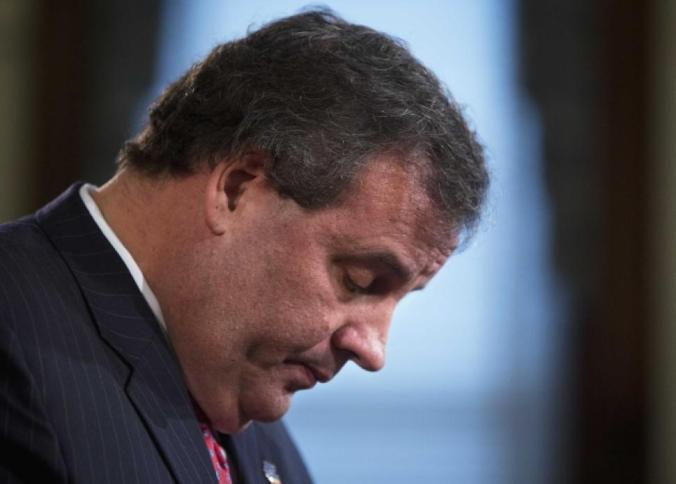
Chris Christie

The only contemporary writer who regularly uses the term “condign justice” is George Will, who uses it frequently. “Condign” is usually paired with “justice” or “punishment,” and means “well-earned,” “appropriate,” or “deserved.”

Donald Trump screwed over New Jersey Governor Chris Christie, who foolishly believed that his cynical endorsement of Trump could buy him a Vice-Presidential slot on a Trump ticket. Christie probably didn’t have a direct quid pro quo deal with Trump; he’s a good enough lawyer to know that this would have been illegal. He probably thought he had an “understanding.” How he could not have had an understanding that he was re-enacting the fable of the frog and the scorpion with him playing the role of the amphibian is a mystery. Trump is untrustworthy. Trump is a con man. Doesn’t everyone know that? We know Christie knows that, because he has said so.

Make no mistake: if and when Donald Trump takes the Oath of Office at the Capitol, Chris Christie will be one of the primary figures accountable for that national disaster. (I am beginning to think #1 will be the Democratic Party and its followers, who could not do a better job of making Trump look like the safer of two risky alternatives if they tried.) When the governor made his endorsement, Ethics Alarms awarded him its rarely given Ethics Villain designation. As the one candidate who could match Trump’s bluntness and audacity without the overwhelming stench of ignorance, Christie was the  Republican challenger with the skills and credentials to take Trump out. Instead, he avoided direct confrontation with Trump in the debates and instead symbolically disemboweled Trump’s other most dangerous opponent, Marco Rubio. Then Christie dropped out, and conferred legitimacy on the blowhard by becoming the first non-wacko holding an important elected position to endorse him.

Uck, yechh, blech, gag. Continue reading

Comment of the Day: “Prelude: Intent, Gross Negligence, And ‘Extremely Careless’”

eyes closed driving

Long-time commenter (and blogger) Glenn Logan has authored not one but three COTD-worthy posts of late. I have chosen his commentary on the gross negligence/extremely careless distinction for the honor, but any of them would have been worthy choices. You can find the others in the threads here and here.

Before I get to Glenn, I want to point out that a recent and ridiculous news story illustrated the difficulty of the gross negligence/extreme carelessness distinction perfectly:

A North Florida woman is saying her prayers after running her car into a home — after saying her prayers.

The 28-year-old woman was driving in the tiny town of Mary Esther, located west of Fort Walton Beach in the Florida Panhandle. Deputies from the Okaloosa County Sheriff’s Office say the driver told them she was praying and had her eyes closed before the incident took place.

According to NWFDailyNews.com, authorities say she ran a stop sign, going through an intersection and into the yard of a home. The driver tried to back out, but her car got stuck in sand and dirt around the home. No one was hurt inside the home and the driver was taken to a nearby hospital for evaluation. She was cited for reckless driving with property damage.

Gross negligence would be praying, driving, and closing her eyes knowing well that it endangered others, and doing it anyway. Extremely careless would be praying, driving, and closing her eyes assuming that no harm would come of it, perhaps because God would be driving the car. “Reckless,” however, may cover both.

Here is Glenn’s Comment of the Day on the post, “Prelude: Intent, Gross Negligence, And ‘Extremely Careless’”: Continue reading

Two Critical Integrity Questions For African-Americans, University Administrators, Democrats, Civil Rights Advocates, Progressives And Social Justice Warriors

Seperate-but-Equal

First question: 

Are you prepared to rationalize this?

From the Wisconsin State Journal:

UW-Madison’s Multicultural Student Center separated attendees by race to discuss a violent week of news that stirred debates about racism and law enforcement, prompting criticism from conservative news outlets that the arrangement amounted to segregation.

Campus officials said the decision to hold separate meetings Monday for white and minority students, faculty and staff was made to ensure people of color had a place to discuss their concerns, and said the rules were not meant to exclude participants.

“No one was turned away from any session,” UW-Madison spokeswoman Meredith McGlone said in a statement.

A post that has since been deleted from the Multicultural Student Center’s Facebook page described the meetings as a place where students and UW employees could emotionally process the prior week, which included fatal police shootings of black men in Minnesota and Louisiana, followed by the targeted killing of five police officers in Dallas.

Two of the meetings were for white students and UW employees, according to the post, while two meetings were for people of color.

The Daily Caller, a national conservative news site, wrote about the meetings Monday night, posting a story that included a historic photo of a segregated waiting room sign. The site Right Wisconsin also wrote about the meetings.

McGlone said participants wanted “a space to express feelings without the fear of being judged.”

“Our students of color often find such spaces hard to come by,” McGlone said. “It is a best practice in student affairs to allow quiet and reflective space for those who request it.”

Still, McGlone said, the intent behind the different meetings “could have been communicated more clearly to avoid any impression of exclusion.”

McGlone did not respond to a followup question asking whether the Multicultural Student Center would use a similar structure for meetings in the future…

Here is a handy link to the Ethics Alarms Rationalizations List, so those of you choosing to try to justify this have all the necessary arguments in one convenient place..

The second question:

If you are not prepared to rationalize it, do you have the courage and integrity to condemn it?

Continue reading

Pokémon Go Ethics: Beware The Terms Of Service Agreement!

pokemon-go-starters

I had a hard time finding anything unethical about Pokémon Go, the smartphone GPS scavenger hunt game that sends players all over the landscape to find and trap those adorable Japanese monsters that caused a trading card craze and more a decade ago. (I assume that anything that seems really dumb is likely to have ethics problems. You’d be amazed how often I’m right.) It seems benign. The game can be good exercise, it’s engaging for people who have no more productive avocation, and best of all, it gives American something to obsess about not named Bill or Hillary. There are some troubling signs: administrators at the National Holocaust Museum and Arlington National Cemetery felt that they needed to ask visitors not to play the game while contemplating the murder of six million Jews and the fallen heroes of foreign ways—what is these spoilsports’ problem?—and some people are letting the game endanger themselves and others, leading to these morons falling off a cliff, causing this idiot to drive  his car into a tree, and prompting this in Arizona…

Pokemon go traffic sign

Continue reading

Four Supreme Court Decisions: Abortion, Guns, Affirmative Action, Corruption…And Ethics. Part 3: Whole Woman’s Health v. Hellerstedt

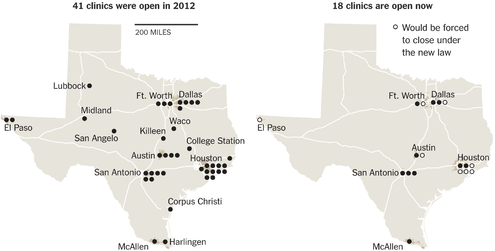
shrinking-number-of-abortion-clinics-in-texas

[The Supreme Court came down with four controversial and ideologically contentious decisions in June, and I apologize for taking almost a month to cover them all. One of the reasons Ethics Alarms occasionally launches a series like this one is to ensure that developing ethics stories of importance do not push important issues to the sidelines. The fact that this four part series had only finished parts 1 and 2 was an irritant to me, as well as some readers.]

In Whole Woman’s Health v. Hellerstedt, decided on June 27, the Supreme Court held in a 5-3 majority that two provisions of a Texas law, one requiring physicians who perform abortions to have admitting privileges at a nearby hospital and another requiring abortion clinics in the state to have facilities comparable to an ambulatory surgical center,  places a substantial and unconstitutional obstacle in the path of women seeking an abortion, because they constituted an undue burden on abortion access.

Life would be so much simpler if our elected officials and activists employed an adaptation of the Golden Rule, and looked objectively at issues from the other side’s point of view. This is especially true in the realm of rights.  Second Amendment absolutists insist that virtually any laws regulating who can purchase guns, when and where they can purchase them, and how and how quickly they can be purchased are efforts to whittle away the right to bear arms. They also argue that such regulations have the ultimate goal of  eliminating that right entirely, which, in many instances is the case, especially if you listen carefully to the rhetoric of the legislators proposing such measures. There is little difference from this and what anti-abortion advocates are attempting to do with laws like House Bill 2 (H. B. 2).

The bill ostensibly is designed to make abortions safer, thus protecting women’s health, just as many gun laws are promoted as safety measures. Oddly, virtually all of the supporters of the Texas bill would make abortion illegal if they could. I’m sure it’s just a coincidence, just as it’s a coincidence that the authors of bills requiring potential gun owners to jump through increasingly burdensome hoops and deal with mandatory trigger locks and “safe gun” technology would gladly repeal the Second Amendment if they could. The ethical principle is the same in both matters: a right isn’t a right if legal obstacles make it difficult to exercise that right.

The question is, what’s a reasonable obstacle? Any regulation imposed on a constitutional right must not create “a substantial obstacle” and must be reasonably related to “a legitimate state interest.” The Supreme Court uses the language and logic of case precedents, which are its previous examinations of these issues and the balancing they require. One such case, though I did not find it mentioned in the majority opinion or dissents in Hellerstedt, would be the voter ID decision of many years ago, in which a strong majority ruled that the state interest in preventing fraudulent voters and maintaining the integrity of the election process justified inconveniencing those who were subjected to the extra burden of obtaining appropriate identification. In recent years, this decision has been questioned because many believe the motive behind voter ID laws is not really to protect the franchise, but to keep likely Democratic voting blocs from the polls.

Is there a difference legally between a bill that is authored with the intent to restrict the right to vote of older, poorer, and darker citizens while claiming that its sole purpose is to make sure non-citizens don’t affect the results of elections, and an identical  bill that is genuinely intended to safeguard the voting rolls, without any political motive at all? No, or at least there shouldn’t be. The Court’s job is to evaluate what the law does, not try to read the minds and hearts of those who wrote it. Justices only should try to do the latter when there is a debate over what the law says.

Ethically, however, there is a significant difference between a law using a public purpose as a sham to accomplish unethical ends, and a law with a legitimate purpose that has some negative side effects. Trying to restrict a citizen’s rights because one doesn’t respect those rights (or perhaps the citizen) is unethical.

The SCOTUS majority, in its typical examination of a balancing case like this, looked at whether there was a sufficient public safety benefit to a law that had resulted in a precipitous reduction in abortion services: Continue reading

“Bewitched” Ethics: A Startling Lesson In How Increased Sensitivity To Other Cultures Constitutes Progress

The Sixties witchery sitcom “Bewitched” is a guilty pleasure, mostly because of the superb cast and unabashed silliness of the enterprise. (I do avoid the episodes with Darrin 2, Dick Sergeant, who took over the role of Samantha’s befuddled mortal husband—without any explanation in the series—after the Definitive Darrin, Dick York, became unable to perform.) A new cable channel is running the series in the morning, and today I saw an episode that delivered a series of shocks that never would have registered in 1968, when it first aired. Some of them should have, though.

The episode, “A Majority of Two” (the title evokes the stage and film comedy “A Majority of One,” about a romance between a middle-aged Japanese man and a Jewish widow from Brooklyn)  involves Darrin’s boss, the weaselly Larry Tate, conning Samantha into hosting a dinner for important advertising client Kensu Mishimoto, who is flying in from Japan. Sam agrees—after all, a nose twitch or two is all it takes—but asks Larry what to serve, Japanese or Western cuisine. Larry is prepared: he gives Samantha a note with the name of what Mishimoto’s secretary told Tate was the businessman’s favorite  dish: Hung Ai Wan Goo Rash. There being no internet, Sam worries about how she will get the recipe.

Let’s count the insensitivity jolts here: Continue reading

Ethics Quote—But Not Necessarily ETHICAL Quote!—Of The Month: Supreme Court Justice Ruth Bader Ginsburg

i-was-wrong

“On reflection, my recent remarks in response to press inquiries were ill-advised and I regret making them. Judges should avoid commenting on a candidate for public office. In the future I will be more circumspect.”

—- Justice Ruth Bader Ginsberg, officially apologizing for making remarks sharply critical of Donald Trump last week, including suggesting (in jest) that if her were elected President, she might “move to New Zealand.”

Observations:

1. Supreme Court justices almost never apologize, and I only say “almost” because I can’t do enough research right now to safely say “never.” They don’t apologize because the don’t have to: they are, ethically, a law unto themselves, and accountable to nobody unless impeached and convicted. (Justice Samuel Chase, was impeached by the U.S. House of Representatives on March 12, 1804, on charges of arbitrary and oppressive conduct of trials; it was a purely political attack. He was, correctly, acquitted by the U.S. Senate on March 1, 1805.)

2. An apology was appropriate, however. Justice Ginsberg proved herself smarter, better, more ethical and more principled than the embarrassing, crypto-facsist “these are not ordinary times” crowd, including the folks at Salon and other left-wing blogs, this guy, and too many of my dear friends on Facebook, whose expressed opinions really are beginning to make me wonder if they will solemnly send me to a Lobotomy Man when I oppose President Clinton’s declaration of open borders, ban on fossil fuels, race and gender quota in all hiring and admissions to (free) colleges, and confiscation of 50% of my property to help pay for national health care including late-term abortion on demand and tax-payer funded recreational drugs.

3. She apologized because any fool could see that her comments did undermine trust in the institution of the Supreme Court, and that her critics were right. Some of my more misguided colleague in the legal ethics field opined that it was silly to think that Justices don’t have political opinions and biases, just as it is silly to think journalists do not, so why shouldn’t she exercise her First Amendment rights? This  lame notion was decisively rebutted by a lawyer whose name I wish I could reveal, except that his comments were on a private list. He wrote in part… Continue reading

The Black Lives Matters Effect, Part 2: Purdue’s Free Speech Chill

Perdue letter


So powerful is the desire to be seen as on the “right” side  in an era where race trumps everything that a major university is harassing a student because he dared to be critical of Black Lives Matter. This is another, more sinister aspect of the Black Lives Matter Effect. A racist hate group that claims to promote virtuous objectives as cover, Black Lives Matter causes well-intentioned progressives-in-denial to equate well-earned attacks on the group to rejection of racial justice.

This episode is especially troubling. Purdue University Northwest student Joshua Nash received an ominous letter summoning him to a “required Administrative Meeting” scheduled by a campus administrator to discuss Nash’s personal Facebook comments. This is as appropriate as a letter demanding a student’s appearance before authorities because there was a complaint about his off-color toast at a wedding reception.

Nash says he isn’t certain which Facebook post was deemed worthy of threatened discipline, but it was probably the one where he states “Black Lives Matter is trash because they do not really care about black lives. They simply care about making money and disrupting events for dead people.” According to Nash, that comment was reported to Facebook, with removed it and suspended his account for 30 days. Nash also claims that a campus official said his social media comments could result in his expulsion.

I assume that FIRE will soon be in Nash’s corner, and maybe, just maybe, the ACLU, depending on what its integrity level is these days. This is campus suppression of free speech. I think the threat of expulsion–for a Facebook post?—is too ridiculous to be taken seriously, but the letter is bad enough. All students need to know is that a politically incorrect Facebook post will get them hauled into a “meeting,” a.k.a. inquisition, and their speech, with the exceptions of a few wilful martyrs, civil libertarians, and rebels, will be effectively muzzled. Continue reading

The Black Lives Matters Effect, Part I: The Tenor And The Blogger

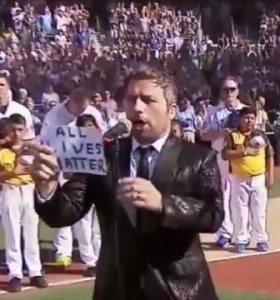
Singing the right lyrics also matters, you boob...

Singing the right lyrics also matters, you boob…

One thing you have to say for Black Lives Matters: it is good at making people make asses of themselves. “Late Night” host Seth Myers was yesterday’s example, but there are oh-so-many-more, and much worse.

For example, in the pre-game ceremonies of the Major League Baseball 2016 All-Star Game in San Diego, a Canadian tenor, apparently driven to distraction by the reverential treatment given to a group that promotes race hatred and a color-based standard for law-enforcement, snapped while performing the Canadian national anthem. Remigio Pereira, a member of  the vocal group The Tenors tapped to sing the anthem, held up a handwritten sign that read “All Lives Matter” altered the lyrics in the line “With glowing hearts we see thee rise. The True North strong and free” to “We’re all brothers and sisters, all lives matter to the great.”

This doesn’t fit the music, and is even worse than the real lyrics, which is quite a feat. Of course, Remigio was unethical to do this, expropriating an event that had nothing to do with Black Lives Matter, nor race, nor politics to make his own grandstanding statement (come to think of it, baseball does have something to do with grandstands. The stunt was disrespectful of everyone—his hosts, Major League Baseball; San Diego; the captive audience in the stadium, the TV audience, Canada. It was also a breach of trust that directly and perhaps fatally wounded his group, which immediately suspended him (Can we say F-I-R-E-D, Tenors? Sure we can) and issued an abject apology.

The statement was not unduly disrespectful to Black Lives Matter, however, which has shown itself to be unworthy of respect, as all divisive hate groups are.

The Black Lives Matters effect is wide-ranging, however, as this episode shows. It not only makes Canadian tenors irresponsible, but sportswriters too. Over at NBC Sports online, baseball blogger Craig Calcaterra couldn’t perceive the unethical nature of a performer hijacking a paid gig for his own purposes, but lectured his readers on the sin of using the term “All Lives Matter,” writing,

This may not seem terribly controversial to some, but in the context of the Black Lives Matter movement that has risen over the past few years, “All Lives Matter” has come to be seen as a reactionary response which fundamentally misunderstands — often intentionally — the purpose of the Black Lives Matter movement. And is used to belittle and marginalize the Black Lives Matter Movement. The phrase “black lives matter” does not mean that “black lives matter more than any other lives.” If it did, sure, maybe “All Lives Matter” would be a reasonable response. But “Black Lives Matter” is a response to a society and, particularly, police, which treat blacks as lesser persons and who do not face repercussions for harming and in some cases killing black people through excessive force. It’s “black lives matter too” — a necessary statement, sadly — not “black lives matter more.”

Sigh. Continue reading