Unethical Quote Of The Day: Valerie Joseph, Wheelchair-Bound Uber User And Class Action Litigant

“I feel frustrated because I have to plan my day.I can’t do things on a whim. I have to plan it days in advance.”

Valerie Joseph, litigant in  class-action lawsuit accusing Uber of discriminating against New York City riders with disabilities by providing inadequate access to wheelchair-accessible cars .

Could there possibly be a better quote to exemplify the entitled mentality of so many Americans, and the unethical values they have somehow extracted from our political culture?

Yes, Valerie, you are handicapped. I’m sorry about that, but I’m not responsible for it. Nor are you entitled to make me, and businesses, and the government pay to ensure that society can mitigate every inconvenience created by your misfortune. You do not have the luxury of doing things “on a whim.” Neither do single mothers. Neither do small business entrepreneurs who have substantial debt. It’s your life, deal with it. I also have to plan my days because of circumstances beyond my control. It’s called adulthood. Grow the hell up.

The lawsuit Valerie champions, filed in State Supreme Court in Manhattan by the non-profit Disability Rights Advocates is a classic. It is seeking to risk putting Uber out of business and remove its lower-cost transportation options for the vast, vast majority of the public by insisting on expensive retrofitting of the company’s cars that would benefit a tiny minority.

The Taxis for All Campaign filed a similar discrimination lawsuit over yellow taxis, virtual legal extortion that resulted in a settlement requiring half of all yellow taxis to be wheelchair accessible by 2020. Thus the litigants in the Uber suit already have an acceptable option: call a cab.  There are now 655 wheelchair accessible taxis in the New York city area.  I’d love to see statistics on how often they are used by the passengers they are designed to serve.  My guess: not that often. As much as anything else, this is an interest group power-play. It is discrimination, they insist,  if handicapped passengers have to wait longer than non-handicapped. New York’s Taxi and Limousine Commission has proposed broad new requirements for wheelchair-accessible service for the entire for-hire industry including Uber and the other ride-hail companies. Naturally: they want to put ride-sharing companies out of business, and this could do it. Continue reading

Morning Ethics Warm-Up: 7/20/17

Καλημέρα!

[This is pronounced “Kaliméra!,” not to be confused with “Calamari!” My father frequently got them confused when he visited Greece with my mom, the former Eleanor Coulouris, and embarrassed her by greeting the natives some mornings by cheerily saying, “Squid!]

1. The newspaper Arts section headline says, “Mayor Ties Arts Money To Diversity.”

The mayor in question is New York City’s DeBlasio, and since his own family is “diverse,” naturally every other entity has to be, or it is baaaad. This is why I oppose government funding of the arts unless it guarantees that the nation, state or city will not attempt to use its support to control the arts organizations in any way.  Of course, governments will never do that, because manipulating the arts to advance  political agendas is usually the underlying motive in arts grants. Ideologues like De Blasio—wow, he’s terrible—will constantly be grandstanding and doing everything in their power to manipulate artists and their art to ensure that they send the “right” messages—you know, like Nazi art and Communist art. It is exactly the same theory and practice: art as political indoctrination.

Quick: who thinks that De Blasio will be focusing on “diversity” in the management (or on the website) of the Dance Theater of Harlem? Even if the government doesn’t attach strings to its support, arts organizations know that there are more of them than there is tax-payer money to disperse, so there is terrible and often irrsistable pressure to distort their product to give their state funders what the artists think they want—just to be safe.

My professional theater company refused to do that, sticking to the integrity of our mission and not resorting to tokens and virtue-signalling. My now defunct professional theater company, that is.

2. Yesterday, I highlighted the head-blasting comments of New York Times film critic A.O. Scott and his alternate-universe pronouncements about the Obama presidency. To be fair to A.O., his entire profession is packed with historical and political ignoramuses who make their readers dumber with every review. I once created a theater reviewer’s code of ethics, which I mailed to a critic, who sent it back to me with a note that said, “Mind your own business.” Years ago, I published an essay that was called “Why Professional Reviewers Are Unethical,” that began,

When Variety announced that it was firing its in-house film and drama reviewers, there was much tut-tutting and garment-rending over the impending demise of professional reviewing in magazines, newspapers and TV stations. The villain, the renders cry, lies, as in the Case of the Slowly Dying Newspapers, with the web, which allows any pajama-clad viewer of bootleg videos to write film reviews, and any blogger who cares to write a review of a play. “I think it’s unfortunate that qualified reviewers are being replaced,” said one movie industry pundit, “but that’s what’s happening.”

I say, “Good. It’s about time.”

It’s not happening quickly enough, though. “Dunkirk” is opening this week, and, as I predicted, film reviewers are showing their utter historical ignorance. The Washington Examiner skewers them deftly in an essay called “Why the (True) History of Dunkirk Matters.” Highlights, or rather lowlights:

  • USA Today critic Brian Truitt complains that “the fact that there are only a couple of women and no lead actors of color may rub some the wrong way.” He is not the only film critic to observe this.

Morons.

  • Slate.com critic Dana Stevens claims that the British Army at Dunkirk was the “last bulwark against Nazi invasion of the British mainland.”

Not even close to true. Continue reading

Incompetent Elected Official Of The Month: Senator Chris Coons (D-Del)

I find it hard to accept that Senator Chris Coons, graduate of Amherst and Yale (MA, JD) can really be an idiot. But when you go on cable news shows and utter a flat-out idiotic statement repeatedly as Coons did today, you can’t be allowed to get away with it.

The latest Donald Trump high crime (Monday it was because he’s fat) was that he dared to have a second, unpublicized, informal  meeting with Putin at the G-20. Since everything Trump does or says is a scandal, CNN and HLN were reporting this like Putin and Trump were found nude in bed together, despite the fact that nothing in the world stops the President of the United States from talking to anyone he wants to, for any reason. Never mind, Senator Coons told CNN, shaking his head somberly like Angela Lansbury would do on every episode of “Murder She Wrote” when she discovered that some old friend had offed someone. The problem, Coons said, was that  Trump didn’t bring a US translator and relied on Putin’s, which the Senator called a “basic failure in terms of national security protocol.” How so? he was asked. Coons replied that there was no way for Trump to know, without his own translator, if the Russian translator was accurately translating what Trump said and whether what Putin said was accurately translated to Trump.

Think about this for a minute, as I hope Coons did not.

First of all, Putin speaks English and understands it, by all accounts. A translator who misled Trump would be asking for a one-way trip to Siberia. So that’s extremely unlikely. Equally as unlikely would be a translator intentionally misrepresenting what Trump said to Putin, for the same reason. Trump would also not know whether a U.S. translator was interpreting accurately, though Putin would. The President allowing Putin’s translator to go it alone might be a gesture of trust to the Russian leader. Whatever it is, it’s not a scandal, and all “basic failure in terms of national security protocol” means is “that’s not the usual way we do it.”

The way they usually do it, apparently, is have someone present at all Presidential meetings who will leak what was said to the news media.

But keep crying “wolf,” Democrats, news media. I’m sure it will work for you. No, really. It’s a great strategy.

I Finally Saw “O.J.: Made In America,” And I Am Depressed

Inspired by the upcoming parole hearing, in which double knife-murderer O.J. Simpson is expected to be paroled (and should be), I decided to watch a much-praised documentary series that I had thus far avoided.

Ezra Edelman’s “O.J.: Made in America” (not to be confused with “The People v. O.J. Simpson: American Crime Story,”the dramatic TV mini-series starring Cuba Gooding, Jr. as the fallen football great, released the same year ) is a 2016 documentary produced for ESPN Films and their 30 for 30 series. I saw it a few days ago. I’m sorry I did.

Not that the film isn’t excellent, thorough, fair and though-provoking. It is. Nor was there too much in it that surprised me. Simpson defense attorney Carl Douglas gloating over how the defense team unethically and dishonestly altered Simpson’s home to deceive the jury made me want to punch him in his smug face, but I already knew about that outrageous tactic. Seeing Mark Furmin on the stand invoking the Fifth Amendment when he was asked whether he had ever planted evidence at a crime scene made me want to gag, but it made me want to gag when I saw it live. One more time, I was convinced that the prosecution had so botched the case that there was plenty of reasonable doubt for a jury to employ to acquit O.J., just as it was obvious from the trial that he was guilty as sin. All of this I expected.

I did not expect to be so emotionally troubled and ethically disoriented by the conclusion of the film, in which one African-American after another, most of them speaking in the present day, tells the camera with various levels of offensiveness that O.J.’s acquittal was a great moment for black America, a form of redemption, pay-back for centuries of abuse and decades of  discrimination by police and the justice system, proof that the system can work for African Americans and not merely against them, a well-earned poke in the eyes of white America, sweet vengeance and retribution, and a result to be honored and cherished as victory for blacks everywhere.

A prominent minister and civil rights leader actually compares Simpson’s acquittal to Jackie Robinson breaking baseball’s color barrier. I wonder what Robinson would have thought about that comparison. Continue reading

Morning Ethics Warm-Up: 7/19/17

Yeah? What’s so “good” about it? HUH? Well?

1. In an article/discussion about the impact of George Romero, the zombie genre creator who died last week, New York Times film critic A.O. Scott said, and I’m not making this up,

A few years ago, when I did a Critics’ Pick video on [Romero’s “Night of the living Dead,”], I hinted that [the film’s African-American hero’s]death could be read as a prophecy of Barack Obama’s presidency: A calm and competent African-American saves the white people from their own rashness and stupidity (as well as from zombies) and is destroyed. Now, of course, the prophecy seems all the more chilling. The casual, unapologetic and ultimately self-destructive violence of white supremacy is the true and enduring horror of American life.

Wait…What?

This insulting, counter-factual, absolutely crackers statement may be an opinion, but it is so stunningly biased and warped that it should have set off ethics alarms at the Times, if any exist. If the film critic could say this in print, he says it among his colleagues. If he has said it among his colleagues and no editor, pundit or colleague has grabbed him by the lapels and said, “What the hell are you talking about, man? You better keep that crap to yourself, because it embarrasses the paper. Better yet, I think you need a vacation!”, then this strongly suggests that almost everyone at the Times is marinating in a crippling fantasy culture that makes independent, objective, trustworthy reporting and punditry impossible.

A.O.’s statement self-destructs at “calm.” Obama “saved” nobody; in fact, he either deliberately or incompetently degraded the one area of our society he was elected to improve: racial harmony and respect. How does a black character’s death (the movie’s hero is shot by authorities who assume he is a zombie) “prophecy” the fate of Barack Obama, elected President twice, cheered upon his leaving office, and immediately rewarded with historical revisionism, obscene speaking fees and a book contract? [I hate to cavil, but it really needs to be pointed out that the Duane Jones character in “Night of the Living Dead,” far from saving the white characters, gets them eaten and zombified by adamantly rejecting one obnoxious white man’s insistence that they should all just lock themselves in the basement. After all those white people the Obama-like hero  “saved” according to A.O. are ambulatory brain-eaters, he survives the zombie onslaught—by locking himself in the basement! I suppose this “prophesied” leading from behind.]

The critic’s statement is thinly veiled anti-white racism, bubbling up from the concentrated anger and Trump hysteria at the Times. White supremacy. Sure, A.O. I won’t be reading any of your reviews anymore, nor your fellow critic Jason Zinoman, who either agrees with your fanciful and hateful assessment, or didn’t have the integrity to tell you that you are paranoid and nuts on the record. Either way, he is also a fool. I don’t care what either of you think about movies, since you view them through bullshit colored  glasses.

2. I have three times now prepared to write a post about what I now call Anti-Trump porn at the Times, highlighted every week by the Sunday Times “Review Section.” Last Sunday was another one. This section’s obsession is stunning: the section is loaded with unrestrained Trump hate, ad hominem insults and hysteria and  from every perspective. I would think other Times readers would be bored, not to mention alarmed, by this monotonous vive and broadcast of bias (An unbiased newspaper would not allow one topic and one point of view to monopolize its weekly commentary section), but apparently the Times readership is insatiable.

The res ipsa loquitur feature this time was an editorial cartoon by Art Spiegelman, who is a brilliant cartoonist when at his best. Like most cartoonists of a political bent, he is all ideology and advocacy, and pretty much devoid of respect for facts and balance. Here was his comment after November 8:

“I see something similar to Hitler in that it’s gone very fast to things that seem surreal to me, like Trump supporters shooting four civilians at a polling place in California – one of them died. And there’s the slide towards uncivility, from what I read on the internet. For the first time I got to see my name with three parentheses signs around it. I don’t think it was a secret that I’m Jewish, but they were making sure that the alt-right people would know that I was Jewish. That’s just something I saw a couple of days ago. ‘Oh, I see. OK, it’s a new day.’ And at this point we don’t care about refugees’ lives. They’re not white lives. So yeah, sure, I’m worried.”

Shut up and draw, Art. Trump supporters did not shoot four civilians at a polling place in California. Middle East refugees are white. And Art must not check the internet very often, if he judges any single  excess or outrage as proof of anything. His was a statement of pure intellectual laziness, bias, bigotry and hysteria—but never mind, political cartoonists don’t have to be fair, accurate or responsible. They just have to communicate what a biased paper’s editors know even its own biased pundits couldn’t get away with, and have the defense that “it was just supposed to be funny!”  Thus here was the Spiegelman cartoon featured on page two of the Times’ Review section last Sunday: Continue reading

Great…Now I Have To Defend ANOTHER Complete And Utter Jerk [Updated]

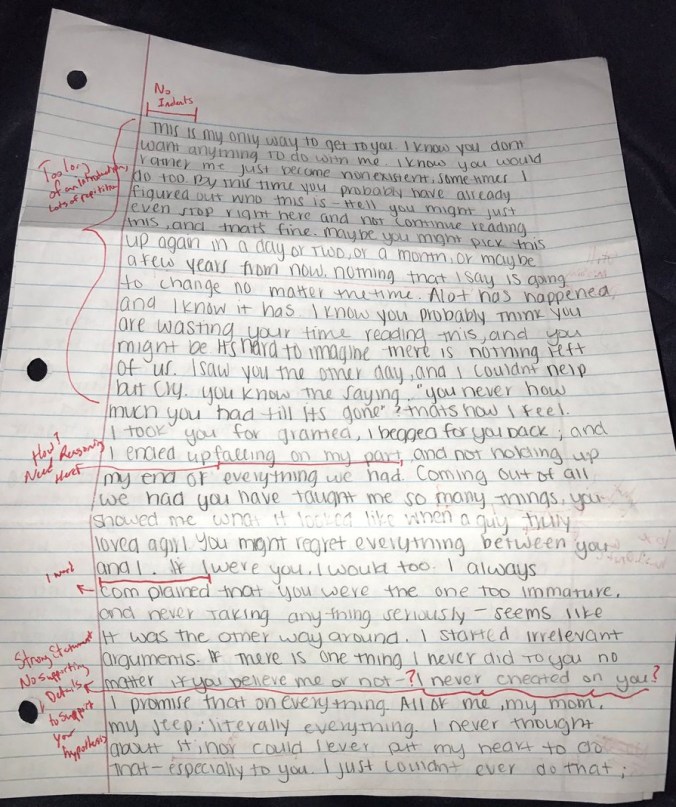
University of Central Florida student Nick Lutz set out to humiliate his ex-girlfriend after she sent him a letter (above)  apologizing after their breakup, so he graded it like a school paper, and instead of keeping the exchange private and between them as a responsible, decent, fair adult would, he tweeted it to the world, where predictably, since the Twitterverse is populated by a lot of people like Nick, it went viral, with hundreds of thousands of like-minded jerks “liking” it.

Nick is, at this stage of his life, a toxic creep without properly functioning ethics alarms. However, his school had no legitimate interest in this matter. Yet it placed him on two semesters of suspension and probation as punishment for this entirely non-school related conduct. (No, the badly treated ex- is not a student.) UCF sent Nick two letters, the first stating that he may have violated the law (no, he didn’t), while the second stated that he had violated the university’s student rules of conduct regarding disruption and cyber-bullying.

Baloney. Read the rules; I did.  Even though the rules are unenforceably broad, they wouldn’t apply to his conduct: Continue reading

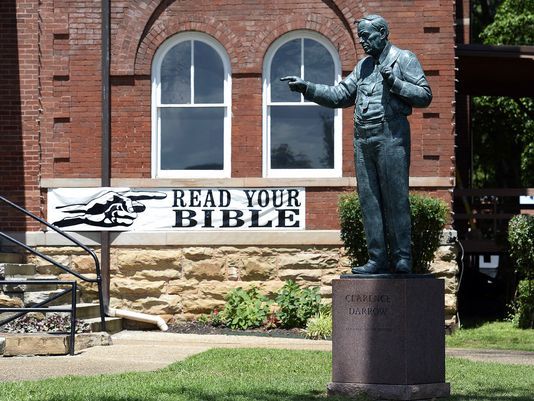
What Clarence Darrow’s Dayton Statue Stands For

Apparently about a third of the population of Tennessee still doesn’t buy Darwin’s Theory of Evolution (according to a 2015 Pew Research Center study) so it should not be too much of a surprise that in Dayton, Tennessee,  site of the famous 1925 Scopes Trial, a newly erected statue of Clarence Darrow in front of the historic red brick courthouse where the trial took place was met with some protests. At a County Commission meeting in the town,  resident Ruth Ann Wilson suggested that bronze Darrow might unleash a plague or a curse. “I rise in opposition to this atheist statue, all right?” she said. “This is very serious, folks.”

No, that isn’t serious, but the persistence of ignorance both generally and about the issues battled over in 1925 are.  Another resident, Brad Putt, is quoted by the New York Times as saying,  “People around here know that if you have a court case, you have to have two sides,” referring to the fact that there has been a Williams Jennings Bryan statue standing in front of the courthouse  since 2005. “You can’t have Optimus Prime unless you have Megatron. You’ve got to have a yin to the yang.” Well, that’s not quite right either, depending on what Bryan and Darrow symbolize. If the idea is to have the most famous opposing counsel in U.S. legal history facing off, okay, that’s fair. If he is saying, as I think he is, that science and religion must counter and balance each other, that’s nonsense. Continue reading

Ethics Dunce: Attorney General Jeff Sessions

There were many good reasons to oppose Jeff Sessions as President Trump’ nominee to be the next Attorney General. One, which I focused on, was that his nomination foolishly fed into the Democratic slur that Trump and the Republicans were racists. Sessions had been successfully tarred decades ago based on some racially-insensitive comments he had made, and even though tangible evidence of any racial bias was thin, it was foolish for Trump to court a controversy when there were plenty of equally or more qualified candidates. Another reason was that Sessions had been an early supporter of Trump’s candidacy for the GOP nomination, which is signature significance for stupidity, poor judgment or recklessness. Take your pick.

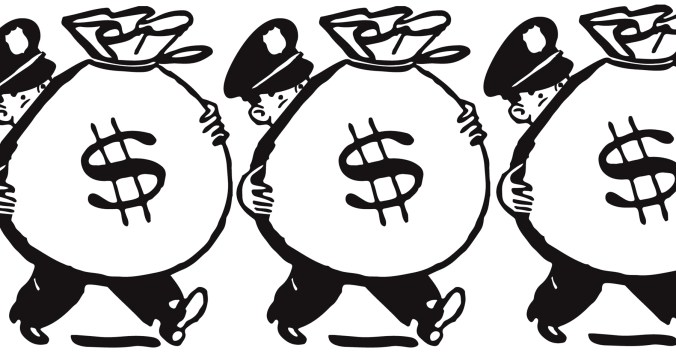
Now Sessions has announced, while speaking at a National District Attorneys Association conference, that the Justice Department will issue new directives to increase the federal government’s use of civil asset forfeiture, an unethical, Constitutionally dubious practice that needs to be cut back or eliminated.

“[W]e hope to issue this week a new directive on asset forfeiture—especially for drug traffickers,” Sessions said. “With care and professionalism, we plan to develop policies to increase forfeitures. No criminal should be allowed to keep the proceeds of their crime. Adoptive forfeitures are appropriate as is sharing with our partners.”


Utah’s Republican Senator Mike Lee expressed alarm at Sessions’ announcement yesterday, saying in a statment, “As Justice Thomas has previously said, there are serious constitutional concerns regarding modern civil asset forfeiture practices. The Department has an obligation to consider due process constraints in crafting its civil asset forfeiture policies.” Justice Clarence Thomas’ had written in his dissent in an asset forfeiture case last month that forfeiture operations “frequently target the poor and other groups least able to defend their interests in forfeiture proceedings.” Continue reading

Morning Ethics Warm-Up: 7/18/17

It’s an All-Fred Morning!

Every day, Ethics Alarms head scout Fred sends me multiple suggestions for posts from he finds heaven-know-where. Even when I can’t fit them in, they often serve as references and always are enlightening.

1. I suspect this belongs in the Polarized Nation of Assholes files: For two years, since he returned from service combat zones in Iraq and Afghanistan, Lieutenant Commander Joshua Corney, has kept his promise to salute his fallen comrades in arms by playing a recording of Taps every evening before 8:00 p.m on his five-acre property in Glen Rock, Pennsylvania. It takes 57 seconds. It does not exceed volume limits. My dog barks longer that that every night after midnight when we put him out. Nonetheless, some of Corney’s neighbors have filed objections with the  borough. Now Glen Rock, which allows church bells to ring, among other sounds, ordered Corney to limit the playing of taps to Sundays and what it termed “flag holidays.” Each violation of the borough’s order would bring a criminal fine of 300 dollars. But the borough’s enforcement action involves two big constitutional no-nos: the heckler’s veto and content-based censorship. The borough is relying on a nuisance ordinance that prohibits sound that “annoys or disturbs” others, and just one individual annoyed by the somber Civil War era bugle solo is enough to deliver a “heckler’s veto.’

The ACLU is on the case, and backing Corney as he fights the action. It writes,

“If a “heckler” could shut down anyone who said or played something that annoyed or offended them by complaining to government officials, freedom of speech would be no more. For more than 75 years, it has been black letter First Amendment law that the government cannot censor speech simply because it is not universally appreciated.

Moreover, the borough cannot use its vague nuisance ordinance to single out only Lt. Commander Corney’s musical expression for censorship from the range of sounds that are part of the borough’s regular sonic landscape. The borough has not ordered Lt. Commander Corney to lower the volume of taps or claimed he has violated a noise-level ordinance.

And it could not claim such a violation because the recording neither exceeds any established noise levels nor is it as loud as many other sounds the borough tolerates — including many sounds that do not communicate a message, like lawnmowers, leaf blowers, chainsaws, and vehicles. Censoring clearly protected expression, like taps, for being too loud, while allowing louder sounds that carry no constitutionally protected message turns the First Amendment on its head.”

Bingo. It is in cases like these that the American Civil Liberties Union shows how essential its role is in protecting the freedoms here that are so frequently under attack.

2. I was surprised when I learned some time ago that undercover police officers used to routinely have sexual relations with prostitutes before arresting them (homosexuals too, when they werebeing persecuted and  prosecuted). Just two months ago, Michigan became the last state in the U.S. to make it illegal for police officers to have sexual intercourse with prostitutes in the course of an under-cover (or covers) sting. Now Alaska wants to go an additional step, banning “sexual contact” with “sex workers” entirely. This could be mere touching or kissing. Advocates of Alaska’s House Bill 73 and Senate Bill 112 argue that police catching sex workers in the act by engaging with them sexually is a human rights violation, and Amnesty International has made an official statement supporting that claim: “Such conduct is an abuse of authority and in some instances amounts to rape and/or entrapment.” Police, quite logically, point out that the bill would make  successful undercover investigations impossible, which is, of course, the whole idea.

“[The prostitutes] ask one simple question: ‘Touch my breast.’ OK, I’m out of the car. Done. And the case is over,” Anchorage Police Department Deputy Chief Sean Case told the Alaska Dispatch News in a hypothetical example. “If we make that act (of touching) a misdemeanor, we have absolutely no way of getting involved in that type of arrest.”

Ethics Alarms is anti-prostitution. As with recreational drug use and probably polygamy, prostitution, which harms families and the young women and men exploited and abused to support it, is almost certainly on the road to legalization. Government won’t protect vital society ethics norms, but it will order you to buy health insurance because it’s for your own good. Continue reading

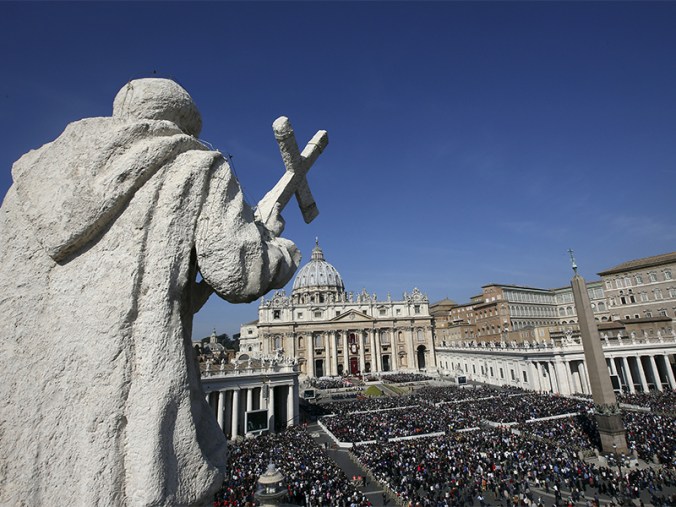
Comment Of The Day: “Ethics Headline Of The Month: ‘Vatican: The Body of Christ Is Not Gluten Free”‘

The original Ethics Alarms post, one of two this month implicitly critical of the Catholic Church, has spawned several remarkable and thoughtful discussions, as well as so many candidates for Comment of The Day that any choice among them is somewhat arbitrary. In the case of Ryan Harkins, I’m not even certain this is the best of his comments on the post, so many excellent ones did I have to choose from. Thus I urge readers to read the entire array, which, I regret to say, is impressive and educational even though it does not include my old friend Patrice, Catholic, theologian, and Church employee who has commented here frequently in the past.

I decided to pair two of Ryan’s comments, the first an overview providing context for my original post’s topic, the Church’s insistence that that the bread and wafers used in Communion include gluten. The second, a response to a series of queries from another commenter, delves into an eternal ethics debate topic, the nexus between God and ethics.

Here is Ryan Harkins’ Dual Comment of the Day on the post, Ethics Headline Of The Month: “Vatican: The Body of Christ Is Not Gluten Free”

I.

Where to begin? The challenge of trying to explain some of the odder details of the Catholic faith is that many of those details don’t make sense without the context of the faith as a whole. So please forgive me if I seem to natter on about tangential matters.

So, let’s begin with a few definitions to make discussion a little easier. A Sacrament is a visible sign, established by Jesus himself, through which God conveys grace upon mankind. A Sacrament is composed of two parts, one spiritual and one material. The reason it possess both qualities is because Sacraments are designed for us, and a human person is a body/spirit composite. We are not purely material beings, nor are we ghosts in a shell. We are not a complete person without our bodies. Now, to have a sign that is purely spiritual would neglect the physical aspect of our existence. To have a sign that is purely physical would neglect the spiritual dimension of our existence.

The Eucharist is one of the Seven Sacraments of the Catholic Church. Catholics really, truly believe Jesus was serious when he said repeatedly, “Amen, amen, I say to you, unless you eat the flesh of the Son of Man and drink his blood, you will not have eternal life.” When at the Last Supper, he blesses bread and wine and says, “Take this and eat. This is my body, given for you” and “This is the cup of my blood, which will be shed for you and for many for the forgiveness of sins”, Catholics believe that yes, Jesus truly held himself in his hands and gave himself to his apostles to consume. So the Eucharist is the Real Presence of Jesus, the fullness of his body, blood, soul, and divinity. When a priest says Mass and confects the Eucharist, Catholics believe that the bread and wine on the altar are transsubstantiated into Jesus. The accidents of bread and wine remain (so yes, consuming Jesus is problematic for anyone who has issues with the accidents of bread and wine), but the substance is entirely Jesus. The smallest drop from the chalice and the tiniest crumb of the loaf contains the fullness of Jesus.

Okay, so a Sacrament has a spiritual and a physical dimension, and the Eucharist obviously uses bread and wine for the physical dimension. Why bread and wine? In just reference to food and drink, we understand the Eucharist as a meal, and historically the greatest communal activity is the sharing together of a meal. In earliest Christianity, the Eucharistic celebration was in the context of the agape feasts, which eventually St. Paul instructed to tone down because people would become drunk and riotous at these feasts. The point, though, is that eating together is sign of communion (which is in part why the Eucharist is also called Communion). Jesus had prayed that “they may all be one, Father, as I am in you and you are in me,” and the Eucharist is the Sacrament Jesus instituted to make that possible. By consuming Jesus himself, we bring him into ourselves and are in turn incorporated into him. (You are what you eat, right?) Continue reading