Afternoon Ethics Incitement, 4/10/2018: All About Apu

Ethics Alarms covered the silly, hyper-political correctness attacks on ‘The Simpsons” character  Apu Nahasapeemapetilon—Oh NO! They are making fun of Indian NAMES!—, the Indian immigrant owner of the local convenience store. Now “The Simpsons” itself addressed the issue:

Naturally, the progressive victim-mongers who cooked up this phony controversy are mad at Marge and Lisa. Here is a typical response from the Angry, Perpetually Offended Left, by former TV critic and lawyer-turned-blogger Linda Holmes, who I am now convinced turned away from the law because she couldn’t meet the tough reasoning requirements.

(And have a mentioned before that taxpayer funds should not be used to pay for social justice warrior drivel like this? I’m sure I have…)

At the end of her screed, she writes,

“I know: It’s a cartoon. That is the easiest, silliest response to this debate. It’s just a cartoon. It’s just a comedy. Or, as the photo of Apu pointedly says, don’t have a cow. But the show doesn’t have this defense to call on, because it has accepted accolades for decades as a thoughtful, intelligent, satirical work that deserves to be taken seriously. It has accepted a Peabody Award, and a GLAAD Media Award. It has been praised and slobbered over and quoted and praised again, and to plead insignificance at this point is unavailing.”

I hate to be harsh, but this is idiotic beyond excusing. To say “It’s a cartoon” is not to say that it is insignificant, and to say “It’s just a comedy” is not to argue that its content doesn’t matter.  It’s a cartoon means that cartoons as an art form, exaggerate, stereotype and mock individuals and groups using funny faces, voices, words and actions, and anyone who takes personal offense—or who works hard to find offense– at a cartoon that was not intended to offend is best dealt with by saying to him or her, “Avoid animated entertainment. You don’t understand it.” And maybe a pat on the head will help.

This is me, by the way:


(I’m not offended, though I am not yellow, have broader shoulders, my skull isn’t that big in proportion to by body and don’t have that big line in my forehead.) Continue reading

From The “Nation Of Assholes” Files: Now President Trump Has Driven The Sociologists Mad

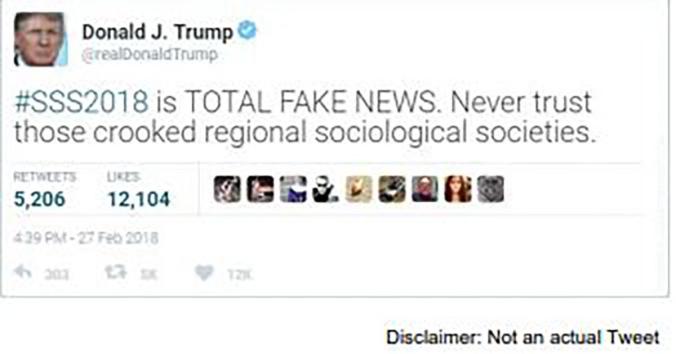
That fake tweet above? It was created by the Southern Sociological Society as promotion for its conference this week. It is also, amusingly, accurate. Based on the conference, titled “Racial Theory, Analysis, and Politics in Trump America,” you can’t trust sociologists any more. Like so many other professional, including among them historians, lawyer, journalists, educators, ethicists and psychiatrists, this group has decided to abandon professional ethics and standards of objectivity and civility for juvenile virtue-signaling and partisan name-calling.

At first I thought this was an Onion parody. From Campus Reform:

…The conference program features two full-color illustrations that crudely depict the President as a baby, six sketches employing similar themes, and nine satirical presidential tweets (each of which comes with a disclaimer alerting the sociologists that it is “not an actual tweet”). The front cover shows the president as a grotesque and overweight infant, sitting in a soiled diaper on top of an image of hooded Klansmen while playing with missiles and nuclear bombs. His outstretched left arm, replete with a tiny hand, may be an attempt to depict him performing the Nazi salute.

A cross superimposed on a series of concentric circles appears above the word “Trump” in the conference title, suggesting the crosshairs on a rifle site…The back cover depicts a similarly-styled Trump, this time with his diaper sagging down and kneeling in a pool of urine inside his crib. Black and white sketches scattered throughout the program, meanwhile, depict Trump in various other unflattering ways, with one showing him urinating on the floor while holding what appears to be a balloon labeled “WW3,” while another drawing portrays him smashing the EPA and healthcare.

The conference schedule indicates that there will be 32 workshops, papers, lectures, discussions, and other sessions that explicitly deal with Trump, including a discussion about “Approaching Resistance to TrumpAmerica” and a session on “How to Talk About Current Events in the Classroom in the Age of Trump without Getting Fired.”

Some sessions, such as “Organizing a Campus-Wide Social Justice Event,” appear to advise professors on how to use their positions to influence campus politics. Continue reading

Comment Of The Day: “Ethics Quiz: Harvard And Evangelicals”

Here is another Comment of the Day emerging from the discussion of Harvard’s suspension of a student religious organization.

The topic is a bit tangential, but interesting nonetheless. One of EA’s readers from across the Atlantic—you can tell he’s British because he spell “theater” wrong— clarifies some history regarding England’s unpleasantness with the Colonies, and as you all know, correcting historical misconceptions is always welcome here.

This is P.M. Lawrence’s Comment of the Day on the post, “Ethics Quiz: Harvard And Evangelicals”:

“When we look at the Second Amendment, it was written at time when a rag-tag group of colonies resisted the greatest empire the world had seen to date.”

Though I mostly just lurk these days, I have seen that misconception so much that I want to rebut it here, as this is one of the few places where the search for truth might let it be taken seriously. Feel free to check what follows for yourselves.

Britain had only just acquired Canada and Bengal, along with hegemony over some (not all) of the rest of India. At that point, all of its gains were yet to be consolidated, and represented drains rather than sources of strength; the same applies to Gibraltar and Minorca too, of which more below. In military, geographical, and economic terms, Britain was weaker than the Chinese, Russian and Ottoman Empires – though all those fell back in one or more of those respects very soon afterwards, when Britain was surging ahead, which may give people the wrong idea from looking anachronistically at what came later. More to the point, Britain was then behind both France and Spain too in most of those respects, and those countries were allied with the revolting colonists.

Britain had just two advantages over France and Spain: it had a more resilient financial system than France and Spain (though not than Holland, a minor rebel ally), and it had denied France more territory even though it had not yet consolidated that for itself.

Britain was – at the time – equal in naval power to France, though not yet to France and Spain combined, which it only became after the Battle of Trafalgar in 1805. That was why Britain lost the.Battle of Chesapeake Bay, which in turn made Yorktown into a Dien Bien Phu rather than at worst a Corunna or a Dunkirk, or at best even a Torres Vedras. Continue reading

From The Ethics Alarms “It’s About Time!” Files: Iowa Strikes Down A “Dangerous Animal” Ordinance

Pinky was a happy, healthy pet dog  until March 2016, when a friend visiting Pinky’s owner let her into the yard unsupervised. The neighbor’s cat, Rebel, had wondered into the yard, and Pinky had the feline in his maw until her owner ran out and commanded her to drop it.  Rebel survived the trauma, but needed three dozen staples for her wounds.

Pinky was impounded after the city’s humane officer declared her a dangerous animal under the city ordinance. Of course, Pinky is a pit bull mix, so bias was already working against her. The Des Moines ordinance that bans the keeping of “dangerous animals” includes banning any animal “that has exhibited vicious propensities in present or past conduct, including such that the animal … has bitten another animal or human that causes a fracture, muscle tear, disfiguring lacerations or injury requiring corrective or cosmetic surgery.”

Such an ordinance could only be written by someone willfully ignorant of the behaviors of dogs as well as the vicissitudes of moral luck. Our wonderful and gentle English Mastiff, Patience, for example, once caused a bloody wound to my wife’s scalp when she gave the dog an unexpected buss on the muzzle. The dog jerked her head in surprise, nicking my wife’s head with a tooth. The wound bled profusely, and required stitches—and it was 100% my wife’s fault. Patience literally wouldn’t hurt a fly…indeed, she was afraid of flies.

As for Rebel, any cat that invades a dog’s home turf is asking for trouble. Continue reading

Morning Ethics Warm-Up, April 9, 2018: Experiment Results, Flowering Trees From Hell, And Ominous Signs From The Left..

Good morning…

…Mrs. Calabash, wherever you are…

1. Apologies for a lost Sunday. I was never able to get back to my computer yesterday. The combination of my responsibilities to the Georgetown Gilbert & Sullivan Society as it celebrated its 46th year of operation against daunting odds, some pressing client matters and important family matters just overwhelmed my schedule, plus I was wiped out by the early evening. Of course, based on the blog’s traffic this month and the continuing ethics rot, I console my self in the message of the most famous song from “Ruddigore,” GG&SS’s student production for the anniversary…especially the final line…

“This particularly rapid unintelligible patter isn’t generally heard, and if it is, it doesn’t matter.”

Ethics commentary in a nutshell.

2. However: The regulars came through in a pinch. The free swim produced at least four  Comment of the Day quality posts, including a history of the Gettysburg address. Thanks everybody. The experiment was a ringing success, and I will have more open forums in the future.

3.  This kind of thing is why I have a hard time taking environmentalist doom-saying seriously. We planted Bradford Pear trees, which are now blooming beautifully as is their wont, in front of our house almost 20 years ago. They have their downsides, to be sure, and you have to trim them back or they are likely to split or fall over. However, here is an environmentalist claiming that they are trees from hell, and who writes in part: Continue reading

Ethics Self-Warm-Up, 4/8/2018: An Ethics Alarms Experiment

My gallant crew, Good Morning!

The combination of the 45th Anniversary of the Gilbert & Sullivan performing organization I founded as 1L student at Georgetown and some unusually complex ethics problems tosses to me by some law firm clients have conspired to put me out of action until this afternoon.

I’m opening this post up to commentary on any ethics issue you please. Stay on topic, please, and be civil.

Comment Of The Day: “Ethics Quiz: Harvard And Evangelicals”


 The theological discussions that periodically break out on Ethics Alarms are always interesting. Naturally the question of whether seeking out a same-sex relationship justified expelling an officer in an evangelical Christian student group at Harvard sparked one. Here is Rich in Ct’s Comment of the Day on the post, “Ethics Quiz: Harvard And Evangelicals”:

“Given that someone other than Jesus Christ created the ideology then I cannot automatically believe that proscriptions against said choices are in fact Christ’s teachings. Much of those ideas are old testament ones. Christ’s teachings obliterated many of those old testament ideas.”

It is a fallacy to make these two unrelated but true statements (that Christ did not address homosexuality, and that Christ negated much of the Old Testament), and imply that the current ideology that homosexuals must abstain is inconsistent with Christ’s teachings. It is also a bit weaselly to say that you cannot “automatically believe” one way or the other, but not examine readily available arguments.

Stipulated: I am only arguing what Christianity historically teaches, not whether Christianity is correct or should be accommodated by Harvard or society at large; my goal is only to point out inconsistent theology and history. In the broader context here, understanding what Christ taught and teachings are inferred is important to understand the particular motivation for the student group.

At a minimum, the bible was not written in a vacuum, but within a living culture. The gospels and epistles were written for specific audiences, to address the particular concerns of those groups, not rotely restate what was already collectively understood. Luke, for instance, was addressed to Theophilos (his most excellency). That Jesus Christ was not recorded as addressing a particular topic just means that the gospel authors did not think it needed to be clarified. There is even a catch-all at the end of John stating as much:

“Now there are also many other things that Jesus did. Were every one of them to be written, I suppose that the world itself could not contain the books that would be written”.

This is not an esoteric concept. We live in our own collective culture. In constitutional law, for instance, justices routinely review contemporary sources to infer the framer’s intent. When we look at the Second Amendment, it was written at time when a rag-tag group of colonies resisted the greatest empire the world had seen to date. When interpreting “the right of the people to keep and bear arms shall not be infringed“, it very clearly echos the Declaration of Independence:

“That to secure these rights, Governments are instituted among Men, deriving their just powers from the consent of the governed, — That whenever any Form of Government becomes destructive of these ends, it is the Right of the People to alter or to abolish it,…”

The right of the people to resist their government as a last resort cannot reasonably be preserved if weapons are only guaranteed to a “militia” not elsewhere defined in the constitution. The Second Amendment can only be interpreted to mean something else if one ignores the culture and contemporary events that motivated it.

When we look at theology, we must interpret the topics discussed by Christ and the biblical authors in light of earlier theological works. To infer his teachings regarding homosexuality, we must look at his words regarding similar topics, and their relationship with Old Testaments view of homosexuality. Specifically, if we look at Christ’s teachings regarding sex, marriage, and lust, Christ act actually clamps down, rather than liberates. He abolishes Mosaic Divorce, binding married couples for life “what god has joined let no man put asunder”.

This must be interpreted within the Jewish culture; if men and woman are now bound for life, but if as stated in the Old Testament “If a man lies with a male as with a woman, both of them have committed an abomination;” it stands to reason that if the man laying with a woman portion of the law were tightened by Christ, then the man lying with a man part were not likely loosened.

However the second part of that line, “they shall surely be put to death; their blood is upon them….” must be equally reinterpreted in light of Christ’s mercy towards the adulterous, the violator of the vary portion of the law he tightened:

“(Let He Who is without Sin cast the First Stone) Woman, where are your accusers? Has no one condemned you?” – “No one, Lord,” she answered. – “Then neither do I condemn you,” Jesus declared. “Now go and sin no more.”

The theologically sound conclusion might be that Christ did not approve of homosexual behavior, but demanded that mercy be shown to them. Continue reading

Morning Ethics Warm-Up, 4/7/2018: “Ruggles Of Red Gap” And “Williamson No Longer Of The Atlantic'”


Good Morning…

(Do you remember when Saturday morning was fun? Stupid, but fun…)

1. Your cultural literacy note of the day. The Charles Laughton classic “Ruggles of Red Gap” was on Turner Movie Classics last night. The movie itself is wonderful—I recommended it in an Independence Day post here—but it is also a cultural literacy triumph.  In 1935, when the film was released, Lincoln’s Gettysburg address was in the process of falling out of the public’s consciousness. The film’s most famous scene, however, revived it. In a saloon, reference is made to “what Lincoln said at Gettysburg,” and all the cowboys in Red Gap ask each other, “What did Lincoln say at Gettysburg?” Then, quietly, unexpectedly, Ruggles the English butler (Laughton) and the only foreign-born man in the room, recites the speech. TCM host Ben Mankiewicz, in his post showing observations, revealed that when the film was first shown, audiences frequently stood and applauded Laughton’s rendition, and the Address itself became more widely known and quoted.

This is how popular culture works when it is in sync with national values, and not attempting to undermine them.

Here is the scene…for some reason YouTube doesn’t have it, but does have the entire film. The saloon scene begins at about the 56:09 mark:


2. The Atlantic-Kevin Williamson controversy. Unless you routinely plumb the depths of pundit wars and cultural bloodletting, you might well be completely unaware of this skirmish, but it is ultimately an ethics story. Continue reading

Red Sox Star Prospect Michael Chavis Tested Positive For Steroids. The Team Should Fire Him

The Office of the Commissioner of Baseball announced today that third baseman Michael Chavis, who is the Red Sox’s No. 1 prospect has been suspended following their violations of the Minor League Drug Prevention and Treatment Program, and has received an 80-game suspension without pay after testing positive for Dehydrochlormethyltestosterone, a performance-enhancing substance in violation of the Minor League Drug Prevention and Treatment Program. The suspension of Chavis is effective immediately. He was expected to be a candidate to come up to the big leagues and help the Red Sox in the stretch drive. His suspension hurts the entire organization.

Chavis tweeted a long and plaintive denial. And you know what the line is about that: “That’s what they all say.” Here is a sample…

“Over the past several months, I have been searching for an answer as to how a prohibited substance I have never heard of, DHMCT, was detected in my urine during the offseason. It is a question that unfortunately has not been answered, and I have run out of time for now to find an answer. As hopeless as this is for me, I am faced with the reality that maybe I never will. The only thing I do know is that I would never, and have never, purposely taken any prohibitive substance in my entire life.”

Continue reading

Ethics Quiz: Harvard And Evangelicals

At Harvard College, the Office of Student Life has placed the student religious group Harvard College Faith and Action on “administrative probation” for a year after the organization pressured a female member of its student leadership to resign in September following her decision to date a woman.

College spokesperson Aaron M. Goldman announced the move to put HCFA in a statement that read,

“After a thorough review and finding that HCFA had conducted itself in a manner grossly inconsistent with the expectations clearly outlined in [the Office of Student Life’s] Student Organization Resource and Policy Guide, OSL has placed HCFA on a one year administrative probation.”

HCFA co-presidents, students Scott Ely and Molly L. Richmond, elaborated:

“Earlier today, we met with an administrator who informed us that the College would place HCFA on probation, citing our relationship with Christian Union as well as our standards for leaders. The decision to suspend HCFA, though, is almost certainly tied to the Sept. 2017 resignation of a female bisexual former assistant Bible course leader. HCFA leadership asked the woman to step down from her position after they learned she was dating another female student—violating guidelines laid out in the Harvard College Student Handbook, which stipulates recognized campus student groups cannot discriminate on the basis of “sexual orientation.”…We reject any notion that we discriminate on the basis of sexual orientation in our fellowship. Broadly speaking, the student in this case was removed because of an irreconcilable theological disagreement pertaining to our character standards.”

In other words, the group did not eject the female student because of her sexual orientation, but because the religious group’s principles dictated that same-sex sexual relations were wrong, thus disqualifying her as a leader.  The ejected student herself confirmed to the Harvard Crimson that this was her understanding.

Your Ethics Alarms Ethics Quiz of the Day:

Is Harvard on solid ethical ground suspending the group?

Continue reading