The Wake-Up Call And The Power Cord

As you may have noticed, your host has been involuntarily separated from Ethics Alarms for about 24 hours. Several things occurred that under normal circumstances would have had me dashing off a post while waiting for flights or preparing to check out of my hotel—and there were definitely several comments that had me reaching for a phantom keyboard—but I was without laptop, thanks to leaving the power cord behind in my previous hotel.

So I have a little story to tell. I stayed at a decent Boston hotel last night, not a 4 star hotel like the one I just left  in Atlanta (The Four Seasons), but a nice one, professionally run, dependable. Yet this morning this was my wake-up call, via recording:

“It’s 7 AM. This is your wake-up call for March 8, 2018.”

Almost at the same time, David Hogg was on CNN, explaining how darned easy it was to create a system that would prevent school shootings forevermore.

Wrong. Systems break down, you experience-free, arrogant, disrespectful, know-nothing puppet.  The belief that human beings can devise systems that will solve every problem, or any problem, and do what they are designed to do without failing miserably at the worst possible times and in the worst imaginable ways is signature significance for a fool, or a child. O-Rings fail. Police don’t act on warnings that a kid is violent. Obamacare raises health care premiums.  Political parties end up nominating Hillary Clinton and Donald Trump. Jack Ruby breaks past police security. Communism ends up killing hundreds of millions rather than creating a worker paradise. The Titanic hits the wrong iceberg exactly where it’s weakest. Hitler takes a sleeping pill during the Normandy invasion.

The T-Rex gets loose. Continue reading

The Definitive Reason Why The Parkland Shooting Freak-Out Is Cynical, Dishonest Fear-mongering, And Why We Should Not Tolerate It Any Further

David Ropeik, who teaches at Harvard and who is a risk assessment expert, finally wrote the article I’ve been waiting for…and it was published almost a month after the Parkland shooting, following almost a month of the ignorant and arrogant grandstanding  by the high school students who have been used as virtual human shields by the anti-gun lobby, almost a month after the news media and expedient politicians, including the President, began pandering to grief and ignorance while going out of their way to make the public believe that school shootings are a national crisis.

I’m glad that some sunlight of reality made it through the human-made fog, but it is unconscionable that it took this long, Now let’s see how thoroughly the news media, a full partner with the ban-gun effort, will bury it.

Before I start, however, let me salute the Washington Post. I have not read a Post Sunday Outlook section since switching over to the Times—a better paper but far, far more partisan and biased than its only close competitor—and it was stunning to be reminded what a Sunday news commentary supplement looked like that didn’t feature hysterical Trump -bashing in 75%-90% of its articles. Not only that, the Post had the courage to challenge the conventional, and false, wisdom about school shootings being actively promoted by the Times and the rest of the mainstream media.

Among the points made by Ropeik in his essay, “School shootings are extraordinarily rare. Why is fear of them driving policy?”:

  • “The Education Department reports that  roughly 50 million children attend public schools for roughly 180 days per year. Since Columbine (1999), approximately 200 public school students have been shot to death while school was in session, including the recent slaughter at Marjory Stoneman Douglas High School in Parkland, Fla. (and a shooting in Birmingham, Ala., on Wednesday that police called accidental that left one student dead). That means the statistical likelihood of any given public school student being killed by a gun, in school, on any given day since 1999 was roughly 1 in 614,000,000.”

This is not a great risk. This is not even a significant risk. To say, as the Kiddie Corps has been telling us, that this risk is “unacceptable” can only mean that the official, anti-gun position is that no risk is acceptable. Surely no one is going to argue that a 1 in 614,000,000 chance of being killed in another Parkland or Newtown is unconscionable, but a one in 1, 228,000,000 chance is just fine. And how do we reach no risk? We spend incredible amounts of money, trash our national liberties, send kids to lightless, joyless iron boxes…and there will still be a risk

  • “[S]ince the 1990s, shootings at schools have been getting less common.”

What? What about all those statistics that claim the opposite? They are advocacy statistics, spun and manipulated.  Cheating, in other words. Ropeik is hardly an NRA shill: it’s clear that he is venturing to make these observations while aware that he is risking his progressive bona fides, and thus his invitations to Cambridge cocktail parties. He writes for example,

The problem with all of this is what our excessive fears could lead to. Having more guns in schools, as President Trump advocates — or more guns anywhere — increases the likelihood of gun violence. …The Parkland tragedy itself teaches that more guns don’t automatically mean more safety: The school was patrolled by an armed guard.

The studies claiming that more guns lead to more gun violence are all based on cross-cultural, international comparisons, which many believe (as do I) pollute the findings. Do more guns in the US lead to more gun violence? Reiko himself  cited a stat that suggests otherwise: there are more guns in the U.S. now than before Columbine, and a decline in the frequency of shootings at schools. As for the armed guard, citing a professional with a gun who doesn’t do his job tells us nothing about guns, just that it is who is holding it that matters—which is what the NRA has been saying since I was knee-high to a chipmunk.

More from Ropeik: Continue reading

These Are Really The People Who Are Informing The American Public? Isn’t That Terrifying?

Jill Abramson was a New York Times executive editor and is a fairly representative example of what the Times culture nurtures. In a uniformly embarrassing column for The Guardian, she concluded with this:

“It’s easy to look at what’s happening in Washington DC and despair. That’s why I carry a little plastic Obama doll in my purse. I pull him out every now and then to remind myself that the United States had a progressive, African American president until very recently. Some people find this strange, but you have to take comfort where you can find it in Donald Trump’s America.”

Observations:

1 There was a great deal to take comfort in last week “in Trump’s America.” The February job report shattered expectations, for example, sending the stock market soaring again,. Despite doomsday predictions that Trump’s refusal to pander to North Korea’s sabre-rattling dictator would trigger a nuclear war, it appears that the rogue nation wants to talk. For those American who are dedicated to the rule of law, the Attorney General’s aggressive action to challenge California’s revival of the pre-Civil War nullification doctrine was extremely welcome. Although the position of the Angry Left and “the resistance” is that the elected President remaining in the White House is itself cause for despair, more rational souls are willing to assess the administration on results more than style. Results have been, to an unexpected extent for those not ideologically inflexible, positive in many areas….and certainly not so negative that the only recourse is Obama dolls.

2. Abramson, like so many of her comrades, appears to dwell in a reality of her own construction. Contrary to her claims, the President’s approval ratings are not sinking, and some polls suggest the opposite. “The Blue Wave” she fervently hope for increasingly looks like wishful thinking and hype: citing the defeat of Roy Moore as indicative of anything (other than the fact that a racist, homophobic, law-defying judge can’t get elected Senator regardless of what party claims him), is an admission that real evidence of such an impending wave is lacking. Continue reading

Comment Of The Day: “The Desperate ‘Gunsplaining’ Dodge”

“Saying you need to understand gun terminology to have opinions on gun policy is the equivalent of saying you need to understand the biology of a heroin overdose to have an opinion on the drug war.”

Thus went the jaw-on-the-floor stupid tweet of Zack Beauchamp, a senior report at Vox. I had written a post about the ridiculous “gunsplaining” article in the Washington Post, and foolishly assumed that even anti-gun fanatics would be embarrassed to endorse the view expressed there that those arguing for material changes in public policy should be required to understand the object of that policy. Then came Zack’s tweet.

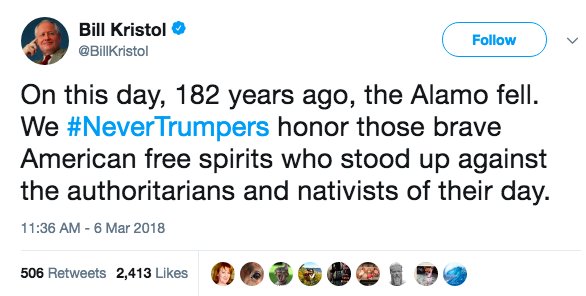
Admittedly, and to be fair, Twitter makes people stupid. We have documented the sad Twitter-feuled decline of Harvard Law School icon Larry Tribe, and new victims of Twitter brain-suck suface every day.  Bill Kristol once had a rather impressive brain, for example; look what he tweeted last week:

Wow. What a terrible, and ahistorical, analogy.  The Texans at the Alamo were fighting in a war to secede from Mexico. Santa Anna was an authoritarian all right, but to Texans he was being authoritarian in the same way Lincoln was when he used forcet to keep the South from leaving. Mexico was hardly “nativist”: it invited Americans to settle the territory, and their arrival was completely legal. Indeed, Texas is a great example of what can happen when a country doesn’t control immigration at all.  Twitter makes you stupid, and bias makes you even more stupid. Add anti-Trump bias to Twitter and you get Bill Kristol sounding like Maxine Waters.

Zach liked Kristol’s bad analogy too!

The fact that Vox employs a senior reporter whose critical thinking skills are so poor and whose judgment is so wretched that he happily displays them on social media is instructive regarding the influence new media commentators like Vox wield. Thus I was grateful for this Comment of the Day, by Michael West, on the post, The Desperate “Gunsplaining” Dodge’: Continue reading

Sunday Morning Ethics Warm-Up, 3/11/2018: Baseball, Bannon, and Chaos

Good Morning!

1 Great. Now I have to defend Steve Bannon. What greeted me this morning, as I surfed the Sunday news shows, Diogenes-like, searching for an honest journalist, but the sight of Steve Bannon in France, addressing the far-right National Front party yesterday and saying, speaking of the party’s effort to stem unrestrained immigration, particularly from Muslim countries,  “Let them call you racist. Let them call you xenophobes. Let them call you nativists. Wear it as a badge of honor.” On every channel, this was interpreted as if Bannon was endorsing racism, xenophobia and nativism. Naturally this was then reflected on Trump as part of the “Trump is a racist” Big Lie that Democrats and the news media push virtually every day.

Bannon has certainly made testaments at other times that raise a rebuttable presumption that he is a racist, but this wasn’t one of them, and the fact that so many journalists would intentionally represent the statement to the public as if it was tells us either that they can’t be trusted to analyze news events, or that they can be trusted to spin them to advance an anti-Trump narrative even when it defies language and reality. From NBC in a typical fake history description: “Bannon’s appearance in France was part of a European tour as he seeks an international platform for his closed-borders, anti-foreigner message that helped Donald Trump win the U.S. presidency.”  Trump did not advocate “closed borders,” nor was his platform “anti-foriegner.” That was the dishonest characterization of “America should enforce its immigration laws” by Democrats and the allied news media.

The words Bannon referenced have been part of the ongoing efforts to silence and demonize legitimate positions that oppose progressive cant, such as condemning rather than welcoming illegal immigration. What  Bannon was obviously saying —and I do mean obviously—is “Don’t let their reflex race-baiting and demonizing tactics discourage you or deter you. Calling sensible immigration laws “xenophobic” is a desperate lie. Calling it racist is a lie. Calling it nativist is a lie. Recognize that their tactics mean you are winning the argument. Be proud, not intimidated.”

The fact that many of those he was addressing may be racists, xenophobes and nativists doesn’t change the meaning of what Bannon said. The news media’s job is to report, not read minds.

I could imagine making the same kind of statement to a colleague who has been savaged as a racist on Facebook for opposing affirmative action, or attacked as a sexist for questioning #MeToo tactics, or called a “Trump apologist” (or a Bannon apologist) for demanding fair and honest treatment from the media for politicians regardless of who they are. “Be proud that they are stooping to name-calling. It means they can’t rebut you on the merits.”

Oh: Bannon also said, “History is on our side.” This really upset the “journalists,” because everyone knows that history is on their side. Continue reading

Comment Of The Day: “NOW What? The Most Discouraging News Of All”

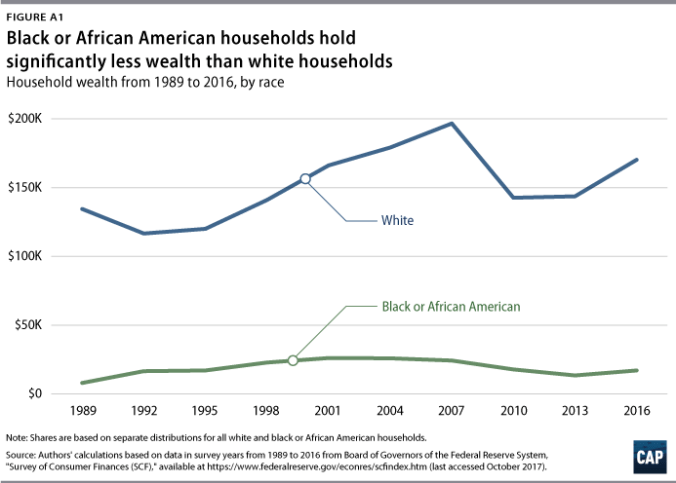
The post a week ago regarding the depressing stats tracing black economic progress over the last 50 years deserves examination indefinitely, until some answers besides “It’s all discrimination!”  are identified and confronted. I remain puzzled that the EPI study received such paltry coverage and discussion in the mainstream media, but to be fair,  there were more important stories, like a porn star suing the President.

Chris Marschner opened the topic for focus here, starting out with one area only, home ownership. I said I would post his comment as aq Comment of the Day to prompt similar exploration by the brain-trust here. Chris starts with home ownership. Other categories African Americans still lag in: health, wages,  educational achievement, wealth, employment, and staying out of prison. As Chris says,

“Each one of these issues must be examined individually and the solutions must be integrative.”

This should be a beginning of a discourse, not the end. (I apologize to Chris for taking so long to post it.)

Here is his  Comment of the Day on the post, NOW What? The Most Discouraging News Of All

On home ownership.

I once suggested that certain select section 8 housing voucher recipients be allowed to use the subsidy to offset mortgage payments. Currently, we are transferring wealth from taxpayers to landlords. Why should existing owners of capital be subsidized? Create an approximation of a reverse mortgage in which taxpayers buy a property and the housing voucher is used to amortize the equivalent of a mortgage back to the taxpayer. In this manner we put up the money upfront and the reciepient retires a mortgage equivalent using the voucher, their contributions, and behavioral requirements not much different than what currently exists for section 8 vouchers. Over time this would increase the rate of ownership, increase vesting in all neighborhoods, and at some point the total subsidy is ended for an individual when the mortgage is fully amortized.

Establishing effective criteria regarding eligibility is key. Criteria could include:

  • Must be a married couple,
  • Children, if any must attend school regularly
  • No illicit drug use
  • Recipients must be employed, with at least one full time.

Planning and execution of such a plan requires more than I can develop here.

Saturday Night Ethics Update, 3/10/2018: 16-Year-Olds And The NRA

Good evening.

(The combination of an early morning seminar, a $^%%#! D.C. marathon that closed down access to the venue, and a lost power cord rendering my netbook useless conspired to prevent both late posts yesterday and early ones today: I’m sorry. I’m back at my desk, chagrined but unbowed…)

1 Why not 10? Why not 2? Poor, declining, Twitter-addict Lawrence Tribe’s ridiculous claim that the voting age should be lowered to 16 was so self-evidently silly that I assumed no one serious would adopt it.  But, as H. L. Mencken kind of said,  “No one ever went broke underestimating the intelligence of the American public,”  and as I’ll say now, nobody can underestimate the level of irresponsible proposals that anti-gun zealots will float in their desperation to gut the Second Amendment.

Last week, Temple University’s Laurence Steinberg, a professor of psychology, issued a Times op-ed arguing for Tribe’s new voters, ignoring his own profession’s conclusions that children that young, in addition to not being, you know, adults, also have not mastered stable reasoning ability because their brains are not fully formed. Never mind, says the prof:

“The last time the United States lowered the federal voting age was in 1971, when it went from 21 to 18. In that instance, the main motivating force was outrage over the fact that 18-year-olds could be sent to fight in Vietnam but could not vote. The proposal to lower the voting age to 16 is motivated by today’s outrage that those most vulnerable to school shootings have no say in how such atrocities are best prevented. Let’s give those young people more than just their voices to make a change.”

Wow, what a well-reasoned argument! I can”t wait for the proposal to lower the voting age to minus-eight months out of outrage that those most vulnerable to abortions have no say in how such atrocities are best prevented. Yes, it’s true: the anti-gun Left is willing to follow President Trump with President Kendall Jenner, as long as we let the government and police have all the guns.

Maybe Temple psychologists and lapsed Harvard Law professors should lose the vote, since they apparently can’t reason above the level of 16-year-olds. Continue reading

Ethics Quote Of The Week: Lee Smith, Making It All Clear

“Yet for its advocates, the questionable veracity of the Russiagate story seems much less important than what has become its real purpose—elite virtue-signaling. Buy into a storyline that turns FBI and CIA bureaucrats and their hand-puppets in the press into heroes while legitimizing the use of a vast surveillance apparatus for partisan purposes, and you’re in. Dissent, and you’re out, or worse—you’re defending Trump…In other words, there’s the truth, and then there’s what’s even more important—sticking it to Trump. Choose wrong, even inadvertently, …no matter how many times you deplore Trump, and you’ll be labeled a Trumpkin.”

Lee Smith in his essay, Who Believes in Russiagate?”

Later he adds,

“What unites [critics of Russiagate on the Left and the Right] obviously isn’t politics—rather, it’s the recognition that the Russiagate campaign represents an attack on American political and social institutions, an attack on our liberties, an attack on us. Russiagate is a conspiracy theory, weaponized by political operatives, much of the press, as well as high-level intelligence and law enforcement bureaucrats to legitimize an American election and protect their own interests, which coincide with those of the country’s larger professional and bureaucratic elite.”

You might wonder why I chose to highlight the first quote  rather than the second. The second tells me nothing I don’t know, or that readers of Ethics Alarms don’t know: I’ve made it a theme here since early in 2017. I learned something from the first quote, however. This is the phenomenon I have been experiencing on Facebook, where periodically pointing out unfair and intellectually dishonest attacks on President Trump and pointing out the news media’s horrific bias increasingly get me labelled as a Trump supporter, apologist or enabler. Meanwhile, I recently had a follow-up exchange  with NPR over my objections to Prof. Butler’s “Oh, come on!” outburst when I was correctly pointing out what was ethically dubious about late accusations of sexual harassment against political figures.  Oh, no, I was told. He wasn’t saying “Oh come on!” because I misrepresented sexual harassment law. He was saying that because he thought I was making excuses for Trump. Continue reading

Indoctrination Begins Early At Yale

From the Yale admissions blog:

“Will we get rescinded if we get suspended for engaging in a school walk-out to bring attention to the school shooting issue?”

In the week since the tragic mass shooting at Marjory Stoneman Douglas High School in Parkland, Florida, something incredible has begun to happen. High school students in Parkland and beyond are stepping up in a refusal to allow the issue of gun control fade from the public eye. Peaceful protests around the nation have begun to echo those in Florida. Included in these demonstrations are a number of school walkouts that have been scheduled over the next several weeks.

Some schools have indicated that students who disrupt class time by participating in such walkouts will face disciplinary action, potentially including suspension. Some, in hopes of discouraging participation, have warned their students that such disciplinary action may negatively affect their college admissions decisions. And so, over the past few days, we continue to get the question: will Yale look unfavorably upon discipline resulting from peaceful demonstrations?

The answer is simple: Of course not.”

Of course not? Why “of course not”? Because Yale as an institution favors the weakening or elimination of the Second Amendment? Because naturally Yale favors students who demonstrate for issues on the progressive agenda? What if the question was,

“Will we get rescinded if we get suspended for engaging in a school walk-out to bring attention to the unethical practice of removing statues of Confederate figures?”

or Continue reading

Now THIS Is An Unethical Judge!

I don’t know what’s happening to judges’ judgment  lately, but it’s not good.

Texas State District Judge George Gallagher was annoyed by defendant Terry Lee Morris’s refusal to answer his questions and making various statements himself, so he ordered that Morris have a stun belt strapped around his legs. From the Appeals Court opinion:

“Mr. Morris, I am giving you one warning,” Gallagher told Morris outside the presence of the jury. “You will not make any additional outbursts like that, because two things will happen. Number 1, I will either remove you from the courtroom or I will use the shock belt on you.”

“All right, sir,” Morris said.

The judge continued: “Now, are you going to follow the rules?”

“Sir, I’ve asked you to recuse yourself,” said Morris.

Gallagher asked again: “Are you going to follow the rules?”

“I have a lawsuit pending against you,” responded Morris.

“Hit him,” Gallagher said to the bailiff.

The bailiff pressed the button that shocks Morris, and then Gallagher asked him again whether he is going to behave. Morris told Gallagher he had a history of mental illness.

“Hit him again,” the judge ordered.

Morris protested that he was being “tortured” just for seeking the recusal.

Gallagher asked the bailiff, “Would you hit him again?”

Each “hit” sent an eight-second, 50,000-volt shock into Morris. Judge Gallagher had Morris shocked three times. It terrified Morris sufficiently that he didn’t return for the remainder of his trial and missed almost all of his sentencing hearing. Continue reading