Directed Verdict Ethics In The The Movies: “Tom Horn” And “To Kill A Mockingbird”

Once again, as I watched the film version of “To Kill A Mockingbird” for the 50th time, I was bothered by the fact that Atticus never asked for a directed verdict, and the kindly, seemingly fair-minded judge never declared one.

A directed verdict is also known as a judgment as a matter of law or JMOL. It means that one side or the other has failed to meet a minimum burden of proof, and is usually declared by a judge  after is a motion made by a party, during trial, claiming the opposing party has presented insufficient evidence to reasonably support its case.  A directed verdict  is similar to judgment on the pleadings and summary judgment. Judgment on the pleadings is  made after pleadings and before discovery; summary judgment occurs after discovery but before trial.

A directed verdict occurs during the trial, and a judge can also render one spontaneously, without a motion. The motion can even  be made after a verdict is returned by a jury, where such a motion is technically for a “renewed” directed verdict, but commonly referred to as judgment notwithstanding the verdict.  In a civil trial, a party must have moved for a directed verdict before the jury reports out its decision. In a criminal trial, as in the fictional Tom Robinson case, there is no such requirement. The court may set aside a guilty verdict and enter an acquittal in the interests of justice.  A criminal defendant is not required to move for a judgment of acquittal before the court submits the case to the jury for the verdict to be overturned. A verdict of not guilty can never be overturned.

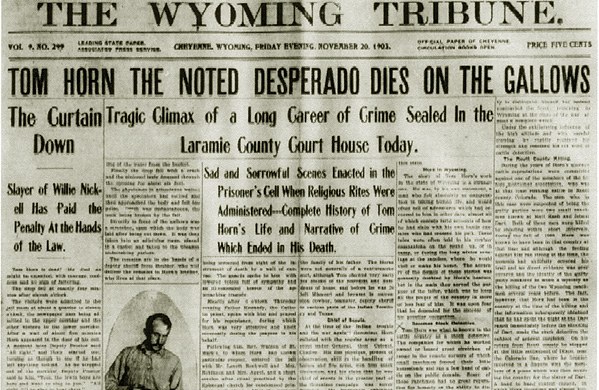
In “To Kill A Mockingbird,” black defendant Tom Robinson is convicted of rape despite the primary prosecution witness, the alleged victim, contradicting her own testimony at several points, and despite strong evidence that the beating she claimed was part of the sexual assault was shown to be delivered by a right-handed man—like her spectacularly vicious and creepy father—when the defendant couldn’t use his right hand at all. Atticus Finch never moves for a directed verdict, and the judge never declares one, though he presides over the fiasco of a trial with a disgusted look throughout. Continue reading
The Judicial Persecution Of Jonathan Vanderhagen

It began when Jonathan Vanderhagen petitioned Macomb County (Michigan) Circuit Court Judge Rachel Rancilio for sole custody of his 2-year-old son, Killian, arguing that Killian’s biological mother was unfit to be his son’s  guardian. Judge Rancilio disagreed and the child’s mother retained custody. Not long after the decision,  Killian was dead. Since his son’s death in 2017, Vanderhagen has harshly criticized the Rancilio’s custody ruling on Facebook. 

As a result, he was arrested and charged with a malicious use of telecommunication services , which includes using a telecommunication service with the intention of terrorizing, intimidating, threatening, or harassing someone, in this case, the judge. From Reason:

The case report filled out by Sgt. Jason Conklin of the Macomb County Sheriff’s Office notes that Rancilio was made aware of Vanderhagen’s posts, several of which included screenshots of her own Facebook page and pins on Pinterest. The screenshots are accompanied by captions promising to expose the corruption of the court system and calling Rancilio and Mary Duross, a 14-year veteran Friend of the Court who was involved in the custody case, “shady.”  “At no point does [Vanderhagen] threaten harm or violence towards Rancilio or Duross,” Conklin wrote in the case report.

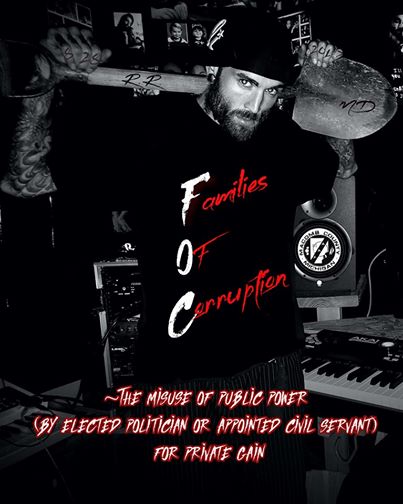
Apparently some of the “threat” claim comes from the meme above and others like it that Vanderhagen—talented!—has created and posted on Facebook. That shovel! Scary! The caption says, “Dada back to digging [and] you best believe [I’m] gonna dig up all the skeletons in this court’s closet.” “I won’t stop till changes are made, people are held accountable, careers are ended, & these kids get the justice they deserve,” he wrote in another one of his “threatening” Facebook posts.

What’s going on here?

I don’t think its a tough question: what’s going on is a concerted effort  by some Michigan judges of dubious skills and character to take vengeance on a citizen who hasn’t been willing to grovel at the the feet of the Robed Ones. Judges are like that all too often, but this is an unusually ugly example that begs for a serious reckoning with Lady Justice—for the judges. Continue reading

How To Kill The American Musical

I have directed musicals professionally in regional and amateur theater, and the shows were a great love of mine growing up. Sadly, the American musical genre is becoming increasingly isolated from the mainstream culture for many reasons, among them the death of the movie musical, the pop-infection of the music and its singing styles, making most Broadway scores (and all of the women) sound the same, the inflated price of professional theater tickets, and production costs and effects that put most modern shows outside the realm of possibility for high schools and colleges.

Another factor,  which it is impolitic to discuss, is that the male gay community has decided to make musicals its own special genre, has been discouraging any talented straight performers from venturing into the field, sometimes unintentionally, sometimes not.

Emblematic of this trend is the Sirius -XM Broadway Channel, which is the only way any kids are likely to hear an excerpt from a cast recording other than buying the song online. The nearly exclusive host is Seth Rudetsky, a writer/performer of some note and obvious talent. To say that he is openly gay is an understatement. Rudetsky’s delivery, speech patterns and preferred subject matter would have once been criticized as evoking cruel anti-gay stereotypes. He’s an actor; Rudetsky could butch up he chose to, and if he cared about musicals continuing as an art form participated in and enjoyed by the whole society and not just a small segment of it, he would. Continue reading

Morning Ethics Warm-Up, 9/23/2019: Post Emmys Edition [UPDATED]

I’m kidding; I  didn’t watch the Emmys, have not watched a second of the Emmys in decades, and can’t imaging a greater waste of time than watching the Emmys, and that includes the time I spent watching “Tusk,” the Kevin Smith black comedy in which a madman played by Michael Parks traps a jerk podcaster played by Justin Long and surgically transforms him into a human walrus. I kind of liked it, to be honest.

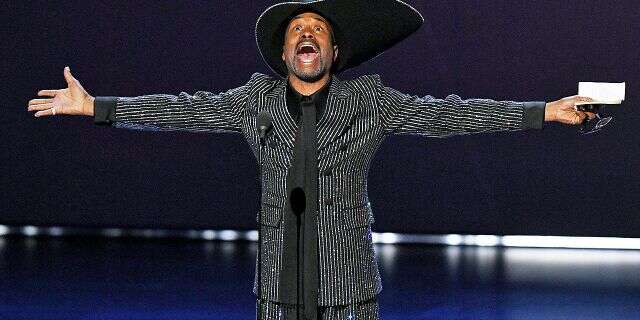
That’s Billy Porter above, by the way, the first openly gay actor to win a performing Emmy, after the many, many non-openly gay actors who have won over all these years. Making a big deal out of this diminishes his honor, since it suggests that his sexual orientation had something to do with his winning the award. I don’t see any reason why who an actor chooses to have sex with should have any relevance to an acting honor.

[UPDATE: Not that it matters, but the Emmy broadcast ratings hit an all-time low. What? People voluntarily passed up a chance to see actresses use their podium time to lecture about acceptance of trans individuals, and basing industry pay levels on gender  equity rather than value?]

1. Country music’s Jackie Robinson. Ken Burns’ documentary “Country Music,” on PBS now, convinced me that Charlie Pride, the first black country music star, deserves more accolades than he has received, as do the white producers and allies, like Chet Akins, Jack D. Johnson, and Louis Allen “Al” Donohue, who made it possible for him to break that culture’s color barrier.

Inspired by Robinson, Pride resolved as a teen to escape the cotton fields. He played minor league baseball, and sang in bars to make extra cash. Then he was “discovered” by two country music figures and advised to go to Nashville.

It’s an amazing story (why Pride’s life hasn’t been made into a movie, I don’t know). Apparently at the beginning of his career, stations played his records without noting his race. In the documentary, Pride describes a Detroit concert where he was introduced to an all-white audience of nearly 20,000 that roared and applauded when he walked out, and then suddenly became silent when they saw his skin color. Do you think that scene might have inspired Richard Pryor to write this one?

2.  Jerk of the Year? Just being the NFL Jerk of the Year is an achievement (there is so much competition), but Antonio Brown, the star receiver signed by the New England Patriots (in their own bid for NFL Jerks of the Year) after he had jerked his way off his previous two teams, then released after two sexual misconduct allegations against him surfaced, went out in a blaze of jerkness.

Immediately after being ditched by the embarrassed Pats, Brown unleashed a torrent of attack tweets, attempting to position himself as a victim. Continue reading

Sunday Ethics Warm-Up, 9/22/2019: Five Ugly Ethics Stories (Sorry!) [Corrected]

A pleasant Sunday…

as long as I don’t read the newspaper or watch the Talking Heads…

1. Before I finish a long post about the most recent contrived Brett Kanavaugh smear by the New York Times, ponder this quote from the Times review of “The Education of Brett Kavanaugh”: “[The authors] come to a generous but also damning conclusion, which is that Blasey Ford and Ramirez are believable and were in fact mistreated by Kavanaugh as teenagers, but that over the next 35 years he became a better person.”

Ugh. The conclusion is “damning” because it relies almost entirely on confirmation bias: Blasey Ford’s own lawyer revealed that her motive in using her “recovered memory” against Kavanaugh was to discredit any future anti-abortion opinions he participated in as a member of the court. The accusation by Ramirez isn’t, apparently, even believable to Ramirez herself, since she says she isn’t certain that the Mad Penis-Dangler was Bret Kavanaugh. Why then, do the authors find the claims “believable”? Oh, because they want to believe them, of course; they work for the New York Times, and they certainly weren’t going to get their book promoted by their employer and snatched up by its readers if they concluded, as objective reporters would, that there is no more reason to believe Justice Kavanaugh did these things than there is reason to believe he didn’t.

The real ugh is this, however: if even these biased analysts conclude that the accusations, even if true, do not have any relevance on the grown man who was nominated to the Supreme Court because they relate to a minor who existed 35 years ago—and who has, as most children do, grown up—then the episodes that their book focuses upon literally don’t matter, shouldn’t have been brought into Kavanaugh’s hearing,  and should not be used now to denigrate and discredit him.

2. From “Social Q’s,” a glimpse of what a malfunctioning ethics alarm is like. Prompting the frequently appearing question in my mind, “How does someone get like this?” was the query into Phillip Gallane’s advice column from a woman who threw herself a birthday party, directed guests not to bring gifts but to make a donation to a charity she supports instead, and was annoyed that some brought gifts anyway. She asked if it would be inappropriate to send the gifts back with a disapproving note so they “would listen” to her “next time.”

I know what I would do “next time”…

3. Hey, sounds great, Facebook! Why wouldn’t everyone trust your judgment? Facebook announced  a series of changes last week to squelch hate speech and extremism—meaning what Facebook and its allies consider such— on its platform in a letter to the chairman of a House panel. Facebook said it would prevent links from the fringe sites 8chan and 4chan from being posted on its platform—you, know like it blocks links to Ethics Alarms!  Then it explained how it would develop an oversight board of at least 11 members to review and oversee content decisions—like the decision that a wide-ranging ethics blog that has no political affiliation or agenda, written by a professional ethicist of some note, doesn’t meet the Facebook “community standards.”

In other, unrelated news regarding the obstacles being thrown in my path, the Appeals Court in Massachusetts finally alerted me that it was taking “under advisement” the request for an appeal of the rejected frivolous defamation suit filed about two years ago by a banned commenter here whose boo-boo I wounded.

(I am not concerned.) Continue reading

Reporting The Mysterious Ukraine “Scandal”: Once Again, I’m Fighting The Urge To Conclude That These Are Just Corrupt, Terrible People


And losing.

When the first notice of the unnamed whistle-blower’s complaint about—well, something involving the President and the Ukraine surfaced on the New York Times front page, in an article that was so devoid of facts, details and corroboration that its only excuse for publication was to titillate Trump-Haters, I wrote,

“This is what the Times considers front page news now. Instantly, “resistance” members and Democrats will leap to the conclusion that whatever it is, it’s impeachable. Those who are thoroughly sick of the successive coup attempts will assume that this is one more concocted sliming by the Deep State, so we can have a “Russiagate” style investigation that will hamstring President Trump’s second term… For my part, I’ll wait for actual facts, thanks. I don’t trust “the intelligence community” not to manufacture ways to undermine the Presidency, not after Comey, McCabe, the FISA fiasco, the FBI lovebirds texts, and Mueller’s statements, among other smoking guns. I don’t trust the Times reporting, I don’t trust President Trump not to do or say something that crosses ethical or legal lines, and I certainly don’t trust Congressional Democrats to determine what are serious transgressions by this President and what are typical maneuvers that have only become ominous because he isn’t Barack Obama.”

Well, I’ve been waiting. As predicted, Democratic impeachment-mongers and Presidential hopefuls are screaming to the skies, and the mainstream media has been flogging the as-yet non-story, another species of fake news, as if it were the Second Coming. Yet here is how the New York Times itself explained the alleged scandal:

What did Mr. Trump do?

In a July 25 phone call, Mr. Trump is said to have pressed the president of Ukraine, Volodymyr Zelensky, to investigate Mr. Biden’s younger son, Hunter, who sat on the board of a Ukrainian energy company. Mr. Trump has seized on an unsubstantiated theory that Mr. Biden was trying to protect the company from prosecution when he called for the firing of Ukraine’s top prosecutor in 2016. Rudolph W. Giuliani, one of Mr. Trump’s personal lawyers, has pushed the Ukrainian government to investigate the matter.

Is “said to have”? By whom? This is not news reporting, it’s gossip. The Biden theory is unsubstantiated? The theory the Times has published multiple stories about regarding the President’s interactions with the Ukraine is far less substantiated.

Why is this coming up now?

Because of an intelligence community whistle-blower who filed a complaint last month about the president’s actions. An inspector general deemed the complaint “credible” and “urgent” and forwarded it to the acting director of national intelligence, Joseph Maguire, who has refused to share it with Congress….

Amazingly, it has now been revealed that the “whistle-blower” did not have  direct knowledge of the communications between President Trump and the foreign leader in question. An official who has been briefed on the matter, however, told CNN that the whistleblower “didn’t have direct knowledge of the communications.” The official said that the concerns and subsequent complaint came in part from the whistleblower “learning information that was not obtained during the course of their work.” That’s hearsay by definition, and means that the report has no probative or evidentiary value whatsoever until it is independently verified. Until then, it is also not news.

What did the whistle-blower claim?

The full extent of the whistle-blower’s complaint, as well as the whistle-blower’s identity, is not publicly known. Reporting by The New York Times and others has established that the complaint involves Mr. Trump’s interactions with Ukraine and a phone call with a foreign leader — possibly, but not necessarily, Mr. Zelensky. It is not clear if it includes other matters.

This is really what the Times itself says. A “whistleblower” from the intelligence community made a complaint about something he was told by an an unnamed party about a private phone call with a yet to be identified official.

Here’s my favorite, though: Continue reading

Saturday Night Ethics Fever, 9/21/2019: Crazy Stuff

1. A simple, factual, ethical rebuttal to Beto O’Rourke, who panders to the anti-gun Democratic base by saying that he’ll confiscate the weapons he thinks we don’t “need.” Lauren Boebert, who with her husband owns local restaurant Shooters Grill, where she and a lot of the staff  open carry a loaded firearm,  confronted  O’Rourke at a town hall in Aurora Colorado. “I was one of the gun-owning Americans who heard you speak regarding your ‘Hell yes, I’m going to take your AR-15s and AK-47s.’ Well, I’m here to say, ‘Hell no, you’re not!”

She was, of course, correct, just as Beto was grandstanding to the ignorant and fearful, in deliberate defiance of the Constitution.

To his credit, Beto tried to control the rabid anti-Second Amendment fanatics in his crowd  who tried to shout Boebert down, as she continued,  “We all have these stories. We all have the experiences. I was living in Aurora during Columbine. I had just recently moved when the Aurora shootings happened. Yet I have very close ties here. Yet all of those people were there defenseless.”

“They had no way to defend themselves against a crazed shooter, so I want to know how you intend to legislate the hearts of men and leave American citizens like myself, American mothers,” Boebert said. above the  abuse from the crowd. “I have four children. I’m 5 foot zero, one hundred pounds, and cannot really defend myself with a fist.”

Then she told a heckler near her that  she didn’t have her AR-15 with her, but  was carrying her Glock. “Well, you shouldn’t have that,” the man said.

Wrong again. It’s not his call, nor his business, whether she has a pistol or not.

2. From the wasteful and pointless protests files: “Hundreds of thousands” of 20-somethings and kids took part in a global protest against “inaction on climate change.” What do they know about climate change? Only what they have been told by agenda- driven activists, teachers and politicians, almost all of them without genuine scientific comprehension of the complexities, vagaries and uncertainty of the topic themselves. Are hundreds of thousands of people who don’t really know what they are talking about more persuasive than, say, one? Should they be?

No. Leading these innocents to believe otherwise is a cruel joke. Margot Guillen of Harvest Collegiate High School, told Yahoo News she was there to send a message, saying, “By protesting peacefully, it shows how committed our generation is to making a change and showing that we know what’s happening and we need to stop it.” They don’t know what’s happening, though, and they don’t know how to stop “it,” in part because they don’t know what “it” is, when “it” will occur, what the extent of “it” will be, and even whether “it,” whatever “it” is, will occur at all.

Good protest.

Typical. Continue reading

Comments Of The Day: “Open Forum, Or ‘I Guess I Picked The Wrong Time To Start Driving All Over Virginia!’” (“Profession Of Journalism” Thread)

Today we have a rare tag team Comment of the Day: JutGory raised the provocative ethics issue of what constitutes a profession and whether journalism qualifies, and Rich in Ct, who has been on fire of late, responded with a sharp analysis.

This was all especially propitious, since the I had a dispute with my legal ethics teaching partner during our (very well-received) “Crossfire”-style seminars last week on just this question. He maintains that it is a a myth to pretend that a profession like the the law is called such for any reason other than the fact lawyers engage in it for compensation. Well, he’s wrong. Professions are not merely occupations, but pursuits one undertakes for the good of society. That is why the hallmark of professionals is that they are trusted and trustworthy, and why their compensation is of secondary priority. The desire for profit undermines professionalism by creating conflicts of interest.

My answer to the question posed by JutGory is that journalism must be a profession, because the public must be able to trust journalists for journalism to benefit society. However presents day journalists are driven by motivations far removed from the public good: their personal political agendas, the pursuit of fame and power, and the love of money. It can be a professiona, and should be a profession, but as currently practiced, it isn’t a profession.

Here are JutGory’s and Rich in Ct.’s  Comments of the Day on the “profession of journalism” thread in the post, “Open Forum, Or ‘I Guess I Picked The Wrong Time To Start Driving All Over Virginia!’”

First, here’s JutGory…

Can journalism be a profession?

My profession, law, has a set of ethical rules. It is a club, and it is self-regulating. Is it self-regulating? Yeah. My state gets about 1000 complaints per year, and about 10 percent each year get disciplined. Every year, you get a handful of disbarments. Not overbearing but I know a lawyer who got a 60-day suspension for a “non-legal” infraction and basically threw in the towel. I can empathize. It is like being accused of a crime; it can be hard to deal with. And, you are held to standards.

The press? You can’t be de-pressed? Dis-presses? Unimpressed?

In a free society, with a free press, can you have a profession where there is no way to regulate its participants.

A shorter way to ask the question: can the press be a true profession if Dan Rather can’t be barred from the profession?

Similar question for teaching. The wrinkle with teaching: can a profession governed by labor unions really enforce ethical standards and discipline?

Rich in Ct’s response… Continue reading

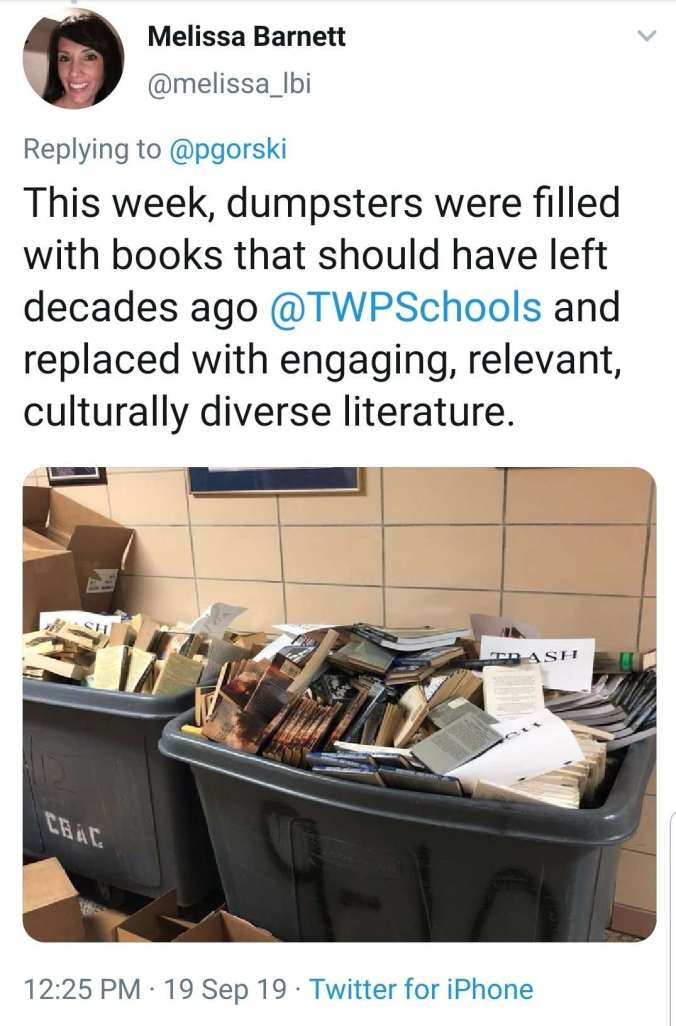
Unethical Tweet Of The Week: Melissa Barnett, The Washington Township, NJ. Public Schools’ Head Of English Language Arts

Nice.

Nah, there’s no public school political indoctrination!

Like most aspiring totalitarians who inadvertently reveal their true nature and agendas, Melissa took down her tweet, and is now hoping that no parents with my proclivities saw it and will demand both an explanation of what she means by “relevant,” what the standards were for eliminating these books, and the titles of the books that were sent to the book-bins of history.

_____________________________

Pointer: Rod Dreher, who writes, “Those poor children of Washington Township schools. The teachers responsible for their education are throwing old books into Dumpsters, and filling their minds with histories of privilege, oppression, and power. It’s all from Paul Gorski and his “Equity Literacy” idea, which is the Marxisization of teaching high school literature. Look at the Principles Of Equity Literacy”… Continue reading

Ethics Quiz: The Declining Neighborhood Contractor

Two weeks ago, The Ethicist (that’s , the real ethicist who authors the New York Times Magazine’s advice column) was asked about the most ethical response to a true ethics conflict. A neighbor who frequently did contracting work in his neighborhood had recently  begun delivering shoddy work.

The inquirer writes, “He has made numerous mistakes, which have required fixes. He occasionally smells of alcohol and admits that he has “a beer” at lunch. Although he is on the job every day, he has not fulfilled the oversight component that we expect from a general contractor, and we have gradually taken over managing the project. “

The inquirer knows the man’s family, which has been going through a difficult period, “which may have impacted his mental health and drinking patterns.” Now he wonders where his loyalties and responsibilities lay. Does he have an obligation to alert neighbors, through a community consumer referral website, that their neighbor’s work is now unreliable? Or is the kind, compassionate action of trying to help the friend work through his current problems, while letting neighbors take their chances, despite the fact that everyone knows the inquirer has referred the contractor favorably in the past?

Appiah makes the predictable ethicist call that the duty to the many over-rides the duty to the one, especially since the inquirer has some responsibility for the community’s trusting the rapidly declining contractor. His advice asserts the equivalent of a duty to warn.

Your Ethics Quiz of the Day:

Is The Ethicist right?

Continue reading