Morning Ethics Warm-Up, 12/5/2019: Post Impeachment Hearing Meltdown Edition

Good Morning!

Somehow a picture of the so-called “unicorn puppy,” appropriately named “Narwhal,” seems appropriate today. The Democratic Party/”resistance”/mainstream media has been pushing its corrupt impeachment plot on the assumption that sufficient Trump-haters would find it cute, but as of yesterday the undemocratic motives and ugliness of the effort stood out like a tail on a puppy’s face. You can’t hide it, and lots of people will convince themselves that it’s attractive. But rationally, the damn thing has to come off.

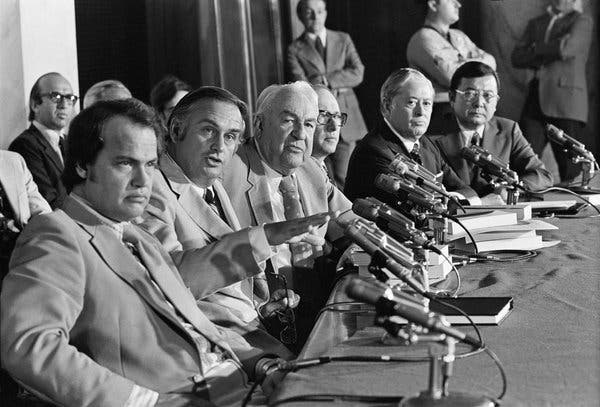
1. On the Stanford law professor’s joke about Barron Trump’s name. Oddly, perhaps the most harmless part of the otherwise embarrassing testimony of Stanford constitutional law professor Pamela S. Karlan yesterday became the most controversial. “While the president can name his son Barron, he can’t make him a baron,” she said.

HAHAHAHAHA! Good one, professor! Gratuitous and completely irrelevant to the issues at hand,  but hey, anything to throw fish to the seals! Based on the outrage around the conservative media, most of which only referenced this knee-slapper without quoting it, I assumed that she had actually insulted the teenager.  I kept reading about how this was one more example of the double standard: using Obama’s daughters for political warfare was off limits, but now this mean professor was getting laughs from Democrats by making fun of Barron Trump. Laura Ingraham tweeted that this joke was guaranteed to turn the public against the impeachment farce for good. (I don’t think so, Laura. You should get out more.) Naturally the First Lady piled on, tweeting at the professor, “A minor child deserves privacy and should be kept out of politics. Pamela Karlan, you should be ashamed of your very angry and obviously biased public pandering, and using a child to do it.” Trump 2020 national press secretary Kayleigh McEnany went even more overboard:

“Only in the minds of crazed liberals is it funny to drag a 13-year-old child into the impeachment nonsense,” she wrote. “Pamela Karlan thought she was being clever and going for laughs, but she instead reinforced for all Americans that Democrats have no boundaries when it comes to their hatred of everything related to President Trump. Hunter Biden is supposedly off-limits according to liberals, but a 13-year-old boy is fair game. Disgusting. Every Democrat in Congress should immediately repudiate Pamela Karlan and call on her to personally apologize to the president and the first lady for mocking their son on national TV.”

Oh come ON. Continue reading

Written Statement of Prof. Jonathan Turley: “The Impeachment Inquiry Into President Donald J. Trump: The Constitutional Basis For Presidential Impeachment” [PART II]

( Part I is here.)

Professor Turley’s testimony continues…

B.  The Nixon Inquiry

The Nixon “impeachment” is often referenced as the “gold standard” for impeachments even though it was not an actual impeachment. President Richard Nixon resigned before the House voted on the final articles of impeachment. Nevertheless, the Nixon inquiry was everything that the Johnson impeachment was not. It was based on an array of clearly defined criminal acts with a broad evidentiary foundation. That record was supported by a number of key judicial decisions on executive privilege claims. It is a worthy model for any presidential impeachment. However, the claim by Chairman Schiff that the Ukrainian controversy is “beyond anything Nixon did” is wildly at odds with the historical record. The allegations in Nixon began with a felony crime of burglary and swept to encompass an array of other crimes involving political slush funds, payments of hush money, maintenance of an enemies list, directing tax audits of critics, witness intimidation, multiple instances of perjury, and even an alleged  kidnapping. Ultimately, there were nearly 70 officials charged and four dozen of them found guilty. Nixon was also named as an unindicted conspirator by a grand jury. The convicted officials include former Attorney General John N. Mitchell (perjury); former Attorney General Richard Kleindienst (contempt of court); former Deputy Director of the Committee to Re-elect The President Jeb Stuart Magruder (conspiracy to the burglary); former Chief of Staff H.R. Haldeman (conspiracy to the burglary, obstruction of justice, and perjury); former counsel and Assistant to the President for Domestic Affairs to Nixon John Ehlichman (conspiracy to the burglary, obstruction of justice, and perjury); former White House Counsel John W. Dean II (obstruction of justice); and former special counsel to the President Charles Colson (obstruction of justice). Many of the Watergate defendants went to jail, with some of the defendants sentenced to as long as 35 years. The claim that the Ukrainian controversy eclipses Watergate is unhinged from history.

While the Ukrainian controversy could still establish impeachable conduct, it undermines that effort to distort the historical record to elevate the current record. Indeed, the comparison to the Nixon inquiry only highlights the glaring differences in the underlying investigations, scope of impeachable conduct, and evidentiary records with the current inquiry. It is a difference between the comprehensive and the cursory; the proven and the presumed. In other words, it is not a comparison the House should invite if it is serious about moving forward in a few weeks on an impeachment based primarily on the Ukrainian controversy. The Nixon inquiry was based on the broadest and most developed evidentiary in any impeachment. There were roughly 14 months of hearings – not 10 weeks. There were scandalous tape recordings of Nixon and a host of criminal pleas and prosecutions. That record included investigations in both the House and the Senate as well as investigations by two special prosecutors, Archibald Cox and Leon Jaworski, including grand jury material. While the inquiry proceeded along sharply partisan lines, the vote on the proposed articles of impeachment ultimately included the support of some Republican members who, again, showed that principle could transcend politics in such historic moments.

Three articles were approved in the Nixon inquiry alleging obstruction of justice, abuse of power, and defiance of committee subpoenas. Two articles of impeachment based on usurping Congress, lying about the bombing of Cambodia, and tax fraud, were rejected on a bipartisan basis. While the Nixon impeachment had the most developed record and comprehensive investigation, I am not a fan of the structure used for the articles. The Committee evaded the need for specificity in alleging crimes like obstruction of justice while listing a variety of specific felonies after a catchall line declaring that “the means used to implement this course of conduct or plan included one or more of the following.” Given its gravity, impeachment should offer concrete and specific allegations in the actual articles. This is the case in most judicial impeachments.

The impeachment began with a felony when “agents of the Committee for the Re- election of the President committed unlawful entry of the headquarters of the Democratic National Committee in Washington, District of Columbia, for the purpose of securing political intelligence.” The first article of impeachment reflected the depth of the record and scope of the alleged crimes in citing Nixon’s personal involvement in the obstruction of federal and congressional investigations. The article included a host of specific criminal acts including lying to federal investigators, suborning perjury, and witness tampering. The second article of impeachment also alleged an array of criminal acts that were placed under the auspices of abuse of power. The article addressed Nixon’s rampant misuse of the IRS, CIA, and FBI to carry out his effort to conceal the evidence and crimes following the break-in. They included Nixon’s use of federal agencies to carry out “covert and unlawful activities” and how he used his office to block the investigation of federal agencies. The third article concerned defiance of Congress stemming from his refusal to turn over material to Congress.

These articles were never subjected to a vote of the full House. In my view, they were flawed in their language and structure. As noted earlier, there was a lack of specificity on the alleged acts due to the use of catch-all lists of alleged offenses. Continue reading

Written Statement of Prof. Jonathan Turley: “The Impeachment Inquiry Into President Donald J. Trump: The Constitutional Basis For Presidential Impeachment” [PART I]

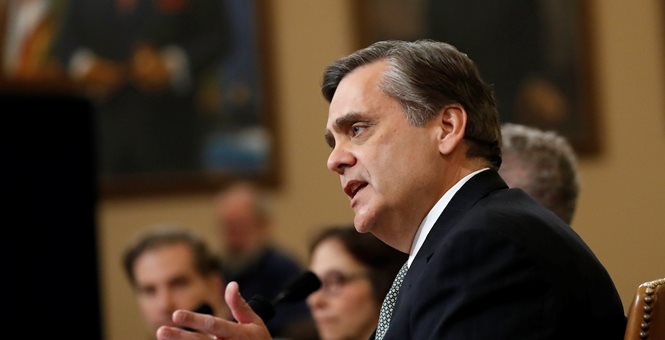
Today, at the impeachment hearings, Prof. Jonathan Turley performed a great public and national service by eviscerating the Democratic theory of impeachment legally, logically and historically. I cannot wait to see if his decisive testimony is given half the prominence by the New York Times as the various headlines shouting about how an official would have done things differently if he or she were President. Unlike almost all of the testimony so far, Turley’s was based on facts and law, and addressed the issue at hand: is there any justification for impeachment proceedings?

It’s a wonderful and clear piece of scholarship that addresses several approaches to the matter that I had wanted to address, notably how the three previous impeachment efforts compare with this one.

Every citizen should read it all; of course, almost none will. The testimony is long, because it is thorough; I have edited it for ease of reading, eliminating footnotes. If you want to read the original document, it is here. Ethics Alarms is going to present this in several parts. Send that link to your smug impeachment-cheering friends, relatives and social media contacts. Tell them that unless they read it, you really don’t want to hear any more on the subject from them, because they want to remain ignorant.

I am proud—relieved?—to find that this serious and admirable scholar embraces many of the positions I have discussed here, though in far more detail and with considerably more authority.

INTRODUCTION

Chairman Nadler, ranking member Collins, members of the Judiciary Committee, my name is Jonathan Turley, and I am a law professor at George Washington University where I hold the J.B. and Maurice C. Shapiro Chair of Public Interest Law. It is an honor to appear before you today to discuss one of the most solemn and important constitutional functions bestowed on this House by the Framers of our Constitution: the impeachment of the President of the United States.

Twenty-one years ago, I sat here before you, Chairman Nadler, and other members of the Judiciary Committee to testify on the history and meaning of the constitutional impeachment standard as part of the impeachment of President William Jefferson Clinton. I never thought that I would have to appear a second time to address the same question with regard to another sitting president. Yet, here we are. Some elements are strikingly similar. The intense rancor and rage of the public debate is the same. It was an atmosphere that the Framers anticipated. Alexander Hamilton warned that charges of impeachable conduct “will seldom fail to agitate the passions of the whole community, and to divide it into parties more or less friendly or inimical to the accused.”2 As with the Clinton impeachment, the Trump impeachment has again proven Hamilton’s words to be prophetic. The stifling intolerance for opposing views is the same. As was the case two decades ago, it is a perilous environment for a legal scholar.

I appear today in my academic capacity to present views founded in prior academic work on impeachment and the separation of powers. My testimony does not reflect the views or approval of CBS News, the BBC, or the newspapers for which I write as a columnist. My testimony was written exclusively by myself with editing assistance from Nicholas Contarino, Andrew Hile, Thomas Huff, and Seth Tate explores the technical and arcane issues normally involved in an academic examination of a legal standard ratified 234 years ago. In truth, the Clinton impeachment hearing proved to be an exception to the tenor of the overall public debate. The testimony from witnesses, ranging from Arthur Schlesinger Jr. to Laurence Tribe to Cass Sunstein, contained divergent views and disciplines. Yet the hearing remained respectful and substantive as we all grappled with this difficult matter. I appear today in the hope that we can achieve that same objective of civil and meaningful discourse despite our good- faith differences on the impeachment standard and its application to the conduct of President Donald J. Trump.

I have spent decades writing about impeachment and presidential powers as an academic and as a legal commentator. My academic work reflects the bias of a Madisonian scholar. I tend to favor Congress in disputes with the Executive Branch and I have been critical of the sweeping claims of presidential power and privileges made by modern Administrations. My prior testimony mirrors my criticism of the expansion of executive powers and privileges. In truth, I have not held much fondness for any president in my lifetime. Indeed, the last president whose executive philosophy I consistently admired was James Madison.

In addition to my academic work, I am a practicing criminal defense lawyer. Among my past cases, I represented the United States House of Representatives as lead counsel challenging payments made under the Affordable Care Act without congressional authorization. I also served as the last lead defense counsel in an impeachment trial in the Senate. With my co-lead counsel Daniel Schwartz, I argued the case on behalf of federal judge Thomas Porteous. (My opposing lead counsel for the House managers was Adam Schiff). In addition to my testimony with other constitutional scholars at the Clinton impeachment hearings, I also represented former Attorneys General during the Clinton impeachment litigation over privilege disputes triggered by the investigation of Independent Counsel Ken Starr. I also served as lead counsel in a bill of attainder case, the sister of impeachment that will be discussed below.

I would like to start, perhaps incongruously, with a statement of three irrelevant facts. First, I am not a supporter of President Trump. I voted against him in 2016 and I have previously voted for Presidents Clinton and Obama. Second, I have been highly critical of President Trump, his policies, and his rhetoric, in dozens of columns. Third, I have repeatedly criticized his raising of the investigation of the Hunter Biden matter with the Ukrainian president. These points are not meant to curry favor or approval. Rather they are meant to drive home a simple point: one can oppose President Trump’s policies or actions but still conclude that the current legal case for impeachment is not just woefully inadequate, but in some respects, dangerous, as the basis for the impeachment of an American president. To put it simply, I hold no brief for President Trump. My personal and political views of President Trump, however, are irrelevant to my impeachment testimony, as they should be to your impeachment vote. Today, my only concern is the integrity and coherence of the constitutional standard and process of impeachment. President Trump will not be our last president and what we leave in the wake of this scandal will shape our democracy for generations to come. I am concerned about lowering impeachment standards to fit a paucity of evidence and an abundance of anger. If the House proceeds solely on the Ukrainian allegations, this impeachment would stand out among modern impeachments as the shortest proceeding, with the thinnest evidentiary record, and the narrowest grounds ever used to impeach a president. That does not bode well for future presidents who are working in a country often sharply and, at times, bitterly divided.

Although I am citing a wide body of my relevant academic work on these questions, I will not repeat that work in this testimony. Instead, I will focus on the history and cases that bear most directly on the questions facing this Committee. My testimony will first address relevant elements of the history and meaning of the impeachment standard. Second, I will discuss the past presidential impeachments and inquiries in the context of this controversy. Finally, I will address some of the specific alleged impeachable offenses raised in this process. In the end, I believe that this process has raised serious and legitimate issues for investigation. Indeed, I have previously stated that a quid pro quo to force the investigation of a political rival in exchange for military aid can be impeachable, if proven. Yet moving forward primarily or exclusively with the Ukraine controversy on this record would be as precarious as it would premature. It comes down to a type of constitutional architecture. Such a slender foundation is a red flag for architects who operate on the accepted 1:10 ratio between the width and height of a structure. The physics are simple. The higher the building, the wider the foundation. There is no higher constitutional structure than the impeachment of a sitting president and, for that reason, an impeachment must have a wide foundation in order to be successful. The Ukraine controversy has not offered such a foundation and would easily collapse in a Senate trial.

Before I address these questions, I would like to make one last cautionary observation regarding the current political atmosphere. In his poem “The Happy Warrior,” William Wordsworth paid homage to Lord Horatio Nelson, a famous admiral and hero of the Napoleonic Wars. Wordsworth began by asking “Who is the happy Warrior? Who is he what every man in arms should wish to be?” The poem captured the deep public sentiment felt by Nelson’s passing and one reader sent Wordsworth a gushing letter proclaiming his love for the poem. Surprisingly, Wordsworth sent back an admonishing response. He told the reader “you are mistaken; your judgment is affected by your moral approval of the lines.” Wordsworth’s point was that it was not his poem that the reader loved, but its subject. My point is only this: it is easy to fall in love with lines that appeal to one’s moral approval. In impeachments, one’s feeling about the subject can distort one’s judgment on the true meaning or quality of an argument. We have too many happy warriors in this impeachment on both sides. What we need are more objective noncombatants, members willing to set aside political passion in favor of constitutional circumspection. Despite our differences of opinion, I believe that this esteemed panel can offer a foundation for such reasoned and civil discourse. If we are to impeach a president for only the third time in our history, we will need to rise above this age of rage and genuinely engage in a civil and substantive discussion. It is to that end that my testimony is offered today. Continue reading

In Sports, Discretion Is The Enemy Of Integrity

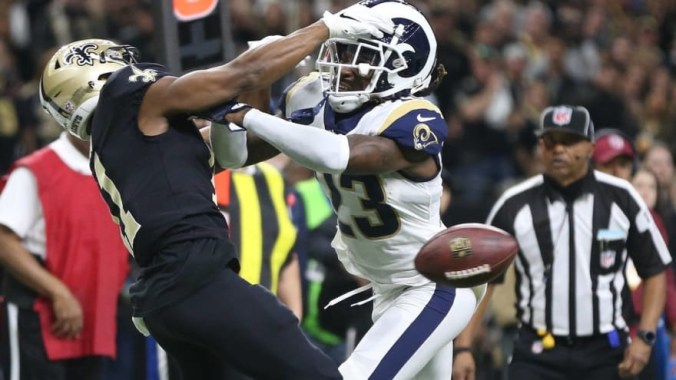
The Denver Bronchos last second win over the San Diego Chargers last weekend was one more game decided by a controversial pass interference call. That rule, with which the NFL has been tinkering and which is now complicated by a video review system, is becoming increasingly controversial this season. Wrote Times football columnist Ben Shpiegel,

[E]very week across the N.F.L.’s vast empire one player interferes with another before a pass arrives — and goes unpunished for it. In these moments, when yellow penalty flags remain lodged in officials’ pockets, aggrieved coaches weigh emotion against reason: Do they challenge the non-call, hoping that by sheer luck it will be overruled by the new video review mechanism? Or do they stew on the sideline, red flag pocketed, and resign themselves to the unlikelihood of a reversal?…After 12 weeks of wasted challenges and lost timeouts, of inconsistency and obfuscation, the league’s erratic application of the defined standard for overturning an on-field decision — “clear and obvious visual evidence” — has made the football masses yearn for simpler times, such as when no one knew what constituted a catch. Over all, through Week 12, 15 of 77 reviews of pass interference were overturned, though nearly half of those reversals — seven of 15 — were initiated by the officials in the replay booth, who are responsible for challenges in the last two minutes of the half… The questionable calls have dented confidence in a mechanism ostensibly intended to restore it after a mess of an N.F.C. championship game, in which Rams cornerback Nickell Robey-Coleman, without consequence, walloped Saints receiver Tommylee Lewis before the ball arrived.

The dilemma isn’t restricted to football. In any sport where an official’s judgment plays a big role in game results, the interjection of technology and the universal broadcast of games has created an integrity crisis. Before multiple camera angles and the  possibility of replays, umpires and referees could blow a crucial call and nobody would be the wiser, or at least would be able to prove that the game was decided by a non-player’s botch. Now, bad calls are there, on a big screen, then the internet, for all to see over and over. The Luddite argument that missed calls are the “human element” and “part of the game” made sense when there was nothing to be done about it. It is ridiculous now. Continue reading

Another Cancel Culture Episode In Canada

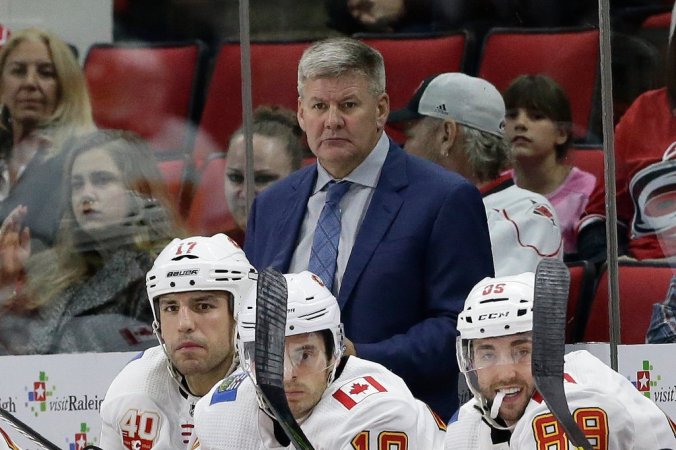
A retired pro hockey player accused the NHL’s Calgary Flames coach Bill Peters of calling him a “nigger” a decade ago when Peters was coaching him on a minor league team, the Rockford Ice Hogs, an affiliate of the Chicago Blackhawks. Peters apologized in a letter to the Flames management after the allegations, and two days later was  forced to resign.

The Nigeria-born  player, Akim Aliu, wrote on Twitter  that when he was playing for a minor league team a decade ago, Peters, who is white, “dropped the N bomb several times toward me in the dressing room in my rookie year because he didn’t like my choice of music.” Aliu further said that he “rebelled” against the coach as a result of the episode,, and that Peters retaliated by advising executives to demote Aliu to a lower-level league. The National Hockey League reacted with a statement saying that Peters’s alleged behavior was “repugnant and unacceptable.” The Flames immediately opened an investigation into Aliu’s allegations.

In a letter of apology, Peters wrote in part, “I was rightfully challenged about my use of language, and I immediately returned to the dressing room to apologize to the team. I have regretted the incident since it happened, and I now also apologize to anyone negatively affected by my words.”

Aliu, who played briefly with  the Flames, in  2012 and 2013, refused to accept the letter as sincere. There are, by my count, about 28 black or bi-racial players in the NHL, or a bit fewer than one a team on average.

There is so much I don’t understand about this story, it’s hard to know where to begin.

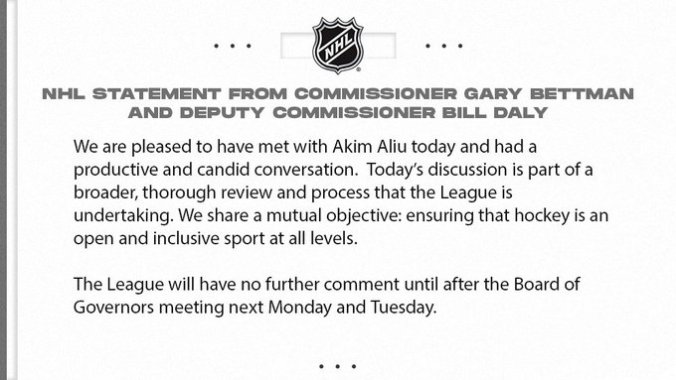
  • Yesterday Aliu met with NHL brass yesterday. Afterward, he told the press, “They couldn’t have been kinder and receptive to the message that we’re trying to bring. I think there’s just some big change coming and it’s long overdue, and I’m excited to see it come to fruition.” Wait, who is “they”? The NHL released a statement too:

  • Akim Aliu is being called a whistleblower.  If so, that was one slow whistle.

How does reporting an incident that took place ten years ago, in a different league, qualify as whistle-blowing in the NHL?

  • Were there other allegation against the Flames coach in his current job? Did he have a long record of bigotry and mistreating players? If this one late hit by Aliu about what happened with the <cough> Ice Hogs is really the whole thing, why did Aliu act now?

His Wikipedia entry describes him as something of a trouble-maker. Was this just vengeance for a his mistreatment for a decade ago?

  • Does it really make sense to fire someone for what he said, with a different employer, that long ago, no matter what it was? Does this mean that Peters can never work again, and will have to wander the world, starving, begging, without friends or shelter? If a statement—not a crime, mind you, but just words, ugly as they may have been— made ten years ago is sufficient to make a man unemployable and a permanent pariah, then why not 20 years ago? Is our enlightened society now concluding that no one can change, or improve, or learn, and a single moment of anger or bad judgment justifying shunning him or her for life?

If I write that this seems cruel and excessive and indeed unethical to me, does that make me racist too?

My usual question as I enter ethical conundrums is “What’s going on here?” In this case, I have no idea, but I doubt that it’s good.

Morning Ethics Warm-Up, 12/4/19: Trump Derangement And The Bad Guys


Good Morning!

1. Quote of the Day: David Bernstein on Instapundit: “What do you call a candidate pool with too women, a gay man, a jew, a half-Jew, and a Catholic?  If you’ve drank a certain type of Kool-Aid, you can this “not diverse”–even though there has been only one Catholic president, and no gay, Jewish, or woman presidents. The obsession with arbitrary and artificial “official” minority status may be the single worse feature of the modern chattering classes.”

Well, of course the problem is “white”: the Democratic party has been demonizing whites for years, and anti-white bigotry is accepted and even cheered. I also disagree  that the “obsession with arbitrary and artificial “official” minority status may be the single worse feature of the modern chattering classes.”  I can think of worse features, but it’s certainly a bad one.

2. Now THIS is Trump Derangement!Long time Leftist wacko Amanda Marcotte persuaded the fast-sinking Salon tp publish her screed headlined, “How Donald Trump ruined Christmas: I won’t celebrate this year, and he’s why: My enthusiasm for the Christmas season was always weak. Amid the ugliness of Trump’s America, it’s disappeared.”

Her lament fits squarely into Big Lie #5 (“Everything is terrible.”) What is amusing and telling is that even though Salon’s readership is as hard left as the site, virtually every comment on her piece is negative. Here is the first one to come up, but the rest pretty much echo it:

Summary: The author is an atheist who doesn’t even believe in the central premise of Christmas, doesn’t have a great relationship with her family, and never really put forward an effort to celebrate the holiday in the past, but somehow Trump has ruined Christmas. She still likes Thanksgiving, however, because it has fewer cultural attachments.

Reaction: How in the world something this mind-bendingly stupid managed to get published by a major company is beyond me, and it’s an example of how the fanatical left has adopted a rhetoric of self-perpetuating trauma around this presidency. “How dare you vote for Trump because it makes me sad! Yes, linoleum makes me sad too, but especially Trump!” It is as if, somehow, they consider the rest of the country responsible for making sure that no part of their eggshell-tranquility is maintained, regardless of the fact that their fragility is entirely of their own making. News flash: No one cares.

Continue reading

Dear Progressives: The Failure Of Reality To Conform To Your Biases And Desires Does Not Make It Unethical

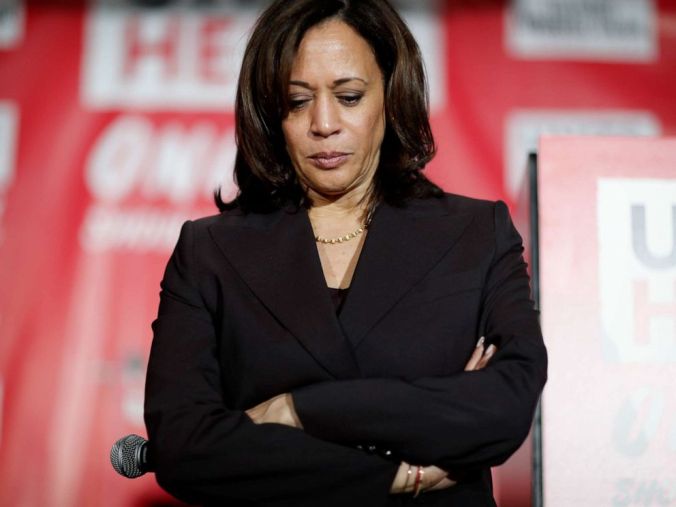
Let us stipulate: the failure of Kamala Harris to thrive in the race for the Democratic nomination for President was not because Democratic voters are racist or sexist.  It is because she was a lousy candidate from the beginning. Checking off boxes is never enough, thank heaven. She is a woman, “of color,” a lawyer and a Senator from a large and powerful state. To top it all off, Harris is relatively young, and attractive. Perfect!

Except it was easy to see that she was an empty suit with a penchant for saying stupid things, often things she couldn’t possibly believe and that contracdicted her record as a prosecutor. She said that it was “outrageous” that the Trump administration wanted to deport illegal immigrants who had committed crimes. [Me: “It is not and cannot be “outrageous” to say that any illegal immigrant, criminal or not, qualifies for deportation. To maintain otherwise is to say that the United States cannot enforce its immigration laws, and not only that, it is “outrageous” to enforce the laws. Is that the position of the Democratic Party? “] She said that she supported legalizing pot because it brought people “joy.” You know, like heroin, rape, and child molesting. She said, when Joe Biden correctly pointed out that a President could not ban “assault weapons” by executive order, she responded, “Well, I mean, I would just say, hey, Joe, instead of saying, no, we can’t, let’s say yes, we can.”  Horrified when she saw the exchange,, law prof Ann Althouse wrote, “The transcript cannot convey the feeling and expression in Kamala Harris’s  [ response]. It is so awful, so lightweight and dismissive of constitutional law (and without any of the dignity of constitutional critique.”

There are plenty more catalogued here, and it is hardly exhaustive. Harris flopped because she proved beyond a shadow of a doubt that she was unqualified to be a Senator, much less a President. As if that wasn’t enough, she couldn’t manage her campaign, which had disintegrated into finger-pointing and defections. When Barack Obama was challenged in 2008 over his lack of leadership experience, he cited the success of his campaign. Slim indeed, but  Harris couldn’t even say that.

As the writing on the wall began to be undeniable, Harris stooped to race- and gender baiting, expressing doubts as to whether a “woman of color” could be elected President (in such a racist, sexist nation, she implied.) No, Senator it’s just that you can’t be elected.

Her polling in free-fall, Harris dropped out today. What was the reaction of the Left’s pundits? Why, outrage over that racism and sexism of the public, of course: Continue reading

A Cautionary Tale: The Corruption Of Post Columnist Colbert King, Part II

Part I is here.

King refused to apply his usual ethics alarms to Obama, but continued to be a credible and objective analyst where the D.C. government was involved. He was an instant Donald Trump-hater, however. the second the 2016 results were known. I can understand reaction to the two-time runaway winner of the Ethics Alarms “Asshole of the Year” award. But King concluded Trump was a racist—his embrace of  birther accusations against his beloved Obama was enough to guarantee that—and once Trump was elected, King became the Post’s counterpart to Trump-deranged Times columnist Charles M. Blow, except that King at his worst is usually more endurable than Blow at his best.

King’s latest anti-Trump screed, however, shows how far a smart pundit can fall when the cognitive dissonance scale and confirmation bias work in tandem, especially when old age marches on and one is mired in both work and personal bubbles where a single bias dominates.

The column begins with one of my least varieties of fake news, future news, when a journalist sets out to push a negative view of a politician based on what he will do.  The headline is “It’s a good bet Trump pardons his felon allies. Here’s when that’s most likely.”

I don’t think it is a good bet, though it is certainly possible. King assumes it is a good bet, as his column makes clear (along with all of his previous columns relating to Trump) because he thinks of the President as a corrupt racketeer. King’s once nimble mind  is now incapable of imagining a justification for pardoning the “allies” in question, Roger Stone, Mike Flynn, and Paul Manafort. I can: arguably all three of them were indicted and convicted because of the “resistance”effort to try to drive Donald Trump from office, and to send a message to anyone who might be of value to his administration that they would instantly be in cross-hairs if they dared to try to support the President. President  Trump might feel responsible for their plight, and use his absolute clemency power to relieve their burdens. If so, it would not be an unprecedented political or personal use of the pardon and clemency power. King reallywas just using this question as a pretense to vent about the President, whom he detests, shredding his own credibility in the process. For example, Continue reading

A Cautionary Tale: The Corruption Of Post Columnist Colbert King, Part I

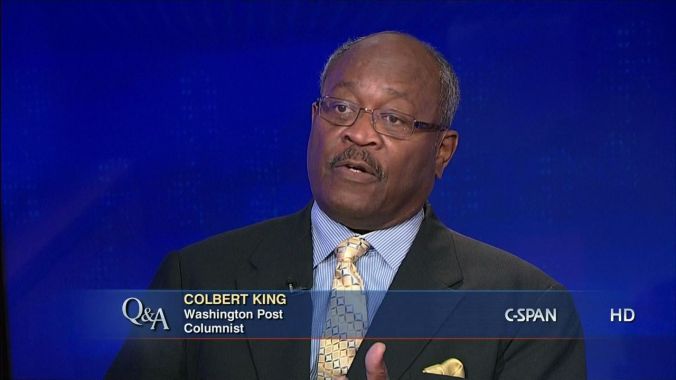
Colbert King is 80 now, but he is still a regular columnist with the Washington Post. As a recent column demonstrated, he has finally fallen prey to the Post culture and no longer is what he once was: the rare pundit, in his case, a liberal one, who could be counted upon for fairness and integrity regardless of the topic. The one-two punches of Barack Obama and Donald Trump showed how cognitive dissonance and confirmation bias can corrupt the best of us, and make no mistake about it, King was once one of the best.

Although he is an African-American, he stood out for decades among his corruption- enabling black colleagues in consistently calling out the D.C. government’s corrupt leadership—notably Marion Barry but many others—on their arrogantly dishonest, venal and untrustworthy practices and attitudes.

Then Barack Obama happened. I listened in surprise on a local Sunday talking head show as King defended Barack Obama’s quiet, decades long assent to the black liberation (that is, anti-white, anti-American rantings of Reverend Wright, Obama’s “spiritual mentor.” Were these rationalizations I heard Colbert King uttering? King reliably mocked rationalizations, and yet here he was using them, notably “Everybody does it,” to defend  a black Presidential candidate’s approval and association with a black racist and demagogue.

Once Obama was elected, King got worse. Not only could Obama do no wrong, but those who criticized were enemies in his eyes; worse, King treated Obama’s appointees and cronies with similar reverence, a complete reversal from his approach to the  parade of incompetent or criminal black politicians in D.C.  Notably, he defended Obama “wing man” Eric Holder, the racialist Attorney General, when he was refusing to comply with a legitimate Congressional inquiry into the Justice Department’s Fast and Furious fiasco. His excuses for Holder and his attacks on Republicans were so redolent of partisan hackery that in 2012 I was moved to write my one-time Ethics Hero the “Open Letter”: Continue reading

Ethics Quiz: That Peloton Commercial

http://www.youtube.com/watch?v=pShKu2icEYw

Hmmmm.

As regular readers here know, I often criticize TV ads for sending unethical messages or endorsing unethical conduct. I have even been accused of being hypersensitive on the subject. With the controversial Peloton commercial above,  I missed it, if there was  an it to miss.

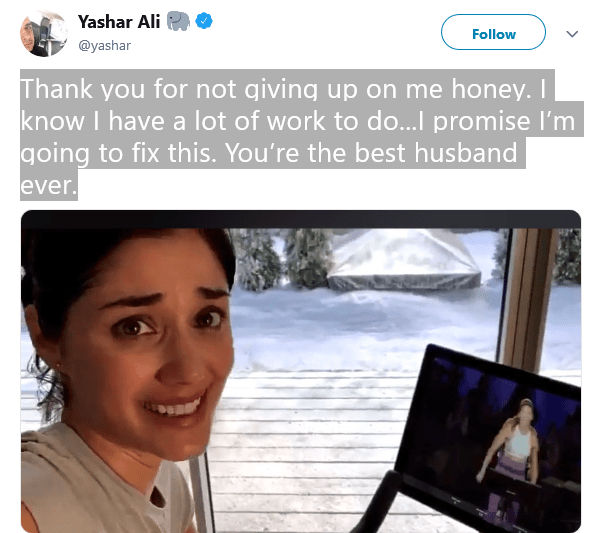
The surprising thing is that a lot of the objections to the ad are coming from the Right. If I had bothered to think about the Peloton commercial, I would have perhaps detected that it was sexist, with a critical husband demanding that his already apparent fit and lovely wife get in better shape, and she dutifully complying. Indeed the Left was annoyed: Yashir Ali, who writes for HuffPo and New York Magazine (and you know what THAT means) captured the spirit of the objections:

Another tweeter wrote, “So sweet. My husband was inspired by the Peloton ad to get me a pair of pants in a child’s medium and a handwritten note that says “Don’t fucking touch me till you can fit into these.”

The Right, however, was equally disdainful. Allahpundit wrote,

The weird part is the … eagerness with which she shows her gratitude. It’s lovely to be grateful for an expensive gift, but she’s *really* grateful and *really, really* wants her husband to know it. It’s not just that she feels compelled to record herself using the bike repeatedly over a span of many months. She looks curiously anxious doing it, even when smiling into the camera. At the end of the clip, when she finally shows him the footage, her eyes are trained on his reaction, seemingly desperate for his approval. Is, um… How do I put this? Is everything okay between these two?

Another conservative wag, Steven Kruiser, wrote, Continue reading