Impeachment Ethics Update, Holiday Edition, Part Two: The President’s Letter

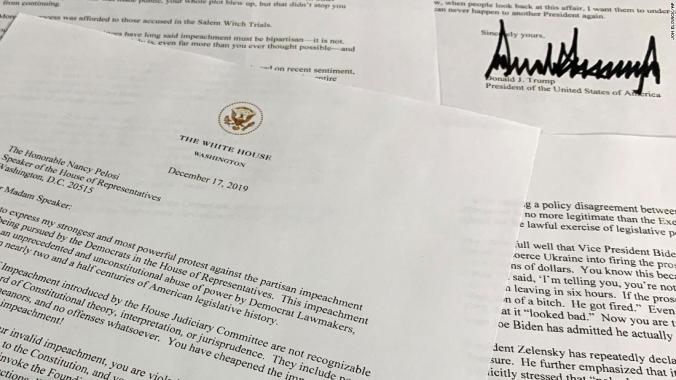
The President’s epic and historic letter to Speaker Pelosi on the eve of the vote to impeach him is nothing if not audacious and to someone who has been making many of the same points the President’s letter does, satisfying. I bet Bill Clinton wishes he had thought of it, except that he had a problem Trump does not: Clinton had in fact committed felonies by lying under oath, something a President must not do. (As I said at the time, without ever hearing a satisfactory rebuttal, if a lawyer would be disbarred for such conduct, as Clinton essentially was—he was forced to quit the Arkansas bar before he was fired from it—how can a President be held to a lower standard?).As President Trump’s letter correctly states, “The Articles of Impeachment introduced by the House Judiciary Committee are not recognizable under any standard of Constitutional theory, interpretation, or jurisprudence. They include no crimes, no misdemeanors, and no offenses whatsoever.”

Well, they are recognizable under some bad and dangerous Constitutional theories, many of which have advocates in the House and among the “resistance” punditry. For example, even now, prominent Democratic House leader Maxine  Waters admits that she has no facts to back up her conviction that the President had a deal with Putin, she’s just sure he did. Waters said she was “ready to talk about” impeachment in February 2017, three weeks after Trump was sworn into office.Her theory later became that an opposing party House majority could impeach a President at will, and didn’t need any reasons other than as assertion that he was “unfit.”

That appears to be what Nancy Pelosi allowed her team to settle on, lacking anything better.

Naturally, the letter has prompted the Democratic Party/”resistance”/mainstream media coup team (what Ethics Alarms calls “The Axis of Unethical Conduct,” or AUC) to have a collective head-explosion orgy. The mainstream print media would not even report on the letter  fairly, in most cases not giving readers the chance to make their own assessment and publishing it with “factchecks” attached, many if not most of which were just partisan spin as rebuttals. For example, in the New York Times version, the section I quoted above was linked to this: “The articles charge Mr. Trump with abuse of power and obstruction of Congress. But an impeachable offense does not have to be a specific crime.” Well…

  • That’s an opinion, not fact. Every previous impeachment has involved a specific crime.
  • As Prof. Dershowitz pointed out, the “obstruction of Congress” referred to in the Articles of Impeachment  cannot be called misconduct, since the Supreme Court has deemed the President’s power in this regard an open question until they rule on it—next June.
  • As Jonathan Turley (and Trump) pointed out, “abuse of power” is too subjective a standard to use as an excuse for impeachment.

Characteristically, as we have seen the past three years, the attacks on the letter have focused on style at least as much as substance. (On substance, however, the letter is difficult to rebut.)

On yesterday’s CNN Newsroom,  the spectacularly hypocritical John Avlon (who once pretended to lead a “no labels” movement as a neutral non-partisan) claimed  that the President’s letter  would cause Republican Senators to raise questions about his “mental state.”  This is rich: Impeachment Plan S is blowing up in Democrats’ faces, so Avlon pivots to good old, evergreen, Plan E : ”Trump is mentally ill so this should trigger the 25th Amendment.”

Yeah, boy, putting out that letter laying out exactly what the impeachment is in language anyone can understand was crazy.

Avlon’s foolishness does raise a question: did the President really write the letter himself? I doubt it. I think someone–Steven Miller has been mentioned as a prime suspect—did an excellent job channeling the President’s unique style and tone, but the letter is too well constructed to be Trump’s alone. Hey, John: if someone else authors a letter for the President that he signs, and you think it’s an “unhinged rant”  and “the definition of not presidential,” does that mean he’s crazy? Can you delegate crazy?

As with so much that has gone before, the President has triggered his foes into broadcasting their own derangement.

A typical, measured, lawyer-checked, restrained Presidential letter would be far less effective. Ann Althouse figured this out, writing, Continue reading

From “The Ethicist”: Revealing The Real Bigots Among Us

, aka “The Ethicist,” apparently received two inquiries last week from what I fear are typical New York Times readers: self-righteous, progressive, and totalitarian at heart. As usually is the case, “The Ethicist’s” answers were competent. I’m not really concerned with his answers, though they were too timid and pandered to people who needed to be metaphorically slapped in the face. It’s the questions that are really ominous.

Inquirer #1 wanted to know what to “do” about her landlady, whom she and her partner “have come to believe that she harbors significant racial and gender biases.” She continued,

When units in our building come up for rent, she often asks  [us] to recommend friends, and over the years a number of our friends have lived here. I value being able to extend what really is an extremely good financial deal to friends who would really benefit from it, but am deeply uncomfortable about the fact that, in doing so, I am enabling her racism and sexism. Is there an ethical solution here? I wish I could report her to some sort of city housing authority (we are in Los Angeles), but I doubt I have any legal recourse as I’m not an aggrieved party and my belief in her biases is based on casual observations and overheard comments. I can’t point to a particular incident. I feel guilty for not wanting to recommend the place, as I know so many friends who could use the financial break, but I also feel like it’s harder and harder to justify “helping” her in any way.

The woman has not observed any incidents of racism or sexism, but she wants to “report” the landlady, who has apparently always treated her well. Inquirer #1 has decided that it’s unethical to “help” such a person because that would be “enabling” her evil ways, whatever they are. Basically, she feels that she is justified in punishing her landlady for not embracing her views, the “right” ones. Continue reading

Comment Of The Day: “Ethics Quiz: Santa In A MAGA Cap”

The issue of whether a mall should have fired a long-time Santa who posed for gag photo in a MAGA cap inevitably invited comparisons with the Naked Teacher Principle, which holds “that a secondary school teacher or administrator (or other role model for  children) who allows pictures of himself or herself to be widely publicized, as on the web, showing the teacher naked or engaging in sexually provocative poses, cannot complain when he or she is dismissed by the school as a result.” There are many variations of the NTP, including the recently visited Naked Congresswoman Principle, which cost Rep. Katie Hill her seat.

The question: Is there, or should there be a “President Trump-supporting Santa Claus Principle?

Here is Alizia’s Comment of the Day on the post, “Ethics Quiz: Santa In A MAGA Cap”

“I think this one might fall into The Naked Teacher Principle.”

I think I can understand why you would say that, but I think there are a few problems with that assessment. I will try to explain:

First, a school teacher who engages in sexual misconduct, is transgressing in a limited area. Our social norms — though this is changing of course — does not allow teachers of children to appear to be loose sexually. Long ago, and more especially for women who were teachers — and mostly women were teachers — it was part of cultural norms that a teacher have a ‘chaste appearance’.

But in a sense there is no issue of ‘speech’ involved when and if a teacher posts a naked photo. That is, there is no ‘speech content’ or political opinion expressed. If there is a ‘speech’ issue it is only of a vary limited sort.

The Santa who had his photo taken with a Trump hat should never have had to apologize to anyone. He was completely free to take such a photo of himself. There is no possible argument that could be brought out in a so-called free society that could successfully take the man’s right away. Continue reading

Afternoon Ethics Notes, 12/17/2019: Miller, Hillary and the Duke [CORRECTED]

Hark!

1. Lesson: Don’t underestimate the Duke! It looks like John Wayne is stronger than the cancel culture after all.  Earlier this year the Woke Avengers tracked down an old Playboy interview where the actor made some inflammatory remarks about blacks and Native Americans (I thought then and I think now that the Duke was deliberately trolling his liberal critics, but it was still a bad interview.) Predictions were rife that the most enduring, influential and popular screen icon of all time had reached the end of his run. It doesn’t appear so: at least two cable channels are running John Wayne film marathons on or around Christmas.

2. The ethical response: feel compassion for Hillary. There are people who get run over and squashed by life, their own failings, and bad luck. We don’t have to like all of them, but the Golden Rule argues that we should feel some pity and compassion for them, even though many have brought some of their misery on themselves.

I think about this when I see, for example, Marcia Clark, the losing prosecutor in the O.J. Simpson case, and her desperately tucked and altered face as she transitioned into a B-media personality. The earliest example of this syndrome that I can remember noticing was perennial Republican Presidential candidate Harold Stassen, with his dazed expression and bad toupee, who once thought he was going to be President. Dubbed the “Boy Wonder,” Stassen was only 41 when he seemed to be on his way to winning the Republican nomination for President for the 1948 election in which President Harry Truman was widely regarded as both a lame and dead duck. Stassen lost the convention battle, however, to Thomas Dewey, of subsequent “Dewey Defeats Truman!” fame. After that, Stassen ran for President in 1952, 1964, 1968, 1980, 1984, 1988, and 1992 , gradually becoming a laughing stock. (He also ran unsucessfully for Governor of Minnesota,  the United States Senate twice, Governor of Pennsylvania twice, Mayor of Philadelphia once; and U.S. Representative). I just thought he was a buffoon until my father told me about his many accomplishments before his dreams were crushed. He was one of the founders of the United Nations, for example.

As I made pretty clear in 2016, when I wrote almost as many critical posts about her and her generally awful ethics as I did about our current President when he was a candidate, I am not a fan of Hillary Clinton. I’ve continued to write critical commentary about her, because she continues to operate with wildly malfunctioning ethics alarms. She is stuck now, in Kübler-Ross terms, in the first three stages of grief: denial, pain and guilt, and anger and bargaining because she lost the election she was certain she was going to win. (So is the entire Democratic Party.)

Now look at her:

3. Marvin Miller makes it into the Hall of Fame. Yecchh. Marvin Miller was described in his obituary as “an economist and labor leader who became one of the most important figures in baseball history by building the major league players union into a force that revolutionized the game and ultimately transformed all of professional sports.” I have no quarrel with any of that. Miller was a labor activist who did his job extremely well. I would put him into a labor leader’s Hall of Fame—-I’m sure one would get at least a hundred or so visitors a year—without blinking. He no more belongs in the the Baseball Hall of Fame in Cooperstown, NY than I do, but he was posthumously elected to that Hall of Fame last week.
Continue reading

Movie Flop Ethics, Part II: “Black Christmas” And The Politicization Of Everything

http://www.youtube.com/watch?v=PtWLNFuzxF4

In Part I, I said I was glad that Clint Eastwood’s latest film “Richard Jewell” was bombing, because the film impugns the integrity of a now-deceased reporter simply to spice up its story. After I read some of Clint’s comments yesterday in response to the controversy, I’m even more glad. Clint said that nobody knows how reporter Kathy Scruggs got a crucial leak from the FBI, but that it could have occurred because she traded sex for information. That’s despicable.

Nevertheless, the other dud among the Hollywood releases over the weekend, “Black Christmas,” deserved to flop even more than Eastwood’s epic.

The original “Black Christmas” (1974) was released under the name “Silent Night, Evil Night.” I saw it with my sister a few days after its opening (I was amused at the ad’s catchline, “If this movie doesn’t make your skin crawl, IT’S ON TOO TIGHT!!!”) and it scared the bejesus out of both of us, but especially her: she slept with the light on for weeks, and to this day my uncanny imitations of the maniac’s phone calls upset her (so I keep doing them, of course.)

Arriving before John Carpenter’s “Halloween” and its later, cheesier rip-off “Friday the 13th,” what was soon re-titled “Black Christmas” anticipated many of the themes and techniques of the slasher genre, perhaps too well. Blessed with a much better cast than any subsequent movie of the type (Olivia Hussey, Keir Dullea, Andrea Martin, John Saxon, and Margot Kidder) and clever and gutsy director Bob Clark (“A Christmas Story,” “Porky’s”), the film was declared too disturbing by many critics. I thought it was easily the best horror movie I had ever seen, and recommended it to many friends, some of whom were not grateful after spending the following night jumping at every sound. It was very gratifying to see “Black Christmas” finally emerge as a cult film and the acknowledged inspiration for the slasher film genre (along with “Psycho,” of course.)

I saw the 2006 “sequel,” which was terrible, and had a sense of dread when I learned that Hollywood would try again. It was clear that the new film was already off to an unethical start when I saw the trailer: this was another example of producers hijacking a familiar title while making a movie barely connected to the older film it was evoking. That trick, essentially a bait and switch, always ticks me off. In the trailer for the new film, we could see that the killer wears a black robe and uses a longbow. Clark’s original famously never shows the maniac murderer at all: much of the movie is shot from his perspective (I assume it’s a he), though we see his shadow, one mad eye, and his arm at various times. We also hear him, and a more crazy-sounding killer has never been recorded.

The new “Black Christmas” takes place in a sorority house around Christmas, and there’s someone knocking off the girls. That’s about the extent of the similarity. To be fair, the advent of cell phones ruined the original film’s most iconic scare: it was the first movie in which we heard the chilling words, “The phone calls are coming from inside the house!”

The promotion of more female film directors is a feminist cause right now. There’s even a Christmas commercial where a little girl tells her parents who have just bought Disney princess toys  to put under the tree for her, “I don’t want to be a princess any more. I want to be a film director!” I have always championed female directors for the stage; there is no question that there are multiple biases against them in theater, and I assume the same bias afflicts them in Hollywood. However, I do not want to see more female directors because they bring a special, feminine perspective to their work, and I really don’t want to see more female directors so they can use their plays and films as feminist propaganda vehicles. Just make a good movie, kid: if your work only stands for the proposition that women can’t just make entertaining and effective films, but have to clobber the audience with feminist tropes, you will have created a legitimate reason for the industry to be wary of female directors. Continue reading

Impeachment Ethics Update, Holiday Edition, Part One

1. A recent exchange in a Facebook debate: I challenged someone who said that the President had extorted a foreign government to get “dirt” on a likely opponent in the election, thus personal gain. This, he said, was impeachable. After pointing out that the evidence of “extortion” is speculative at best, since a) no money was ultimately withheld,  b) the government at issue says they did not feel extorted, and c), as many have pointed out, using such goodies as foreign aid and state visits as carrots to persuade governments to agree to various U.S. requests and demands that, among other results, might help a President or his party win an election is international politics as usual, and has only been called sinister during this administration.

Then I asked, “If all the facts were the same, except that Joe Biden had not entered the Presidential race, would there be anything wrong, much less impeachable, about the President asking the Ukraine to investigate what appears to have been possible illicit influences on the Vice President of the U.S. through benefits being showered on his son?”

No answer was forthcoming.

So much for impeachment article #1.

2. Alan Dershowitz explained last week  that the Supreme Court “pulled the rug out of part two of impeachment”  by agreeing to hear a trio of cases involving subpoenas for the President’s financial records. He is quite right; I would say inarguably so.

Dershowitz explained that by granting certiorari in three cases where Trump had challenged a congressional subpoena, SCOTUS had made a statement that there was a legal question regarding whether the subpoenas were valid.  Because the Supreme Court said the issue needed to be settled, the message was that the President was right,, that he does not have to comply with a subpoena by Congress unless a court orders him  to comply.

“Now, we don’t know how the court is going to come out,” the former Harvard professor said. “But they made it clear that’s a viable issue. So, that charge, that ground of impeachment, should be immediately removed by the House and not sent to the Senate. There’s nothing to it anymore after the Supreme Court today said you’re entitled to a review on an issue when the President challenges the subpoena power of Congress.”

And that’s it for #2. “It’s all done. It’s over,” says Dershowitz . Continue reading

Final ‘Week Before Christmas’ Ethics Shopping, 12/16/2019: Joy, Obama, And JPMorgan

Inspiring Christmas lyrics of the week:

Oh, the world is your snowball, see how it grows
That’s how it goes, whenever it snows
The world is your snowball just for a song
Get out and roll it along

1. That this kind of thing could happen at a major bank in 2019 is inexplicable and disgusting. Jimmy Kennedy, a nine-year NFL veteran,  earned $13 million during his nine-year career and had been told that he would be accepted as a “private client” at JPMorgan Chase, an elite designation with perks like travel discounts, exclusive event invitations and better deals on loans. When he went to  his local JPMorgan branch in Arizona to determine why he had not been accepted into the cataegory, he was told by his representative, who is black, “You’re bigger than the average person, period. And you’re also an African-American. We’re in Arizona. I don’t have to tell you about what the demographics are in Arizona. They don’t see people like you a lot.”

Kennedy recorded the conversation, and after pulling most of his money out of JPMorgan,  complained to the bank as well as an industry watchdog agency. The bank sent him a letter saying, “You stated that Mr. Belton informed you that our firm was prejudiced against you and intimidated by you because of your race. We found no evidence to substantiate your allegations.”

He also sent the recording to the New York Times, which wrote about Kennedy’s experience. A few days later, Jamie Dimon, the chairman and chief executive of JPMorgan Chase, sent a memo telling employees that such behavior “does not reflect who we are as a company and how we serve our clients and communities every day.”

That’s the Pazuzu Excuse: “It wasn’t me!” Sorry, chief, but if you have employees treating African Americans like Kennedy was treated, that is who you are as a company, and as CEO, you’re responsible. Continue reading

Comment Of The Day: “Saturday Morning Ethics Warm-Up. 12/14/19: Insulting George Washington And Other Annoyances”

There goes Professor Morrison!!!

This is the third (in three days) and final, for now, of a series of  impeachment-related Comments of the Day by Ethics Alarms loyalist and ace  Glenn Logan. He’s authored a couple more COTD-worthy posts since this one went up two days ago; at this rate, I might just turn the blog over to him and Mrs. Q (whose latest column is coming!) and retire to beachcombing and directing satirical musical reviews.

In his latest, Glenn did me a favor and defenestrated George Washington law professor, Alan Morrison’s depressingly lame attempt to rebut Jonathan Turley’s superb explanation of why the House’s impeachment ploy was misguided and wrong.

Here is his Comment of the Day on the post, “Saturday Morning Ethics Warm-Up. 12/14/19: Insulting George Washington And Other Annoyances”:

Morrison complains that the House cannot obtain the information they need to impeach Trump or not because Trump insists on is right as the head of an equal branch of government to have the House demands on the executive subjected to judicial scrutiny.

Therefore, his claim is that the House has no choice but to infer whatever it can from the witnesses who have testified so they can get the President impeached before the election.

This is not just a weak argument, but a completely specious one. The President:

a) considers the investigation illegitimate and partisan, and;

b) has a duty to protect his office against just such an illegitimate partisan investigation by legitimately referring such demands to the courts. Continue reading

Movie Flop Ethics, Part I: “Richard Jewell” And The Alleged ‘Female Reporter Trading Sex For Scoops’ Smear

The two big flops among movies that opened last weekend were director Clint Eastwood’s “Richard Jewell” and “Black Christmas,” the second attempt to re-boot the 1976 slasher cult film. Both disasters have ethics lessons to teach, or not teach. Let’s look at Clint’s movie first.

“Richard Jewell” made lass that $4.5 million in its first weekend, and has also been snubbed by the various year-end awards. It is based on the now mostly forgotten  story of how Jewell, initially hailed as a hero for his part in foiling the 1996 Atlanta Olympics bombing plot,  was falsely accused  of complicity by local law enforcement, the FBI, and the news media. Conservative outlets loved the film, but the other side of the divide focused on a subplot, as the film’s screenplay  suggested that a named Atlanta Journal Constitution reporter, now deceased,  used sex to persuade a source to break the story.  The Journal Constitution has been attacking the film, denying that Kathy Scruggs would ever used he body to get a scoop. Her colleagues, friends and  family all insist that she would not have slept with a source, and reporters around the country circled the metaphorical wagons to proclaim they were shocked–shocked!—that anyone would even suggest such a thing. Jeffrey Young, senior reporter for HuffPost tweeted,  “The lazy, offensive, shitty way screenwriters so often treat female journalists infuriates me. Depicting women using sex to get stories is disgusting and disrespectful. It’s also hacky as hell. I was planning to see this movie but not anymore.’ Melissa Gomez of the Los Angeles Times wrote,  “Hollywood has, for a long time, portrayed female journalists as sleeping with sources to do their job. It’s so deeply wrong, yet they continue to do it. Disappointing that they would apply this tired and sexist trope about Kathy Scruggs, a real reporter.’ Susan Fowler, an opinion editor at the New York Times tweeted “The whole “female journalist sleeps with a source for a scoop” trope doesn’t even make any sense…”

This would be damning, except that while it may not be standard practice, there are plenty of examples of female journalists doing exactly what Eastwood’s film suggests.  Last year the Times—yes, Susan Fowler’s paper—reported on the three-year affair between  Times reporter Ali Watkins and James Wolfe, senior aide to the Senate Intelligence Committee, and a regular source for her stories. In October,  an employee of the United States Defense Intelligence Agency was arrested for leaking classified material to two reporters, and he was involved in a romantic relationship with one of them. Both reporters are still employed by their respective news organizations, the  Times and CNBC, so its hard to argue that sex-for-scoops is being strongly discouraged.

Continue reading

A Holiday Jumbo! The Non-Racist Confederacy/Nazi Enthusiast

In Billy Rose’s spectacular musical “Jumbo,” Jimmy Durante was confronted by a sheriff as Jimmy tries to tiptoe off with the largest elephant in captivity trailing on a rope behind him. In answer to the officer’s question, “Where are you going with that elephant?”,  the immortal Schnoz answered, innocently, “Elephant? What elephant?”

Sadly, “Jumbo” will never be produced again: too old, too expensive, too politically incorrect (it’s about the traditional circuses that had trained animals, like elephants, in their shows). Nonetheless, Jimmy’s tradition is alive and well, if you can call denying what is obvious to anyone “well.”

In Des Moines, Iowa, William Stark has painted Confederate battle flags and swastikas on pallets around his property, which is next to an elementary school. Nice. Morris Elementary has released a statement denouncing Stark’s display, which the students, who are about 60% black and Hispanic, can see when they come and go from the school, and from the playground.

Stark says he can’t imagine what their problem is. “They don’t know their history, evidently,” he protests. “That’s the only reason I can think of that they can think anything bad about it—they don’t know their history.”

I wonder what history he’s referring to.

Stark denies that there’s anything about his Nazi-Confederacy display that suggests racism, thus entering “Racism? What racism?” into the Ethics Alarms Jumbo log.

“It’s a free country,”  Stark adds. “I’ll put it out there if I want to.”

Verdict: Racist asshole.

Here’s Willy and his “non-racist” artwork:

He does have a Christmas wreath on his door, however….