
Harpers’ “anti-cancel culture” letter, discussed here was instructive, but not in the manner that its sponsors intended. It excluded most conservatives (except Stockholm Syndrome types like David Brooks) and all of those who had been damaged by progressive cancel-mobs, making the exercise suspect as Left-wing grandstanding. Worse, an alarming number of progressives who didn’t sign the letter expressed disappointment that others did, because they fervently believe that expressing opinions that vary from woke cant should be punished, and that (though they won’t come right out and say it) free expression is undesirable. Hate speech, you know—makes people feel “unsafe” to have to associate with the unenlightened.
For some reason the criticism centered on Vox, the website begun by Washington Post reporter Ezra Klein when pretending to be anything but a partisan shill became too much for him. Vox is as biased leftward as Breitbart is biased in the other direction, which is why I seldom use, and never trust, either. Several Vox employees publicly objected to the fact that their colleague Matt Yglesias signed the letter, apparently forgetting that Yglesias, “by any means necessary” fan that he is, once admitted.
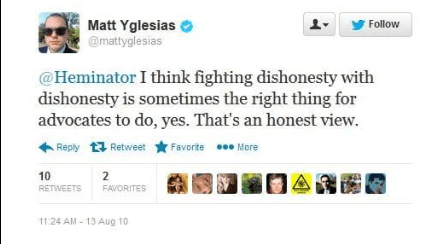
In response to the uproar, senior foreign editor Jennifer Williams tweeted,
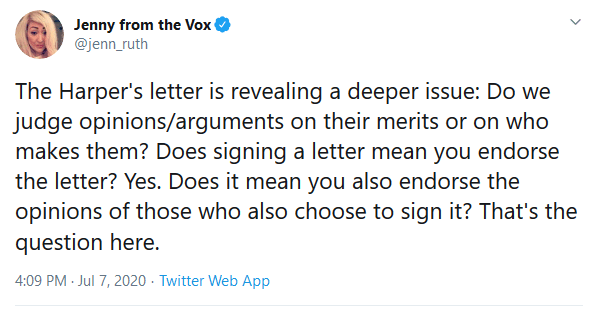
What a fascinating set of ethics questions!
Let’s examine them, shall we?
Question #2, the one Williams answers, is apparently not as obvious as she seems to think it is. Tufts University history lecturer Kerri Greenidge demanded to have her name removed from the list of signers, claiming that her name was used without her knowledge or consent. “I do not endorse this @ Harpers letter,” Prof. Greenidge tweeted. “I am in contact with Harper’s about a retraction.” The Tufts historian’s sisters, novelist and New York Times opinion writer Kaitlyn Greenidge and playwright Kirsten Greenidge also asserted that Kerri was included among the signatories without her consent or knowledge.
Prof. Greenidge was lying—to the public, and to her family. Harper’s quickly produced an email exchange from late June in which Greenidge agreed to sign. “Yes, I will add my signature. It reads well,” Greenidge wrote from her Tufts email address. “Let me know what more you need from me.”
“Oh, just a promise that you won’t cave like a wet cardboard box and start blaming us if some of your progressive pals and family members complain, I guess,” is what Harper’s should have responded. Continue reading




 Ethics Alarms
I had two Comments of the Day to choose from to greet the morning. This one, by Lumiere, was the less depressing of the two, so you can imagine what the other one was like. However, The last paragraph in the post, a comment on the climatologist who admits in a new book that he joined his colleagues in hyping and fearmongering, gives me hope.
My mind was already on indoctrination and the way our scientists, scholars and educators have abused the public’s trust. A truly frightening story was revealed by College Fix: an incoming freshman at Marquette, Samantha Pfefferle, posted a (silly and obnoxious) pro-Trump video on the social media site Tik Tok, and administrators at the school began suggesting to her that her admission might be revoked because of her unacceptable beliefs. What was unacceptable about them was that, based on the video, she supported the President of the United States, ergo his policy positions. The Horror.
The “response” she was getting from her video was threats, harassment and intimidation, perhaps from Marquette students. Strange: that would seem to be the problem that administrators had a legitimate reason to be concerned about. No, they apparently approved, since the college officials decided to engage in some intimidation of their own: “Nice little college acceptance you have here…too bad if something were to happen to it..”
I would normally be skeptical that any administrators from a reputable college would challenge a student’s political opinions in the manner Pfefferle described, but Marquette confirmed that “the admissions team did recently have a conversation with incoming freshman Samantha Pfefferle about statements made on her social media accounts.” After unwelcome publicity on several blogs and conservative websites, Marquette announced that the student’s acceptance was not in peril and had been finalized, firmly placing what the school did in the “it’s not the worst thing” category.
It was bad enough. It is unethical for educational institutions to promote viewpoint conformity among their students, yet this incident, like the confession of the suddenly remorseful climate scientist, indicates that this is increasingly how our professionals whose duty is to enlighten us see their roles: not to inform, but to indoctrinate.
Here is Lumiere’s Comment of the Day on the post, Ethics Hero: Michael Shellenberger: