The Baby On The Album Cover: Dumb Lawsuit, Valid Ethics Point

Naked baby cover

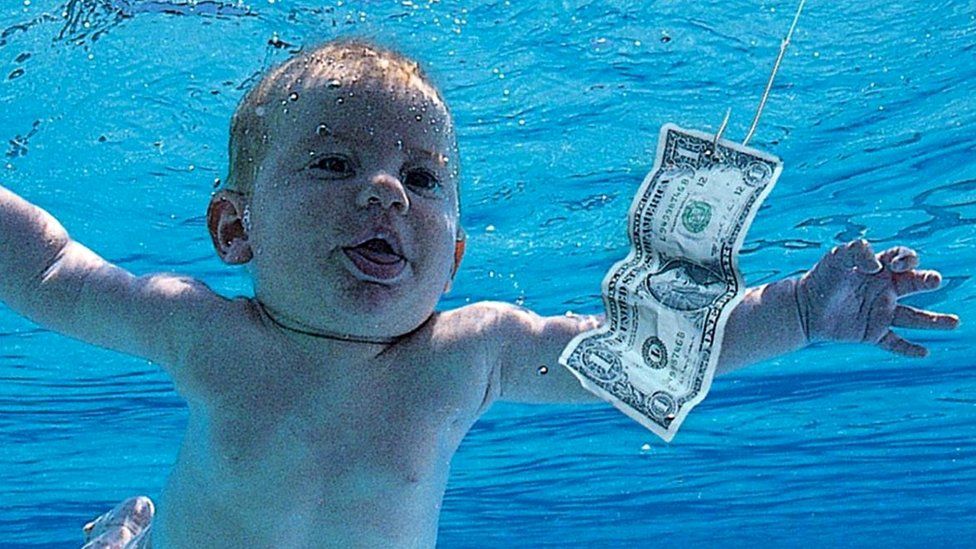
Thirty years ago, Spencer Elden, age four months, was photographed by a family friend naked and floating in a pool at the Rose Bowl Aquatics Center in Pasadena, California. The striking and cute photo was then sold by his parents to be the cover of “Nevermind,” the rock band Nirvana’s second album that shot the Seattle band to international fame. (Never could stand Nirvana myself.)

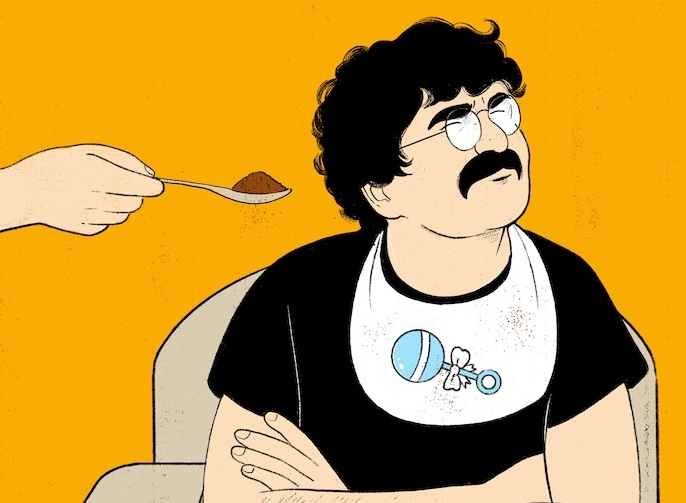
Through the years Elden pretty much exhausted the opportunities to exploit his accidental celebrity, recreating the wet, wild and adorable moment for the album’s 10th, 17th, 20th and 25th anniversaries (but not with his naughty bits exposed, of course) “It’s cool but weird to be part of something so important that I don’t even remember,” he said in an interview with The New York Post in 2016, in which he posed holding the album cover at 25. Eldon even reportedly has “Nevermind” tattooed on his chest.But this year he needs money, or has a change of heart, or met up with an unethical lawyer, or something. Now Elden is suing Nirvana for damages, claiming his parents never signed a release authorizing the use of his image on the album, and more provocatively, that his nude infant image constitutes child pornography.

“The images exposed Spencer’s intimate body part and lasciviously displayed Spencer’s genitals from the time he was an infant to the present day,” legal papers filed in California claim. Lasciviously? The album cover indeed showed Elden as a baby with his genitalia exposed. Maybe it also made tiny Spencer seem greedy, since the graphic artist added a digitally added dollar bill on a fishing line, leaving the impression that the tot was trying to grab the dollar.

Of course, he IS greedy now.

Continue reading

The FIFA Scandal’s Lesson: The U.S. Government Does Not Comprehend The Principle Of “A Culture Of Corruption”

jackheadexplosion

Why I am I not surp….oh, oh, there goes the head again. I guess I am surprised after all.

Since I regard soccer as about as entertaining as watching paint dry, I took only scant notice of the massive scandal in 2015 involving the Fédération Internationale de Football Association (FIFA), which oversees international soccer. More than 50 people and companies were charged in the case, and dozens have pleaded guilty. You can catch up here; I’ll wait.

All set? OK, then process this: six years after the massive criminal indictment exposed decades of corruption in global soccer, the U.S. government approved the payment of more than $200 million to….wait for it!—- to FIFA as well as its two member confederations also implicated in the scandal.

See, the theory is that the organization that was run by the individuals who stole all that money and engaged in bribery, money laundering and corruption, was really just another victim of it all. The repayment begins with an initial payment of $32.3 million in forfeited funds, the Justice Department announced, and prosecutors have approved a plan in which the soccer organizations could receive as much as $201 million.

Continue reading

Speaking Of Big Buts, The Unethical Quote Of The Month: Dr. Anthony Fauci

Fauci

“I know I respect people’s freedom, but…”

—-Dr. Anthony Fauci, Director of the National Institute of Allergy and Infectious Diseases and the Chief Medical Advisor to the President

Fauci was talking about the need for everyone to get vaccinated, but it doesn’t matter what he was talking about. When government officials, whether they are elected or not, follow statements like “I respect people’s/personal freedom/liberty/rights with the word “but,” that’s all Americans need to hear to know that the speaker does not respect our freedom, liberty or rights, and that not only he or she cannot and must not be trusted, no government that continues to employ such an official can be trusted either. Continue reading

Competence Check: Learn To Communicate, You Inarticulate Boobs.

I’ll make this quick.

Sullivan and U.S. Army Maj. Gen. Christopher Donahue, commander of the 82nd Airborne, spoke with ABC News’ Ian Pannell yesterday at Kabul’s Hamid Karzai International Airport about the evacuations taking place there. As the Taliban is taking control of the country, Sullivan said that his Marines are managing an unprecedented humanitarian crisis, saying, “I think whether you’re in a combat situation or a humanitarian operation, the human element is always there. But this event is an unprecedented event. I have my years of deploy[ment] into combat and to other crisis areas… I’ve never seen anything like it before.”

Then the two Ethics Dunce Congressmen, Seth Moulton, a Bay State Democrat, and Republican Peter Meijer of Michigan, both Iraq War veterans as the news media keeps reminding us (as if that excuses them), made a secret, unapproved visit to the Hamid Karzai International Airport on Tuesday “to conduct oversight” on the evacuation. They also said it wasn’t grandstanding. Of course it was grandstanding. The Administration’s anger at the two as well as Speaker Pelosi’s criticism was 100% appropriate.

But I digress. Moulton, who tweeted his reactions, wrote at one point, “I visited Kabul airport to conduct oversight on the evacuation. Witnessing our young Marines and soldiers at the gates, navigating a confluence of humanity as raw and visceral as the world has ever seen, was indescribable.”

“I’ve never seen anything like it before.”

“Indescribable.”

This is not sufficient or acceptable. It is incompetent and lazy communication of information that the generals and the congressmen have a duty to communicate. Those descriptions could mean anything, and they deliberately or negligently leave their meaning to the imaginations of listeners and readers, when they didn’t see a thing. If officials can’t do better than that explaining a situation to the public through the news media, then they shouldn’t be talking to the news media, and they shouldn’t be officials.

Meanwhile, adding to the incompetence, reporters in a position to do so must not take such useless generalities as answers.

“What did you see that you have never seen before, General?”

“Please describe what you mean by indescribable, Congressman!”

Or go back to grade school and learn to talk. I’m sick of this.

Afternoon Ethics Julep, 8/24/2021: Harry Truman Revelations For The Dog Days…

Mint Julep

1. Good Harry, bad Harry. I recently watched the 1961 interviews David Susskind did with Harry Truman in 1961. You can see them on Amazon Prime streaming. I was very impressed; I could not remember any President in my lifetime who appeared so candid, open, and sincere about his principles, certainly none of our recent POTUSes. Truman is not one of favorite Presidents; I regard him as a mediocre man thrust into a job far above his abilities who managed to do better than anyone could have predicted. He rose to the occasion as best he could, and that is deserving of respect. The interviews elevated Harry in my estimation.

Then, yesterday, I read a scholarly paper by Prof. Paul Campos of the University of Colorado Law School that shattered my newly grown regard for Harry. The Former Presidents Act (FPA), a 1958 statute provides ex-Presidents with millions of dollars in future taxpayer-funded benefits. One of the motives behind the House’s “snap impeachment” of Donald Trump was to ensure that he not be a beneficiary of the Act. (They failed. As Nelson Muntz would say, “HAHA!”) Campos’s research shows that while the FPA has always been explained as a response to former President Truman’s financial struggles in part because he refused to exploit his status as a former President cash in (like some Presidents of recent vintage), this was not just a false narrative, but a spectacularly false narrative. Campos writes,

Using recently released and until now unexamined archival evidence… in a complete contravention of the existing standard historical record, [it appears that] Harry Truman was, as a direct result of being president, a very wealthy man on the day he left the White House, with an estimated net worth, in relative economic terms, of approximately $58 million in 2021 dollars. …[T]his wealth was a result of both Truman’s enormous presidential salary — several times larger, in real terms, than the current salary for the office — and, more problematically, of the evident fact that Truman misappropriated essentially all of the multi-million dollar — in 2021 terms — presidential expense account that was set up for him by Congress at the beginning of his second term….[A]gain contrary to the current historical understanding, Truman made another fortune after he left the Presidency, by doing precisely what he claimed he was not doing, that is, exploiting his status as a former President to maximum economic advantage. Indeed, by the time Congress passed the FPA in response to Truman’s various claims that he was at least teetering on the brink of potential financial distress, Truman’s net worth was, in relative economic terms, approximately $72 million in 2021 dollars.”

Well, there goes that newfound respect! Truman was a member of the corrupt Prendergast political machine in Kansas City before entering national politics, so this isn’t as much of a surprise as it would be for some other icons.

Continue reading

Unethical Quote Of The Month: “A New Deal For Broadway”

“[N]ever assemble an all-white creative team on a production again, regardless of the subject matter of the show…”

——A provision in the “New Deal for Broadway,”  an agreement signed by Broadway “power-brokers” pledging to strengthen the industry’s diversity practices as theaters reopen following the nearly 18-month pandemic shutdown.

A New Deal for Broadway,” was developed by Black Theater United, one of several organizations established last year, the Times story tells us, “as an outgrowth of the anger Black theater artists felt over the police killings” of George Floyd in Minnesota and Breonna Taylor in Kentucky. “Black Theater United’s founding members include some of the most celebrated performers working in the American theater, including Audra McDonald, Brian Stokes Mitchell, Billy Porter, Wendell Pierce, Norm Lewis and LaChanze.”

The pledge was signed by the owners and operators of all 41 Broadway theaters as well as the Broadway League, the trade organization representing producers, and Actors’ Equity Association, which represents actors and stage managers.

Observations: Continue reading

No, Gene Weingarten, YOU Are The Poopyface, But Not For The Reason You Confessed To

Weingarten cartoon2

Harry Truman liked to say “If you can’t stand the heat, stay out of the kitchen.” That applies in a lot of fields, but perhaps nowhere more than in the field of humor and satire in these days where would-be censors and race-baiters slither across the landscape. If you are going to venture into these dangerous environs (what they endanger is free speech, expression, and freedom itself), you better have the courage of conviction and willingness to fight the adventure requires. If not, you will make things worse. You will become part of the problem, and it is a big problem.

Gene Weingarten is a longtime columnist for the Washington Post, I’ve written about one of his serious pieces here (also here) and had debates with him via email on occasion. He often writes humorous columns, and it was one of those that unjustly made him the target of the social media mobs.

I assume Gene was a little stuck for a topic, because his theme, foods he won’t eat, is a pretty hoary one. I have read very similar joke essays by other writers, going back to Robert Benchley. Clarence Darrow used to riff on foods he didn’t like: he once said, “I don’t like spinach, and I’m glad I don’t, because if I liked it I’d eat it, and I’d just hate it.“ Another of Darrow’s was “I don’t like turnips, and I don’t like anyone who does.”

So Weingarten whipped off a lazy column joking about all the foods he says he hates; remember, actually hating them isn’t an ethical requirement. The idea is just a platform to justify snarkiness and to make silly comments like ” Balsamic vinegar likely broke up the Beatles.” Among his targets: Old Bay seasoning (hate it), hazelnut (I agree), anchovies (it depends), blue cheese (yecchh), pizza with more than two toppings (I think that’s about right), “garbage sushi,” meaning junk like California rolls (not worth hating) and sweet pickles (absolutely). It should be obvious to a spaniel that all of his laments are tongue in cheek, but that spaniel might object to “Drowning good food in wildly disparate other tastes is — I do not mean to exaggerate — like drowning puppies in a toilet.”

Continue reading

Ethics Hero: Verda Tetteh

Here I am, always desperately searching for positive ethics stories, and there was a great one sitting for two months in my “Read This” file…

Verda Tetteh, a 17-year-old Fitchburg, Massachusetts high school senior, was already accepted into Harvard (poor kid!) which is going to pay her tuition, room and board. She also had qualified her other scholarships that would cover her college expenses. Her guidance counselor still urged her to go for another one, the $40,000 local award called “The General Excellence Prize.” Every year the prize goes to one male and one female student selected by a committee of teachers, administrators and guidance counselors

Verda applied to shut him up, essentially, assuming she would never win. But she did. She found out at her graduation ceremony on June 4, when the assistant principal of Fitchburg High School announced to the audience that she was the winner. Surprised, she accepted the award, thought hard as she walked away, then turned and walked back to the podium.

“I am so very grateful for this, but I also know that I am not the one who needs this the most,” Verda said, her voice shaky. “I would be so very grateful if administration would consider giving the General Excellence scholarship to someone who is going into community college.”

Her fellow classmates and the crowd rose to give her a standing ovation.

Ethics Hero.

Wow.

The Ashli Babbitt Cover-Up

Someone please explain how the closing of the investigation of the shooting of Ashli Babbitt can be reconciled with the sentence just handed down in the case of the Alabama officer who shot an allegedly suicidal man who would not drop his gun.

The US Capitol Police officer who shot and killed pro-Trump rioter Ashli Babbitt on January 6, 2020 will not face any disciplinary action. “USCP’s Office of Professional Responsibility (OPR) determined the officer’s conduct was lawful and within Department policy, which says an officer may use deadly force only when the officer reasonably believes that action is in the defense of human life, including the officer’s own life, or in the defense of any person in immediate danger of serious physical injury,” the department said in a statement. The department will not name the officer out of consideration for the officer’s safety, although his name has been unofficially on the web for quite a while. If this is not a USCP double standard, it is certainly a journalism and political double standard. A black officer who shot an unarmed white women is protected with official anonymity while one white officer after another in police-involved shootings of black men have had their names not only released, but published and made the targets of attacks by elected officials.

Prof. Jonathan Turley, hardly a rabble-rouser, writes in damning prose:

Continue reading

“Why Aren’t People Ashamed To Ask A Question Like This?,” The Sequel

In this post from yesterday, I asked the question in the headline regarding a woman who wondered whether it was ethical to dump her dog-walker because a friend claimed that she had posted insufficiently woke opinions on social media. I have a question to top that one now. On “Social Q’s,” the New York Times weekly advice column on manners and social interaction dilemmas that I seldom read any more because of columnist Phillip Gallane’s addiction to gratuitous partisan talking points, a question from “Anonymous” caused me to do a spit-take at breakfast. Here it is:

A few days ago, while I was driving home — way below the speed limit! — the neighbors’ dog darted into the street. (It looked like he was chasing something.) I slammed on my brakes and felt a thud. I got out of the car and saw that I had hit the dog. He was dead. I carried him to my neighbors’ house, but no one was home. So, I left him on the doorstep. I was going to write a note, but I chickened out. Now, the neighbors have posted signs around the neighborhood asking if anyone knows what happened. I feel terrible! Is it too late to speak up?

Continue reading