Comment Of The Day: “Sunday Ethics Picnic, 8/15/2021: Afghanistan Accountability And Suicide Ethics”

This Comment of the Day, by new commenter David C, is more emotional than most EA COTDs, but the topic is an emotional one: suicide. Checking the web on the topic, there are so many essays and articles about why suicide is not a “selfish act” that I sense a politically correct mandate at work. Depression is a serious illness that is stigmatized, depressed people commit suicide in large numbers, ergo criticizing suicide is a cruel attack on victims who deserve only sympathy and empathy.

I will accept a rebuke for writing in the post that “suicide has been accurately called the most selfish human act of all.” I should not have written “accurately,” and I apologize and retract it. It is an act the is often selfish, unless we want to absolved suicides from all responsibility for their actions, which seems to be David’s orientation.

I am not entire inexperienced in the area of depression and suicide. I served on an NIH task force on the former, and have had a roommate and three first cousins kill themselves. One cousin threw himself from an overpass and fell through the window of a passing truck. Selfish? The truck driver could not continue driving after experiencing that trauma. His brother deliberately drown himself in front of his former fiancee as she watched helplessly. Selfish? Often…not always…suicide is an intentional act of aggression and hostility toward society. The harm these acts do to family and others is extreme: I’ve seen it. Do note that the post comment upon was about grandstanding suicides for effect, involving people hurling themselves off a prominent public attraction. David’s argument seems to be “they are sick,” so they can’t be blamed—none of them.

I also believe that sanctifying suicide makes it more common by making it more acceptable. Once, when it was considered a crime and a sin, society looked on suicide as a shameful act. As with addiction, sex outside of marriage and unwed pregnancy, removing the element of shame also increased conduct that has serious societal drawbacks.I think its fair to say that killing oneself has serious societal drawbacks, and that if potential suicides were encouraged to give serious thought to how their deaths would affect others, they might seek less violent solutions to their very real problems. Or should be take the position that the depressed are not capable of being ethical, and we should not expect them to be?

Here is David C’s Comment of the Day on the post, Sunday Ethics Picnic, 8/15/2021: Afghanistan Accountability And Suicide.

***

I have avidly followed your blog for well over 2 years now. Occasionally I feel let down by some of your remarks on mental health, but perhaps my expectations are unreasonable as it is not your wheelhouse. The pandemic has shown us many things but chief among them is that every person’s mental health can be vulnerable in the right circumstances. I know this is very complicated issue but I feel equipped to make some points.

Yes it is a myth that talking about suicide will plant and germinate the idea in a person’s head. Hotlines are more accessible than ever with smartphones. Whether people avail themselves of hotlines is one question, and whether they help is another, but it is always better to be aware of the existence of the resources that are out there. And yes, as far as I know there is research that suggests that if people are fixated for whatever reason on a certain means of suicide, they will not turn to another method if access to that method is removed.

To tar the act wholesale as selfish in my eyes tends to be a facile dismissal of what is a profoundly complex matter. And if that accusation is launched one could certainly charge those who demand the person in pain remain alive as equally “selfish” at least. After all, isn’t it easy to ask other people to endure pain that you don’t experience? Not to mention when it comes to such an issue of such great sensitivity I don’t find such language to be helpful and conducive to anything positive. We need to be talk openly, and in many cases it is just dead inaccurate. And as someone with a mountain of experience in crisis intervention, I can tell you why: in many cases these people are convinced, literally convinced that their families, friends, society, the WORLD is better off without their presence. Selfish…what a word to describe them! And whether you think their thinking is misguided or distorted or whatever doesn’t matter (even if it may be) because what matters is what they believe at the time of their action. I have no doubt you can appreciate that.
Continue reading

The Times Afghanistan Editorial

new yorktimes

The New York Times’ editorial on the debacle in Afghanistan is many things. Mostly, it is schizophrenic. The paper’s unshakable bias and determination to serve as the Democratic Party’s Pravda constantly leads the editors into self-contradiction and hypocrisy. They know they have to be critical, but they feel they have to be supportive at the same time. This is a case study in how bias not only makes one stupid, but how it also makes integrity impossible. Here is the whole thing; I’ll break in when appropriate:

The rapid reconquest of the capital, Kabul, by the Taliban after two decades of a staggeringly expensive, bloody effort to establish a secular government with functioning security forces in Afghanistan is, above all, unutterably tragic. Tragic because the American dream of being the “indispensable nation” in shaping a world where the values of civil rights, women’s empowerment and religious tolerance rule proved to be just that: a dream.

This is more anti-American nonsense. The United States has successfully advanced all of those values and more by simply existing and thriving. It undermines those values, and our unique founding principles, when it appears weak, incompetent, and feckless.

This longest of American wars was code-named first Operation Enduring Freedom and then Operation Freedom’s Sentinel. Yet after more than $2 trillion and at least 2,448 American service members’ lives lost in Afghanistan, it is difficult to see what of lasting significance has been achieved.

The Times gets this right.

Continue reading

Morning Ethics Warm-Up, 8/17/2012: The Ethics Buck Stops Here [Updated]

All My Fault

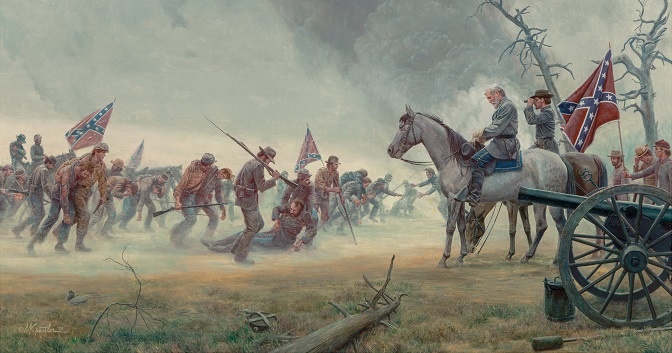
1. Note to future elected officials and politicians trying to weasel their way out of a fiasco of their own making: if you say “I take full responsibility,” then you can’t go on to blame anyone you can think of. The painting above, by artist Mort Künstler (b. 1931) is titled “It’s All My Fault,” and depicts the moment when General Robert E. Lee met his shattered troops after they had marched, under his orders, into Union artillery and Meade’s troops entrenched on higher ground, in the doomed “Pickett’s Charge” that ended the Battle of Gettysburg. “It’s all my fault!” is what he reportedly told his men. National leaders like President Biden, Hillary Clinton and former President Biden might well reflect on those words, which in my view justify remembering and honoring Lee all by themselves, as their supporters tear down Lee’s statues. (President Trump tried to protect the statues, but he has never emulated Lee in the matter of accepting responsibility either.) Their version of taking responsibility is to mouth “I take full responsibility” followed by a string of “buts” that translate into “It wasn’t my fault!” In the Biden version, you do this and then refuse to take questions (Like, say, “WHAT???) and jump on a plane to flee.

Yesterday, President Biden cynically used Harry Truman’s creed “The buck stops here” after blaming the Afghanistan debacle on President Trump and the Afghans themselves. Apparently in a competition with other media hacks for the boot-licking gold, Brian Williams said, on the air, that Biden’s speech wasn’t what it was (Rationalization #64). “He didn’t run from it, he owned it. He owned this decision. He owned the fact that, as he put it, the buck stops with him,” the exiled former NBC news anchor said. Since Williams has no credibility whatsoever, he has none to lose, but this was still stunning: not just a lie, but a Jumbo: “Excuses? What excuses?”

Continue reading

A Ripley! Believe It Or Not, Rep. Ted Lieu Is Even Worse Than You Thought!

believe-it-or-not

This is right up there with Robert Ripley’s discovery of “the Lighthouse Man,” a Szechuan eccentric who drilled a hole into his skull so he could carry a lit candle on his head to light the way through dark passages. After all, Ted Lieu (D-Cal) has already proven himself to be unbelievably awful, with a series of unbelievable statements (and I’m sure I’ve missed a lot). In 2018, for example, he told CNN host Brianna Keilar, among other things, “I would love to be able to regulate the content of speech.” Ethics Alarms named him the Incompetent Elected Official of the Month back in 2011, when he was just a humble State Senator. Naturally, by the consistent logic of California voters, this distinction meant he was ready for the big time, and should be sent to Washington. He was, and racked up two more Incompetent Elected Official awards and an Ethics Dunce. Lieu would be a legitimate feature in several Ripley strips: for example, he is not the dumbest member of Congress. Believe it or not!

He’s probably not the most unethical either, despite this news: Lieu contributed $51,046 to his alma mater, Stanford University, shortly before his son was admitted. Not only did he do this while the “Varsity Blues” celebrity college admissions scandal was being roundly condemned, but according to reports, the bribe was came out of Lieu’s campaign funds.

Continue reading

Ethics And Leadership Failure On Afghanistan, Part II: Signature Significance For An Untrustworthy Leader

Slow Joe

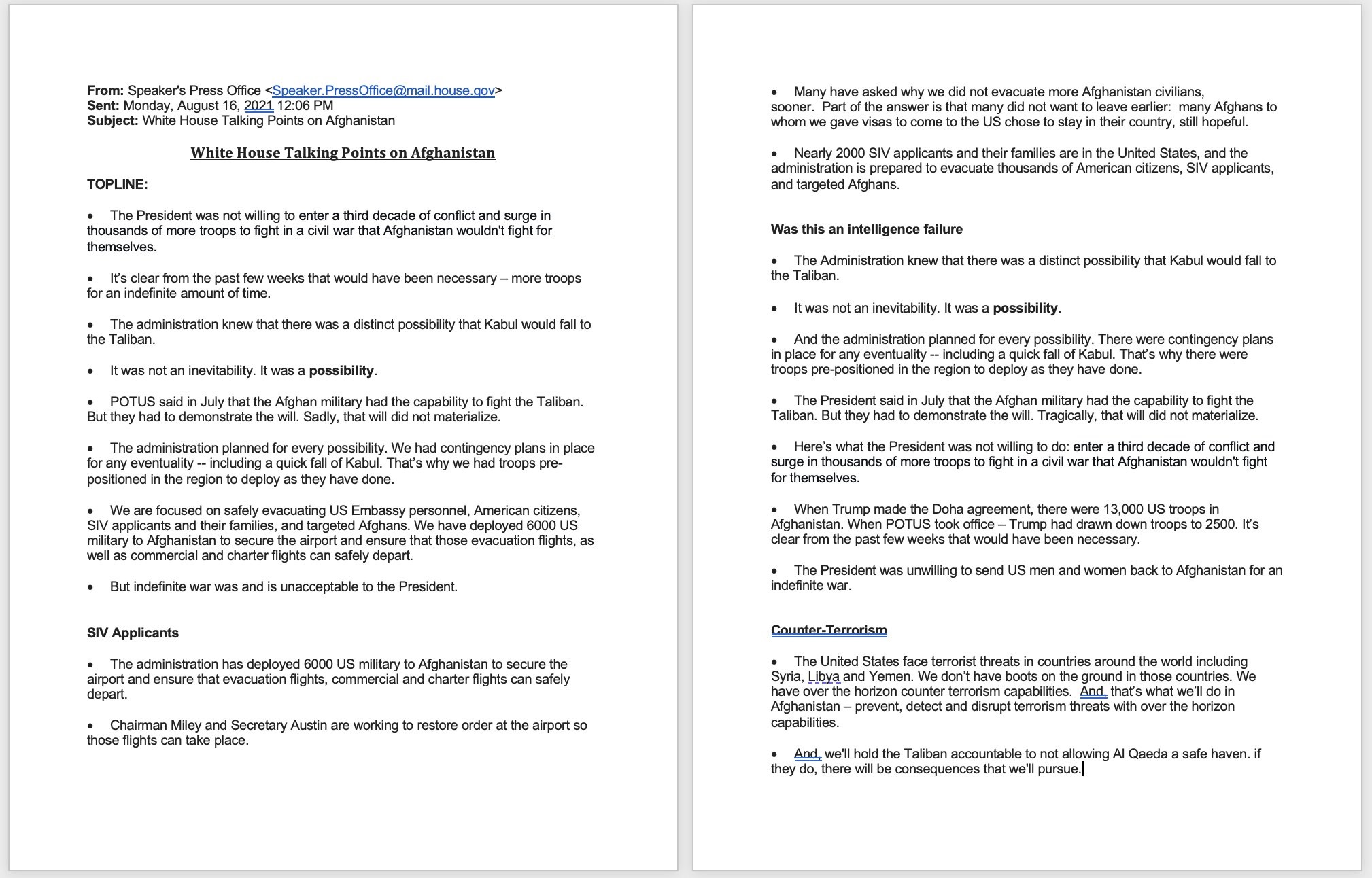
I waited before writing this until President Biden’s hastily prepared TV address \ to stop the metaphorical bleeding (but not the real bleeding in Afghanistan) as critics assailed him for going into hiding, a fair description. I shouldn’t have, and I should have been confident that what we heard was what we would hear: pure deflection. Nancy Pelosi’s leaked “talking points,” which emanated from the White House, told us what the plan was:

Talking points afgh

The issue isn’t whether it was a good idea to get out of Afghanistan, or that, as the President said, the U.S. shouldn’t get bogged down in 20 year wars in foreign lands. The issue is the astoundingly inept, weak and irresponsible manner in which this was handled, and the terrifying leadership deficit it signals.

Here are the markers:

Continue reading

Ethics And Leadership Failure On Afghanistan, Part I: In And Out

I’m not a foreign policy expert. (Is anyone a foreign policy expert?) so Ethics Alarms will go light on what “should” have been done by the U.S. in Afghanistan. The one thing I am unalterably convinced of now, as I was in 2001, is that the U.S. had to take strong military action against the Taliban after it aided and abetted Osama bin Laden. No nation can just shrug off a fatal, ambush attack on its citizens with a finger wag and a stern, “Now don’t do that again, or you’ll be sorry!”

Obviously staying twenty years in the pseudo-nation was way, way too long, expensive and costly in American lives, but dreaded mission creep set in. My approach after 9/11—and I think that of several past Presidents, including Eisenhower and Truman—would have been to strike hard, make sure as many military and government officials as possible were among the dead, accept the civilian casualties as unavoidable, and make sure that a properly frightening death toll—ten times what we lost on 9/11, perhaps, 30,000?—made the necessary point: “Don’t mess with the United States of America.” Once that message was delivered, get out. Colin Powell’s too often quoted nostrum that if you broke a country you were obligated to fix it should not have applied. Afghanistan was already broken; it was and remains a chaotic mess of warlords and medieval thinking supported by the heroin trade. Nobody can “fix” it. However, the Taliban was bad, and worst of all it oppressed women, so all of a sudden our objective became an ethical one, not retaliation but reform.

Continue reading

Sunday Ethics Picnic, 8/15/2021: Afghanistan Accountability And Suicide Ethics [Corrected!]

Vessel I

1. Giving credit where credit is due, at least some of the mainstream media isn’t avoiding calling attention to the Biden Administration’s epic debacle in Afghanistan. This is only a half IIPTDXTTNMIAFB: if Trump had done something even close to this incompetent, the news media would have been in full-fledged meltdown. In fact, there are enough harsh assessments coming from places that are not conservative mouthpieces that maybe Biden will face actual accountability for a change. (Nah, what am I saying?) CNN’s Jake Tapper, who occasionally has flashbacks to his pre-CNN days when he was a fairand trustworthy journalist, grilled Secretary of State Antony Blinken regarding Biden’s comments from last month, when he declared that it was “highly unlikely” the Taliban would overrun Afghanistan. That’s some intelligence work there, Joe! After some awkward huminahumina-ing, Blinken, kept trying to change the subject, defaulting to how everything was Trump’s fault. Amazingly, Tapper wouldn’t let him get away with it.

“You keep changing the subject to whether or not we should be there forever. And I’m not talking about that,” Tapper told Blinken. “I’m talking about whether or not this exit was done properly, taking out all the service members before those Americans and those Afghan translators could get out. That’s what I’m talking about. And then you have to send people back in. That’s the definition of, ‘Oh, we shouldn’t have taken those troops out, because now we have to send twice as many back in.'”

On Medium, political analyst John Ellis was on fire, writing in part,

“Handing over Afghanistan to the Taliban is President Biden’s idea, if that’s the right word, and his alone. It is terrible policy, on any number of levels. “Worse than a crime, a mistake” (Talleyrand’s phrase) describes it best. Axios reports that the Administration “derives comfort from the fact that the American public is behind them — an overwhelming majority support withdrawal from Afghanistan — and they bet they won’t be punished politically for executing a withdrawal.” Given events and the likely consequences, the fact that the Administration “derives comfort” from anything regarding its decision to hand over Afghanistan to the Taliban is nauseous. That they’re “betting” they will escape political punishment is perhaps more so….”

But that’s the routine, now. The Democrats count on the news media to minimize or hide their worst botches, so the public won’t know what’s going on and will keep on voting like good littel lambs. Other notes from Ellis:

  • “Abandoning the Kurds under Trump was bad enough. But this makes that look like home leave. This is an epic betrayal and strategically foolish to boot….
  • “…If you’re President Xi, you see Afghanistan, clearly, for what it is: a humiliating defeat for the United States. He might call it “flexible humiliation.” And what he knows from history is that defeated nations have little appetite for war in the immediate aftermath of losing one. Taiwan is there for the taking….
  • “When President Biden first announced that the US would be “leaving” Afghanistan, he set September 11, 2021 as the date when every last one of our people would be out. The announcement was greeted with astonished disbelief around the world. Could it really be possible that the US would officially hand over Afghanistan to the people who made it possible for Al Qaeda to attack it 20 years ago………on the very day of that attack? The answer was “yes,” although the Administration subsequently tried to walk it back without bringing attention to the fact that they were trying to walk it back.”

Ellis concludes, “Remarkably, the American press gave the president a pass on this, which seems to be its default setting when it comes to the Biden administration. “Trump was so much worse,” is the always-applicable rationale. Not in this case. Not by a long shot.”

Continue reading

Ethics Quiz: Shock Therapy For The Disabled

15electricshock-3-jumbo

Here is an issue from July that I never had time to write about…

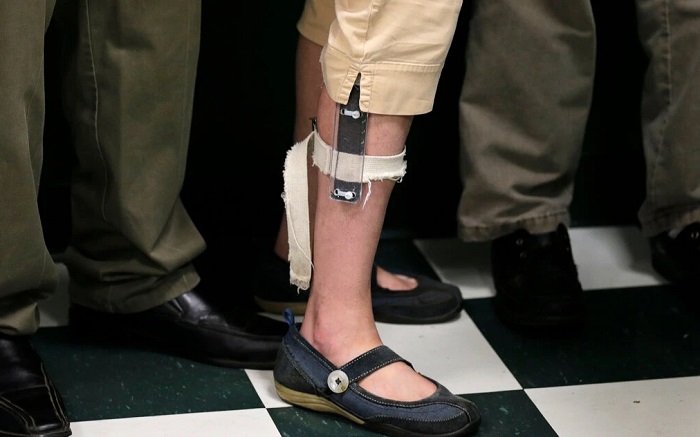
In a 2-1 opinion, the U.S. Court of Appeals for the D.C. Circuit overturned a Federal the ban on the use of electric shock devices to modify destructive or otherwise problematic behavior by students with intellectual disabilities. The Food and Drug Administration sought to prohibit the devices in March 2020, saying that delivering shocks to students presents “an unreasonable and substantial risk of illness or injury.” The court ruled, however that the ban was a regulation of the practice of medicine, which is beyond the FDA’s authority.

The now banned ban only affected a single school, the Judge Rotenberg Educational Center in Canton, Massachusetts. It is the only facility in the United States that employs the shock devices to correct self-harming or aggressive behavior. The center serves and houses both children and adults with intellectual disabilities or behavioral, emotional or psychiatric problems.

What ethics approach do we use to assess such a practice?

Continue reading

Oh, Good…A Non-Political Reason To Avoid Saturday Night Live

Sanz and Fallon

It’s a sad truth, at least for me: the more you know about comedians and comics, the harder it is to laugh at them. There are notable exceptions of course (and as always): Martin Short, John Candy, Carol Burnett and a few more apparently are or were genuinely nice and relatively normal human beings. As a rule, however, extraordinary comedy talent is nourished by misery and emotional pain, and misery and emotional pain have a strong tendency to produce broken, sick, untrustworthy people.

For a lot of audience members, this isn’t a problem. For me, it is. I love great comedy, I’ve directed comedies, I’ve written comic scripts, revues, parodies and essays, and I’ve performed comedy. But once I learn that a comedy genius was or is a horrible human being, or acts like one sufficiently frequently not to be trusted, I just don’t enjoy watching and listening to that performer any more. The list of those who have landed on my “Can’t Make Me Laugh List” is too long to compile, and I really don’t care to encourage debates about whether it should matter that Charlie Chaplin was sexually attracted to little girls, or that Danny Kaye was a cruel misanthrope. It matters to me.

There are a few compensating advantages of this mindset, though. I haven’t watched a single minute of Saturday Night Live for so long I don’t even remember exactly when I started finding the show repugnant after years of never missing an episode. The reason I stopped watching was the show’s increasingly smug political bias that began to swallow the satire whole. I know it was somewhere around the George W. Bush presidency. (I had a similar experience then with David Letterman and The Daily Show.) SNL’s conversion into a full-time shill for progressives and Democrats became especially nauseating when it became addicted to using left-wing thug Alec Baldwin as a guest. There is no one on Earth I hate enough to find Alec Baldwin mocking him or her funny, and when it comes to Baldwin’s Trump impression, only the biases of Saturday Night Live directors and audiences can explain its popularity. As a director, I’d consider his amateurish routine unacceptable in a Cub Scout skit.

Fortunately, a recent emerging scandal looks like it will give me a new reason to detest the show that has nothing to do with politics.

Continue reading

Saturday Afternoon Ethics Breezes, 8/14/2021: Weenies, Suckers And Fools

1. Ethics Quote of the Week? I’d say it’s rebel progressive and former Rolling Stone pundit Matt Taibbi in “The Vanishing Legacy of Barack Obama.” (Of course, Obama’s real legacy, toxic racial division in America, hasn’t vanished at all, more’s the pity.) Taibbi writes,

“Obama was set up to be the greatest of American heroes, but proved to be a common swindler and one of the great political liars of all time — he fooled us all. Moreover, his remarkably vacuous post-presidency is proving true everything Trump said in 2016 about the grasping Washington politicians whose only motives are personal enrichment, and who’d do anything, even attend his wedding, for a buck. Trump’s point was that he, Trump, was already swinishly rich, while politicians have only one thing to sell to get the upper class status they crave: us. Obama did that. He sold us out, and it’s time to start talking about the role he played in bringing about the hopeless cynical mess that is modern America.”

Were Matt and his fellow progressives really fooled that badly? Wow. Times Queen of Snark Maureeen Down, like Matt writing about Obama’s deliberately offensive birthday bash, what Taibbi calls his “Fuck it moment,” writes,

“The party crystallized the caricature of the Democratic Party that Joe Biden had to fight against in order to get elected. It was as far from Flint and Scranton as you can imagine: an orgy of the 1 percent — private jets, Martha’s Vineyard, limousine liberals and Hollywood whoring — complete with a meat-free menu. The disinvitados, as one referred to them, were in four camps: Some didn’t care; some pretended they didn’t care; some were annoyed; and some were deeply hurt, especially loyal former staffers who felt they had contributed more to the Obama legacy than the likes of George Clooney, John Legend and Don Cheadle.”

Continue reading