Addendum To “An Ethics Conflict Conundrum: The Fraudulent Friend”

Apparently my choice of words confused some readers when I wrote that once “The Ethicist’s” inquirer in this post was made aware of a serious fraud (and an ongoing one) perpetrated by a close friend, she had become an accessory after the fact. That’s a legal term of art and I was careless to use it in nontechnical context. Almost no one is ever charged as an accessory for not blowing the metaphorical whistle, but the woman nonetheless shared responsibility for the harm done by the ongoing fraud by knowing about it, having the ability to stop it, and not doing so, thus letting it continue.

The duty she breached was an ethical one, not a legal one. As I said, I should have been clearer.

I am reminded of a personal experience that might clarify the issue further. I may have even related this story in another post; if so, I can’t find it, and it is worth repeating.

A lawyer friend contacted me for advice. He had been meeting with a client at the client’s home, and overheard, in the kitchen, a loud argument between his client and his wife culminating in what sounded like a hard punch in the face, the woman crying out in pain, and someone falling on the floor. My friend said he had said nothing, but was increasingly bothered by what he heard.

Continue reading

Dear Proudly Obese Lady: It Is Not Everyone’s Obligation To Solve Your Problems

I hate to be unkind, but this is a Popeye if I ever there was one.

Jaelynn Chaney (above) is a fat positivity activist, which is jake with me, sort of, if I apply the “its not the worst thing” rationalization. (Maybe Bud Light will put her on a beer can, if possible.) However, she is now demanding, via a Change.Org petition, that the rest of us pay to make it easier for her (and her not quite as obese love-bunny to fly on commercial airlines.

Poor Jaelynn! As she writes in her repetitious and ungrammatical introduction to her demands,

Air travel should be comfortable and accessible for everyone, regardless of size. As plus-size travelers, my partner and I have unfortunately experienced discrimination and discomfort while flying. During a flight from Pasco to Denver, my fiancé was subjected to hateful comments, disapproving looks, and even refusal to sit next to them, amounting to discrimination. Similarly, on another flight, I was forced to occupy only one seat with immovable armrests that caused me pain and bruises. Being forced to occupy only one seat can result in pain and vulnerability to poor treatment from fellow passengers, including hateful comments, disapproving looks, and even refusal to sit next to them. This mistreatment of plus-size passengers is unacceptable, and it highlights the urgent need for better policies that protect the dignity and rights of all passengers, regardless of size. Unfortunately, plus-size passengers often experience discomfort and discrimination when flying. The lack of a uniform customer-of-size airline policy is unacceptable and must be addressed.

Continue reading

An Ethics Conflict Conundrum: The Fraudulent Friend

From “The Ethicist” (that’s the New York Times Magazine’s ethics advice columnist, his name is Kwame Anthony Appiah, and he’s not bad) comes a new version of an eternal ethics conflict that I have encountered both hypothetically and in life:

My friend told me that she and her husband, who combined earn around $500,000, asked their son’s stepmother to declare him on her taxes for the last two years so that he could get more financial aid for college. Their son doesn’t even live with the stepmother, and she provides no support.

I just learned that her son is now getting a full grant to a very expensive private college. I’m supposed to take a weekend trip with my friend in a few weeks, but I’m so angry about this I don’t know if I can speak to her. Is this fraud? What is my responsibility in this situation?

“The Ethicist” waffles and settles on,

Continue reading

Great Moments In Unethical Polling Manipulation: Grinnell College On “Gender-Affirming Care”

We should expect activists, politicians and journalists to engage in rampant deceit in their use of language to confuse and mislead the public. The abortion debate, a complex and ethically crucial societal controversy that requires clarity and honesty, has been just about permanently distorted by the routine use of deliberately deceptive cover-terms “pro-choice” and “pro-life.” One should we able to rely on educational and research institutions to be careful to avoid this malady, but as polls prove repeatedly, we can’t.

Continue reading

Unethical Quote Of The Month: Yale Junior Bianca Nam

“Some arguments aren’t worth engaging with, and quite frankly are dangerous for even existing. ..The burden is not on us to talk our mouths dry and educate others, and frankly it is past the point of being an intellectual challenge. It’s an insult to our personhood, experience and rights to have to hold some of these “debates.” …Abort the conversation.”

—Yale Daily News columnist Bianca Nanin her essay rejecting the concept of civil discourse and debate among students on issues she has made up her mind regarding what the “right” answer is.

20 years old, after nearly three years of education at one of the nation’s elite institutions of higher learning, and this is what Bianca Nan has learned. Not only is she and her ideological clones right about a wide range of political and social issues, but it is a waste of time to even listen to differing views and debate their validity, because such points of view are inherently dangerous and not worthy of debate.

What issues does she consider so settled and self-evident to right-thinking people that her virtuous and superior viewpoint cannot and should not be challenged? Not just abortion, though that is certainly one: she writes,

Continue reading

Comment Of The Day: “The Trouble With ‘Do Something!’ Part II”

Saturday is a ghost town on Ethics Alarms these days; I’ve decided to stop obsessing about it, and blog traffic generally, other than with occasional rueful observations like this one. Despite the lack of quantity, Saturday often produces a disproportionate level of high quality commentary and Comments of the Day, such as JutGory‘s observations on the “Do something!” conundrum. I was particularly charmed by his preface, which represented a microcosm of the eternal “Do something” vs “Do nothing” conflict:

“Been going back and forth all day (appropriately, perhaps) about whether I should comment or not). Eventually, the inclination to comment won out, because I think it will do some good. However, my hesitation is based upon the effort it would take to frame a fully organized and coherent response. So, having abandoned that as a goal, there is no reason not to comment.”

Here is JutGory’s Comment of the Day on the post, “The Trouble With “Do Something!” Part II: Applying The Scale.”

***

First off, a few first principles when it comes to action and inaction:

“The only thing necessary for the triumph of evil is for good men to do nothing.”Edmund Burke (attribution may be disputed)

“The only thing necessary for the triumph of good is for evil men to do nothing.” -JutGory

“All human action is aimed toward some good.”Aristotle (heavily paraphrased opening lines from the “Nicomachean Ethics”)

“All of humanity’s problems stem from man’s inability to sit quietly in a room alone.”Pascal

The inclination to “do something” is natural because we all view our actions as good and we don’t want to stand by while evil people are causing trouble.

The problem with this mindset is that good people and evil people are often equally stupid.

The people who killed Emmett Till thought they were carrying out some good and they did not want to be one of those good people who did nothing.

Nazis too.

Freedom Riders.

Tea Party Members.

Along with the laundry list of protesters, strikers, and saboteurs.

Continue reading

San Francisco Spin, Brought To You By The Great Stupid: “Since Bob Lee Wasn’t Murdered By A Drug Addict, Homeless Person Or Coddled Criminal, The City Is Safe After All, So There!”

It’s come to this.

San Francisco is one of many irrationally woke cities falling apart in chunks because of “social justice” policies that encourage crime, make responsible citizenship difficult, and devastate local businesses. “The City by the Bay” is a particularly depressing case study in the nationwide phenomenon, with the city’s most storied locations marred by human feces, discarded drug paraphernalia, and obstreperously entitled homeless. Meanwhile, businesses are fleeing because shoplifting has become epidemic.

When Bob Lee, the former chief technology officer of Square and one of the founders of Cash App, was stabbed to death ten days ago, his high-profile murder was pointed to by social media critics and conservative pundits as more evidence of San Francisco’s decline as its culture embraces progressive cant over the lessons of civilization. Ah, but this week a rival tech entrepreneur was arrested for the murder, prompting the city’s defenders–and the defenders of its bonkers policies— to launch into one of the most bizarre victory laps ever conceived.

Continue reading

Weekend Ethics Round-Up, April 15, 2023: Remember Jackie Robinson!

April 15 is one of the more momentous dates in history, and not just history, but ethics history:

  • Abraham Lincoln died in the early morning hours of April 15, 1865, after being shot in the head by John Wilkes Booth.
  • ” The Titanic” sank in 1912, killing more than 1500 passengers and crew, with almost too many ethics-related episodes to count, from the head of the White Star lines grabbing a seat in a lifeboat while many of America’s rich and famous stayed on board to allow “women and children first,” to the negligence and hubris that led the ship’s owners and captain to allow an inadequate number of life boats, to the so-called “mystery ship” that ignored the “Titanic’s” calls for help while the captain of the “Carpathia” risked his own vessel to race to pick up survivors, and much more, the disaster is one of the richest subjects for ethics discussions of all.
  • The Boston Marathon bombing occurred in 2013, as two Muslim brothers planted pipe bombs that killed three of the assembled spectators while injuring 260, many of whom lost limbs. The young men acted, it is now believed, entirely on their own, motivated by “extreme Islamic beliefs.”

The greatest ethical impact of all on this date, however, may have come from Jackie Robinson breaking baseball’s apartheid in 1947 by stepping onto Ebbetts Field in Brooklyn and ending 50 years of discrimination in the sport, while establishing an advance in civil rights generally that propelled the crucial movement forward. You know all about Jackie, don’t you? You should; so should your kids, grandchildren, sisters, cousins and aunts. He’s enshrined in the Baseball Hall of Fame, and also in the Ethics Alarms Hall of Heroes as an Ethics Hero Emeritus.

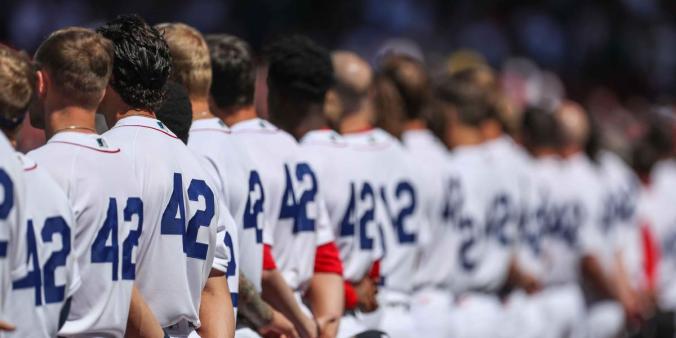
Today was Jackie Robinson Day around the MLB ballparks, with every player wearing Robinson’s retired uniform number, 42.

1. What the heck is going on at Newton North High School? Last month, as discussed here, the once-celebrated Boston area high school, got caught racially segregating auditions for the school play, telling white students that their talents were not needed. This month, the same school hosted “Missy Steak,” a drag queen, as she spoke to and sang to students in a 30-minute assembly celebrating of “Transgender Bisexual Gay and Lesbian Awareness Day.” The Boston news media seems to think it is decisive that more supporters of promoting non-conventional sexual behavior in school showed up than protesters. After all, ethics is based on “majority rules,” right?

I see no competent or responsible argument for any sexual behavior to be promoted as part of public education, other than essential law and ethics.

2. What? Justice Alito didn’t automatically side with the radical, loose cannon judge trying to ban abortion pills approved by the FDA? The New York Times reports:

Justice Samuel A. Alito Jr. issued an order on Friday temporarily ensuring that a common abortion pill would remain widely available while the Supreme Court considered whether to grant the Biden administration’s emergency request to preserve the Food and Drug Administration’s approval of the drug.

The order was meant to maintain the status quo while the justices studied the briefs and lower court rulings, and it did not forecast how the court would ultimately rule in the most important case about access to abortion since its conservative majority overturned Roe v. Wade last June.

Justice Alito set a brisk schedule for the court’s consideration of the case. His order, an administrative stay, instructed the groups challenging the F.D.A.’s approval of the abortion drug, mifepristone, to file their brief by Tuesday at noon.

The stay itself is set to expire on Wednesday at midnight, meaning the court is very likely to act before then and could in the coming days further curtail access to abortion, even in states where it is legal.

Justice Alito did this because, though he is probably the most conservative member of the Supreme Court who shouldn’t have resigned by now, he still is a competent jurist who knows garbage judging when he sees it. There is no way that Judge Matthew Kacsmaryk‘s unethical ruling will stand; nevertheless, Times SCOTUS reporter Adam Liptak couldn’t resist implying that a judicial restriction on abortion is in the wind. This is pure fear-mongering and partisan manipulation of public opinion.

3. Speaking of the Honorable Judge Kacsmaryk, the Washington Post revealed that as his Senate confirmation hearings for Federal judge approached, he had his name scrubbed from a law review article he had submitted. As part of the confirmation process, Kacsmaryk was required to list all of his published work on a questionnaire submitted to the Senate Judiciary Committee, including “books, articles, reports, letters to the editor, editorial pieces, or other published material you have written or edited.” The article, titled “The Jurisprudence of the Body,” was published in September 2017 by the Texas Review of Law and Politics, a conservative legal journal that Kacsmaryk had edited as a law student at the University of Texas. But he did not l list the article for the Senate, obviously feeling his views in it might endanger his confirmation.

He should resign too.

The Trouble With “Do Something!” Part II: Applying The Scale

As is often the case, baseball led me to an epiphany regarding the recent “Do something!” mania. Bill James, in the 2023 Bill James Baseball Handbook, was discussing the how the tactic of the intentional walk—when a manager orders that an opposing batter be avoided and placed on first base on the theory that the lesser risk is facing the batter after him, even though placing another potential run on base tempts fate—has become increasingly rare, when once it was very common. James writes that this was a bad gamble all along (except in rare situations, like when a team’s best hitter has its worst hitter batting behind him) but was popular because managers and coaches in all sports overuse strategies that “give them control over the flow of action.”

“It’s human nature,” observes James. “It happens in all offices, all businesses. Managers over-manage because letting events take their course feels risky.”

Of course! Upon reflection that seems self-evident, but because I am slow, apparently, I never quite framed it that way in my mind before. Leaders think like managers, and the populations they lead identify assertive action with strong leadership and letting matters take their course with weakness. In truth, deciding that the best course is to do nothing is just as much a proactive decision as “doing something,” and often a more courageous one. But there it is again: human nature. The applicable Ethics Alarms motto is “Human nature is the ultimate pre-unethical condition.”

Continue reading

And Just Think: Abe Lincoln Wrote The Gettysburg Address All By Himself On The Back Of An Envelope…

Hey, it’s only money!

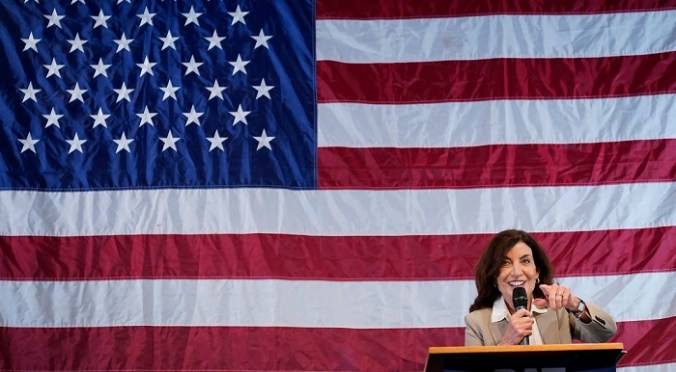
The New York Times today reveals that New York’s governor Kathy Hochul spent about 2 million dollars to outside consultants for help in preparing her 2022 and 2023 “State of the State” speeches. Apparently no previous governor had done that, or anything close: they relied on their staffs for speech ghostwriting.

The extravagant expenditure cannot be justified, though even as the Times exposes it, the paper tries to rationalize Hochul’s waste of taxpayer funds, emphasizing repeatedly that “the speech is among the most significant a governor delivers each year, laying the groundwork for months of negotiations and browbeating over the executive budget and other priorities.” Sure. It’s a speech. It’s not a contract, and what a governor says in it doesn’t commit her to anything, nor is anyone likely to remember what she said within a week of its delivery (especially the way Hochul talks). To be fair to the Times, Hochul is a Democrat, and the Times sees its job as protecting the party, even as the paper reports on inconvenient facts. When it chooses to….

Paying 2 million bucks for help on two speeches not only indicates unseemly insecurity in an elected official, it demonstrates no respect for budgets, priorities, or the public’s hard-earned tax payments. The consultants who got the job also were recipients of non-bid contracts. (Heck, I would have written one of those speeches for some Red Sox -Yankee tickets!)

The arrogance of our current class of elected leaders is a disfiguring blotch on the face of democracy, one that will only get uglier until voters hold them accountable for displays like Hochul’s.