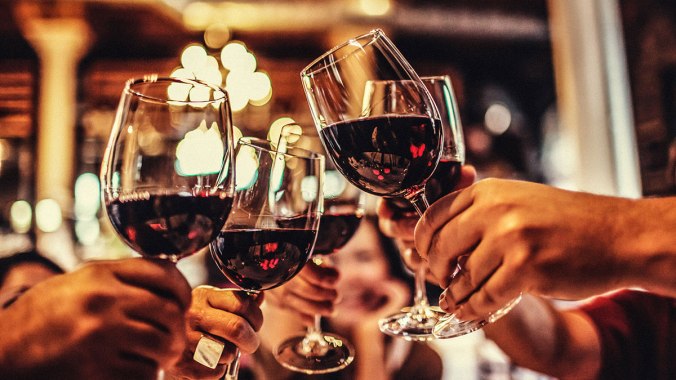
Eric Boschman, once named Belgium’s best sommelier (that’s wine steward in English), now an entertainer, and the team at On n’est pas des pigeons, a Belgian consumer magazine and television program, bought a cheap supermarket wine and entered it at the prestigious international wine competition, Gilbert et Gaillard. To try to fool the experts with a wine that cost less than three bucks, they made up a name for the swill, calling it “Chateau Colombier,” and designed a phony label. They told the judges that it was made from rare grapes in Côtes de Sambre and Meuse (wherever they are). Along with the entrance fee and samples of the wine for tasting, the tricksters provided fake laboratory data of the acidity, alcohol and sugar levels borrowed from a genuine prize-winning wine. Boschman, meanwhile, praised the wine as exceptional to fellow sommeliers and wine enthusiasts, attempting to seed confirmation bias.
And it worked! The supermarket wine won the gold medal, with judges describing it as “suave, nervous (a quality of fresh wine) and rich palate with clean young scents that promise a nice complexity, very interesting.”
As with the wags who submit fake research papers to “peer-reviewed” scholarly journals, this wine charade was dishonest, but I will give it a utilitarian pass for exposing a process that has too little integrity to be trusted, for the benefit of consumers.
Of course, I say this as someone who couldn’t tell a real fine wine from a class of motor oil.
______________
Source: Oddity Central
 Ethics Alarms
This kind of trick has been done many times over.
Yes, it is dishonest (by design). But, it highlights two important things: 1) when it comes to wine, drink what you like (to the right palate, a $15 bottle of wine is as good as a $200 one); and 2) bias pervades everything.
In that sense, it should not surprise anyone how peer-reviewed journals can be fooled. If you are not dealing with “real science,” (did I really just type that), peer review is practically meaningless (just slightly better than a wine review (at least studies have statistics and methodology to review, unlike professional winos, I mean, sommeliers).
Einstein, Planck, Fermi, Bohr, Schrodinger, Maxwell, Copernicus, Darwin? You can’t dress up their research to pass peer review. For instance, for Einstein, you just do the math. It either checks out or it doesn’t.
-Jut
Agreed. A good wine is one you enjoy.
In fields where accuracy matters, this is done routinely. Fake samples are submitted to labs, sometimes with misleading information, to see if the results will match the actual sample. This is typically done with analytical chemistry labs, but not those that only deal with forensic evidence.
The owner of the fast-food restaurant I worked for in high school used to do this. He would give his friends and acquaintances money, a description of what they were supposed to order (drive through or lobby) and a stopwatch. They filled out a report on the time and quality of the food, as well as the courteousness of the service.
The latter are the genesis for mystery shoppers. It makes sense to have a relatively objective observer to check the quality of your product, in this case the speed and customer service of the store.
This is depressing. I enjoy decent wine and have a reliable source for good, reasonably priced wines. I doubtless pay the guy a premium but it’s like buying insurance. The wines are invariably good. Most all wine sold is priced below twenty bucks a bottle, and yes, there’s always Two Buck Chuck. But frankly, I think it’s unfortunate that the vast majority of wine drinkers have never tasted decent wine and have no idea how unpalatable the stuff they put up with is.
I’m with Ben Franklin: The quote originally came from a letter that Franklin wrote to his friend André Morellet while he was in France. He stated, “Behold the rain which descends from heaven upon our vineyards, and which incorporates itself with the grapes to be changed into wine; a constant proof that God loves us, and loves to see us happy!” (Personally, I’d say the same thing about good, loving, monogamous sex.)
Just had a flyover here at the house in Phoenix by a formation of four WWII vintage trainer biplanes (I’m assuming they’re Stearmans) in their bright yellow and blue livery. Lots a pilots trained in Arizona during the war, and I know about 80,000 U.S. airmen were killed while doing strategic bombing from England. And who knows if it even worked. An unimaginable sacrifice.
A C-47 just flew over. Remembering my HS English teacher’s husband who retired as a check pilot for Pan Am after having flown The Hump in WWII. And my mother’s cousin who was an ambulance driver in India and killed when the plane he was flying in was shot down by the Japanese. And my son in law’s uncle Mike killed in Vietnam, as well as a neighborhood kid my brother’s age, Steve Gomez killed in Vietnam shortly after graduating from high school.
I often wish I had a more discerning palate. But I just don’t recognize many of the tastes and smells in wine that allegedly make one bottle worth/cost more than another. [I blame bad allergies] While I don’t walk around slugging Mad Dog, I am very content with a $15 bottle [or two]
I mean, in the end, what the hell do I know?
This sums up my wine tasting prowess:
https://www.gocomics.com/reallifeadventures/2010/02/27
Happy Memorial Day
$15 is a very comfortable price point for many. As with many things the question of “if it worth it?” comes to mind. At what point is the quality not worth the price? For every individual it’s going to be different. One of my favorite Chardonnays has a screw cap and is about $15.
To quote Alan Young in his book “Making Sense of Wine Tasting”:
The marketing side of the international wine industry thrives and drives on lies, lies and more damned lies.
Yes, those hints of caramel, pecan, black cherries …I have often suspected that a lot of it is snobbish baloney to manufacture elite cliques drive sales. The Emperor’s New Clothes, wine edition.
This type of thing has happened in the past. Often in an informal way at wine events. Price is no guarantee of quality.
As someone who has some wine training (judging not serving) I am curious about the judging process. I may be told “These are all Chardonnay” or “These are all Sauvignon Blanc from New Zealand”. I’m not given any scientific or winery information. I have to judge it based on the characteristics of that grape. I don’t know who submitted it.
For wines whose varietal I’ve never had, I have specific criteria. Never had Baco Noir before? I have to score on very specific scale. It might be judged with other similar wines.
But, like every organization *cough* Olympics *cough* Grand Court of Sommeliers *cough* the world of wine is open to influence, greed, and cronyism.