Ethics Quiz: “Erica Marsh” [Corrected]

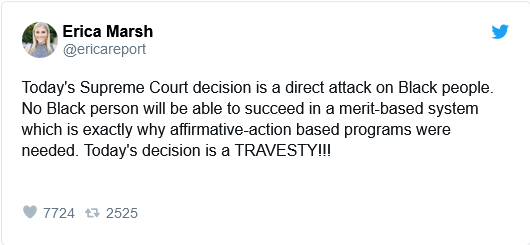
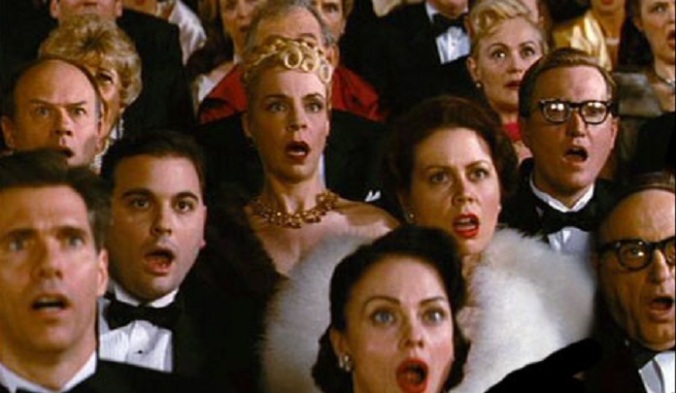
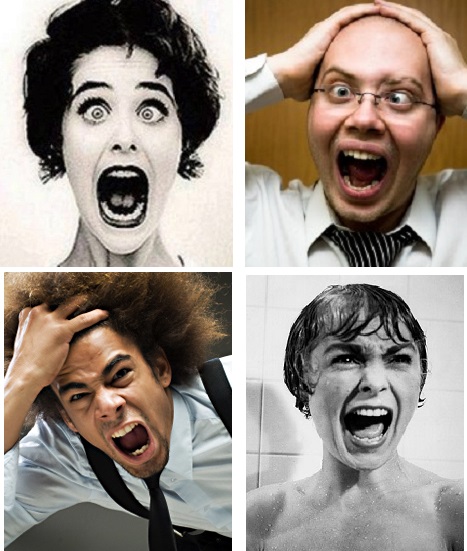
The tweet above has “gone viral” with its seemingly approving statement of the underlying arguments being raised in protest of yesterday’s SCOTUS decision ending affirmative action in universities. Conservative pundits and wags are using it to mock the hypocrisy and racism of progressives, some apparently believing the tweet is sincere, others believing it is satire but treating is as genuine anyway. The low-IQ quadrant of Woke World like the tweet because its denizens can’t detect its glaring idiocy; the smarter segment is outraged at the tweet’s blood-drawing power, and reacting like this:

Before I pose today’s ethics quiz question, here are a few things to consider:
Continue reading

The Affirmative Action Demise Freakout

In some respects the Left’s reaction to Students For Fair Admissions, Inc. v. President and Fellows of Harvard College is more disturbing, if less hysterical, than its response to the elimination of Roe v. Wade. The near complete disregard for Constitution and the principles it represents being displayed is stunning, and a warning. Robert Kennedy, Jr., who may be a wacko regarding vaccinations but who is as about as representative of the current state of the Democratic Party and Woke World as an individual can be, was usefully specific, tweeting,

“Regarding the Supreme Court banning affirmative action in higher ed — I know many Americans feel that purely race-based decisions are unfair. However, this feeling misses important context. The effects of racist policies going back centuries are now self-perpetuating. Affirmative action understands this and uses race-based policies to undo the effects of racist policies. ‘Color-blind’ admissions tend to favor those who are already in the circle of privilege. It favors those who grew up in affluent, educated households. Wouldn’t you like to invite in those who have been left out in the cold?”

And there it is. “It’s  okay, in fact the right thing to do, to deliberately violate the Constitution and ignore U.S. law if it serves ‘the greater good’ and our judgment regarding the needs of social justice.” That has become the entire operating philosophy of the Democrats. It can be seen as one that would open the door to unlimited totalitarian abuses. This is why the First, Second and Sixth Amendments, the Equal Protection Clause, Due Process and the entire Constitution itself are under sustained attack to undermine it in the eyes of an ignorant public we allowed to grow to adulthood without ever being adequately educated about the importance of the Founding documents. Bobby Jr. explains: if Constitutional restrictions favor the “wrong” people, then to hell with the Constitution. The direct line from his reasoning to government censorship of speech should be obvious (but since the news media won’t draw that line, or is too inept to do so clearly, it won’t be to the dim Americans who need to see it most.

RFKJ’s last argument, “Wouldn’t you like to invite in those who have been left out in the cold?” is a another classic hide-the-ball, bury-the-lede, “its isn’t what it is” con. He is really asking the tribal interests that support his party, “Wouldn’t you like to have a fist on the scales giving your race/ethnicity/sex a permanent advantage in everything you do?

We should be grateful to Kennedy for being comparatively honest. President Biden, who hasn’t read the decision, had the gall to say, “This isn’t a normal Court,” again darkly suggesting malign intent—from its enforcement of the Constitution, its duty. Journalists and pundits are giving us a vivid picture of what we can expect in the upcoming election campaign with deceptive, misleading or written-for-morons headlines like:

Continue reading

This Is How The Dean Of Berkeley Law School Teaches Ethics To His Students…

Nice. Violate the law, ignore basic fairness, and honesty, but as long as you don’t tell anyone and can’t be caught, it’s okay.

Chemerinsky is a well-established partisan hack whose legal commentary is almost always polluted by his leftist agenda, but this was low even for him. Do you ever wonder where unethical lawyers come from?

Classes like his.

And professors like him. Yale Law School’s Dean, Georgetown Law Center’s Dean, and others supposedly overseeing the training of tomorrow’s legal professionals have similarly made it clear with their actions and words that ethics are secondary to their political and social agendas. None have done so quite as flagrantly and smugly as Chemerinsky, however.

From The Pro-Abortion Side, An “It Isn’t What It Is” Spectacular!

The advocacy for abortion has always relied heavily on Rationalization #64, “Yoo’s Rationalization” or “It isn’t what it is;” indeed abortion is one of the unethical tactic’s most prominent domains. For abortion isn’t a matter of “choice,” but rather a controversy over when and to what extent society should tolerate the killing of one human being (or millions) for the benefit of another. Calling the issue “a woman’s choice” is deliberate obfuscation.

Democratic Rep. Rosa DeLauro of Connecticut—and I will wrestle my hands to the floor to avoid typing some obvious and well-deserved characterizations of the woman—recently made the head-exploding argument that abortion was squarely supported by the moral teachings of the Catholic Church.

No, she really did. I’m not making this up! This was stated on social media by an elected official who is obligated to uphold the public trust. Here’s Rose:

Continue reading

From The “Res Ipsa Loquitur” Files

Analyzing this would be like shooting dead fish in a barrel, but by all means, go ahead if you want to.

SCOTUS Strikes Down Harvard’s Affirmative Action Admissions Policy

Good.

Much about this was predicted and predictable: the split, 6-3, in which the diversity trio (A wise Latina, the historic black woman, and a lesbian) took their required stand, and the decision’s spokesjustice, Roberts, who had signaled this result by famously saying, last time around this controversy, “The way to stop discrimination on the basis of race is to stop discriminating on the basis of race.” However, many thought the opinion would ultimately provide wiggle room for colleges, and it does not. From the opinion, here, by Chief Justice Roberts, who reflected on Justice Sandra Day O’Connor’s observation in a previous affirmative action case that “25 years from now, the use of racial preferences will no longer be necessary to further the interest approved today” (which signaled that the Court was allowing an exception to Constitutional requirements continue for a limited period):

Twenty years later, no end is in sight. “Harvard’s view about when [race-based admissions will end] doesn’t have a date on it.” Tr. of Oral Arg. in No. 20–1199, p. 85; Brief for Respondent in No. 20–1199, p. 52. Neither does UNC’s. 567 F. Supp. 3d, at 612. Yet both insist that the use of race in their admissions programs must continue.

But we have permitted race-based admissions only within the confines of narrow restrictions. University programs must comply with strict scrutiny, they may never use race as a stereotype or negative, and—at some point—they must end. Respondents’ admissions systems—however well intentioned and implemented in good faith—fail each of these criteria. They must therefore be invalidated under the Equal Protection Clause of the Fourteenth Amendment….

It is true that our cases have recognized a “tradition of giving a degree of deference to a university’s academic decisions.” Grutter, 539 U. S., at 328. But we have been unmistakably clear that any deference must exist “within constitutionally prescribed limits,” ibid., and that “deference does not imply abandonment or abdication of judicial review,” Miller–El v. Cockrell, 537 U. S. 322, 340 (2003). Universities may define their missions as they see fit. The Constitution defines ours. Courts may not license separating students on the basis of race without an exceedingly persuasive justification that is measurable and concrete enough to permit judicial review.

I particularly want to applaud Roberts’ clear statement that the use of “diversity” by colleges to justify discrimination is undefined, pie-in-the-sky hooey, if not outright flim-flammery:

Unlike discerning whether a prisoner will be injured or whether an employee should receive backpay, the question whether a particular mix of minority students produces “engaged and productive citizens,” sufficiently “enhance[s] appreciation, respect, and empathy,” or effectively “train[s] future leaders” is standardless. 567 F. Supp. 3d, at 656; 980 F. 3d, at 173–174. The interests that respondents seek, though plainly worthy, are inescapably imponderable.

Later, the Chief chides Harvard et al. for the obvious phoniness and arbitrary nature of their categories:

Continue reading

Ethics Quote Of The Month: John W. Jenkins

“The University defends the truth,” says the Harvard logo. ‘The emblem shows respect for science, using only verified facts within the University’s walls and a willingness to defend the truth.’ Yet as it relates to climate change, the University has set aside obvious truths and brought together its five professional schools supporting the new “Save the Planet” religious dogma of the past decade.”

—Harvard M.B.A John W. Jenkins, in a letter to the alumni magazine protesting the University’s complicity in promoting “imprudent policies perpetuated on our populations by Green environmental activists whose view of history is only 20 years deep.”

Jenkins, whom I have thus far not succeeded in contacting, has authored one of the clearest and most persuasive debunking of current climatic change cant, and perfectly chastised our mutual alma mater, Harvard, for its cowardly and irresponsible alliance with an unethical and destructive movement. The author appears to be in his late eighties, and more skilled in communication than graduates half, indeed a quarter his age.

Harvard Magazine published his letter, but I am trying hard to believe it was a coincidence that its second half was difficult to locate due to a pagination error. I hope Mr. Jenkins does not mind Ethics Alarms re-publishing his entire statement. It deserves to be seen by as many people as possible. The whole thing is an Ethics Quote of the Month. Here it is:

Continue reading

A Student Wrongly Accused Of Rape Can Seek Damages From His Accuser, And Rightly So

Maybe this case helped convince Donald Trump that he should sue E. Jean Carroll, the victorious plaintiff in the sexual assault case against him, for defamation.

The Connecticut Supreme Court ruled 7-0 that a former Yale student is not immune from being sued for defamation by the male student she accused of raping her. Saifullah Khan was found not guilty in a criminal trial of raping “Jane Doe” in her dorm room in October 2015 in what Khan insisted, and a jury agreed, was an incident of consensual sex. Yale had expelled Khan using the “preponderance of the evidence” standard forced on educational institutions by the Obama Department of Education.

The court determined that because Khan had fewer rights to defend himself in university proceedings, which, again prompted by the Obama administration, provided limited due process protections, his accuser should not benefit from the civil immunity granted to witnesses in criminal proceedings. “Statements made in sexual misconduct disciplinary proceedings that are offered and accepted without adequate procedural safeguards carry too great a risk of unfair or unreliable outcomes,” the unanimous opinion held.

Continue reading

Regarding Justice Alito’s “Appearance Of Impropriety” Scandal

Justice Samuel Alito did not disclose a 2008 trip on the private jet of Paul Singer, a billionaire GOP donor, and did not recuse himself from a later case involving Singer’s hedge fund. Since the Supreme Court is now under a sustained attack by Democrats and progressives, partially because of the Dobbs ruling (How dare unelected judges rule that unelected judges shouldn’t decide matters the Constitution leaves to legislators?) and partially because they see the current conservative-leaning Court as its greatest roadblock to a socialist, quasi-totalitarian Nirvana, his best, most responsible and most ethical course was to admit he made a mistake, show that he understood the public’s concern, and vow to be more mindful of his conduct going forward.

Instead, Alito penned a Wall Street Journal op-ed defending his indefensible conduct,  declaring himself as innocent as a newborn lamb, and, of course, making things worse. His piece was full of legalistic hair-splitting to explain why he was well-within the requirements of the Ethics in Government Act, but the universal ethics requirement that judges must avoid the appearance of impropriety does not rest upon legal niceties. It rests upon how the public perceives things, and most of the public can’t read a statute and don’t read court opinions.

Continue reading