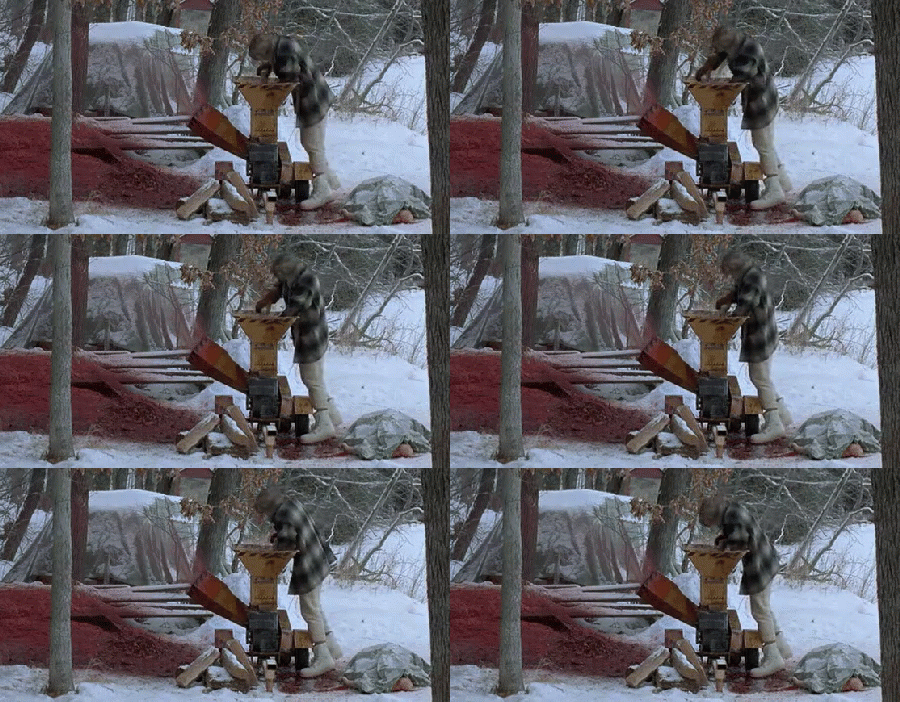
I can’t stand it. All sides are too stupid to breathe or too cynical to be tolerated. This is the kind of thing that drove Sweeney Todd to serial killing. I think I’ll just ask my neighbor Ted to feed me through his woodchipper, like Steve Buscemi in the memorable moment above from “Fargo.”
A Utah state law passed last year allows school districts to remove “pornographic or indecent” books from school libraries. Someone in the Davis School District, seeking to demonstrate the law’s over-reach, submitted a complaint about the King James Bible, arguing the text was “pornographic by our new definition.” The complaint was treated as if it were made in good faith, and the Bible was duly pulled from elementary school libraries, thus making Utah conservatives look ridiculous.
Which was the whole idea. And which they are.
I admit to having a low threshold of tolerance for idiots, but still: State Sen. Todd Weiler (R), who sponsored the obscene book law in the Utah Senate, said he hoped the district’s decision would be overturned, but he called the Bible’s removal a “fair trade” for the removal of other books containing what he described as “explicit X-rated content.”
That’s a good policy: let’s barter for books! The Right gets to throw out “Catcher in the Rye,” and the Left gets to throw out “Founding Brothers,” about all those racists who founded the nation.
Gah. First, nobody’s banning books, nor are they, as the Washington Post claims in typical spinning style, restricting what students read. Parents still have the right and power to let their children read anything on the planet, from “Huckleberry Finn” to “Sexus,” Nexus,” and “Plexus.” The issue is whether parents should be able to limit what their children read in school, now that the trustworthiness of teachers and school administrators is legitimately open to question, and ideological and sexual indoctrination are rampant. It is a valid issue.
The obsession with school libraries is nonsense. Here’s a confession: I did rather well in school, and never used a school library in my life. Not once. I used the town library, and nobody policed which section I used. I even used university libraries. Today, I’d use the internet.
The Bible is not pornographic. It can’t be taught as theology in a state-run school, but it obviously has historical and cultural value. The complaint was made in bad faith (no pun intended) and a competent system would have rejected it instantly. Instead, a committee determined that the text does not contain the type of “sensitive material” the law seeks to keep out of schools—ya think???—but that the Bible was “not age-appropriate for elementary and middle-schoolers” (who have been taught from the Bible in Sunday schools for centuries). Thus the bone-headed decision to pull it from the libraries seven of elementary and middle schools. It will stay in high school libraries. Hooray.
If I had a child in that district, it would be home-schooling from then on. My kid won’t be made literate and capable of critical thinking by morons, no matter which side of the ideological divide they squat on.
“[The episode] does illustrate how even a text of world historical importance can, through the current prism of how books are being evaluated, wind up in this prohibited pile of books,” said Jonathan Friedman, a director at the free-speech advocacy organization PEN America.
Oh, just shut up. It doesn’t illustrate anything of the kind.
I’m off to the woodchipper. Good luck, everybody.
 Ethics Alarms
To be fair… Even Christians don’t read the entire Bible verbatim to children. There is a lot of very heavy material in there… Polygamy, drug usage, death, war, slavery, abuse… Guiding kids around some of the more explicit material and towards the morals is explicitly what catechism does.
I’m not convinced this was an entirely bad move, but I’d love to hear from some of our more fundamentalist commentators – Do you actually buy copies of The Book and just give them to your eight-year-olds?
I was going to something very similar. There are lots of kiddie-versions of Bible Stories. But, those have explicit religious themes (not that the Bible doesn’t, but you can read the Biblical version of Noah and treat it like any other piece of ancient “mythology,” but the kiddie-version of the story of Noah has a religious purpose).
Contrast this with many child-appropriate Greek Mythology books that might be out there. The problem the Bible has is that it raises First Amendment issues that are hardly implicated by a pop-up version of the Iliad.
There is a decent argument to be made that the Bible is not age-appropriate for elementary school, any more than it would be appropriate to have works by Nietzsche or Kierkegaard (though Spuds may disagree) in an elementary school library (though I would fully support an elementary school library having a pop-up version of Thus Spoke Zarathustra).
-Jut
Yep. There are kid versions that hit the main stories necessary to learn the overall theme and story arc of the Bible that aids in understanding the rest of the story later on.
My favorite kids bible has a cover on it with all the characters smiling. One of the character is Goliath. I always thought it amusing that he’s smiling like he hasn’t read ahead.
Evidently some editors realized this too as later editions have everyone smiling but Goliath who has a concerned look on his face.
I think I was probably nine or so when I got my first personal set of scriptures (Bible, Book of Mormon, etc.) I was always a voracious reader, but I remember it took me a while to switch from the kiddie versions to the “real thing” due to the archaic language. I think I was in my teens when I read the Bible from start to finish. Reading the Book of Mormon cover-to-cover is strongly encouraged for pre-teens on up in the Church of the Jesus Christ of Latter-Day Saints, both because it’s relatively short and it’s the foundation of our particular faith. Nothing in it more “objectionable” than the Bible.
Our kids have the full book. They don’t read it though. And we teach them from it, as we teach them in all things, what they are ready for at their particular age.
And if something does lead to an uncomfortable question simple truth doesn’t hurt anything “hey kids, there’s bad people that do bad things.”
The Song of Solomon in the Old Testament gets a bit racy. We certainly didn’t study it in church Primary class when I was a kid. That being said, I certainly wouldn’t classify the Bible as pornographic under the Utah Code: https://le.utah.gov/xcode/Title76/Chapter10/76-10-S1203.html?v=C76-10-S1203_1800010118000101
On the OTHER hand, if I was in charge of materials for aa brand new elementary or middle school, unless it was specifically involved in the curriculum, I’d say, “Let’s leave the scriptures for church.”
Unlike you, Jack, I took out a lot of books from my school library. It was convenient: I was already in the building five days a week, after all, and going to the public library involved either trying to cadge a ride with someone or a mile walk each way with a substantial hill at the end of the return trip. Yes, I did go there on occasion, and I, too, used the university library although I didn’t have borrowing privileges there.
But the school library was always my first stop, not least because it was well stocked: I remember checking out a number of books which would be considered “controversial” today: The Catcher in the Rye and The Communist Manifesto, to name two. I found the former okay but overhyped; the latter bored me half to death.
I wrote on my own blog about the Utah case when it first hit the headlines back in March; you can, as Casey Stengel would say, look it up. The petitioner calls attention to the silliness of the process, writing, “I thank the Utah Legislature and Utah Parents United for making this bad faith process so much easier and way more efficient. Now we can all ban books and you don’t even need to read them or be accurate about it. Heck, you don’t even need to see the book!”
This is a reaction, in part, to a statement by the general counsel to the state legislature. He determined that a book doesn’t have to be “taken as a whole,” but that if even a short section is—or even could be (!)—deemed inappropriate, then the book cannot be safe from removal even if it has serious literary, artistic, political, or scientific value. In other words, because the petitioner is correct that the Bible contains descriptions of “incest, onanism, bestiality, prostitution, genital mutilation, fellatio, dildos, rape, and even infanticide,” it is, according to the state’s new definition, pornographic, and no positive attributes are relevant.
It is difficult to determine whether the law was so poorly written (and interpreted by the general counsel) because of incompetence or the devout hope that it would be selectively enforced. And that’s really the crux of the issue. No one is suggesting that books that actually meet the generally agreed definition of “explicit X-rated content” ought to be readily available to little kids.
The problem is two-fold. First, many of these determinations must be classified along a continuum, and deciding exactly which side of the line to place a particular book is often difficult. We can all agree that Winnie-the-Pooh is on one side of the line and Hustler is on the other, but where do we place Anna Karenina, or Madame Bovary, or Love in the Time of Cholera, or even Hamlet, all of which are regarded as classics of literature, and all of which have significant plot elements involving marital infidelity and which feature dirty jokes, descriptions of sex per se, or other kinds of… erm… “country matters”?
Of course, a lot of the current problem concerns books which feature gay characters. According to many on the right, if a book concerns teenaged Bobby and his girlfriend Dana, then it’s a charming story about young love. Ah, but if it’s about Bobby and his boyfriend Dana, then it is obviously about sex. That’s why that Florida teacher got into trouble for showing a Disney movie to her class, after all. A universal recognition that gay people exist would go a long way.
Also relevant to the current situation are the motives of all concerned. Of course we’ll grant that the person who sought to pull the Bible from school library shelves doesn’t really think the book is without value; the object of that exercise was to point out the hypocrisy of the censors. I suspect the petitioner hoped that the state would recognize how problematic the new law was and pull back. The desired trade-off was the opposite of what happened.
And I don’t think I’m being too cynical to suggest that at least some of the pols who voted for the bill did so as a grandstanding gesture to the more fervent members of their base, not even thinking about the potential ramifications of their actions.
Finally, we can grant that there’s a difference between banning a book and pulling it from school libraries. That said, there’s also a difference between a parent restricting their child’s access to a book and restricting every parent’s child’s access to that book. I’m not going to come down on the side of school librarians 10 times out of 10. More like 9.5 times.
Comment of the Day.
My Dad, an only child before television, began reading voraciously as a child, and had knocked off more classics, including Hamlet, Anna Karenina and Huckleberry Finn by the time he was 10 than I had finished by 21. Personally, I would never want to take any book out of a school library that had any literary value whatsoever—as long as I, as a parent, had access to the list of books being assigned, and trusted the teachers assigning them.
Funny: the Catcher in the Rye bored me half to death, and The Communist Manifesto I found okay but overhyped.
“ No one is suggesting that books that actually meet the generally agreed definition of “explicit X-rated content” ought to be readily available to little kids.”
Yes, they are.
https://thefederalist.com/2023/05/31/biden-education-bureaucrats-overrule-georgia-parents-to-protect-porn-in-schools/
Unless you really think content like this is somehow comparable to Hamlet.
Yikes.
Yikes, indeed. I had to go wash my brain out with soap after looking at that.
I will note, that finding the actual materials that are being reported on and argued over is extremely difficult. It took me a while to locate an actual example of what is being curated in these school libraries. Virtually none of the articles covering these materials actually show the materials in question. Search engines are steering all queries about the sexual content in schools to left wing news sources, which of course excuse the content with buzzword frontier gibberish like this:
“Katherine Kidd, coordinator of the Syracuse English Studies program, told the student paper The Daily Orange that keeping a book like “Gender Queer” out of schools “solely on the basis of it being sexually explicit limits discussions about young adults’ discovery of gender identity in relation to their bodies.”
Kidd said banning the book — the most challenged publication of 2021 — “erases” the experiences of what folks like author Maia Kobabe describe, and added it’s “scary” that it is being “challenged for pornographic material.””
Right wing coverage simply states that the content is pornographic without showing the actual content.
How is anyone supposed to be informed if all the press is too busy telling people what to think to provide any actual information? People should know what it is they are arguing over.
I concede the point. Allow me to re-phrase:
No one isI am not suggesting that books that actually meet the generally agreed definition of “explicit X-rated content” ought to bereadilyavailable to little kids, or to older kids without explicit parental consent.I still believe that overreach is the greater concern, but no, I don’t want 8-year-olds seeing this stuff.
Overreach is always a serious concern. I would not want the books banned in general. I do think banning some types of content from elementary school libraries has to be on the table if people cannot simply act responsibly of their own accord. I would far prefer for people simply to be reasonable and not make this an issue in the first place.
“It is difficult to determine whether the law was so poorly written (and interpreted by the general counsel) because of incompetence or the devout hope that it would be selectively enforced.”
I struggle with this too… There are laws being written that people have to know are going to be contentious, opposed, and weaponized. In cases like that, if a law is to be written, I think that it behooves people to write what the law is supposed to do clearly and competently. And yet, it seems more the rule than the exception that these laws are poorly written, patchwork, ill-conceived, vague, unconstitutional or
contradicting to the point of being self-defeating. This isn’t even a Republican thing… We’re seeing it right now with a lot of these LGBT laws, but Democrats have not only done this, they’ve done it for massive federal pieces of legislation – The ACA might go down in history as the best example possible. It was atrocious legislation.
I don’t know what drives that. Are they lazy or stupid? I don’t know what else it could be.
“Are they lazy or stupid?”
As one of my favorite students was fond of saying, ¿Porque no los dos?
Hanlon’s Razor.
Why argue about the King James Bible? It is not the individual books chosen for the bonfire but the very fact that a legal ‘repository’ for such books and their ashes even exists — as defined and created by a bunch of moronic local leaders. (And based of course on their knowledge of history, literature, and the peculiar American culture based on the various freedoms our Constitution promises.)
And discussing the books themselves only gives credence to the idea that there really are some books that should be banned, and that the law allowing this “selection” is all right, depending on the particular books chosen, and obviating the larger issues surrounding the law itself, which is the abomination. (“You can have the King James Bible, as long as I can have James Joyce… “) Talk about your slippery slope.
And another thing: let’s hear it for the Reverend Bowdler !!