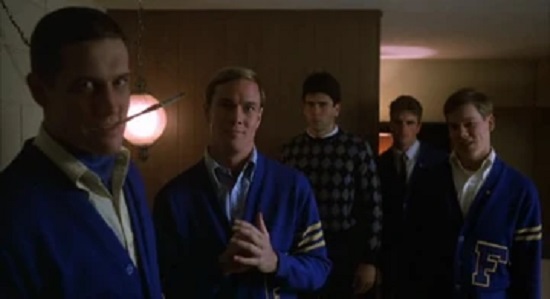
After posting about the ethics professor who trapped the cheaters in his class by planting the wrong answers in a version of his test uploaded to a exam-cheating site, I realized that I never discussed the ethics of the Omega Theta Pi fraternity in “Animal House” who tricked our heroes (Bluto, Otter, et al.) with a similar scheme. In Part I, I described Kevin Bacon’s frat brothers as “evil,” as indeed they were, and their motive for planting a fake psych exam answer sheet where they knew Bluto and D-Day would find it was hate and vengeance. Does that make their scheme unethical, even though the professor’s similar stratagem was ethical?
Nope. Motives don’t matter when you do the right thing. The Delta House members were trying to cheat, and they deserved to be exposed and punished if they did. If they were prone to cheating, they also deserved to be kicked out of Faber College (“Knowledge is Good”). It doesn’t matter if the Omegas (and equally villainous Dean Wormer) would get pleasure out of their fall.
Planting a fake exam sheet that could only cause pain to attempted cheaters is harmless to any legitimate, ethical student. It’s not entrapment (an accusation hurled at the professor in Part I by some Twitter critics), because entrapment is when someone is induced to commit a crime or misconduct who would not have engaged in it otherwise. The Delta’s were going to look for the exam answer sheet; they were going to cheat. As with the professor’s unethical ethics students, nobody made them look for the answers to the upcoming test.
 Ethics Alarms
Although it should not be, it is still surprising to me that so many people can’t see the difference between providing an opportunity to commit a crime and actually inducing someone to do so. For a time, I was part of a team targeting what we called “on-view” thefts, criminals stealing from vehicles parked on or near the street, or sometimes the actual vehicles themselves. One of our frequent tactics was “planting” a target vehicle in a problem locations and staking it out. We seldom had to wait more than a few hours before the bait was taken and a criminal arrested in the act. Inevitably the claim of entrapment was made. I have even had defense counsel argue that it wasn’t a “real” crime.
One of the hardest parts of managing informants is making sure that they aren’t (acting as your agent) inducing some third party to commit crime, which they would then report to you. I could deliver that lecture in my sleep.
An ethics conflict that occurs to me, which I don’t have time to fully flesh out, is the bystander student who doesn’t seek the answers illicitly, but studies with someone who does. They are exposed to a handful of absurd answers before removing themselves from the situation (peer pressure, etc., is a strong non-ethical consideration that may delay reacting to the cheating). The student might question if they studied properly at all, and have little recourse to clarity. If they go to the professor, they expose their classmates (even themselves) as peaking at the answers. They throw their classmates under the bus, or potentially bear the brunt themselves for admitting to cheating by being failed on the assignment (honesty tax).
The cheating students who found the answers bear most of the guilt, but I guess this is how trainwrecks form: an unethical act leads to rationalized behavior as every man fends for himself.
As a former TA, low level cheating is so rampant that academic honesty is basically a facade. I graded so many homeworks, where answers were copied verbatim from the teacher’s manual (including strategically placed wrong answers similar to the professor’s experiment here). I’d dutifully mark the assignment zero, and put them in the class mailbox for students to pick up. After a few weeks, students never picked up the assignment, so never learned nor cared they failed (the individual homework assignments were so small a part of the final grade as to be irrelevant).
Now, here is the frustrating part as a painfully honest person. Prior to my time as a TA, when I was still an undergrad, I found the amount of homework assigned utterly stifling, and couldn’t keep up. I’d struggle through assignments and not be able to figure out the answers, and wondered how my classmates could pull it off. I felt weak and pathetic.
As a TA, seeing that the vast majority of students couldn’t pull it off and resorted to cheating was eye opening. We have a pedogy problem, and professor’s have clearly adopted a “wink-wink” approach to such low- and mid-level cheating.
Or contrived ignorance.
Academic honesty codes can’t be enforced because the system is rigged so as to make it deadletter. Honest students fall behind for not playing the game.
I observed this from just a semester or two of TA’ing. That the professor in this case study was shocked by the results of his experiment is disturbing. Most professors are not professional eductors, but neither am I. Schools and colleges need to step and develop curriculum and methods that reinforce academic vigor and honesty; not pretend dishonesty doesn’t exist.
You do need to realize that professors have a very high bar to accuse, let alone punish, a student for cheating. I catch and turn in students for cheating every semester, but only the most blatant examples. There is a lot of cheating I know I wouldn’t be allowed to punish.
Remember, the administration doesn’t want the faculty to find cheating. Cheating makes the school look bad in the press, it deters students (who like cheating) from coming to the school, and significant punishments for cheating can entice students to leave your school for more ‘cheater friendly’ schools. In addition, cheating is so rampant, and has been for so long, that many of the faculty cheated THEIR way through school (sometimes it shows). Some fields have become so numb to what I consider cheating that they encourage it.
So, what do you need to prove cheating to your upper administrators?
(1) It has to be the same wrong answers. Writing the same, correct answer, even if using the exact same words and figures, is not sufficient. You can’t convince any administrator that it is unlikely that 2 people who sat next to each other would come up with the exact same words and figures (in the same place on the page) to explain what determines the efficiency of an engine.
(2) All the wrong answers on the document have to be the same on both papers. If one person has a different wrong answer, even though the previous 8 wrong answers were identical (even the same wording), you are going to have a hard time. The students will claim “Well, we studied together, so we were thinking the same way”.
(3) You have to prove that they knew they weren’t allowed to cheat on the exam or assignment. Many students will say “I didn’t know we couldn’t work together on the exam”. Your exam better say in bold print, “This is an individual assignment. You may use X sources, but Y sources are forbidden.” and talk about it in class, and have it in the syllabus, and have them do a quiz where they state that they understand it. I have had cheating cases rejected despite all of the above because an administrator said “I don’t think they understood they couldn’t copy off each other during the exam”.
(4) A paper needs to be significantly the same. This is the digital age. Many of the students are smart enough to take their friend’s report and just reword some sentences. You aren’t allowed to stop this. Gone are the days when I had students turn in someone else’s report with the name covered in white-out and the new name written over it in pen. My students have told me their friends are using ChatGPT to write their papers, then rewording each sentence so that the grammar and punctuation is their own (atrocious). That is the main way to determine a ChatGPT paper from a student written one, the punctuation and grammar are correct.
The last couple of years, I have had trouble with people cheating by looking up answers on the internet for take-home assignments.. How do I know they copied them off the internet? Because they are wrong! The internet likes to post answers that are just wrong or at least oversimplified for science topics. Light is usually described as Maxwell described in in the mid-1800’s, not using Einstein’s description from 1905. Let this be a warning to all who wish to use AI to solve problems, the AI’s source material is wrong or way out of date for most science or engineering topics. It is difficult to get an administrator to back you up, however, if ‘the internet’ agrees with the student.
A friend of mine recounted a specific example. He was listening to his child’s science class online, when he heard the teacher say that there was no difference between microwaves and radiowaves, they are the exact same thing. My colleague objected that this is very wrong. His wife confronted him, and said the teacher was right because the book and ‘the intenet’ said they were the same. She said if the teacher, the book, and ‘the intenet’ agreed, he must be wrong. He has a degree in physics, but that doesn’t matter because the ‘EXPERTS’ and ‘AUTHORITIES’ disagreed. His statement was dismissed as ‘misinformation’.
Many years ago, I had a student whose reports just copied entire paragraphs from textbooks without quotes or citations. When I discovered it, I collected several to make sure the honor court would take it seriously. When I pressed the cheating case, his father intervened. His father was on the NSF ethics board and he threatened to personally investigate every NSF grant at the university for ethics violations if we didn’t drop the case against his son. The university, of course, caved. (sarcasm alert) Gee, I’m shocked by all the unethical behavior by the CDC, the FDA, OSHA, etc during COVID. People asked me why I didn’t trust the ‘scientists’ at those agencies. You now know 1 reason out of many.
Now you see the barriers to is punishing cheating. It is difficult to make the administrators see cheating when their job requires them NOT to see cheating. It also makes you no friends. So, why would you worry about cheating?
(1) We have a competence problem in this country.
https://time.com/5753435/amazon-atlas-air-cargo-crash/
Additional information indicated that coworkers rated him the worst pilot they had ever seen and, tellingly, stated that he didn’t seem to understand that he was a bad pilot. Note that American grounded 150 flights because of lack of pilots today. Those same bad pilots will be crashing your passenger flight soon.
(2) You don’t need to catch all the cheaters. Punishing the most blatant cheaters gets most of the students to start doing their own work. For most students, this is the first time they have ever heard of someone being punished for cheating.
(3) Almost all the students cheat when they first enter college. Almost all of them cheat. You have to hold at least the worst offenders responsible for the rest to understand that this is wrong. They have had 13 years of school where the teachers said cheating was bad, but the cheaters were never punished and made good grades. You have to address cheating or they will never learn anything. This is OK in fields where no knowledge is required, but in many fields, you do have to know something or bad things will happen, just look at Palestine, OH.
So, what can you do about it?
(1) Make sure you take away everything but their writing utensils and a non-programmable, non-graphing calculator.
(2) Spread them out.
(3) Give multiple test forms. Don’t make it obvious that there are multiple test forms. Moving the decimal place in the problem between the forms is a good way to do this. You can’t be accused of making one test form harder than the other if the difference in problem #5 is 5.22 on one form and 52.2 on the other. Give the multiple forms different ways each time. Don’t use the same pattern of handing them out or the students will ‘stage’ themselves in class to cheat off people with the same test form.
(4) Put a similar test on the web for practice. This is mainly to help them study, but it also helps find the cheaters/lazy people. Many students will just write down the answers from the practice test on the in-class test despite the fact that the questions are different. Public school trained them to do this by routinely giving them the test and answers beforehand to ‘study’.
A good lesson, don’t cheat in a physics class at UVA.
The article above was not the case I was looking for. About this time, a UVA physics professor was attending his mandatory ‘beginning of the school meetings’ when the honor court people made a presentation about how they want ALL incidents of cheating reported. A physics professor said “No, you don’t.” The honor court people insisted that they did. The professor asked if they would back him 100% if he reported obvious cases of cheating and they stated that they would in front of the entire faculty (note: Don’t challenge a physics professor this way).
At many large schools, the students insist on knowing what the answers to the exam are immediately after the exam. As a result, many faculty post the answers to the exam somewhere WHILE THE EXAM IS TAKING PLACE. This professor knew that students were having their friends text them the answers during the exam. So, this professor posted a fake answer key AFTER THE EXAM BEGAN. It was multiple choice, so the cheating students received a 0%. Running all the 0% scantrons against the fake key confirmed they used the fake key (the chance of ‘accidentally doing this on a 25 question test is 1 in 1,100,000,000,000,000). Just over half of his class cheated. The only penalty for cheating at UVA is permanent expulsion. The honor court people cried foul, of course, They couldn’t just throw out over 100 people for cheating in one class! Remember their promise to back the professor? Yeah, they lied.
So, now you understand the difficulties a professor has maintaining academic integrity in the classroom. In many fields, this seems to be completely gone. I didn’t even touch on the multiculturalism, DIE, racism charges that traditional academic standards are ‘whiteness’. It is really difficult to get any of the younger faculty to take cheating seriously.
My take: Fake keys should be widely promoted and distributed to get people to start doing their own work and stop trying to find the easy way out. The students should be encouraged to use the study aids their faculty provide and not try to find such cheating aids on the internet. As for the entrapment and honey pot, arguments, they are garbage. If you weren’t looking for ways to cheat, you never would have found the fake key. If you were just ‘using it to study’, you would have noticed that the answers made no sense. This case had a built-in failsafe for an ‘honest’ student who was given this by a friend to ‘study’.
If I was in charge of state-mandated end-of-year testing, I would have my staff offer to sell copies of the tests to schools and then send them different tests than they were actually going to get. I found out that the state tests are being leaked to some schools, who then copy them and provide them to the students to study (because my child brought them home). The fact that such schools still only have 25% of the students pass the tests is disturbing at many levels.
At first blush, I found nothing wrong with what the professor did, and also concluded that his “trick” unearthed cheaters. After thinking more about it, I’m not so certain anymore.
Is it really cheating to look old exams and learn what the correct answers to the questions are? I’m not sure I think so.
The only way this would be cheating is if the professor had said he’s using questions from old exams and prohibited the students from looking them up, which this professor did not appear to do.
I think the bigger issue here is that sites like quizit exist because many professors (usually old tendered ones, mainly teaching humanities or other non-STEM subjects) are too lazy to come up with new questions and tend to re-use old ones. If anything the existence of this website is further proof of the deep issues that exist in our education system and in the takeover of that system by lazy, entitled, and/or committed ideologues who care more about indoctrination and/or maintaining their cushy jobs and fat benefits than they do about educating.
Studying from past quizzes is useful because books and lectures teach what right looks like – but there’s a lot of ways our thinking leads up to a wrong answer that feels right and the past quizzes can give us an idea of what wrong also looks like to help us find flaws in our thinking about material we’ve learned over the past semester.
There two forces at work here though –
1) I think it is perfectly fine for past quizzes to be available (if the authorities of that course permit it) for study.
2) Professors can switch up questions and answers over the years, but eventually, in any particular course, there will be repeats because the important knowledge of a course is finite.
Concluding then – there’s a fine line between a student using past exams to memorize right answers to questions and a student using past exams to hone their knowledge as a study supplement. Also – if a student memorizes the right answers… isn’t that…. learning?
Also – eventually, if a professor in pursuit of #2 ends up going through all possible important questions and his exams in the future are all ultimately regurgitations of previous questions – and a student then has to compile 10 years worth of exams to study – well…. aren’t they really just …. studying the material?
The difference is using old quizzes or tests from the professor and using a cheating site. Most faculty are forced to use centralized copy centers to copy their tests. These copy centers are staffed by students. These students will sometimes take a copy for themselves, distribute them to friends, or post them to websites. If the test was Exam 3, Spring 2023 and posted that way, it is cheating to use it. It isn’t an ‘old’ test, it is a stolen copy of the current test.
If they really were just using the test for studying, they wouldn’t have put down outrageously wrong answers to the questions. Why would you just trust that a 3rd party website has the correct answers to your professor’s exam? In other words, they weren’t using them for studying, they were trying to cheat. One of the reasons I didn’t cheat in school is that I didn’t trust anyone else to have the correct answers.
“Also – if a student memorizes the right answers… isn’t that…. learning?”
No, no, no, no, and NO! Memorizing is not learning. Memorizing is memorizing. This is why ChatGPT can pass the medical board exams, but only get a diagnosis right ~50% of the time in the first 6 guesses. Learning requires memorization of basic material, understanding of how things work, and the ability to put the two together to work out the answers.
If all you can do is mindlessly memorize answers, you can be replaced with a book or a database.
Multiple choice questions are based entirely on memorizing knowledge.
If we’re looking to test whether that knowledge is synthesized into a body a quickly accessible information when the moment of inspiration arrives- we need to talk about something more rigorous than a multiple choice exam.
But even then, memorization is also *essential* to that process.
Are you kidding me? No, they aren’t.
Example: A bullet with a mass of 25 g and a velocity of 300 m/s hits a tree. It exits the tree with the same mass, but a velocity of 120 m/s. How much energy was lost as heat in the process?
(a) 945 kJ
(b) 945 J
(c) 1125 J
(d) 1125 kJ
(e) not enough information
You don’t just memorize every possible question that could be asked.
I think we’re focusing differently here. I don’t disagree that an exam that consists entirely of math problems, in this case math applied to physics, could be entirely different every, single, year and at that point its on the diligence of the test-maker to create variability.
But that’s different than our philosophy or ethics professor above. Take history for example. A test on the American Revolution – there’s not a lot of ways to vary a question on the subject of “When what the Declaration of Independence Signed”. Can’t really re-word that topic for a different answer.
Which of the following were based on the philosophy and cosmology of Aristotle?
1. When the Lutheran church said the earth couldn’t move.
2. When the Catholic church said the earth couldn’t move
3. When Tycho Brahe said the earth couldn’t move
4. When Galileo had the planets move in circular orbits
5. When Kepler said the stars were in a crystal sphere
6. When Copernicus had the planets move in circular orbits
(a) 1, 2, and 3
(b) 2, 3, and 6
(c) 2, 3, 4, and 6
(d) 3,4,5, and 6
(e) 1, 3, 4, and 6
New ideas in physics can cause problems when they are introduced because they defy the reality that people were used to (their worldview). Which (if any) are examples.
1. Newtonian physics was deterministic and people couldn’t accept that
2. Newtonian physics was probabilistic and people couldn’t accept that
3. Quantum mechanics was deterministic and people couldn’t accept that
4. Quantum mechanics was probabilistic and people couldn’t accept that
5. Einstein’s relativity kept acceleration absolute, but velocity relative, and people couldn’t accept that
6. Einstein’s relativity made mass vary, and people couldn’t accept that
(a) 1, 4, 5, and 6
(b) 2, 3, 5, and 6
(c) 1, 4, and 6
(d) 1, 3, 5, and 6
(e) None of the above
I feel like those bolster my point.
SAT, MCAT, and LSAT preparation is heavily, if not entirely, dependent on review of prior tests as study guides. Tons of material is available from ETS, online and Barnes and Noble to support this study. Back in the day, contemporaneous with Animal House (1978), prior PhD qualifying exams of Electrical Engineering were made available through the departmant. We should be able to stipulate that studying from prior exams is in no way unethical.
Of the 56 students apparently not implicated in Professor Merriam’s sting, had any used his scam exam as a study guide, they would have been duped. Purposely teaching false, what, information or doctrine or whatever, sure sounds unethical to me. As you said “Motives don’t matter when you do the right thing.” So maybe motives don’t matter when you do the wrong thing either. And what was his motivation? To catch cheaters? As Rich notes and I know from my minimal contact with current academia, cheating is rampant and is essentailly tolerated. So Professor Merriam gotcha was pissing in the ocean.
The nail in the coffin to me is that Professor Merriam posted a “copy” of his exam, which I read as an “exact copy”, with false information. Yes, I find that unethical. And for what? Catching cheaters as in “Animal House”, a 45 year old farce? I’m betting there are no consequences
One more point, when I was in school in the pre-internet last millennium, a take-home test was open-book, open-notes, open-library, open-everything. Why do it otherwise?
So, would you have bought MCAT exams from a site marked ‘Hacked MCAT Exams’? What about a site that had photos surreptitiously taken by students during an exam? Are those ‘legitimate study aids’? If it turns out that the tests from those sources didn’t have the right answers on them, would you sue?
You are equating a cheating site with the study material published by the test organizations like ETS. Those are NOT the same. I have old exams for students to study. I have links to outside study material. If someone breaks into my office, copies my exam off my computer, and uploads it with a bunch of garbage answers to the internet, it is NOT the same thing. I don’t know why this is difficult to understand.
I don’t know why these sites aren’t taken off line. I write my own tests. They are mine and I retain copyright to them. If you post them online, you are infringing on my copyright. Many professors use test-generating utilities from their textbook publisher. That material is also copyrighted, and used with permission by the professors. It is not allowable to upload them.
Look, I’m not equating anything to anything. I don’t know from quizlet or d ‘Hacked MCAT Exams’.
“If someone breaks into my office, copies my exam off my computer, and uploads it with a bunch of garbage answers to the internet, it is NOT the same thing. I don’t know why this is difficult to understand.” Why would you infer that I find that difficult to understand? Frankly, I don’t much get your response, but don’t feel the need to clarify as I hear Logan approaching.
Reading this thread has taught me that I have been doing school wrong my entire life. Wow.
When I studied for tests, I started out by reading all the required material as the semester progressed, and highlighting all the important parts in the reading material. I took copious notes during lectures, usually to the extent that my notes were more like dictation of the lecture than notes. When it came time for the exam, I typed up all my notes and turned them into an outline of the topics covered in the course. I then typed up all my highlights from the reading material and did the same thing. Then I combined the two. Then I checked the syllabus, any study guides provided, and if there were practice tests I skimmed those to make sure my outline wasn’t missing any topics. If I was missing topics I went looking for the missing information. Then I memorized my outline. Then I quizzed myself on the outline. Then I would take any practice tests available. Only THEN did I look at any answer keys!!! Just to check if I had actually learned the material.
Apparently, I am a neurotic crazy person. But I would have noticed all the answers were wrong on the fake quiz.
N.P.:
Same here. I completed undergrad in 1977, then worked eight years saving the money to go back to grad school on a cash basis and got my Master’s in 1988. Same study system. There were a number of people with whom I went to school who were smarter than me, but very few who worked as hard.
“Education is one of the few things a person is willing to pay for and not get.” -William Lowe Bryan