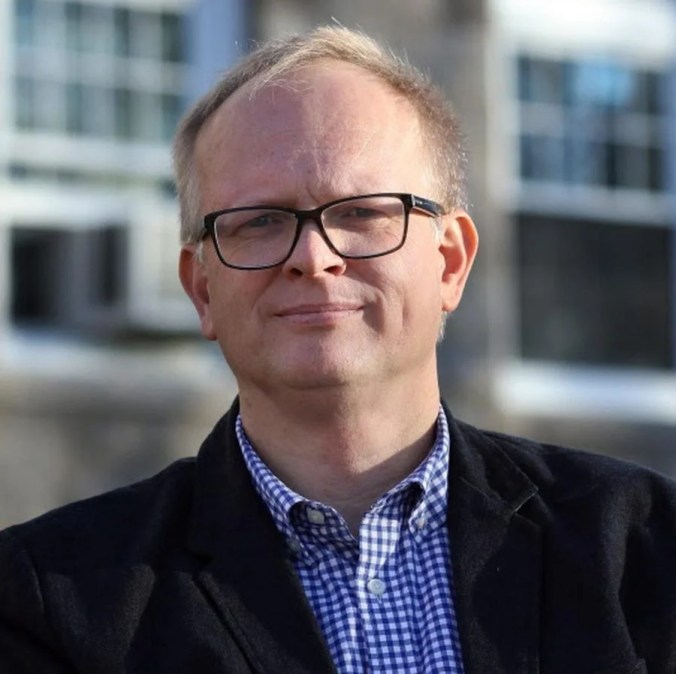
In 2020, Prof Erik Loomis, a far, far Left radical (not that there’s anything wrong with that) who teaches at the University of Rhode Island, was discussing the murder of Aaron “Jay” Danielson, a member of the right-wing group Patriot Prayer who perished during rioting in Portland, Oregon. In a September blog post titled “Why was Michael Reinoehl killed?” (Reinoehl is the man suspected of fatally shooting Danielson; he was killed as federal authorities tried to arrest him), Loomis responded to a commenter who had limited sympathy for Reinoehl because he (probably) had shot Danielson by writing,
He killed a fascist. I see nothing wrong with it, at least from a moral perspective…tactically, that’s a different story. But you could say the same thing about John Brown.”
Loomis frequently issues such inflammatory opinions: he once called for NRA executive Wayne LaPierre’s “head on a stick.” Nonetheless, Loomis is still a tenured member of the university’s faculty
The first thing I did upon learning (just a bit late) of Loomis’s defense of the murder of a Trump supporter was to check Jonathan Turley’s blog to see if he had opined that academic freedom and freedom of speech required that even irresponsible , hyper-ideological nut-jobs like Loomis should be immune from sanctions no matter what offal he sprayed around the web and, presumably, his campus. Sure enough, he had. Turley wrote in part…
The specific context in Portland is that Danielson went with a right-wing group to advocate for his own views, just as protesters from Black Lives Matter have been doing. He was stalked and murdered, which Loomis finds perfectly moral.
Loomis’ rhetoric and views are strikingly similar to those in the “bible” of the Antifa movement: Rutgers Professor Mark Bray’s Antifa: The Anti-Fascist Handbook. As I stated in my Senate testimony, Antifa bears strong resemblance to groups that emerged during earlier periods of attacks on free speech. Simply replacing anti-communism with anti-fascism does not materially change the same anti-free speech purpose of these movements… Their goal is not co-existence but, as stated in the Antifa Handbook, “to end their politics.” …Once freed of the values of free speech and democratic values, violence becomes merely politics by other means. …What is so striking is how Danielson is no longer treated as a human being with family or even individual worth. Loomis seems to revel in the notion that such lives are now inconsequential and can be taken for purely tactical reason. It is the liberating element of extremism. Once uncoupled from the confines of morality, Loomis and others can assume a license for violence, even murder, to advance their agenda.
For an academic to espouse such hateful and violent views is particularly distressing. There are likely many conservatives among the student body at Rhode Island who Loomis would also declare “fascists.” Their lives would be equally fungible and worthless under this view.
Then Turley concludes, “It is often hard to advocate for the free speech rights of people like Loomis when he justifies not just the silencing but the actual killing of those with opposing views. However, Loomis is the price of free speech.”
Wrong. Loomis is the price of the leftist lurch by higher education permitting anti-democratic indoctrination to not merely metastasize on campuses but to flourish as a long-term strategy aimed at undermining core American values and liberties. Loomis definitely has an absolute right to say and write whatever mad nonsense he chooses; he should not have a right to teach it to students who have paid to be educated, not warped.
I discovered Prof. Loomis’s advocacy of murder and terrorism ( Loomis extolled John Brown, who was a murderer as well as a terrorist) while trying to explain how this guy (Item #3) could be permitted to teach students, much less be allowed to represent the U.S. at the U.N. I’m all in favor of universities having a wide array of opinions and philosophies represented on campus (There isn’t one, though, with 75% of all faculty in the U.S. being rated as far left), but there still have to be limits. Turley, typically professorial in his rebukes, says Loomis’s comments are “distressing.” They are a hell of a lot worse than that; they are corrupting. Students should not be corrupted by their college experience. People like Loomis, whatever their erudition, should be required to keep their sick values to themselves, or, if they can’t be trusted to do so, they should be in another line of work.
Professor Turley’s thanks for defending Loomis’s right to advocate murder and terrorism as a professor and scholar was rewarded by this tweet from Loomis, signature significance for someone with dead ethics alarms as well as an asshole:
“Professor Jonathan Turley thinks I support murder. Meanwhile, his preferred policies kill people around the world every day. But hey, I’m not bought and sold by capitalists. Wonder what it feels like to be a disgusting human being.”
 Ethics Alarms
This is a free speech issue.
An employee saying disgusting things in their private life should not be penalized by their employer.
Would you be okay with a pro-life professor being fired by a liberal college because the students felt “unsafe” with them teaching on campus?
What about a biology teacher who attends flat earth conventions?
It’s not a free speech issue.
A professor advocating racial discrimination would be fired. A professor advocating the superiority of men over women would be fired. Or rape. A professor advocating criminal activity, including murder, has to be canned. Immediately. As Turley noted, students with conservative views have a reason to feel unsafe anywhere that this professor has influence and a platform. That cannot be permitted. Free speech on campuses cannot be absolute, and is not. If there was no other way around it, the school should simply eliminate his classes and officially disavow anything he says or writes. It was unethical to hire him in the first place. Moreover, extreme public positions that reflect badly on the university that employs such a professor should not have to be tolerated. If a contract doesn’t include such a limitation, it should.
From Inside Higher Ed:
Academic freedom was not intended to make professors into oracles, with the right to do or say anything they wanted. It was intended to protect controversial ideas held by professional scholars while they were teaching students about those controversial subjects. While reiterating the principles of academic freedom in 1940, the AAUP stated, “Teachers are entitled to freedom in the classroom in discussing their subject, but they should be careful not to introduce into their teaching controversial matter which has no relation to their subject.” An English professor is not guaranteed the right to use his classroom as a platform to teach about QAnon. A professor cannot use a class on educational media to advance his religious convictions.
I propose that this history, as well as the subsequent legal interpretations of the concept, points to three basic pillars for understanding the boundaries of academic freedom. First, academic freedom in the classroom must be understood to protect speech that is germane to the subject of the class. Professors are not oracles or gods. They are professional scholars, with expertise in a particular subject, and protection for their speech should be limited on that basis.
Second, when it comes to expertise, we must pull apart subject matter expertise from expertise in pedagogy. Though it may shock some to learn, many professors have little or no training in or understanding of the science of teaching and learning. Unlike secondary school teachers, who receive hundreds of hours of training and continuing education in how to teach, many faculty members bring nothing other than subject matter expertise to their classroom. For this reason, where it comes to pedagogical techniques, academic freedom does not entitle a professor to do whatever they want in the classroom, particularly if their judgment about what is “good for students” may cause significant harm. Thus, academic freedom did not—and should not—protect a university basketball coach who believed using the N-word was an appropriate way to motivate players.
Third, academic freedom must be understood to protect speech about matters of public concern, not private convictions, religious beliefs or personal vendettas.
Free speech on campuses cannot be absolute, and is not.
This wasn’t on campus.
Do you have an example for a professor being legally fired for saying racist things in their private time? Or any of the other examples of a professor being fired for doing saying something in their private life outside of work?
Yes it happens. I worked in a post secondary institution and have witnessed such an occurence.
Sure: first one to pop up in my files:Columbia University’s Dr. Jeffrey Lieberman, the psychiatry department chair at Columbia’s Vagelos College of Physicians and Surgeons and the psychiatrist-in-chief at Irving Medical Center/New York-Presbyterian Hospital, was fired as chair because he retweeted a photo of Sudanese model Nyakim Gatwech with a post considered “culturally-insensitive” claiming that Gatwech is listed in the Guinness Book of World Records for having “the darkest skin ever seen on Earth.” Lieberman’s tweet added the caption, “Whether a work of art or freak of nature, she’s a beautiful sight to behold.” Columbia suspended him, then he had to grovel an apology to sat on in the faculty.
There is a distinction: his tweet wasn’t racist. But close enough to be punished.
I asked for a professor who was fired from their teaching job for something they said in their private life.
Dr. Lieberman is still a professor at Columbia.
Also, it’s a private school.
He would have been fired if he didn’t grovel. He was fired as department head—did you bot see that? That’s a job. It involves more money. He was suspended, which is pushiness for the same speech. The tweet was if as private as the RI professor’s blog post. The example meets the relevant standards you were looking for. In terms of free speech, there is no difference between firing and a suspension—if free speech applied, either would be a breach.
He would have been fired if he didn’t grovel.
Glad we agree he wasn’t fired. I asked for a professor who was fired from their teaching position for something they said outside of the classroom.
He’s STILL at Columbia. It doesn’t meet your standards at all.
You want Loomis to not teach at this college anymore.
That’s the example I’m asking for.
The example I gave was on point: a professor who lost a job, being fired by the college for comments made off campus, and being suspended from teaching From a First Amendment standpoint, there is no distinction between a suspension and a firing, or whether the job terminated was administrative or a teaching position. If one is unacceptable under free speech principles, they all are.
There is no exact equivalent of Loomis suggesting that conservatives can be “morally” murdered, because he’s a very special asshole. But a Drexel University political scientist was forced to resign in 2017 after a tweet that stated all he wanted for Christmas was “white genocide” and other comments in which the professor expressed disgust with the military and called white people “inhuman.” Racist enough for you?
Also in that year, a visiting professor at the University of Tampa lost his job after tweeting that Hurricane Harvey, which killed more than 100 people, was payback for Texas’ support of Republicans.
More recently, among other cases, the Institute for Free Speech is representing Bakersfield College Professor Daymon Johnson in a lawsuit that alleges his colleague, Professor Matthew Garrett, was terminated after expressing unpopular (as in “un-woke”) political beliefs through newspaper op-eds and radio show appearances Garrett was fired based on his comments defending the term “cultural Marxism,” among other alleged “misconduct.”
Would you agree that advocating terrorism and murder is just a bit more harmful to a university culture than opposing “cultural Marxism”?
He was fired from his position as Department head. That’s being fired for statements made off campus. He kept his teaching position because he groveled an apology, which he shouldn’t have done because what he tweeted wasn’t racist in the least. However, being punished in any way for a statement made separate from teaching and off-campus is exactly what the point of the post is about: a university can dump a professor whose statements are sufficiently heinous and damaging to the institution’s reputation. You asked for an example of a professor fired for racist comments off campus. Columbia fired him, and he was a professor and the sole justification was off-campus comments deemed politically incorrect—less outrageous than Loomis’s statement.
I agree wholeheartedly with your view of John Brown. He was a murderer. He was wrong to incite a slave revolt that would have killed innocent people. His extremism required that he could not consider those that supported the peculiar institution to be innocent. Like the so-called anti-fascists today, holding a differing opinion is sufficient to be labeled an enemy.
You once mentioned how it’s easy to understand why George Soros contributes to so many leftist causes, having experienced the Nazi years. Certainly, one can sympathize with survivors of that time and their desire never to go through such a thing again. It does, however, contribute to blind spots of its own.
I am finally completely the massive three-volume diaries of German intellectual Victor Klemperer (cousin of famed conductor Otto who was, in turn, father of famed actor Werner). A Protestant, Klemperer was, nonetheless, labeled a racial Jew by the Nazis and was spared the concentration camp by virtue of luck and his marriage to a non-Jew. He was still a victim of Nazi persecution – losing his position, being forced from his home, subject to the racial laws involving diminished rations, shopping hours, access to public transportation and other petty minutiae designed to make life miserable for the racially undesirable.
During those years, though, he was staunchly against Bolshevism and Zionism as much as he was against Nazism. They were sides of the same coin: their language was the same; their tactics were the same.
After surviving the firebombing of Dresden and returning to his home upon the end of the war, he found himself in Soviet-occupied East Germany. The horrors of the Holocaust revealed, he decided to become a Communist because, in his words, it was the “lesser evil”.
The extremism of the right had caused a moderate German to become reactionary. It’s interesting to read Klemperer freely admit that the language of the GDR was similar to the language of the Third Reich, complain about how often and for how long the applause for Stalin takes up meeting time (Solzhenitsyn had not yet written “The Gulag Archipelago” or its memorable anecdote about how one should never be the first person to stop applauding Stalin) and even expressed distaste for how the party was making election results suspicious by changing an acceptable 5% opposition vote to .7% instead which he readily recognized made people distrust the ballot process. None of this was enough to shake his firm conviction that Communism was better than the Zionist-supporting Capitalism of the West that kept former Nazis in the government (pretty much the way GDR did, too).
In one sad, but memorable – and timely- exchange, he and his wife debate the strict police state that is developing in which people are denied positions or removed from them because of their contact with those in the west and in which people disappear for short periods.
From his 7/2/1952 entry: Klemperer’s wife explains, “This is the path to denunciation, to new concentration camps, to new violence, it was a mistaken policy.” He adds, “She says: ‘Action only where proven crimes, not talk.’ Klemperer expounds, “Good. But yet wrong. The Nazis were allowed to talk freely for so long until they were able to commit their crimes.”
Are we not hearing the same things today? 80 years ago, this survivor of Nazi persecution felt that allowing people too much freedom to speak their minds was the equivalent of letting the Nazis build up enough momentum to murder people again. His blind spot helped support a replacement police state in East Germany that was among the most oppressive in Eastern Europe and that he did not recognize as a genuine threat until he himself fell out of political favor a couple of years before his death.
In one of his final diary entries, he reminds himself that he had advocated the return of the death penalty for political offenses. He wonders why he does not recant now and knows it’s because he doesn’t want his wife to suffer after his death.
Blind spots, folks.
I think people are missing the point about the professor. He is stating that people that he disagrees with don’t have the right to live. Well, he can’t be a faculty member. Sorry. If you hate blacks or think hispanics are mentally inferior to whites, you can’t be a faculty member either.
Your job as a faculty member is to teach students. If you express the opinion that you hate certain groups based on their beliefs or characteristics, you can’t teach them effectively. If you don’t think your students have the right to even exist, you can’t be trusted to teach them and grade them fairly.
As for tenure, people really don’t understand it. When the universities began, they didn’t have buildings or vice-presidents of diversity. They had faculty. New faculty members were brought in on a probationary basis, they they were offered tenure. I think a similar thing exists in law firms where people are made partners. To be tenured is to be part of the university. You can’t arbitrarily fire a law partner just like you can’t arbitrarily fire a tenured professor. Tenure is different from academic freedom. You could have a school with academic freedom and no tenure, just as you can have schools with tenure and no academic freedom. Usually, tenure supports academic freedom, but it isn’t the same thing. Now, when the state began to take over the universities and then they were started by other agencies, tenure wasn’t exactly the same, but that is how tenure started and what tenure is supposed to be.