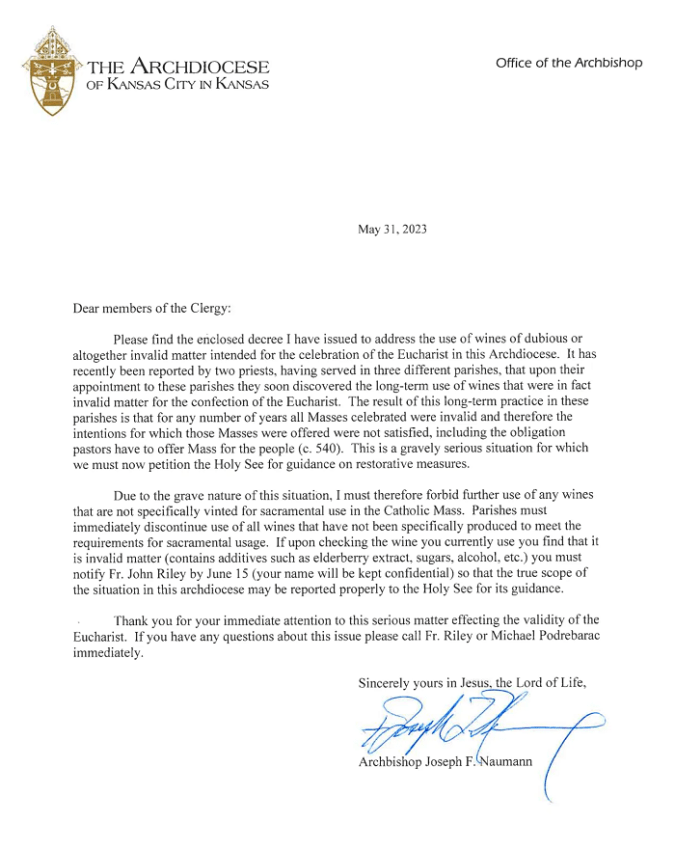
If you have trouble reading that, here’s the text:
Dear members of the Clergy: Please find the enclosed decree I have issued to address the use of wines of dubious or altogether invalid matter intended for the celebration of the Eucharist in this Archdiocese. It has recently been reported by two priests, having served in three different parishes, that upon their appointment to these parishes they soon discovered the long-term use of wines that were in fact invalid matter for the confection of the Eucharist. The result of this long-term practice in these parishes is that for any number of years all Masses celebrated were invalid and therefore the intentions for which those Masses were offered were not satisfied, including the obligation pastors have to offer Mass for the people… This is a gravely serious situation for which we must now petition the Holy See for guidance on restorative measures. Due to the grave nature of this situation, I must therefore forbid further use of any wines that are not specifically vinted for sacramental use in the Catholic Mass. Parishes must immediately discontinue use of all wines that have not been specifically produced to meet the requirements for sacramental usage. If upon checking the wine you currently use you find that it is invalid matter (contains additives such as elderberry extract, sugars, alcohol, etc.) you must notify Fr. John Riley by June 15 (your name will be kept confidential) so that the true scope of the situation in this archdiocese may be reported properly to the Holy See for its guidance.
Thank you for your immediate attention to this serious matter effecting the validity of the Eucharist…
It is times like these that I wish old Ethics Alarms commenting star tgt was still around. His epic battles with Michael West will be sung about by troubadours until the stars grow cold. Tgt was an icy-eyed foe of religion, and a story like this would have surely generated an epic Comment of the Day.
I’m not quite in tgt’s league regarding disdain for organized religion, but what an ethics mess. The Catholic Church requires all wine used for communion to be made from grapes without any additives: after all, it is supposed to be the literal blood of Christ. Additional flavoring, sugar, alcohol makes it “invalid matter.” The Church has lists of local wineries that produce wines that qualify as “valid matter” that Catholic priests can use; it also apparently has black lists of blasphemous brands that may promote their wines as “sacramental” when they are not.
How many masses have been held using “invalid matter,” thus rendering the masses themselves invalid? How many other masses around the country have been held using similarly taboo wine, and are similarly invalid? What is the remedy for that?
The Catholic Church can’t exactly say, “Oopsie! Well, it no big deal, the whole ritual is just symbolic anyway.” The whole structure of Catholicism is based on faith that these are more than just traditions and symbols. To paraphrase Old Lodge Skins in “Little Big Man,” either the magic works, or it doesn’t. All of these devout Catholics trusted priests to make the magic work, and suddenly they are told that it didn’t. Rules are rules: this isn’t just ethics but morality at stake. The 2004 document “Redemptionis Sacramentum” released by the Congregation for Divine Worship states (I almost said “clearly”) that invalid wine nullifies the liturgical act:
“The wine that is used in the most sacred celebration of the Eucharistic Sacrifice must be natural, from the fruit of the grape, pure and incorrupt, not mixed with other substances… It is altogether forbidden to use wine of doubtful authenticity or provenance, for the Church requires certainty regarding the conditions necessary for the validity of the sacraments. Nor are other drinks of any kind to be admitted for any reason, as they do not constitute valid matter.”
Explaining how serious this is, or should be, if the sacraments have any integrity, Hemant Mehta writes,
...a similar mistake occurred a few years ago when Father Matthew Hood, a priest from Detroit, found video evidence that he was never truly baptized because his priest used the phrase “We baptize” instead of “I baptize” when performing the ritual on him, and therefore, it didn’t count.
In Hood’s mind, if he wasn’t baptized as a baby—and he technically wasn’t—then he wasn’t ever really a Christian…And if he wasn’t a Christian, then he couldn’t really be a Catholic priest no matter what he did in seminary. And if he was never a priest, then just about all the rituals he performed “pretending” to be a priest were also invalid.
That mistake…meant a whole bunch of people were destined to go to Hell for eternity…It also meant there was no recourse for people who had been fake-baptized by Hood and died before his discovery….
Just consider the confession booth. If someone confessed their sins to Hood…Those people were technically still unrepentant sinners because they didn’t confess to a real priest…What about Last Rites? If he cleansed the sins of people on their deathbeds, supposedly preparing their souls for the afterlife, it was all for nothing since he didn’t cleanse them of anything.
Mehta is a tgt-scale athiest; I omitted his many snide swipes at the Church, Christianity and religion in the section above. He is correct, however, that if the rules dictating how the various sacred rituals are performed aren’t followed, the Church cannot shrug it off as “close enough” and claim any integrity whatsoever. Or is the solution some sort of a Voodoo-like theory that as long as you believe it, it works?
This reminds me of one of the disputes in the Florida recount chaos in the wake of the 2000 Presidential election. One confused idiot cast a punch-out voting card that he had just scrawled with “I want to vote for Al Gore!” Democrats claimed (of course they did) that since his intent was clear, it was a valid vote. No, it was not. If clear violations of the voting process aren’t enforced, then there are no standards or rules. If that ballot is valid, why can’t someone just run into the middle of the street, shout out their name and preferred candidate, and say they voted?
The same principle applies here. What the priests in Kansas City did was unethical and immoral. The Catholics who trusted them are victims: the Church must make them whole. It seems to me to be an existential crisis. If the Church says, “It’s OK, we’ll let it go this time,” why would anyone continue to believe in Roman Catholic theology?
And again, how many other priests have been using invalid wine, and for how long?
 Ethics Alarms
So what the dioceses are saying is not that only certain wines will transmogrify into Jesus’ blood, but that if this “rule” is not followed the entire sacrament will be ignored by the Church itself. Too bad: as silly as it is, I was hoping that the magic (or miracle) could not happen without the basest of red wine. No: in fact according to the letter, is it an administrative decision with nothing to support it, but still is guaranteed to horrify Roman Catholic believers and send them straight to hell (or purgatory). Wise decision. No wonder the Roman Catholic Church is losing so many members.
I should like to remind people of Christ’s attitude towards the pharisees.
While the Catholic church has many traditions I admire (injecting a bit of reverence for God in certain ways) there are some issues when one looks at how and what Christ taught.
Righteousness does not come by anything man does, but what Christ has already done. And that not of ourselves, lest any man should boast.
What I’m still learning the hard way is that the Christian life is hard to live absent the spirit. When I simply trust this Jesus character and what he says and how he says to worship, my life turns in ways I didn’t imagine.
Seek first his kingdom, and all these things…. When I live by trying to “follow the rules” (in this case, the type of wine used), life just seems harder – and in that sense, I’m doing it to myself.
Jesus never healed anyone the same way twice, and no reverent act done the same way all the time every time begets righteousness or salvation, so the church in this case should stand on that fact.
It’s ok to be reverent and say “we wish to honor God by using the best ingredients in this solemn tradition”, but salvation comes by faith in Christ, and the “proper” response is to say if one partook of the sacrament in the spirit of faith in honoring Christ, Christ accepts that.
Anything else is straining a gnat.
Inevitably, someone will point to this event and say what foolishness religion creates. Yes, well, welcome to mankind. What thing haven’t we touched and turned in to complete stupidity? Or, as Jack has pointed out and I’ll slightly modify, turned in to “The Great Stupidity”.
I’ll end with my pastor’s response to, “I don’t attend church, nothing but a bunch of hypocrites.”
“Come on down, we’ve always got room for one more!”
This is a matter of obedience. The bishop said, “Use wine from these wineries”. The parishes in question did not. There is nothing “hard” about following this rule.
Sir, my only question is obedience to whom?
The bishop, who is responsible for sacramental integrity within the diocese. He gave a list of approved vendors, some parishes if ignores his instructions.
Here, here.
The Old Testament Jews had to follow every tittle of the Law of Moses to be free from sin. Over time, the religious leaders added more and more rules to it.
For some reason, the original Church morphed into a series of rituals and dogma that I believe gets between God and mankind and makes it just as burdensome as the rules of the Pharisees.
A friend who is a Lutheran minister recounts the tale of going into a liquor store and asking if they had any sacramental wines. The clerk replied, “No, but we have some nice Napa cabernets.”
There is no Biblical basis for the restrictions on the exact nature of wine used in the sacrament. It is all just an accumulation of church rules and doctrine handed down over the centuries. Seems to me a great triumph of form over substance.
I thought that if the pope said they could use red Mad Dog 20-20, that would make it okay, him being infallible and all. Gee, it is good to be a Protestant!
“…why would anyone continue to believe in Roman Catholic theology?” Why indeed.
Having grown up in the Lutheran church (my father is a Lutheran minister) I can tell you that the wine used for communion is usually Mogen David or Manischewitz – which I always found oddly amusing.
Exactly the kind of wine Jesus would drink.
-Jut
Ha!
Yes, I have found the kosher wines prevalent in Protestant communion.
As a lapsed Catholic son of a wonderful, devout, Irish Catholic mother who, thankfully, died before the priest pedophile stories broke, all I can say is “Oy vey.”
You know, I just watched an episode of “Gilligan’s Island” in which the Howells find out – via the very convenient radio – that the minister who officiated at their wedding was a fraud so they’re not legally married. There’re hijinks that follow but no one thinks to just say, “Hey, you’ve lived as a married couple for years and years. Nothing has changed!”. And, of course, the thing turns out right in the end anyway.
If you had a mass performed over you that you believed was legit, isn’t that between you and God? When my church shut down for months during the early part of the pandemic, we used cranberry juice and Ritz crackers for communion. It never occurred to us that our prayers before God could be invalid because of the stuff we used.
I believe there will be many Catholics in Heaven. But I’m so glad I’m not beholden to how well a priest follows a ritual to have a relationship with God.
You know if ever there was a case where ‘What Would Jesus Say?” would be appropriate, this is it.
Do we really think he would condemn all these believers to Hell because their priest didn’t follow a ritual exactly? I think he’d be casting out that archbishop as he did the Pharisees. My sisters have worked with RCIA for several decades — this is not the sort of thing I hear from listening to their conferences.
Even when you are merely a degree off heading, every 60 miles you travel puts you one mile off course. Like all organized religions, the Catholic Church is now a scam on people, preying on fear and guilt to keep them in line.
Is there a god or isn’t there a god? Does god care if you believe? Some suggest that these questions have answers. Are these even relevant questions?
What is known, is that cause and effect rule the universe equally, and two sides of an equation are always equal. Just spend time observing the world and you may agree that if you act selfishly, sometimes you get hit with a pillow and sometimes you get stabbed with a knife. I think Jack calls it “moral luck”.
Some people profess to “believe” a man who said that the Kingdom of God is within you. The path to that Kingdom is to act unselfishly here, and you get to experience that Kingdom now.
I would have more sympathy and respect for the Catholic Church if it spent less time on crap like this and more time on addressing the clergy sex abuse (by both getting rid of abusing priests instead of protecting AND standing up more to “activists” and “journalists” using this issue as pretext to attack and weaken organized religion), standing up to anti-Catholic/anti-religious hate group masquerading as something else (like LGBT activist group), and standing up to catholic politicians pretending to be “good” Catholics while undermining every pillar and value of the religion.
Ron
I totally agree.
Just a few points to clarify my perspective. I am a recovering Catholic and I generally reject the doctrines of all the religions of which I am familiar. I am, however, a spiritual individual much along the lines of a Deist. I view spirituality as my relationship with God and religion is someone else’s view of what my relationship with God should be. My problems with the Catholic church began in the third grade when a nun teaching me catechism stated that Catholicism was the only true religion. Since I had Jewish and non-Catholic Christian friends, her position just didn’t seem right to me even then. My displeasure with the Catholic Church reached its breaking point when the complicity of the church in hiding and condoning pedophilia by their clergy became public. Given that fact, I had difficulty accepting that “The Church” was really in the morality business.
Regarding the wine issue or any other rules and rituals the Church follows; provided they are not violating any governmental laws; they can do anything they want. They are a private club. What you or I may think is ridiculous is irrelevant. Likewise, I could care less if you worshipped a table lamp as our higher power.
Ron,
I would argue that the Catholic Church has done a much better job at responding to the clerical sex abuse scandal than it has it protecting the sacred elements of the liturgy and sacraments. There’s a push in the United States dioceses currently to try to combat the statistic that almost 70% of American Catholics do not believe in the Real Presence in Eucharist. The Eucharist, which we describe as the “source and summit” of our faith, our bread from heaven, our spiritual food for the journey, our daily bread for which we pray in the Our Father! Somehow we’ve so seriously dropped the ball that most American Catholics cannot articulate that in the Mass, during consecration, the bread and wine are transubstantiated into the body, blood, soul, and divinity (meaning the whole, the entire) of Jesus. Maybe people trip over the big word, but they should be able to state that while the appearance of bread and wine remain (and yes, EC, it will look like bread and wine under a microscope) the what the bread and wine are change. That they can’t articulate this is a big scandal in and of itself.
Since the sexual abuse scandal broke, the Catholic Church has implemented measures across the board to combat abuse. It has tightened its vetting of priests. It has adopted a zero-tolerance policy that is now sweeping far more innocent priests in its dragnet than abusive priests, because whenever there is a credible accusation, the priest is immediate removed from active duty. It has required all parishes to produce plans to ensure that no one has the opportunity to groom or abuse children. It has also set aside millions of dollars for reparation, treatment, and other services for victims. The response has been so broad and so thorough that the reporting rate of new cases has plunged to almost nothing. (The vast majority of cases that are making headlines are from decades ago. It is outrageous that they happened, absolutely, but since these occurred prior to the changes the Church has made, those cases cannot be held as evidence that the Church has not been trying to address the issue.)
Both the loss of understanding of the Eucharist and the sex scandal have something of a common source, which is poor catechesis. If the people are not taught the faith, they cannot faithfully hand it on themselves. Nor can they defend their faith against the incursion of error, and there are many people from both within and without the Church that seek to get the faithful to embrace error. The desire to modernize the Mass in the aftermath of the Second Vatican Council was to address two major concerns. First, the Tridentine Mass, predominantly in Latin, had become a ritual in which the faithful came, sat, made gestures and responses, all without understanding what was being said, and increasingly often not understanding even what was happening. Second, the Council thought it appropriate to return the Mass to the liturgical forms practiced in the early Church, which includes such minor changes as the priest facing the congregation, and including Old Testament readings. But what many factions saw in the revising of the liturgy was an opportunity to hijack the Mass and make it into their own thing. For a period in the 1970’s, there were parishes that baptized with elements other than water (even beer!), and tried to confect the Eucharist with elements other than wheat bread and grape wine. These abuses to the liturgy have largely been stamped down, but there are still places that struggle with improper liturgical practices. And this struggle persists because the faithful have not been well-instructed in what the norms are and why they are.
This leads to the biggest issue, which is the loss of understanding of matter. Catholics are not Gnostics, who hold matter to be evil. Nor do Catholics profess a modified thesis in which matter is simply irrelevant. Instead, Catholics are steeped in matter, and the idea that matter matters. The Seven Sacraments all have a material component to them, and cannot be effective (normally) without them. Baptism requires water. Confirmation requires chrism. The Eucharist requires bread and wine. Confession requires a priest who can hear the sins and speak the words “Your sins are forgiven”. Anointing of the Sick requires oil. Holy Orders requires a man. Matrimony requires a man and a woman. The Sacraments speak to mankind both spiritually and physically because man is fundamentally a spirit/body composite. We are not simply ghosts in a machine, who are either freed when released from the body or are still complete when separated from the body. We require our bodies in order to be a whole person.
This then shows why this issue with the invalid wine is a problem. The deeper problem of not understanding, or perhaps even rejecting, the core principle that matter is important tears down the faith the way a worm can sicken and kill a tree. If matter is not important, then why is it important that Jesus was a man, not a woman? If matter is not important, why is it important that a priest be a man? If matter is not important, why is it important that marriage be between a man and woman? Why should sexual expression be contained within marriage? Why should my physical presence matter at Mass? Why should my physicality be constrained in any way? Yes, I am drawing a line from rejecting grape wine for the Eucharist to the trans craze infecting our nation. If you don’t understand why matter matters, there’s no good defense against the idea that a person could be trapped in a body of the wrong sex.
Of course, poor catechesis also leads to grave ills such as the majority of Catholics voting for a man who professes to be Catholic and yet publicly denies many Church doctrines on morality. Bishops and priests cannot alone be responsible for calling out unfaithful politicians. They are responsible for their flocks, yes, and if that politician is in a particular bishop’s flock, that bishop should rightly seek to correct that politician. But the entire flock should be able to recognize when a politician is being unfaithful to Church teaching. The entire flock should also be able to recognize anti-Catholic groups and have good defenses prepared against them. Unfortunately, there’s a big gulf between “should” and “is”. But I firmly believe that poor catechesis is at the heart of the Church’s issues (well, that, and original sin and its effects, and the Devil and all his fallen angels…), and much can be corrected through good catechesis.
The controversy posed by the original topic has subtle echoes of the Donatist controversy of the early centuries and the work around for this situation will also be subtle echoes of how that controversy was solved.
But on this:
“The deeper problem of not understanding, or perhaps even rejecting, the core principle that matter is important tears down the faith the way a worm can sicken and kill a tree. If matter is not important, then why is it important that Jesus was a man, not a woman? If matter is not important, why is it important that a priest be a man? If matter is not important, why is it important that marriage be between a man and woman? Why should sexual expression be contained within marriage? Why should my physical presence matter at Mass? Why should my physicality be constrained in any way? Yes, I am drawing a line from rejecting grape wine for the Eucharist to the trans craze infecting our nation. If you don’t understand why matter matters, there’s no good defense against the idea that a person could be trapped in a body of the wrong sex.”
None of these questions have an inconsistent answer if you don’t adhere to sacramental theology and also saying “not a big deal that the Lord’s Supper is memorialized by something other than wine coming from a particular vendor – what’s important is the heart of the celebrant.
Michael,
The controversy posed by the original topic has subtle echoes of the Donatist controversy of the early centuries and the work around for this situation will also be subtle echoes of how that controversy was solved.
There are similarities, but keep in mind that the Donatists held that the efficacy of the sacraments depended upon the holiness of the minister, and the Catholic Church declared that such a stance was untenable. Since no one can know the hearts of other men (apart from some scant few who have been given a special grace to do so), the faithful could never be sure the sacraments were effective. The priest could always be hiding some secret sin that would disqualify him, and that doubt would destroy any faith in the validity of any sacrament, and ultimately it would ruin the whole Church.
So in this case, we have the validity of the sacraments in question regarding the matter that was used. And the Church has taught pretty consistently on this, especially in light of difficult situations like gluten-intolerance and alcoholism, that the Eucharist must be confected from wheat bread and grape wine. The distinction is by far more clear than with the Donatists, because one could conceivably determine that the wine is not grape wine, or at least not purely grape wine, from taste or experiment, or from observing where the wine came from.
None of these questions have an inconsistent answer if you don’t adhere to sacramental theology…
I agree and I disagree. I agree because there are coherent ways of answering those questions apart from sacramental theology, but I don’t think we’d agree how those questions would be answered. I wish I had more time to wax eloquent on my thoughts about different paradigms, and how the different views of teleology and eschatology impact ontology, and how that impacts ethics itself. But in short, when you shift the paradigm, the view of the nature of the human person shifts, as well. In the short run, the changes seem small enough that there isn’t an iota’s difference, but in the long run I think those differences accumulate to an irreconcilable conflict. Anyway, I hope I’ll be able to write more on this later.
This sort of nonsense is what happens when people don’t learn how to see things from an existentialist perspective. If people don’t functionally define the goals they’re trying to accomplish with rituals, then the rituals may not accomplish those goals no matter how strictly people follow the instructions.
All abstract concepts, including spiritual ones, can be defined from the ground up, starting with concrete, observable experiences and the predictions we make about them. If people lose track of where concepts come from, those concepts start becoming empty words, like “holy.”
Bad Bob and others already pointed out the relevance of Jesus of Nazareth’s description of Pharisees metaphorically straining at gnats, emphasizing superficial rituals and neglecting spiritual matters.
Also, that last paragraph in the letter should say “affecting [influencing, altering] the validity of the Eucharist”, not “effecting [causing] the validity of the Eucharist”.
I did have fun making a list of riffs, though:
1. We’ve replaced the communion wine with Folger’s instant wine crystals. Let’s see if Jesus notices.
(Well, we already established that mortal sommeliers can’t judge how fancy a wine is without looking at the label. It turns out neither can the divine ones.)
2. Maybe the real Catholicism was the cultures we obliterated along the way.
3. Double-blind testing with a placebo reveals that wine quality in a Catholic Mass has no effect on the relationship between a human consciousness and a completely unfalsifiable higher power.
4. Given that Mass can be facilitated without the use of sacrament wine, we have ruled out sacrament wine as a necessary factor in the generation of Higgs bosons.
5. Notice: If valid communion wine is unavailable, please obtain potable water and submit a prayer for Jesus Christ to convert it into valid wine prior to the transubstantiation. We appreciate your flexibility.
6. Headline: Pope performs emergency ritual to retroactively sanctify Mass.
To fix the errors of fallible priests, the Pope communes with God and infallibly declares that God says He will make an exception just this once, but seriously, don’t do it again.
7. Alternatively: The Pope relays God’s message: “Look what you made Me do! You got the wrong wine and now I have to send all these people to Hell! Do you think I like imposing completely unnecessary consequences when your otherwise harmless actions go against My commands? You better be grateful I love you, because you don’t deserve it! Now beg Me for forgiveness, sinner!”
(Did you feel like a god / when the mortals all drowned? / Do you feel better now? / They all are Hell-bound…)
Most everyone’s comments here are from the perspective of non-Catholics. As a protestant, I can readily say “seriously? This isn’t that big of a deal, it’s pretty obvious the solutions here.”
But that doesn’t answer the ethics of the problem – wherein, inside the Catholic community, some premises that we don’t share as non-Catholics, are Deadly serious. Within the realm of those premises – which all participants in the community have agreed to – we have to treat as ethical breaches of great consequence.
And yes, the Catholic Church here looks like it is aiming to figure out the scope of the injury with an ideal aim to remedy the effects.
Oh, I absolutely agree that this event constitutes an ethical breach, a violation of trust and duty on the part of the priests responsible.
I also hold that it highlights how Catholicism takes meaningful aspects of life such as behavior, material form, ritual, and life milestones, and assigns them additional meanings that are both superfluous and vacuous. Those stapled-on meanings might be intended to get people to take those aspects of life more seriously, but often they just end up supplanting the original meanings and causing people to develop unhealthy relationships with those aspects of life.
It always boggles me that humans are able to act as though arbitrary, inconsistent, or existentially incoherent statements are somehow self-evident. That may just be what happens when most people lack existential literacy.
What I deduce from my observations of Earth is that if there is some sort of caretaker deity for humanity, it is not trustworthy in the slightest, and if it ever intended to impart any message of wisdom to humanity then it is an abysmal teacher. I am certain that humans can do better than what they have “learned” from their ancestors’ confusion and manipulation, and I intend to prove it.
The first thing to note about this issue is the rules on what is valid wine in a Catholic Mass. Valid wine is wine that a reasonable person could reasonably be expected to recognize as grape wine. FULL STOP.
Wine that is valid includes red wine, white wine, white wine made from red grapes with the skins removed, rose wine, sweetened wine (yes sugar is valid), dry wine, and fortified wine up to 18% alcohol. What is not allowed is wine made of other fruits, other alcohols like beer or whiskey, water, grape juice, cranberry juice, or port. For a priest to not follow this REALLY SIMPLE rule is much like when I tell my kids to go upstairs clean their room and them going downstairs and throwing train tracks at each other. This is a big deal. This requires a sub room temperature IQ or outright disregard for the rules.
Not all of those drinks are LICIT but they are valid. That is a very important distinction that few outside of the Catholic faith, and not very many inside of the faith understand the distinction of. Invalid matter does make the celebration invalid. Illicit matter does not invalidate the Mass. There is a degree of debate going on as to whether the wine used was invalid or illicit.
So what is the Catholic Church, and specifically the diocese doing about this? Well, the bishop has written the document above, tightening screws far tighter than they are originally supposed to be, so that his disobedient sheep (we use the shepherd metaphor pretty literally) will get in line. This, using the analogy of my children above, is much like my requiring that all baseboards in the house be polished each day after I spent an evening cleaning up train tracks and removing a running train from the screaming four-year old’s hair. The bishop has also petitioned the Vatican to make a ruling on the situation. There is no public information that I can find on the exact nature of the invalid wine. If the Vatican comes back and says the wine is valid, the bishop was mistaken, or this really can be considered an invalid wine, then steps will need to be taken. Anything else is premature.
I will point out that the Catholic Church teaches that intention has a huge effect on the action taken. If one intends good, he is held to that which he intends. The faithful are required to perpetually inform themselves of what is good, what is right, and what is just. Did the laity commit idolatry because they worshiped bread and wine, rather than the Body and Blood of God? No. They believed, and had every reason to believe, that the Eucharist was validly confected.
The Church holds that things are held to a scale of intent, knowledge and import. For an example, the Catholic Church holds that permanent sterilization of one’s self for the selfish reason of having no children is grave matter, something that MAY be mortal sin. Let us consider three women: one who has cancer, one who wants to sterilize herself but has never heard that it was wrong, and one who wants the sterilization and knows it is held to be wrong, but will do it anyway. The first woman has no guilt imputed to her whatsoever. She is sterilizing herself, but not because she doesn’t want kids. She is sterilizing herself as a side effect of curing her cancer. The second woman sins, but not to the degree that she denies God, what we call a mortal sin. Upon learning of her sin, she is to repent of it, but is not condemning herself to hell. The third woman, who knows what God wants and refuses to do it, is probably condemning herself to hell, unless she repents at a later date.
I give you all this information to answer the question: what does this truly mean for the faithful in this instance? Well, really not much, at least not yet. We have covered this years ago, laying the foundations for this beginning the debate in 303 AD and the doctrine stated unequivocally in 413 AD. Currently, the phrasing most important to this issue was restated in 1983, strengthening the statements dating from the fourth century. Canon 1248, paragraph 1 states: “The precept of participating in the Mass is satisfied by assistance at a Mass which is celebrated anywhere in a Catholic rite either on the holy day or on the evening of the preceding day.” If the priest messed up the Mass, the faithful still did their best to follow the law of God. They went to Mass, participated to the best of their ability, and tried to follow the law. Those that learn of this, should make sure to go to Mass and receive the Eucharist validly, but there is no sin imputed to them. One who has received an invalid First Communion (the only thing that this affects) should talk to a priest (ideally not these priests) and make sure that they are ok going forward. They may need to make their First Communion again. However, little can be done until the Vatican rules on this.
It is the souls of those priests that are in danger, not the souls of the laity, from this action, except as this causes scandal and causes people to turn from God’s Church, especially with all the misunderstandings that follow from this. This is serious, but the people who are harmed are few, and those not badly. Also, this is not just a hand wave of “no it doesn’t matter,” but instead the first steps in rectifying the wrongs.
Fantastic comment.
I was raised non- denominational, scripture based church, and always took communion with grape juice until recently when it was obvious that the one of the Wuhan individual sealed rice-cracker and juice packs I’d been served had fermented.
Ephesians 2, the verse explaining faith but not works is what leads to salvation was usually cited as the case against Orthodox ritualism. I was taught that the tearing of the tabernacle curtain at the crucifixion was the reason sins were confessed in private prayer and not to a priest.
Can salvation come solely from faith in ritualism though? No. Clearly not, that’s exactly what the letter to the Ephesians was about. Then it also stands that a ritual that didn’t follow the rules doesn’t condemn the participants, willing and knowing or not.
Is ritualism adjacent to faith in salvation by redemption harmful? I don’t think so. But elders and clergy should be careful not to get in the habit of selling ritual instead of faith, like indulgences to their followers.
Now that I got that all out, I’ll get to a question that has bugged me for years. My second child was born in a Catholic hospital, and while under the doctors knife and anesthesia she was asked about sterilization. I complained then that the timing of the question was inappropriate, and did again later to another doctor who worked with the health system and that other doctor also didn’t seem to have an issue with it. But now realizing that it’s additionally putting the patient in a state of sin under Catholic doctrine just adds more questions.
Thoughts?
First, regarding the question you had involving the sterilization, I must say that just because someone or some organization CLAIMS to be Catholic does not mean that they are faithful to the Catholic Church. I give you exhibits A, B, and C: Joe Biden, Nancy Pelosi, and Catholic Charities. It has been a scandal of decades that certain Catholic hospitals have not been Catholic at all. It is absolutely revolting that they ask that question as they do. That question was asked of me at all my children’s births as well. The hospital I went to was not remotely Catholic, and it was asked of me at my pre-labor check-in, as well as my in-labor check-in. 37 weeks pregnant is not a good time to decide about sterilization, as you are (or I was, times four) so miserable that you’d just about sign anything if you could get sleep. Active labor is even worse. Doctors, nurses, and administrators still think it’s ok, and I argue that it is horribly unethical, but I feel that many medical practices are pretty unethical now, as we do not give informed consent in a reasonable environment. There is a logical reason doctors ask that question, especially in a C-section, since they already have you cut open and can more easily perform the surgery without a bunch of extra risk to the patient, but I still believe that it is an inappropriate time. That’s my soap box.
For a Catholic hospital to offer sterilization to your wife on the table, or at all, could get them in a great deal of trouble with the bishop. Assuming a good bishop (the US has some great ones, and some that are no more Catholic in approach than Uncle Joe), this could really harm the hospital’s “Catholic” status, unless there are immediate steps taken.
Now I’m going to comment on some of the rest, since you asked for thoughts. You shouldn’t ask someone like me for thoughts in such a broad manner. I’ll take it as permission to give too many. But you did, so here we are. I am not trying to convince you that you need to be Catholic, just that Catholics have thought about these things you are concerned about. I’ll reference the Bible, but this isn’t meant to be verse slinging, so much as to show that this has been thought about in reference to the Bible. We aren’t on the right forum for verse slinging and theological debate. I will say that the catechism of Catholics in the US and most of Western Europe has been horrible for at least three generations. It was complained about by the popes in the 1800s as an area that needed work, but now it has reached a nadir. The Church has had to change how it teaches, and while inroads are being made, most Catholics can’t explain the meaning to anything we do.
You reference Ephesians 2 in regards to works and faith. I will say that for any place that we discuss faith and works with faith being emphasized, there is at least another passage where works are emphasized. Romans 2:6, another Pauline commentary, discusses works. Matthew 25:31-46, Galatians 6:7, and James 2:14-26 are among the passages that Catholics love to discuss. What we believe is, in modern terms, is that we must “embrace the healing power of and”. There must be faith and works. This means that we must both believe and ACT AS THOUGH we believed. Most of the elements of the Catholic Mass can be tied back into some combination of Old Testament activities, and documents dating even as far back as the first century describing how the apostles taught us how to worship. Catholics also believe we have to confess to the priest. We believe that the tearing of the veil was the opening of Heaven for us. It did not remove the priesthood. Hebrews reminds us that Jesus is the High Priest forever. Jesus shares his priesthood with the apostles when he says that “those sins you forgive will have been forgiven and those you retain will have been retained.” We can see that after his death, the priesthood continues, and the forgiveness of sins was always one of the primary jobs of the priesthood, we firmly believe it should continue, and that Jesus commanded that it is the proper way of receiving forgiveness of sins.
Salvation, to a Catholic, means more than just ritualism. The Mass is not a ritual. We are taught that it is the closest thing to Heaven we can see on earth. It is a beautiful, formal declaration of God’s extreme love and is a simple response from us. Every action the priest takes in Mass has huge significance with Biblical, historical, and traditional meaning, and every response by the parishioners has just as much significance. However, very few people know what all this means. I have been studying it recently and have learned more about my faith than I could have comprehended when I was a child. Ritualism helps us continue all the significant demonstrations, while allowing for easy teaching. However, we fail to catechize ourselves and our children well enough to remember what it means and it becomes a hand wave. The second Vatican Counsel tried to remove a certain degree of mysticism because the Magisterium felt that some elements of the faith were becoming too ritual and less focused on God. We believe that MUST have a personal relationship with God, close enough to call him Daddy, the translation of Abba, but while never forgetting that he is so holy as to require a degree of reverence that has basically been lost in modern society. It’s a hard line to walk.
In conclusion, Catholics, at least properly catechized Catholics, of which there are probably three in the US (and I’m not one), know how to use rituals to help worship God in all solemness while cultivating a profound personal relationship with him.
Thank you for answering broadly. I respect Catholicism more and more as I learn more about it. Much of cross-denominanational discourse is one side taking pot shots at others that don’t fully understand the other.
Once took a ‘religion that fits you best’ quiz online, and it suggested Religious Society of Friends, so perhaps there’s some innate distrust of hierarchy.
It could have been worse: they might have used Bud Lite.
Bravo.
I did a quick search, and the use of beer in the liturgy was condemned in the 13th century by Pope Gregory IX, when it was discovered that some Norwegian parishes were baptizing with beer because of a water shortage.