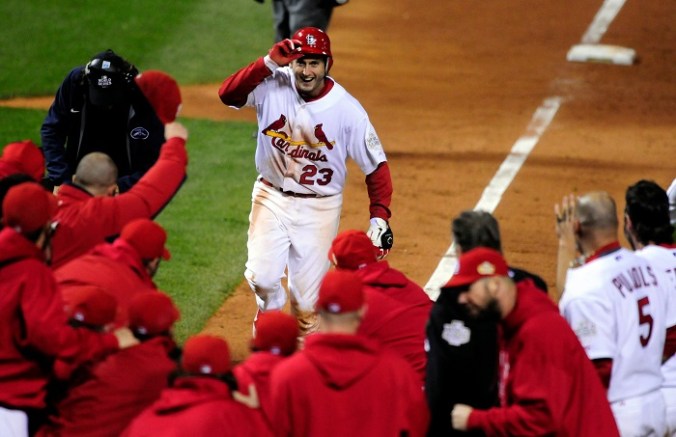
Former MLB player David Freese was voted by St. Louis Cardinals fans into the team’s Hall of Fame. To everyone’s surprise, he declined the honor.
“This is something that I have given an extreme amount of thought to, humbly, even before the voting process began,” Freese said in a statement. “I am aware of the impact I had helping the team bring great memories to the city I grew up in, including the 11th championship. I feel strongly about my decision and understand how people might feel about this. I get it. I’ll wear it. Thank you for always being there for me, and I am excited to be around the Cardinals as we move forward.”
He also said that he did not feel “deserving” of the honor. “I look at who I was during my tenure, and that weighs heavily on me,” said Freese, who recived the most votes of any former Cardinals player for induction in online balloting. “The Cardinals and the entire city have always had my back in every way. I’m forever grateful to be part of such an amazing organization and fan base then, now and in the future,” he said. “I’m especially sorry to the fans that took the time to cast their votes. Cardinal Nation is basically the reason why I’ve unfortunately waited so long for this decision and made it more of a headache for so many people.”
Perhaps you will not be surprised to learn that Freese has battled clinical depression his entire life, and is a recovering alcoholic.
Freese is fondly remembered by Cardinals fans despite a solid but not great major league career. He had one brief shining moment in 2011, becoming the World Series National League Championship Series MVPs while driving in 21 runs during the 2011 postseason, a record. In the World Series, Freese hit .348 with seven RBIs, three doubles and an dramatic Game 6 home run that kept the Cardinals alive in the series against the Texas Rangers. He spent just five of his 11 MLB seasons in St. Louis.
The Cardinals Hall of Fame honors many of the greatest players in baseball history, like Dizzy Dean, Stan Musial, and Bob Gibson, as well as well-loved stars who didn’t quite measure up to Cooperstown standards, like Curt Flood, Joe Torre and Tim McCarver. It also contains a few far less impressive players who were fan favorites for one reason or another, or organizational veterans. For example, elected with Freese to the Cardinal Hall was long-time Cards utilityman Jose Oquendo, whose mediocre career makes Freese look like Mike Schmidt.
There are two ways of looking at Freese’s decision:
Pro: He’s standing up for the integrity of the process and the institution. He is correct that he was not a great player or even a star, nor was he one of the Cardinals’ career-long veterans. There is a valid argument that watering down the quality of a Hall of Fame’s members reduces the honor for everyone. )I subscribe to that argument. (See: Barry Bonds) Speaking of Bonds, Freese is also injecting his own “character clause” into the process, like the Major League Baseball Hall of Fame in Cooperstown, which requires inductees to embody good character and sportsmanship in their baseball-related activities. If anyone knows what Freese’s character was while he was playing, it’s Freese, and he feels it wasn’t up to par.
Con: It’s the fans who vote, and the fans’ choice to make. The Hall of Fame at Cooperstown specifically states that a single achievement cannot justify enshrinement, but the Cardinals version does not. Freese’s homer in Game 6 particularly is one of the highlights of the venerable franchise’s entire history.
Speaking as a Red Sox fan, I join my fellow Red Sox Nation members in holding Dave Roberts, now manager of the Dodgers but in 2004 a late -season pinch-running specialist, substantially responsible for the team beating its “curse” and finally winning the World Series. As a pinch-runner in the 9th inning with the Red Sox facing elimination in a sweep by the hated Yankees in the American League Championship Series, he barely stole second base and subsequently scored the tying run, leading to Boston’s historic comeback and eventual World series victory against…the Cardinals! I’d vote for Roberts to be in the Red Sox Hall of Fame. (Let’s see…nope, Dave is ineligible because he didn’t play for the Sox at least three years.)
Your Ethics Alarms Post-Juneteenth Ethics Quiz is….
Is Freese’s decision ethical, or unethical?
The story immediately reminded me of this one, from last year, when Dolly Parton earned an Ethics Hero honor here for withdrawing her name from the Rock ‘n Roll Hall of Fame on the grounds that she hadn’t sung any rock of note, and didn’t deserve the honor. There are some material differences, however. In pop music, the Cleveland-based Hall is the equivilent of Cooperstown, where Freese couldn’t get admitted without a ticket. Moreover, Dolly collected her Ethics Hero and then changed her mind and accepted the Hall of Fame’s call after all. So much for standing up for integrity. (And she didn’t even give back her ethics hero award!)
 Ethics Alarms
(I know, I know, that mysterious little “1” is back. It’s just WordPress messing with me…)
I remember David Freese as a baseball player, not because I’m a Cardinals fan but because he broke my heart in 2012 when he was a major reason the Redbirds defeated the Washington Nationals in the NL Division Series that was DC’s first postseason baseball in decades. (I know, making a grownup little kid sad over a baseball team isn’t an ethics issue, but I thought I’d mention it anyway.)
I’m so old I always got him confused with Gene Freese.
I may still have a Gene Freese baseball card, clipped from the back of a Post cereal box. I confess I’d forgotten he’d ever existed.
David was much better than Gene.
In 1957 the Cincinnati Red legs had seven players voted into the all star game. I believe that was a promotion sponsored by a radio station and the fans went all in!So when you mention fans voting in a player. I have to take that with a certain cynical eye.
Freese knew he didn’t belong either via longevity or statistically. A Gil Meche ethical approach.
That reads like extremely low self-esteem. He believes he could have and should have been a better player, and he’s just been reminded that he wasn’t. A participation trophy just rubs in the failure.
It’s personal demons, not ethics.
I’ll second “It’s personal demons, not ethics.” That’s the compassionate, and correct, analysis.
It’s ethical, for the reasons you mentioned in the “Pro” section. It’s a dangerous thing to put words in someone’s mouth or thoughts in their mind, but in some sense, that’s what I’m doing in my response, so I apologize to David in advance.
We know David’s history, as does David, and I’m guessing that history has put him in a place where he simply does not think more highly of his baseball career and accomplishments than he ought. He knows who he is, and he knows those that are enshrined in the Cardinals HOF, and he sees a gulf between the two. That’s not to say that Joe Torre or Stan the Man didn’t have personal issues outside of baseball, but Freese knows his career – even without those issues – doesn’t measure up to theirs.
In a world where self-aggrandizement, fame, and a following have become the end goal for millions, a huge kudos to David Freese for giving us a moment of humility and honest self-assessment.
In my mind, he’s an ethics hero.
I’ll take up a little for Jose Oquendo – he one of only eight players to have played all nine positions in a season, per Baseball Almanac: https://www.baseball-almanac.com/recbooks/positions_played_records.shtml.
While not Cooperstown worthy, it probably did warrant a spot for a team’s hall of fame.
As a Brewers fan, I am loathe to stick up for any Cardinal based on the 2011 NLCS.
What’s the opposite of ethics zugswang? I think this is an example, as either choice–to accept the honor or not to do so–is ethical. Accept it because you really are a fan favorite (for good reason) and according to the rules of the Cards’ HOF, the fans get to decide. Or decline it because you played fewer than 500 games for the Cardinals and compiled a .783 OPS in your time with the team: hardly HOF numbers (but yes, way better than Jose Oquendo). Either is an honorable position.
This is, by the way, about the complete opposite of the R&R HOF, which pretends to care what fans think and then proceeds to ignore them, or rather to include a single “fan ballot” as one of over 1000 votes. Seven of the fourteen nominees on this year’s ballot were selected. Numbers 2-5 in the fan voting were not; #13 was. I’m not certain the Dave Matthews Band belongs, but they placed first in the fan balloting three years ago and haven’t even been on the ballot since. The R&R HOF is a scam. The Cardinals’ is not, if we accept it for what it is.
As a side note, I was moved to do a little catch-up with the R&R Hall, and read harsh criticism of The Zombies’ performance at their induction in 2019. The Zombies should have been in the Hall decades ago, and because they don’t get their over-due humor until their are pushing 80, its THEIR fault that they can’t hit the high notes in songs they sang 60 years ago?
Or should they have declined to sing in the interests of integrity?
I have been a passionate Cardinals fan since 1968.
In the 2011 Postseason, David Freese was both the MVP of the NLCS and the MVP of the World Series. The WS Game 6 heroics, when the light shined brighter than mere mortals can fathom – Bottom of the 9th, about to lose the World Series, down two runs with two outs and a 1-2 count – he hits a 2 run triple to tie the game and send it into extra innings.
2 innings later, he hits the game winning walk off HR in the bottom of the 11th.
Not one, but two incredibly heroic AB’s in what is arguably the greatest baseball game in history.
I do not agree with him not accepting his Red Jacket. He could easily in his speech tell us of how unworthy he thinks he is for whatever reason[s]. But with maturity, he should embrace how he was blessed with having one of the greatest postseasons, and in particular, WS game of all time and how beloved he is as a Cardinals player for it. We all know it’s essentially for 2011, duh. But what an epic 2011 it was.
I think he made a mistake here. But what the hell do I know?
Well, here’s one thing you don’t know: That game wasn’t the GOAT in WS history. I watched it too: it was definitely one of the best, but it doesn’t measure up to Game 6 in the 1975 Series, Reds-Red Sox, with Fisk’s iconic homer off the pole in Left.
For some reason I cannot be totally objective about this. I actually don’t remember Freese, but I do remember Game 6.
As a long time Ranger fan, and especially as a long time fan of their play-by-play announcer Eric Nadel (who’s been calling their games since, I think, about 1980) — this was finally their moment, finally the year when they would win the very first World Series title in their history. And they had it in their grasp, more than once. But.
2010 they won their first ever pennant, but they were overmatched in the Series. But 2011 was their year, and they just could not close the deal.
*sigh*
===============
At any rate, if Freese doesn’t want to be in the Cardinals’ HOF, let’s invite him to Arlington. We can have him run over with a Zamboni or something.
Jack, Jack, Jack! Of course you’d say the Fisk HR was a bigger high, you crazy Sox fan, you!
Seriously – It was iconic and arguably the best game ever played, I agree wholeheartedly. Extra innings, on the brink of defeat, and then – how he willed and waved it to stay fair. The only thing that torments me about it was that the Reds go on to win that dang Series.
My enjoyment was undoubtedly enhanced by being at the game, in field box seats with the Reds club contingent, who did not appreciate my loyalties. I’ll always remember literally seconds before Bernie Carbo his the 8th inning, two out, two strike, pinch-hit 3-run homer to tie the game, a Reds exec turning around in his seat and saying to me, certain that the Reds bullpen would secure the win and thus the Series, as the Reds were ahead 3-2 in games: “Hey, you guys should be proud. Nobody thought you’d get this far! Your team put up a good fight.” Then WHAM! Right into the centerfield bleachers.
Sorry to keep this thing going but – I can’t get over you were at that game! What a great memory for you! What a great game to have attended, especially as a Red Sox fan. An All-Timer.
And Carbo, what a character. You can thank St. Louis for him.
Loved Bernie…persecuted because he was the closest thing to an openly gay player Boston had ever seen, and Don Zimmer hated him. His homer, not Fisk’s, was the big hit of that game, as anyone in the stands would tell you. And Bernie looked helpless in his first two swings.
Oh yeah, one of my best memories, baseball or otherwise.
I think the problem here is the system.
You mentioned that the Red Sox require 3 years to be eligible, so he would not have qualified for their Hall of his career had been there.
But, baseball is more than the players who play the game; it is also about the moments in the game that are historical. You mentioned Fisk’s home run; you could know nothing about Fisk, but might still know about the home run. Relating this to my area of interest, I think about Jack Morris single year with the Twins. They went to the World Series with him in 1991. He was the starting pitcher for 3 of the 7 games and completed a 10-inning Game 7 and was the World Series MVP that year.
Playing a single year for the Twins (and going into Cooperstown as a Tiger), he probably will never be a Twins Haller of Famer (I don’t know what the rules are but, with a single year, he is probably not eligible). However, his performance in the 1991 World Series was Hall of Fame worthy; it was a moment like Fisk’s home run, or Freese’s performance that is a defining MOMENT in the history of the team. Though it does not seem that things are run like this anywhere, if I ran the Twins, I would create a Hall of Fame category for a player who may not qualify for the Hall of Fame, but who did something that was worthy of recognition. The Twins may not have many of those, but Jack Morris would certainly get one.
The Cardinals may believe that Freese is worthy of such an honor.
But, unless that honor really exists, he may be right to think that he does not deserve to be in the Hall of Fame.
As I said, the system is the problem.
-Jut
It is. The problem is also embedded in the term “fame.” Baseball statheads have long found reasons to argue that X player who only hard core baseball fans have heard of was really “more qualified” for the Cooperstown Hall of Fame than Y player who is genuinely famous. But fame is real, and it signifies something real that the player had, be it presence, leadership, charisma, timing, or one brief shining moment that will be remembered forever. The question is then, “how important is fame in a Hall of Fame?” I’d say to ask the question is to answer it. Morris is a perfect example: He won the Twins a championship by carrying them to victor on his back. Of course he belongs in the Twins Hall of Fame.
The three-year requirement keeps out other Red Sox Players whose bright shining moments need to be remembered. Jerry Adair, a quite, competent secondbaseman for many years with the Orioles, was traded to the Sox as a bench player in June of 1967, and from then on, became a crucial clutch hitter all season. It’s completely forgotten now, but at the time, fans and sportswriters were commenting on how Adair was second only to Carl Yastzemski in making the team’s shock pennant that year (by a single game) come to pass. But he only played two years in Boston. Dave Henderson hit the two strike, two-out 9th inning home run that snatched the AL pennant from the Angels’ grasp in 1986, a Bobby Thompson moment, but Hendu only played two years as well.