by Curmie
I had a post about half-written, talking about the fact that SCOTUS justices are nominated and confirmed (or not) primarily for their adherence to certain political principles rather than for their integrity, judgment, legal expertise, or temperament.
‘Twas not ever thus. In my lifetime, five SCOTUS Justices were confirmed by a voice vote and three others received all 100% of the votes. Another seven received at least 80% of the votes. But of the current members of SCOTUS, only Chief Justice Roberts received majority support from Senators of both parties… and that was by a single vote. Justice Thomas, who’s been around the longest, is the only currently-serving member of the Supreme Court to have been confirmed by a Senate controlled by the party not in the White House at the time.
This, I was about to argue, makes the process depressingly predictable: liberals over here, conservatives over there, with Roberts as the closest thing to an unreliable vote for “his side.” I was getting around to talking about the allegations against Justice Alito: did he really do something wrong, or is furor mostly partisan in nature? Answer to both questions: yes.
But then, despite the predictable split in the two Affirmative Action cases, we also see Gorsuch writing a scathing dissent on Arizona v. Navajo Nation, Barrett and Kavanaugh voting with the liberal bloc on Moore v. Harper, and Jack saying pretty much what I would have said about the Alito case. I may want to return to the general outline of my half-written essay at some point in the future… but the timing isn’t right, now.
So let me go off in a different direction and talk about a faculty member dismissed from an elite university for her political statements. The headline on the FIRE article begins “Yale shreds faculty rights to rid itself of professor…” Certainly we’ve seen a fair amount of that kind of fare here on Ethics Alarms. What’s different is what follows in that title: “…who called Trump mentally unstable.” Well, that sure goes against the whole “universities are cesspools of Woke indoctrination” mantra, doesn’t it?
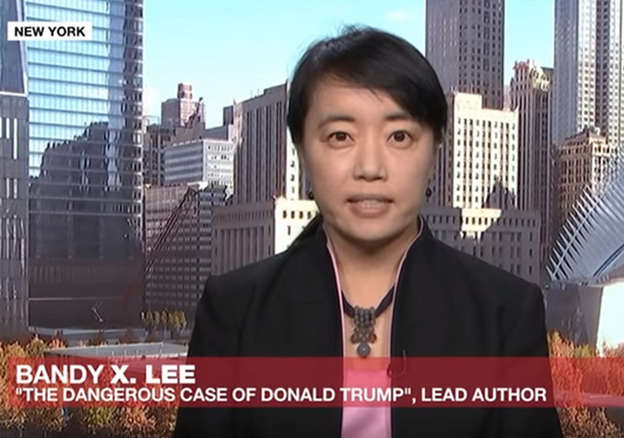
The case involves the firing—wait, no, Yale wants to be sure it’s called a “non-renewal”—of Dr. Bandy Lee, a voluntary assistant clinical psychiatry professor, for a series of statements to the House Judiciary Committee</a> and subsequent tweets calling then-President Trump “mentally unstable” and his supporters suffering from a “shared psychosis.”
A federal court upheld Yale’s claim that its oft-repeated purported adherence to the “Chicago Principles” wasn’t… you know… a statement of policy, much less “a set of contractual promises.” In other words, Yale believes unequivocally in freedom of expression, except when it might be inconvenient to do so.
And, of course, they’re equal opportunity censorious asshats (H/t to Ken White, as per tradition, for the phrase), having earned FIRE’s Lifetime Censorship Award in 2022 for a variety of restrictions on free expression, most of which stemmed from a commitment to the squishy ethical values associated with Woke authoritarianism. It turns out that Yale’s self-image as Guardians of Conformity is non-partisan… or whimsical… or that the med school is run by different censorious asshats than the undergrad and law schools… or whatever.
The court also found that Lee was not entitled to Connecticut’s statutory protection for employees against employer discipline or discharge for 1st Amendment protected activity because, being unpaid, she was not really an employee, despite their acknowledging that Lee received office space, access to library and laboratory facilities, technology, and other forms of “indirect remuneration.”
OK. So. Yale is hypocritical in all this, and so far, at least, the courts have allowed them to be so. Fine. But there are some nuances here that make the ethical considerations a little more complicated.
Had I been the one to say what she said in early 2020, I would have been protected not merely by the 1st Amendment, but also by academic freedom, since I was a tenured professor. It has been argued that the original intention of tenure was to allow faculty to speak and publish controversial opinions within their area of expertise (e.g. my argument that few of the “groundlings” in Shakespeare’s theatre were really from the working class).
This is true, but it is now accepted as the norm that tenured faculty are free to express their ideas about a wide variety of issues, including the policies of their university’s administration, and, indeed, politics. But academic freedom only fully kicks in with tenure, and Lee’s position at Yale was a couple steps down the ladder from anything resembling full protection.
Or, rather, it would have been, except that Yale so exuberantly touts its commitment to academic freedom in a way that does indeed suggest that all members of the Yale community are entitled to these protections, even though the university now argues the contrary in court.
More centrally, I am not a psychiatrist, and don’t claim to be. If I, or Jack, or any of the vast majority of the people who read this blog, called President Trump (or his successor) mentally unstable, it would be regarded as essentially a figure of speech, filtered through the speaker’s own biases and political predilections. We might mean exactly what we said, but no one would think it was other than a personal opinion.
If, hypothetically, I say “Anyone who believes in Trump’s innocence is insane,” there will be a variety of (perhaps unspoken) responses. Most would be a variation on “What Curmie really means is that he believes firmly in Trump’s guilt on this particular issue; he’s simply over-stating the case. It’s clear that his statement shouldn’t be taken literally.” Other responses would be metaphorical applause or brickbats, depending on the perspective of the reader. What that reaction would not be is a belief that I have psychoanalyzed Trump’s defenders and rendered a professional judgment.
Dr. Lee lacks that escape path, especially when her twitter profile highlights her advanced degrees, and she certainly suggests that her opinion ought to carry more weight than other people’s because she’s a psychiatrist. There’s a real ethical question about whether she should be using professional terminology to describe, publicly, people she has never even met. There’s something called the Goldwater rule , which may or may not be a rule, per se, may or may not still be in effect, etc. The idea is that no one in the profession should make public diagnoses of public figures they have not personally examined.
I won’t claim to be an authority on the ethics standards of the psychiatric community—Lee says she adhered to existing policy; others, including several on that Twitter chain linked above, would argue that point. I’m not taking a side in that dispute except to describe her actions as probably well-meaning (the good of the nation) but definitely partisan and provocative. Is that enough to get fired? Under normal circumstances, probably not. But there was no little furor about her tweets, and it’s not entirely unreasonable to think that the Yale administration decided that keeping an unpaid faculty member around wasn’t worth the controversy.
Curiously, I can find nothing to suggest that was Yale’s thinking. I find no mention of “unprofessional conduct,” for example. Rather, they seem to have relied on arguing that the promises they made and continue to make to faculty and students are so much puffery, and none of us should expect them to keep their word.
“O brave new world / That has such people in’t!” I’m more with Huxley than with Shakespeare’s Miranda on this one.
***
[This is your host. I apologize for breaking in here on Curmie’s space, but WordPress is going through one of those stages where it prevents me from commenting on my own blog. What follows should be considered just that, a reader’s comment, but I wrote it, it wouldn’t post, and I don’t want to forget it]
I’m always thrilled when a participant here relieves me of the responsibility of writing a post I was planning on writing, and Curmie’s second column went one better, relieving my conscience of regret from having failed to post on Bandy’s fate when it was on my version of Koko’s little list for a more than a week. I never considered the academic freedom aspect of the firing. I wrote about Lee here several times, and I viewed her firing as both welcome and justified, because she was, I felt and feel, exploiting a minor position at Yale to get anti-Trump media gigs, was embarrassing the institution, and, whether Yale used the term or not, was extremely unprofessional by the standards of her own profession (The Goldwater Rule just formalized basic common sense).
Of course, my view on this issue was also informed by my conclusion that the “Trump is mentally unfit” was absolute partisan garbage, one among the long list above of the bogus “Get Trump!” strategies employed by the Axis of Unethical Conduct.
I don’t agree with Prof. Turley regarding the sanctity of academic freedom when a professor or lecturer or anyone who teaches causes fair and objective people to wonder, “What kind of people are they hiring in that place?” or to conclude, “I can’t trust those people, and I’m sure as hell not going into hock so my kid can be warped by them.” I think teachers of any kind should be made to understand that they always represent the university or college that employs them, and that they have an obligation to behave and speak in public accordingly.
But as Curmie points out—and I didn’t consider this either—Yale clearly is employing the King’s Pass here.
 Ethics Alarms
I want to comment about the unpaid professor. Thirty years ago, adjunct professors were few and far between, almost everything was taught by full-time faculty. Adjuncts tended to be people employed in the field teaching a night class once or twice. Sometimes this was done because the adjunct in a specialty that the college didn’t have and the adjunct filled a hole in the curriculum. In other words, adjuncts were used sparingly, often to enhance the educational experience of the students.
Then, many schools (especially prestigious schools) started to use a lot of adjuncts to teach core and freshman-level classes. One of the reasons for this is that the teaching faculty that were given tenure in the late 60’s and early 70’s began to retire. These faculty were typically stuck at the Associate Professor level, had always been teaching, not research, faculty, taught 3 courses/semester, and had no lab space. In the 70’s, teaching really fell out of favor and only research faculty were hired. These faculty typically require $50,000-$100,000 in startup money, research space, and teach 1 class/semester. As the last wave of teaching faculty began to retire, the schools began to panic. Who was going to teach the classes? Many tried to implement new teaching positions, but arrogant elitists would always sabotage the tenure process by voting down anyone without publications and grants. The solution they settled on was adjuncts. They would take recent graduates with dreams of a tenured position at a prestigious school in a desirable part of the country and lead them on with the suggestion that if they taught some freshman courses for $2000/course they could be considered for a tenured faculty spot. Many such graduates would adjunct at 2-3 different schools to make ends meet, leaving their lectures just in time to make it to the next lecture at another school. This was terrible for the students (no office hours, limited engagement, etc).
Because of the large number of adjuncts being hired with no job security and never seeming to get a permanent job, adjuncts began to complain about their plight. At the same time, however, smaller and less prestigious schools were suffering from a lack of applicants to their tenure-track positions. The good, but not-good-enough-for-Stanford graduates were trapped in perpetual limbo of adjunctship, becoming bitter and less employable by the semester. They would never apply to Northwestern Kansas State University because that would be admitting that they aren’t really good enough for Stanford. Eventually, they would take jobs elsewhere, out of academia, maybe out of their field of study (as a bank teller, at Kinko’s, etc). Nothwestern Kansas State University would have to hire people who weren’t good enough to adjunct for Stanford.
Now, people are so desperate that they are willing to do the jobs FOR FREE. They are being led on with the informal understanding that if they do a good job, they will be seriously considered for the next tenured faculty spot that opens up. That will almost never happen. After 2 years of teaching freshman service courses for free, they look really bad compared to the hotshot postdoc that just came out of MIT with the next killer idea from their Nobel-prize winning mentor.
The unpaid professorships are unethical. The universities are playing on the false hope of getting a permanent faculty position. The graduates agreeing to this are unrealistically evaluating their own worth to the detriment of their careers. Finally, the ‘lesser’ schools are being starved of quality faculty in this scheme.
I know this is an unpopular opinion since I was essentially banned from the Chronicle of Higher Education forums for expressing it, however, I do believe it is a realistic view of the situation. It is one of the many current problems destroying higher ed.
And all the dollars the schools are saving by employing adjuncts and non-tenure track instructors and assistant professors, paid and unpaid, is plowed into the salaries of more and more administrative and fund-raising positions.
Sports, campus activities, fancier and fancier housing, and a variety of vice-presidents of fill-in-the-blank social issue with their staffs eat up a lot of money. My guess is that academic instruction costs about $12,000/year.
My math: Faculty cost $100,000/year
Each faculty member only teaches 15 full time student equivalents (FTE)
$100,000/15 = $6,666
Make it about double for overhead.
Now, most faculty at teaching schools are teaching much more than 15 FTE, so this is actually a large number.
The rest is for the ‘extras’.
Sticker price for a year of college: $250,000.00
Where? Do you mean 5 years of college? I would estimate it at $25k-$30k.
Man, I am flummoxed by the variety of responses I could make here, but I don’t know that I quite understand the issues fully.
I generally try to avoid opining on legal matters when asked about them by non-lawyers (“normals,” as I like to call them). I tend not to follow public cases and usually actively try not to. Derek Chauvin’s case may have been an exception because one of my “colleagues” was trying the case and so many of my other colleagues were discussing it.
Maybe I refrain from opining on legal matters because I don’t want to mislead others that I am an authority. I am; however, when your profession’s catch phrase is “It depends,” there are very few instances where I express greater confidence than that.
I assess; I opine: I advise; then I obey. I steadfastly refuse to predict the future and disclaim any ability to do so. I simply point out the 10 different paths the future may take. So, yes, psychologists and psychiatrists should shut up. But, if their profession says it is okay, I guess it is okay.
As far as academic freedom goes, I think you have to be more reflective and cautious. I was listening to a historian today talking about white privilege and recent historical theories on slavery. he was talking about all of the historical implantations of slavery (probably infused with the 1619 Project). I initially was curious about whether his views as a historian took into account any of the economic aspects of slavery.
But, what really intrigued me is that he attempted to address a common “white person” response to slavery: my ancestors never owned slaves and came here after slavery ended. Reparations are not my problem.
My interest was piqued because most or all of my ancestors came after 1840 (when the Potato Famine in Ireland started). Many came through Boston and left that Cesspool while setting their fanciful thoughts on the Promised Lands of Wisconsin (?) and Minnesota (!).
His argument, which I think I fairly considered, was that, even if your ancestors did not own slaves, they were attracted to an economy that has prospered through slave labor and the institution of slavery.
This guy was a historian. He was probably not an economist. And, he probably was not a historian with special knowledge of the UK.
Considering his argument, which I had not heard before, I think it was unpersuasive. Many of the Irish did not come here for the economic powerhouse that was fueled by the slave laws. The Irish were fleeing decades of discrimination (the Penal Laws of Ireland may have rivaled the slave laws in the US in their degradation of people) and death by starvation. Did they care about the wealth created by slaves? Or, did they seek freedom to own land, work the land, and keep the fruits of their labor?
Ultimately, I think that historian’s argument was not persuasive. He was not an economist and he probably was no expert in Irish History (neither am I, but, as an amateur, I am not persuaded he is smarter than me on the issue).
Bottom Line: It depends (whatever it is).
-Jut
Funniest thing; under the same circumstances as her evaluation of President Trump (in absentia), Lee deemed it unethical to comment on someone else’s…um…perceived diminished mental capacity.
Yale Psychiatrist Who Has Repeatedly Called Trump Mentally UnfitRefuses to Diagnose Biden
MONEY QUOTE: “I do not diagnose without examination and do not speak about public figures in general, unless there is evidence of such profound danger to public health”
I, for one, think academic freedom for tenured people is a pretty straightforward notion. If you’re tenured, and you’re talking about your area of expertise, you are free to say anything potentially controversial about your area of expertise because to do otherwise would hinder progress in said area. If you’re a tenured person and you say controversial things outside of your area of expertise, you’re on your own, and if you embarrass your employer, you just may get fired. I think things have gotten completely out of whack as a result of people like Larry Tribe and Noam Chomsky going completely off the rails and issuing pronouncements on every damned thing. Tenured professors too often become prima donnas and deem themselves experts in everything on earth. There’s the rub. Stick to your knitting.